Filmy Substance

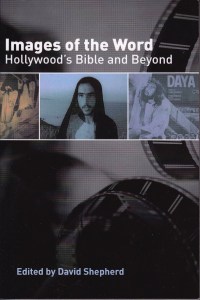
It’s all about Jesus. Well, that’s an overstatement, even in context. One of the amazing things to me about books addressing the Bible in film is just how often Jesus movies come up. If it’s not Jesus movies, it’s movies that have a “Christ figure” or some such Christian trope. Don’t get me wrong—I have no issues with Jesus. It’s just that the Bible and film have so much more in common than this. David Shepherd’s edited collection, Images of the Word: Hollywood’s Bible and Beyond, has some insightful pieces in it and some of what has become “standard fare” already in a field that’s so new. I found Richard A. Blake’s response fascinating. Maybe this was because he doesn’t approach the topic from a biblicists’ point of view.

I’m not really complaining about scholars who look to cinema for a rich source of reception history. I do it myself from time to time. Most of the books on this topic are collections of essays and collections are, by default, uneven. There’s an amazing amount of biblical material in movies that simply goes overlooked. Also, I would suggest, movies offer valid interpretations of the Bible. Somewhere along the development of the discipline we seem to have slipped into thinking that only certain people can legitimately interpret the Good Book. If it is a sacred text, however, it is as much in the public domain as any text can be. And texts in the public domain can legitimately be interpreted by hoi polloi. That’s the nature of being a text with universal assertions, I suspect. Directors and writers, therefore, are legitimate interpreters. We could learn a lot about the Bible from going to the theater.

Like many who’ve taught Bible to undergrads, I sometimes discussed films with them. I always believed students were legitimate interpreters of Scripture, too. This is a dialogue. One of the more interesting aspects of Shepherd’s collection is the pieces that focus on non-Hollywood movies. I don’t see a problem discussing Hollywood since we can assume a larger body of those who’ve seen the film. It is nice, however, to be reminded that “foreign” films also delve into what is sometimes treated as propriety material by Christians. Hindu representations of the life of Jesus? That’s a very interesting idea! Of course, not everyone likes to know how “outsiders” see them. That’s one of the beauties of using cinema as a means of interpreting the Bible. Those of us who study it don’t have the money to influence movies enough to make them in our image. It’s fun to watch someone else’s interpretation.


Clearly Religion

GoingClear“There is no point in questioning Scientology’s standing as a religion; in the United States, the only opinion that really counts is that of the IRS;” so Lawrence Wright partially concludes Going Clear: Scientology, Hollywood, and the Prison of Belief. This is an important book, and one which once again demonstrates how seriously religions should be taken. New religious movements offer a ringside seat to how orthodoxies are born. Facts may be distorted or covered up, but there is information to be had on L. Ron Hubbard, Joseph Smith, and Mary Baker Eddy. We can learn from the way their ideas may move from fiction to fact, and how intelligent people still feeling spiritual yearning can turn to a religion invented recently as well as those invented millennia ago. As Wright points out, all religions make improbable claims. Fact-checking, however, is much more difficult for periods long gone that left only meager records. The distance in time may lend ancient assertions the benefit of the doubt, but the real decision-maker is money.

Given universities’ interests in lucre, one might logically conclude that religions would be of great interest. It is telling that, especially in the case of Scientology, that the factor most important to the status of the church is its money. Religions may claim tax-exempt status, setting them apart from purely commercial enterprises. This gives religions an advantage when they are careful with their finances, and the whole question of whether a religion is a religion is not left to scholars but to the lawyers of the Internal Revenue Service. The truth of religion lies in its bank-books, not its holy books. No doubt in the case of Scientology this is because of the high-profile court cases in which the status of the religion was challenged by government agencies. Nevertheless, when it comes to the laying down of the law, only money really matters in defining a religion.

As Wright discusses, one of the problems we face is that religion is poorly defined. Nobody can really assert much beyond that religions involve belief of some kind. Beliefs, in this case, about L. Ron Hubbard and his ideas. Although facts about his life are disputed, there can be no doubt that Hubbard was an intriguing man. He was a prolific writer with great imagination, and he clearly had keen insight into psychology. A religion used to be measured by the good it produced. Now it is measured by the dollars. As Going Clear illustrates, trying to construct an unbiased account of Scientology is a fraught enterprise. Like many modern religions, Scientology is very secretive. Even the early Christians knew that if everybody could join, then the club loses its appeal. Apart from belief, religions also must have outsiders and well as insiders. In a world measured by consumerism, wealth is the surest sign of blessing. No one should be at all surprised, therefore, that it takes the IRS to decide that which used to be taken by faith alone.


Jesus of Hollywood

What hath Hollywood to do with Boston? Not enough, apparently. In this week’s Time magazine, an article entitled “Films Are His Flock” by Josh Sanburn revisits the ark. Actually, it throws the doors open a little wider—it looks at Hollywood’s effort to woo the religious. Ironically, although universities all across the country offer courses in religion in popular culture and the Bible in popular media, they are constantly trying to rid themselves of the detritus known as biblical scholars. High brow is in, while Hollywood makes no secret of its love to the common people. For Americans the common person is religious, or at least doesn’t block out religion like the educated crowd does. And they come with pockets lined. Religious movies, if marketed well, can be phenomenal successes. In my four years teaching at a secular state university, my Bible classes were filled to capacity each semester. Still, Rutgers coyly refused to hire me full-time. “There’s no interest,” they seemed to say. “Nobody reads the Bible.”

Meanwhile, according to the article, Jonathan Bock, founder of Grace Hill Media, a marketing firm that sells the Bible to Hollywood, knows a good thing when he sees it. Noah is about to come splashing into theaters. Son of God has already incarnated. Exodus is yet to come. And those are only the movies that are explicitly religious. I had no trouble pointing out to my long-suffering January term classes that religion plays a role in many movies, most of them explicitly secular. Those in Hollywood know that religious themes—the Bible even—resonate with the general public. Having grown up in, or maybe even below, John Q. Public, I have always known that the Bible makes good movies. Doubt it? Ask E.T. As he appeared risen, ascended, and glorified, the stranger from above wearing a white shroud and backlit with a nimbus, many of us squirmed in our seats for we had seen a clever representation of our Lord.

Perhaps it is resistance to the McCarthyism of the 1950s that so many intellectuals associate with religion, but academics just can’t seem to understand that this is important. The Bible business is a multi-million dollar industry, and yet, universities would prefer to ignore the implications. Meanwhile in Hollywood, they’re trying to make sure they get the blend just right. Theatrics and theology. You’ve got to be careful whom you choose to offend. The Last Temptation of Christ, based on a novel written by a devout Nikos Kazantzakis, just didn’t perform as a Scorsese movie. It is the job of people like Jonathan Bock to figure out why. And it isn’t hard to see that it’s a buyers market on America’s left coast. Indeed, without a hint of cynicism the Bible will bring in a flood. But that’s just academic. Or it should be.

Noah looks down over Times Square

Noah looks down over Times Square


Reaping the Exodus

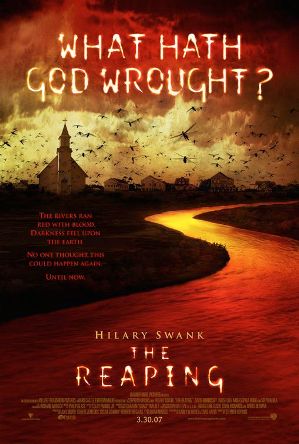
Strange coincidences transpire. In 2007, just after the professor in my discipline at Rutgers University retired, I showed up in the Religion Department seeking adjunct work. With the vicissitudes of “full-time” employment, at times my part-time stint at Rutgers is all I have. While covering the book of Exodus my first year there, students began asking me what I thought of The Reaping. I hadn’t seen the movie, which had been released on Good Friday of that year, but I promised my charges that I would. Still on my Hollyptic kick, I decided to rewatch it last night. The script was handled much better than that of Lost Souls, although the movie as a whole lacks credibility. It is, however, an example of how the Bible mystique continues to pulse through Hollywood’s veins.

The concept of bringing the plagues against Egypt into the bayou was a fresh one, but the satanic cult aspect has been overdone. A strong female lead in the role of a disenchanted former clergy-woman was a nice touch, and although the premise of her back-story was contrived, it was also decidedly eerie. The element of the movie that students wanted professional comment upon, however, was Katherine’s scientific assessment of the plagues of Egypt. This idea has a comparatively long history. Since critical biblical scholarship began, naturalistic suggestions for the non-historical plagues have been offered. Strangely, these offerings are intended to buttress an historical event that the theories themselves undermine. There is no archaeological or historical evidence for the exodus. Why then, are scientific explanations of the plagues necessary?

The story of the exodus is liberating; slaves liberated by a loving God forms a back-story that most oppressed people want to be true. The sad fact is that religion is more often used to repress than to liberate. Somewhere along the trajectory of human social evolution, religion became a key element in the control of the masses. This becomes clear from the merest glimpse at religion as it existed in ancient Egypt itself, or any of the other cultures contributing to Israel’s religious tradition. The Reaping, like so many films that springboard from the Bible, offers a conflicted worldview where nobody really knows who is in charge of the universe. In that aspect, it mirrors human religious experience.