J-Horror

J-Horror better move over.  There’s a new kid on the block.

For many years those of us strange fans of horror have used “J-Horror” as shorthand for Japanese Horror.  With two highly successful films (eventually series) of the mid-nineties (Ju-On and Ringu) the Japanese contribution stormed back into American consciousness.  Those of us who grew up on Godzilla knew that J-Horror had been around for decades already, but these new movies were distinctly creepy.  So much so that English-language versions were remade for both original films (The Grudge and The Ring, respectively—rather like Let the Right One In and Let Me In).  So far, so good.  So why does J-Horror need to move over?

At least three separate friends have pointed me to another emerging J-Horror trend: Jewish horror movies.  These used to be rare.  With cases of early antisemitic themes in horror, and the real life horror of the Holocaust, this is certainly understandable.  “Christian” producers or directors delving into Jewish themes would seem to be in bad taste.  Still, some notable Jewish-themed horror has begun to emerge.  (I addressed one such film in my recent Horror Homeroom piece.)  The Possession (discussed in both of my most recent books) centers around the need for a Jewish exorcist in the case of a dybbuk problem.  For more information, you know where to look!  It seemed to me that the dybbuk box contents were reminiscent of the Holocaust, but that may not have been intentional.

I recently wrote a post about The Golem.  This is a recent Israeli movie that builds on the traditional Jewish monster.  Although set before the Holocaust, the fact that there’s a pogrom in the film shows that the concept is not far off.  The movie that people have recently been pointing me toward is The Vigil.  I’ve not had an opportunity to see it yet, but the press it’s received suggests it too will be another classic based on lived experience in Judaism.  I’m not sure if Jewish horror will eventually rival the numbers of Japanese horror films, but the offerings thus far have been noteworthy.  Horror often addresses the problem of human suffering.  With all the oppressions in “white” society, it’s no wonder that, along with Black horror, Jewish horror is beginning to garner attention.  Although it’s clearly not to everyone’s taste, horror is often a genre with a conscience.  It becomes a screen on which we can see our worst behaviors projected.  And if we’re wise, we’ll take steps to make such suffering become merely an unfortunate memory.

Golem

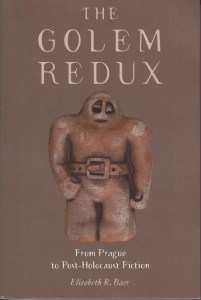
GolemReduxI read a lot of books. About a hundred a year. At the end of the year I go over them all again and many of them, I see, failed to make a deep impression. Some, I know, before I close the back cover, will stay with me. Maybe even haunt me. I count Elizabeth R. Baer’s The Golum Redux: From Prague to Post-Holocaust Fiction among those that will linger long. My regular readers will know of my predilection for monsters, so a golem book will hardly be a surprise. I realized, however, upon completing my academic paper on Sleepy Hollow, that my reading on the golem was rather slim. I’m no longer sure that it’s even a monster. As a goy who’s spent a good deal of his life among the Hebrew Scriptures, there’s a natural resonance, it seems, with those oppressed for being who they are. Golems are created in times of crisis but have unexpected, or at least unwanted, repercussions. Baer offers a thoughtful, intertextual study of the golem, largely through the lens of Jewish fiction.

Having dealt with the Bible as portrayed in Sleepy Hollow, I treated the episode where its significance truly unfolds (“The Golem”) as the entryway into the culmination of the first season. Now it appears likely that season three will be the erasure of the aleph, it seems appropriate to give golems their due. The story begins with the oppression of the Jews in early modern Prague. Rabbi Loew makes a golem from mud to protect the beleaguered community. This soulless, selfless protector becomes an archetype for various superheroes and literary characters ably summarized by Baer. The book put me in mind of my only visit to Prague, too brief and too ill-informed to truly appreciate what I was seeing. To see you have to learn to read.

While some writers have fun with the golem, others understand it in more serious tones. Those who can’t forget the Holocaust see things in a way that others cannot. Not that only Jews can summon a golem, but its origins and reuse have a special place in a community that longs for a protector. I’m reminded of the book of Job, and there’s a good reason for that. While reading The Golem Redux on my commute, I came home to find a copy of Pete Hamill’s Snow in August on my wife’s stack of books to read. As it is one of the titles studied by Baer, I felt an odd synchronicity at play. The book had been recommended by one of the booksellers at our local indie shop just a few weekends back. Tied in with all the other golem-based thoughts in my head recently, I’m inclined to think that this was no mere coincidence.


Dead Certain

One look frightens me above all others. I have spent probably too many hours watching horror movies late at night, and I’ve seen actors—talented and otherwise—projecting the look of fear. It is a temporary thrill, soon banished by a more mundane reality. The look that frightens me above all others, however, is that of certainty. Well I remember it planted, etched, chiseled on the face of a man who believed without question that his duty was to deprive me of a career. I have seen it on faces devoid of any human emotion, but with a surfeit of self-righteousness. I was reminded of this when my wife pointed me to an article in the New York Times blog entitled “The Dangers of Certainty: A Lesson from Auschwitz,” by Simon Critchley. In this piece Critchley recounts watching Jacob Bronowski’s “The Ascent of Man” as a child. He focuses on the episode wherein Bronowski describes the danger of certainty, which often eclipses wonder when science alone is understood to be the basis of knowledge. And we have gone forty years further down that road.

Bronowski, in the clip provided by Critchley, describes how unwavering certainty led to the holocaust. It is a moving and poignant scene; indeed, the only one I remember from the episode as I watched it along with my classmates in the required humanities module at Grove City College. Bronowski, who had relatives murdered at Auschwitz, walks into the pond where their ashes were flushed, a man in a suit and good shoes, oblivious to the rational, and reaches down to touch whatever remains of the millions who died there. The scene has stayed in my head for over thirty years.

As an undergraduate I was certain. I knew the unflinching truths taught by my rock-solid faith. After four years as a religion major I had become more circumspect. Seminary found me still pretty well convinced, although much more temperately so. The doctorate, which required more intensive work than all the previous years combined, convinced me of how little I knew. I went to Nashotah House full of questions, and my goal was to bring my students, many of them very certain, to that human point of unknowing. We need to live with a question mark before we can be truly human. Curiosity is one of the more endearing traits people possess. Certainty disallows curiosity—questioning becomes the devil’s tool and honesty is the farthest thing from God that one might attain. In this era of easy certainty I often see a look on the faces of those in power that frightens me. I need to be reminded, along with Bronowski, that when shoes become more of a concern than human beings, we’ve already gone too far.

800px-Nazi_Holocaust_by_bullets_-_Jewish_mass_grave_near_Zolochiv,_west_Ukraine


Witch Crazy

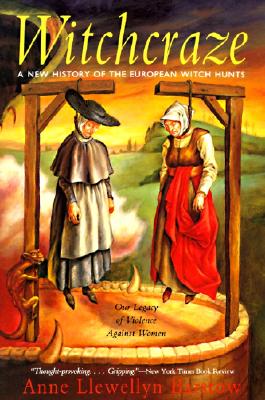
The self-destructive tendencies of human societies should be of major interest to those who study the mind. Why a highly evolved species would forego reason—or create an entire false logic—to give itself an excuse to mass-murder its own is among the greatest trials of theodicy. Can God be justified in such circumstances? With or without divine approval, God is nevertheless implicated. One of those homicidal events, the European witch craze of early modern history is a prime example. Anne Llewellyn Barstow’s Witchcraze: A New History of the European Witch Hunts is a disturbing book on many levels. For a human being with any level of empathy, reading about the torturous destruction of at least 100,000 people—generally women—is hard going. We don’t want to be reminded that we were ever so naïve as to believe that women slept with the devil, flew through the air to meet with other witches, and were trying to bring down society. The “upright,” as Barstow makes very clear, feared for the church. Concern for the ways of God excused—demanded even—the death of the innocent. Many of the victims confessed, under torture, that the godly men had got it right.

Barstow contends that economic stresses and fear for the sanctity of the church, along with a generous dose of native misogyny, fueled this holocaust. She notes that it happened in the same society that would initiate another holocaust a mere three centuries later. But why women? Coming out of the medieval period, societies were strengthening centralized governments. Roles of power that belonged to women were highly individualized, and therefore considered threats. The healer, in absence of a medical profession, was often female, frequently a midwife. In days of high infant mortality, they were sometimes blamed for performing abortions, something men in power simply couldn’t accept. Barstow points out that population increases were stressing the economic production of the period. The newly minted Reformation advocated a very active devil in the world. Since the devil, like God, was a guy, well, women satisfied his lust.

The most disturbing aspect of reading this book for me, however, is the fact that our society has come to resemble that one once again. Strong centralized governments control what citizens do through fear—what else would compel us to allow Patriot Acts to pass? They target women as scapegoats—otherwise the issue of abortion would not command such male attention. Fear for the sanctity of God is repeatedly invoked. Sometimes these modern witches are persecuted on the basis of ethnic background as well as gender. And in both the witch hunter society and that of today an elite class has collected the wealth and sits back to let the remainder incinerate itself in the name of God. Witches don’t fly through the night to meet a fictional devil. The real threat to society is right here among us, but its not who the powerful want us to think it is. And it is very human.