Behind the Scenes

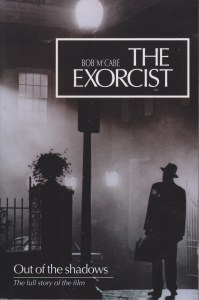
Although I confess to being a horror aficionado, it took many years before I could convince myself to watch The Exorcist. I finally saw it in the mid-20-aughts, and have watched it many times since. It’s a movie that I discuss in Holy Horror, and it will star in Nightmares with the Bible as well. Although younger people often don’t experience the movie as scary—certainly the increasing trust in science and growth of secularity contribute to this—there is a sincerity about it that earns it its deserved place in the pantheon of horror. Bob McCabe surely counts as a fan for his The Exorcist: Out of the Shadows. Sub-subtitled The Full Story of the Film, this book is a gallimaufry of anecdotes, interviews, and facts about the movie and even its sequels. It’s like of like a sustained reaction shot.

The book doesn’t lack insight and McCabe is surely right that this was one of the most influential movies of the early 1970s. It has become a frame of reference on its own and it has defined, in large measure, what people believe about demonic possession. One of the quotes from McCabe’s treatment however, uses the phrase “metaphysical unknown” to explain why the film retains its power to scare, and there’s a great deal of wisdom in that assessment. Fear of the unknown, of course, is prime real estate for horror, and one of the most interesting things about demons is how little the Bible, or other ancient texts, really says (or say) about them. They are an embodiment of the unknown that can take over a person and make her somebody else. But it’s that metaphysical that’s really scary.

As we continue into a time of less and less that remains unclaimed by scientific theory, those metaphysical unknowns continue to lurk and to frighten. Maybe it’s the concept of the metaphysical itself that scares—can there really be something larger, more intelligent than us? The human psyche bruises easily, and we don’t like to be reminded that we lack the control we suppose we have each day. The metaphysical challenges all that. Since it refuses to submit to empirical verification, it remains unknown. A great many people interpret this as the same as not believing in it. Every once in a while, however, a powerful statement such as The Exorcist comes along. Few people thought about demons before William Peter Blatty’s novel and subsequent film. Then the world was full of them again. Requests for exorcisms are on the rise, and the metaphysical unknown haunts us now as much as it ever has.
The Hardest Part

The waiting, Tom Petty suggested, is a most difficult portion (no copyright violations!). The late, great departed rocker had a point. When I was younger I thought waiting was a theological problem, but the fact is it’s an unavoidable part of life. Right now I’m in that holding pattern between having submitted my files for Holy Horror and awaiting anxiously the proofs. Anxiously because there’s so much going on right now that I’m not sure how I can carve out the time to read them. Time and tides, they say, wait for no one.

I suspect a big part of this is that I have high hopes for this book. Not that I’m being unrealistic. I’m hoping to break that 500 copies barrier that holds most academic books hostage. Holy Horror isn’t really academic—it’s not technical at all like my last two books were—it’s just that the premise is academic. What do horror movies tell us about the Bible? I take that question seriously. You see, I read about the Bible a lot. Whether we want to admit it or not, western culture is based on it both implicitly and explicitly. People who castigate it don’t seem to realize that our very way of thinking is based on it. If you doubt that, talk to someone raised in eastern Asia. Someone thoroughly Buddhist or Confucian in outlook. The way we frame our thinking is based on a biblical worldview over here. It’s smart to pay attention to things like that.

At the same time, we are believers in media. Looking out the bus window on the way home I’m always amazed at how many people on the Parkway are texting while they’re driving (yes, you can be seen from above!). We can’t live without our media. When it comes to the Good Book, most people rely on media to tell them what it says. Horror, although not popular with many people, always does well at the box office. And one of the things I explore in Holy Horror is just how often the Bible appears in such movies. It’s not ubiquitous, but it certainly isn’t rare either. We should take to heart what other people say about us. Not that they know the truth of the matter—they seldom do—but we are social animals and we make our reality based on interactions with others. Those who make horror movies know things about the Bible that scholars don’t. And they know that suspense—waiting, as it were—is the hardest part.


Breaking News

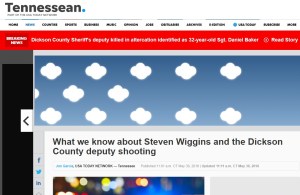
Herostratus, it is said, tried to destroy the Temple of Artemis so that he might become famous. His name is now associated with gaining fame at any cost. In case any of my readers suppose I might be like Herostratus, I would be glad to confirm that I’m not the Steve Wiggins in the headline below. While I do have a beard, I’ve only been to Tennessee once that I know of. When a friend contacted me to ask why I’d shot the deputy (but I did not shoot the sheriff) it reminded me of a post on this blog from many years ago about sharing the name of the gospel singer Steve Wiggins. He’s always at the top for any Google search, which is why I always tell people to use my middle initial when seeking even more than you can find on this blog: “Steve A. Wiggins” usually brings me up. I’m not as desperate as Herostratus yet.

Names can be tricky that way. I’ve written a number of books in my life, and three of them are either published or in production. Holy Horror, which is now available on McFarland’s website (the book itself will be out in August) is listed on Amazon. It isn’t paired with my other two books yet, perhaps because it is so different. My Amazon author page brings up A Reassessment of Asherah and Weathering the Psalms, but it’s a little coy about Holy Horror. This blog isn’t quite like trying to destroy Artemis’ temple, but then, it isn’t exactly a Twitter-follower magnet either.

I have a friend who has a fictional Twitter account. He has more than twice the number of followers I do, and his Twitter persona is made up. I follow people who don’t follow me back. I do hope this isn’t how Herostratus got started. It is tragic that a deputy was shot and killed by an armed Wiggins in the south. I’m no friend of the NRA, and like most of the world I believe we’d be better off with far fewer guns, and Herostratus is pretty much forgotten today. In fact, every time I want to mention him I have to do a Google search to find his name. Destroying property of the gods, apparently, doesn’t always give you lasting fame. Looking at what’s happening in DC these days I see confirmation of that all the time. But then don’t take my word for it—I’m only a blogger with a tiny Twitter following. Just don’t accuse me of having a gun or trying to sing in public.


Strange Passions

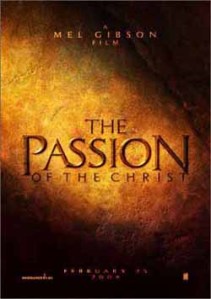
In Holy Horror I make the suggestion that Mel Gibson’s The Passion of the Christ can be considered a horror film. It certainly has more gratuitous blood and gore than many examples of the genre I’ve seen. Really, I had no desire to see it. One of the great aspects of teaching is learning from students. While an adjunct at Rutgers one of my undergrads brought me a copy of the DVD to watch. She said I needed to see it. Obligingly I did so. I knew if I returned the disc to her without watching she’d ask why I hadn’t. Apart from the famously sadistic flogging scene, it was, like any other Bible film, off base quite a bit of the time. This was commentary, not Scripture.

This came back to me reading Bob Cranmer’s account of his haunted house on Brownsville Road in the book about which I blogged a few days ago. Cranmer didn’t exactly follow orthodox methods for driving the demon out of his house. Some of his tactics were improvised. The one I found the most startling was that in the rooms that were most badly affected he played The Passion of the Christ on a continuous loop for weeks at a time. Not only does this suggest demons are capable of watching movies, but that this film can stand in for the actual events that took place in Israel two millennia ago. If the priests involved objected to this method, he didn’t record it. So we have what could be considered a horror movie being used to try to drive out a real life monster (depending on one’s point of view).

Interestingly, this is one of the points behind Holy Horror. Film (and other media) can be a powerful force in our experience of the world. We don’t just go to the cinema because everybody’s talking about a movie. Our experience of watching it is transformative, if only temporary. The same is true of live theater or a concert. Far from being mere entertainment, these cultural events provide a form of transcendence, if they speak to us. In my own case The Passion of the Christ didn’t sell me on Mr. Gibson’s vision. I have no doubts that Roman crucifixion was a horrible spectacle. I also have no doubts that the Good Book indicates that the point of all of this was elsewhere. The Gospels weren’t an effort to traumatize readers. That’s the job of horror movies. Apparently this is something on which even demons agree.


Good Book Gone Bad

The Bible is a book of horror. This isn’t the main point in Holy Horror, but the fact is terror is never far from the surface in the Good Book. My days as a young scholar of the Bible were defined by the works of feminist scholars. One of the influential books of that generation was Texts of Terror by Phyllis Trible. Not hiding behind a masculine orthodoxy, she looked at how various biblical stories appeared from the eyes of female readers. There is indeed terror everywhere. The evils of slavery condemn that hideous loss of agency when one human being becomes considered the property of another. Women, before the feminist movement began, were taught that the Good Book demands this perverted social structure. They are indeed, in the eyes of its patriarchal world, property.

Important as this realization is, the terrors of Scripture go deeper. Even overlooking the genocides—the numbers make it difficult to take in the horrors of the individuals classed as faceless victims—there are multiple accounts of gruesome murders and violence in the Bible. Wars were an annual expectation. Diplomacy was often considered religious compromise. “Us verses them” mentality led to constant conflict. When it came to executing one another, the denizens of the Good Book could be quite inventive. No doubt women and foreigners were poorly treated on a daily basis, but when left to their own devices with divine voices in their heads, the men of Holy Writ knew how to terrorize one another quite effectively.

Even after the message of Jesus of Nazareth, which included love and care and compassion, the Bible goes on to close with the violent visions of Revelation. Perhaps it’s not appreciated so much in the present day, but the Apocalypse had a difficult time making it into the Good Book. Unfortunately the reasons weren’t that it was a book of horror, but the very fact that its status was debated should give us pause when hiding behind the rhetoric of a canon with its door slammed shut. The Bible contains some high, soaring words of noble thoughts and divine consolation. God can be an empathetic lover. With its status, in toto, as a book of divine revelation we have to pay serious attention to the fact of its participation in the genre of horror. Much of this is in the backstory of the films I discuss in Holy Horror. Others may have already explored this dynamic of Scripture, but it’s often a Good Book gone bad.


Watching Research

Now that Holy Horror’s been announced, I’m at work on my next book based on horror movies. Although some people might question the aesthetic of the horror genre, these films are sometimes remarkably intelligent and can indeed be good cinema. Having spent the better part of last weekend watching multiple flicks, however, I’ve come to realize that watching films for research is quite different than viewing them for fun. We all know the feeling of going to the theater to be exposed to the mythology of the present day; movies are the new mythology and are a common source of meaning and hope for individuals in a post-religion era. We go for the spectacle and the story. We leave, if the movie is good, with a renewed sense of purpose, or in a thoughtful state. That’s what mythology does.

In writing up my analyses of many films, I’ve noticed how little the detail is generally acknowledged in many synopses. They can make a flick seem banal. I’ve even had very intelligent people ask me why I think watching movies should be considered intellectual exercises. One reason for this, at least in my experience, is how often people rely on what they see in movies to inform them of important things. Historical events, for example. For the average person, an historical recreation on celluloid can provide recall better than a detail from some 400-page tome on the topic. Human beings are visually oriented by nature and evolution. It takes us years to learn how to read, and if we don’t keep up with the practice our ability to comprehend advanced writing atrophies. It’s easier to watch a film.

No doubt movie scripts are available for purchase. To get the message of a film, however, you need to watch. Immerse yourself in a kind of flickering light baptism. Research watching, however, involves multiple viewings. Taking notes. Watching again to make sure you got that detail correct. Some may doubt that this is an intellectual exercise at all. Still, one of the concerns that some scholars feel is that we’ve lost touch with what hoi polloi believe. People have turned to mythology from the beginning of time in the quest for meaning. Science tells us how the world works, but not why. For such questions we need our mythologies, ancient and modern. Since Nightmares with the Bible focuses on demons, I’ve had to construct a cinematic demonology that’s quite different from those of the Middle Ages. It requires, after all, a modern research method for a modern mythology. And movie watching. Lots of movie watching.


Updates

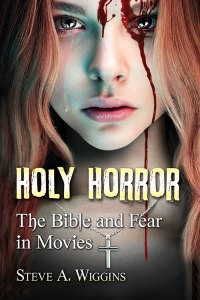
So, I’m getting ready to update this website. I’ll give you a warning before things change. Another update, however, is in order. I’ve been promising that I’d let you know when my forthcoming book with McFarland received its final title. Well, drum roll please! The final title is actually the first title I proposed—Holy Horror: The Bible and Fear in Movies. And it has an ISBN: 978-1-4766-7466-7. And a cover design too, but I can’t share that just yet. It is appropriately lurid, matching the subject. But in all seriousness, the book makes a case for the fact that many people understand their religion via popular media. Being a bad boy, I look at it through horror movies.

The title Holy Horror was a play on Douglas Cowan’s excellent book, Sacred Terror. I recall reading that book, starting the night I bought it as SBL, curled up in the swank conference hotel bed, turning pages until I couldn’t hold my eyes open any longer. It had honestly never occurred to me that religion scholars could get away with writing about horror movies. Cowan had the natural advantage of being a Canadian, something I’ve always longed to be. He also has a secure university post. I was, at the time, just a guy trying to feel secure in what seemed like (and turned out in reality to be) a threatening seminary position that was shortly to end.

It may be difficult to understand how horror can be consoling. It can. I’m a squeamish guy. I don’t like blood and gore. I hate being startled. Nevertheless, I took comfort in this genre as my career was falling apart. Holy Horror was a cathartic book for me to write. There’s more than a little metaphor in it. One thing that will become clear to readers is that the Bible is no stranger to horror movies. Ironically, many of them are strangely conservative—Carol J. Clover’s classic Men, Women, and Chainsaws (which I’ve reviewed on this blog) made that point clearly. Horror often has the same message as your typical Disney film, although it’s presently slightly differently. How so? Well, I can’t say very much here or you’ll have no reason to read my book. McFarland does a great job with publishing this kind of title. You won’t find it in Barnes and Noble, and not likely in your local indie either, but it’ll be available on Amazon and these days that’s enough. And before long these pages will change to reflect its coming.