Trisagion

Irony is all around. When we hook words up into phrases or titles they often take on unexpected connotations. I often see the sign for Jesus’ Bookstore on a highway not far from here. I didn’t know the Lord sold books. In this economic climate, I hope he’s diversified his portfolio. One of the other ironies of life is that as soon as I started getting mailings from AARP (aarrpp, indeed! Retirement is a myth!) I also started to receive advertisements for funeral homes. While you’re planning for retirement (hah!) why not plan for the next step beyond? It is more certain. A nice, long sleep sounds good right about now. So I didn’t ignore the flier from the Mausoleum of the Holy Spirit. What’s not to like about that?

Mausoleum

That name, though. Mausoleum of the Holy Spirit. What sense of that troubling little preposition “of” is intended? Has the Holy Spirit been buried here? Or is it the of of ownership? One should probably be concerned with whom will be around the premises if one is to spend the rest of eternity there. Where your treasure is, there your heart will be also. The drawing of the mausoleum indicates that this is an effort at fund raising. We certainly prefer our graves to be whitewashed. That is the biblical way.

“We sincerely regret,” the reverse reads, “if this should reach any home where there is illness or sorrow, as this was certainly not intended.” In a world of ubiquitous illness and sorrow, such must be a risky proposition from the start. Also, one might note, if one is not Catholic. Are those not welcome at the eucharistic altar welcome at the Mausoleum of the Holy Spirit? What if one has a down-payment? Isn’t all of life a down-payment on eternity? In this day of facile information sharing, it isn’t unusual to have people you don’t even know wishing you happy birthday online (by the way, it’s not). It seems we’ve now gone to the other extreme to anticipate a happy death-day. That is, if I’m reading that preposition correctly.

Sleepy Jean

Last week in the Chronicle of Higher Education, an article by Cristina Richie entitled “The Scandal of the (Female) Evangelical Mind” appeared. Richie points out that despite great strides being made in employing women in religious studies positions, Evangelical institutions still fall behind. This dynamic is not unexpected, however. Those of us who grew up evangelical know that no matter how much it may talk the talk of equality, evangelicalism walks the masculine walk of deeply seated patriarchalism. For those who literally “believe the Bible” there is simply no way around a male Jesus. Even if you go that dangerously risqué step and suggest that the Holy Spirit is somehow feminine, when the divine couple gets together (and Father is always in charge), the offspring must be either male or female. In any literal reading, women cannot possibly claim equality. For their very salvation they are dependent on a male. A god with testosterone. As in heaven, so on earth.

Evangelical institutions have a difficult time with women leading men. They’re not alone. As early as the first century of the Common Era, Paul had the same issues. Literal religion in a biologically dimorphic world will always be problematic. Either there is one god, or there are three. In either scenario the males outnumber the females. Should we posit a divine couple (as some in ancient Israel appear to have done—please wave “hi” to Asherah for me) we still have a culture that is dominated by men. The divine couple will always have the goddess deferring to the will of the god. And you can be sure that he will never pull over and ask for directions. We already know which way this chariot is going.

Every once in a while, the Chronicle likes to sit back and take stock of the religious landscape. Religious studies is, despite the bad press, a thriving area of academic interest. Surely to those in more quantifiable fields, our little squabbles over whether god is a man or a woman must seem pedantic and a little pathetic. And yet, the evangelical institution has an instruction book. That book, if followed word-for-word, leads to eternal rewards for those who are willing to foot the hardships. And for at least half of those (and likely much more than half) that will mean living on an earth that mirrors that realm beyond the sky. Although you can’t see it with any telescope, if you believe hard enough, it is there. And in that ideal place, the god in charge is a man’s god.

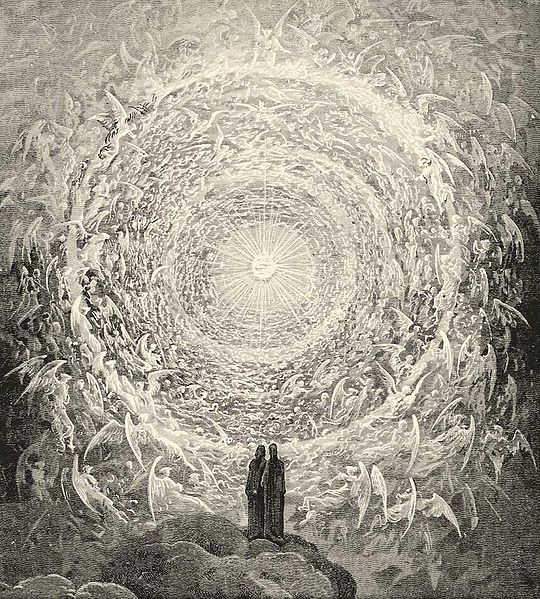
540px-Paradiso_Canto_31