The Philosophical Neanderthal

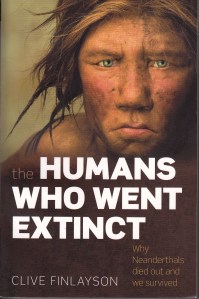
HumansExtinctExtinction. It’s a depression concept, but one that nevertheless constitutes a reality in evolution’s world. When applied to members of our own species we term it genocide and declare it an evil. Our perspective—not to dispute the value judgment—is hopelessly foreshortened. Our brains have evolved to promote individual survival, not to see the longue durée. How often do we worry about the extinction of Homo erectus? Or the australopithecines? Without them we wouldn’t be here, and yet, they’re gone. The case of the Neanderthals is perhaps closer to home. We now know that Homo sapiens overlapped with Neanderthals. Some of the questions raised by Neanderthal extinction are given serious consideration by Clive Finlayson in his study, The Humans Who Went Extinct: Why Neanderthals Died out and We Survived. To get a sense of how this works out, and how it applies with our current contribution to global warming, we must be prepared to view the extreme longue durée. Duration beyond comprehension.

One thing that becomes clear from the very beginning here is that climate has driven evolution perhaps more than we often think. Species, which tend not to live through the relatively long reach of climate change timescales, adapt to the circumstances of their environment. They either do, or they go extinct. Climate, however, is a balancing act teetering toward equilibrium. Hot and cold, evening each other out. Over an even longer duration, our sun will run out of metaphorical steam and things will get quite a bit chillier out there. For the meantime, however, shifts between ice ages and periods of warming will continue to seesaw across time and our race, among many, will need to adjust to survive. Perhaps acknowledging our own role in the current global warming might be a way to start. Our species tends to be short-sighted.

There is an irony here. History and prehistory have shown that, as Finlayson points out, that those best equipped to survive radical changes are the poor. Extinctions—some of them quite dramatic—have occurred before. They will surely come again. When times get tough, it seems, the comfortable get going. Going extinct, that is. Those who climb the corporate ladder the highest have the longest distance to fall when things go bad. The poor, who have to struggle every day to survive, are the ones who know how to get along in circumstances that turn sour. I have called this an irony for what might seem obvious reasons. There is another as well; here we have science pointing again in the direction of the Bible. There it was noted long ago that the meek would inherit the earth. And that’s a bit, it seems, that should be taken literally.

M Is for Mary

While pre-celebrating Christmas with some friends recently, the topic of cats came up. This really isn’t surprising since two of the families present had been members of the local 4-H cats club. For a while cats were ubiquitous on the internet, but since I have so little time to browse the web anymore, I’m not sure if that’s still the case. Nevertheless, being near Christmas, someone narrated a story I’d never heard before. Tabby cats (like many jungle cats) have a distinctive marking in the form of an “M” on their foreheads. The legend suggests that on the first Christmas a tabby cat was in the manger. Seeing a mouse trying to crawl into the trough were baby Jesus lay, the cat killed the mouse, earning the thanks of Mary, who kissed it on the forehead, bestowing her characteristic M. It is a nice story (apart from the point of view of the mouse, I suppose)—an etiology to explain an evolutionary development in fur patterns.

Blessed is M...

Blessed is M…

Shortly after that my wife sent me a story on the BBC about the oldest inscribed human artifact. Zigzag marking found on a fossilized clam shell from Indonesia suggest that Homo erectus was an abstract thinker, I’m told. The markings, which must at least be 430,000 years old, predate the earliest known human markings by 300,000 years. If accepted by anthropologists this evidence could rewrite all of human history. We had no idea that Homo erectus had time to doodle on shells. Looking at the photos accompanying the BBC article, I couldn’t help but notice they’re in the shape of an M. Perhaps Mary kissed these shells too? So etiologies begin.

If you’ll pardon me for attempting to brush off my training in ancient languages, Mary of Nazareth was likely born into an Aramaic-speaking family. Her name, Mariam, would have been spelled with mem, which, although representing water is some scripts, took roughly this form: מ (assuming the Imperial Aramaic alphabet). If Mary were both historical and literate (the latter, at least, is doubtful) she would not have recognized the tabby’s distinctive mark as part of her name. It would have been an abstract symbol. Of course, God, being a natural lover of cats, may have had the Greek alphabet in mind, where the letter mu gives us our classical capital M. Mary, however, would probably still not have known what to make of it. We love to attribute significances to perceived patterns. The tabby’s distinctive M, as well as Homo erectus’s early exercises in penmanship present us with opportunities to continue making myths. And we should keep the myths in Christmas.


Animal Mentalism

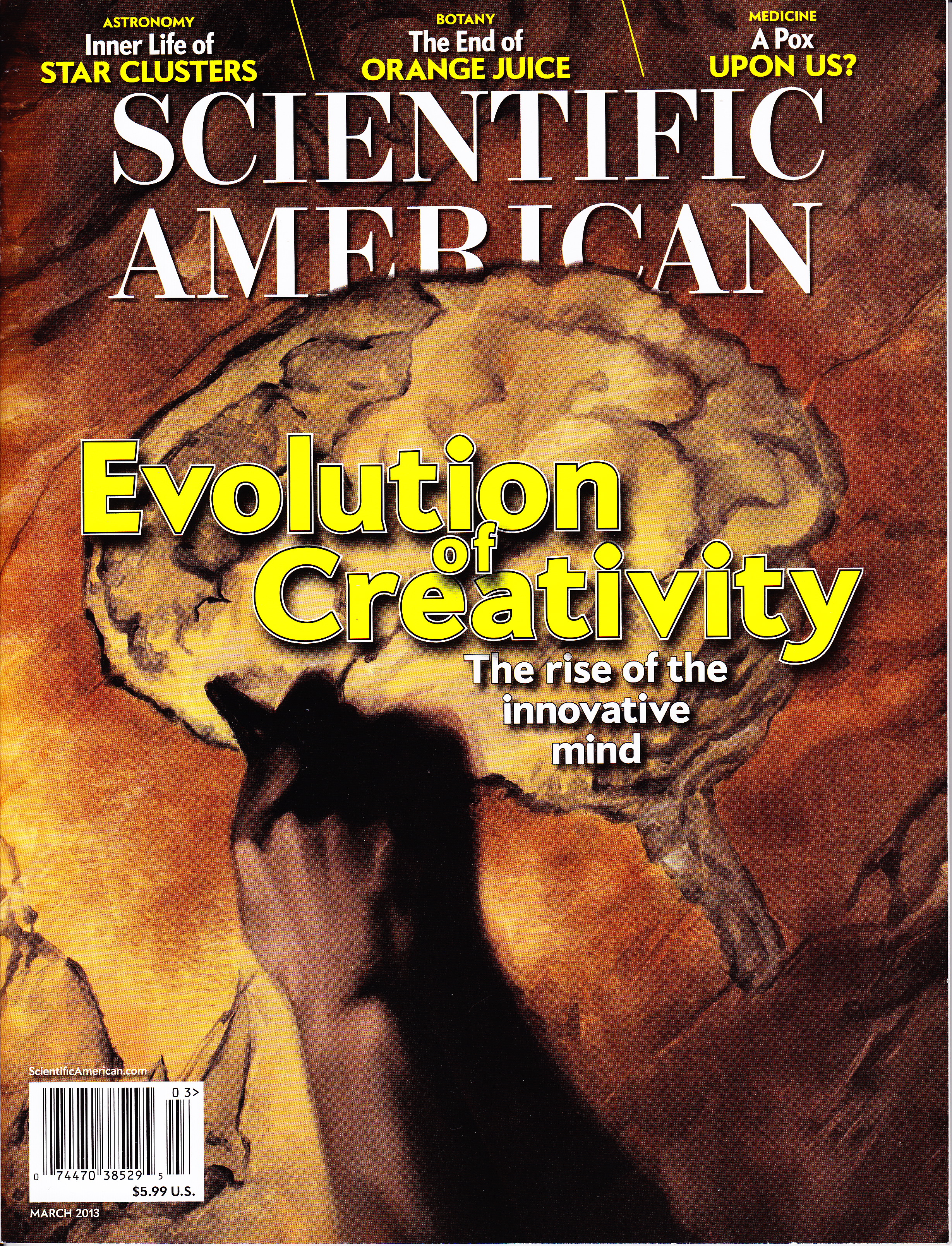
SciAmScience is how we know things. Most things, at least. One of the fundamental aspects of human life not yet grasped by the great empirical method is creativity. We generally have an idea how it works, but, like so much of human experience, it is difficult to describe precisely. When I saw this month’s Scientific American fronting with the headline “Evolution of Creativity”—two of my favorite topics—I knew I’d have to read it. The article by Heather Pringle zeroes in on the archaeology of very early human history. Before modern human, actually. I’d been telling students for years that the development of such traits as artistic representation, burial, music, and an awareness of some forces “out there” could be found tens of thousands of years ago. These, I suggested, marked the beginnings of religious sensibilities. I’d be willing to go even farther, however, and suggest that we share some of these traits with our fellow creatures. Religion may have a biological basis. That’s not where Pringle is going, however, and she addresses not religion, but creativity.

Pringle suggests that evidence for human technology—modest though it may be—stretches back further than the 40K epoch that seemed to house an explosion of human innovation. She shows how sophisticated knowledge of the environment and corresponding innovations were occurring 77,000 years ago, and even earlier. Some of it stretches back before Homo sapiens; stone weapons may be as early as Homo heidelbergensis and kindling fire as early as Homo erectus. Even our Australopithicene cousins seem to have been happily knapping stones two-and-a-half million years ago. The evidence, at the moment, seems to end there. I wonder, however, how far back cognitive development goes. We tend to underestimate the thinking abilities of animals, despite our constant surprise at how smart they seem to be. How very human! How very male, to assume that everything else is here for our use and pleasure.

Scientists often come upon with astonishment ideas that creative folks have been pondering for centuries. Science must be careful—that is one of its limitations. Creativity, the phenomenon Pringle explores, contains, in the words of Lyn Wadley’s team in Science, chemistry and alchemy. Creativity, like religion, isn’t afraid of magic. No doubt, some scientists will claim that true intelligence only begins with humanity. Looking at the way we treat each other, sometimes I doubt that it begins even there. If there is any hope for us, I would humbly suggest, it will come in the form of creativity. It is that very alchemy that keeps me coming back to science, and science will teach us, eventually, that animals are creative too. When we place ourselves among them, we will have created a world.