Creeping Religion

In a disappointing email, Amazon Prime has announced that its free movie streaming of select titles for members will now be subject to commercials.  I suppose that’s little difference, actually, from the way I watched most movies growing up.  I watched them on television before cable, and commercials were a necessary evil then.  Speaking of evil, I decided to watch a film that I missed in my childhood.  It was better than expected.  The Creeping Flesh suggested itself by star power.  Although not a Hammer film, it features both Peter Cushing and Christopher Lee as a pair of mad scientists.  Interestingly enough, it struggles with the question of evil and, appropriately enough, has an ambiguous ending.  There’ll be spoilers below, but since the movie was released over a half-century ago, I’ll use them with a clear conscience.

Cushing’s character, Dr. Emmanuel Hildern, has discovered a skeleton of pure evil personified.  It will become the end of the world once it’s revivified.  Meanwhile his half-brother, Dr. James Hildern (Lee), runs an insane asylum where questionable treatments are performed.  The brothers are rivals and although not quite estranged, they don’t work together.  It’s actually late in the movie that the corpse of evil is resurrected, but in the meanwhile Emmanuel’s daughter goes insane, like her mother had, after being given a vaccine against evil that her father devised.  Her Ms. Hyde-like exploits make her dangerous to Victorian society and she has to be committed to her uncle’s asylum.  The being of evil attacks Emmanuel and we find him at last in his brother’s asylum.  James is explaining to his assistant that this madman thinks he is his brother and that another patient is his daughter.  The film has been a fantasy in an unbalanced mind.  Except for a suggestion in the final close-up that the story of the corpse may indeed have actually happened.

What particularly intrigues me is the discussion of evil in the film.  Emmanuel claims that it is like a virus, an actual physical pathogen.  He believes it can be prevented by a vaccine.  I’ve actually read some academic work in the past few years that suggests that “sin” is an actual, almost physical thing.  A kind of cosmic force.  More sophisticated, of course, but not entirely unlike what this horror film was suggesting fifty years ago.  The Creeping Flesh isn’t a great movie—it suffers from pacing and a somewhat convoluted plot, but still it demonstrates why I keep at this.  Horror often addresses the same questions religion scholars do.  And occasionally it even seems to anticipate more academic ideas, fed to a viewership making the same queries.  It’s worth watching, even with commercials.

Demonic Night

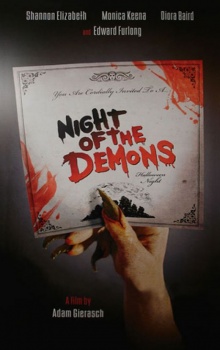
There’s a type of film—I don’t have the vocabulary for it—where the action is loud, brash, and in-your-face.  Colors are often lurid and, in horror, gross sounds are emphasized.  I’m not sure what it’s called, but it’s the style used with Night of the Demons.  I didn’t realize until after I’d seen it that it was a remake of an earlier film by the same name.  The one I saw was the 2009 version.  I’d just finished a book about demons, and I was looking over Amazon Prime and what I could watch without spending any more money.  Well, I did learn something.  But first, a little plot reveal: a group of friends are going to a Halloween party in a haunted mansion.  Mainly they’re looking for controlled substances and uninhibited sex.  The party hostess has rented said haunted mansion for the night.

Once they get there the final girl, Maddie (and you can tell from the beginning that she’ll be the final girl) starts to realize that there seem to be supernatural forces at play.  The cops show up and break up the rave, but seven kids remain behind since they’ve been locked in.  They find a hidden room where the bodies of six previous victims have decomposed.  This leads to the possession of the woman hosting the group and these demons are transferred either by bite or sex—they are sexually transmitted demons.  So, naturally, all the friends except the final girl fall victim.  These demons dissolve in the sunlight unless they get seven victims, so when Maddie makes it through Halloween night, the demons are defeated.

What makes this moving interesting is the type of demons on show.  These seven demons are so bad that they’ve been kicked out of Hell—they don’t follow the rules.  This made me think.  Logically, no demons in Hell follow the rules.  The root of the word “pandemonium” means “all demons.”  If none of them obey rules, how can any be kicked out for breaking rules?  Laws and rules are what preserve any civilization.  Those who use their money and power to flaunt the law are, in their own way, demonic.  These demons are kept at bay by spells written on the walls of one room in the house.  Those rules they must obey.  Is this a parable about free will?  It doesn’t seem sophisticated enough for that.  Night of the Demons is one of those fast, loud, lurid movies that need a monster.  Demons, which have no basic form, seem to be purpose made to fill such gaps.


Cinematic Demons

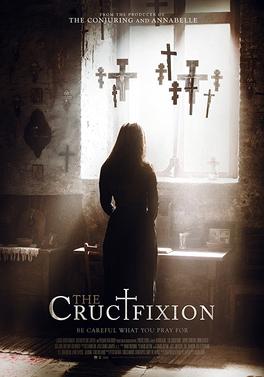
It was because I read The Exorcist Effect.  I realize that there are lots of movies that I could’ve watched for Nightmares with the Bible, but with limited time, limited budget, and limited social contact, I made choices without all the data.  I guess no one ever has all the data, really.  In any case, I could’ve discussed The Crucifixion.  I’ve been taking a bit of a break from exorcism movies, but since this one was based on a true story I’d not heard before Exorcist Effect, I decided to give it a go.  Although highly fictionalized, the movie crew did pick up on significant details from the case of Maricica Irina Cornici, who died after an exorcism in Romania.  The framing story is that of Nicole Rawlins, a journalist who wants to learn the truth.

In fact, the story is really about how Rawlins comes to faith after confronting the demon Agares.  Rawlins has guilt over being an atheist, unable to convince her dying mother to try new treatment and then by letting her die with the knowledge that her daughter has no faith.  In Romania Rawlins drives around a lot and, in one of the most difficult to accept aspects, everyone freely gives information.  Sister Adelina Marinescu, the victim, we’re led to believe, picked up a sexually transmitted demon in Germany.  Her brother, and friends, even the bishop, all freely share their opinions.  Rawlins develops a crush on the local priest, Fr. Anton.  He wants her to regain faith since, as an atheist, she’s an easy target with a demon on the loose.

It turns out that the demon was actually transmitted from a possessed priest, who got it from a possessed farmer.  It then passed to Sister Adelina and from her to Rawlins.  Her possession becomes apparent on the farm of the original possessed man and Fr. Anton performs an unplanned exorcism to save Rawlins from the same fate as Sister Adelina.  Rawlins comes to believe; she saw her mother during a brief moment when, it’s implied, Nicole died.  The film has a rather convoluted plot and many scenes where logic seems to break down, but it is certainly a passable horror film.  Rawlins earns sympathy as the lead, and the Romanian setting is a nice (if historical) touch.  The local festival “like Halloween” adds intrigue.  The movie didn’t rock the critics, but it seems like it works for what it is.  And if I even write a follow-up to Nightmares, it will definitely be included.


Not Handel’s Messiah

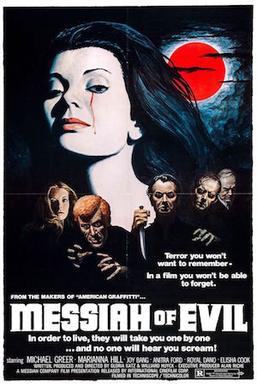
It’s polarizing.  Even now, nearing fifty, Messiah of Evil is either adored or excoriated.  So it was at its release.  I was pointed to the movie by an adorer—a somewhat unexpected New York Times seasonal article.  Suggesting that there’s nothing else like it, the article recommended it for autumnal viewing.  So, what’s it all about?  I’m not really sure, but that won’t stop me from trying.  Arletty is a young woman who wants to find her father (with you so far).  He’s moved to New Bethlehem, California, now known as Port Dome.  She finds his house abandoned, and the locals decidedly unfriendly.  Her father’s diary explains that he’s transforming into something inhuman.  The locals are cannibals, it turns out, awaiting the return of, well, the messiah of evil.  (The title is never used in the movie.)

Although I learn more towards the excoriating opinion of things, this is a great horror and religion film.  The original messiah of evil was a preacher stranded with the Donner party.  He started a new religion and, wanting to spread it, went to California.  Now, whenever a blood moon comes, he arises from the sea and his followers become aggressive.  The movie is set a century following this first appearance, and the dark master is due to return.  His followers await him on the beach, and Arletty is their intended sacrifice.  Elements of Lovecraft are clearly evident—people transforming, old gods, evil emerging from the ocean.  Yet, there are many things unexplained.  Or maybe I’m just naive.

The male lead, Thom, travels with a mini-harem.  He’s in Port Dume because he likes to gather folktales—like the blood moon—and he likes Arletty’s father’s art and came to buy some locally.  The movie features a blind art dealer, cops who apparently know nothing about the infestation of ghouls in their town, and a guy who could drive away from the attacking hordes who decides to run instead.  The directors (Willard Huyck and Gloria Katz) were a talented couple, but this wasn’t their best collaboration.  Still, many recommend this as an overlooked horror gem from decades ago.  Others not so much.  I’m glad to have seen it, although I fall into the latter camp.  Mainly because it continues a theme that I’ve tried to pick up at several points on this blog—that horror and religion have a great deal in common.  Even if one (or both) shows its age and fails to impress.


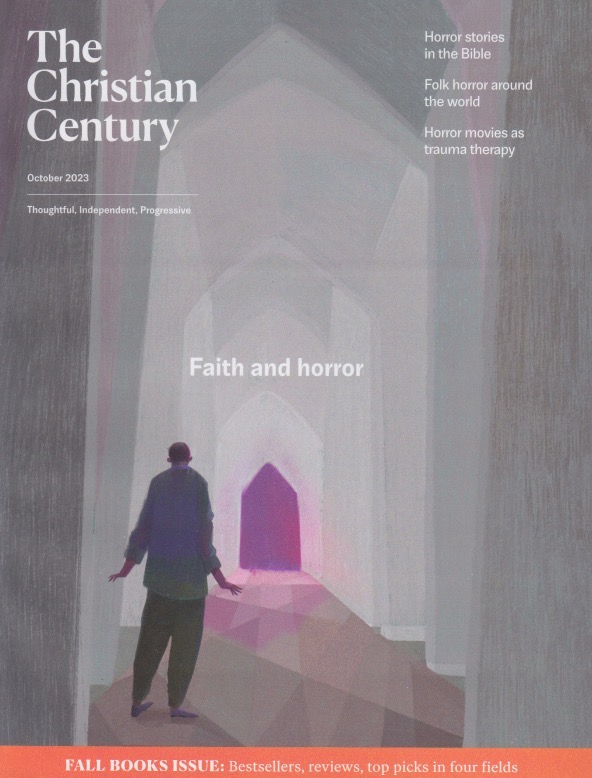
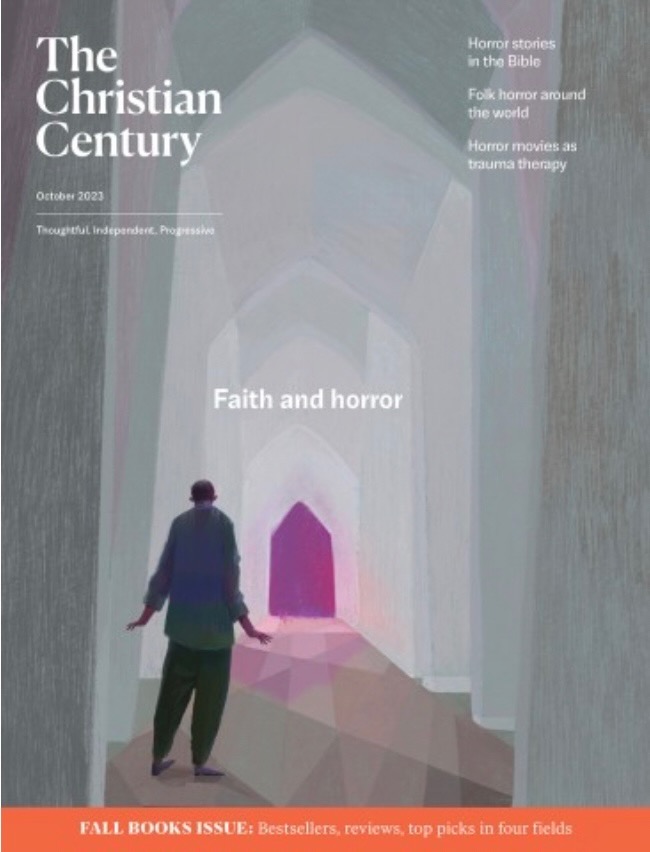
A Century of Horror

I’m not a magazine reader.  When I go to a waiting room (which is quite a bit lately), I tend to take a book.  The October issue of The Christian Century, however, caught my eye.  As a more mainstream/progressive Christian periodical, CC used to circulate in the office of one of my employers since it features books, the way progressives generally will.  This October, however, it featured five articles on “faith and horror.”  I had to take a look.  I know three of the five authors, one of them without realizing he was a horror fan.  An article by Brandon R. Grafius, “The monsters we fear,” discusses the commonalities between fear and religion, ground that he treats in Lurking under the Surface.  “The wisdom of folk horror” was written by Philip Jenkins—I didn’t know his horror interest—and it engages, briefly, The Wicker Man.  He’s making the point that folk horror is often about somebody else’s religion.

It was “Horror movie mom” by Jessica Mesman that really hit me.  Mesman was traumatized in her youth, and like many of us who were, has turned to horror for therapy.  This is a moving piece and is worth the cover price of the magazine.  Gil Stafford’s “A theology of ghosts” also gave me pause.  Stafford is an Episcopal priest who considers ghosts to be more than just woo.  In this very personal piece he thinks about what that means.  The last feature, “God’s first worst enemy,” is by Esther J. Hamori, one of the colleagues who talks monsters with me.  The piece is adapted from her recent book, God’s Monsters.  Taken together these pieces are quite a mouthful to chew on.  While numbers in mainstream Christianity are declining, Christian Century is still a pretty widespread indication of normalcy.

When I wrote Holy Horror I only knew about the work of Timothy Beal and Douglas Cowan as religion professors writing on monsters and horror.  That book admitted me to a club I didn’t know existed—the religion and monster crowd.  Since I’m not welcome in the academy, I’m particularly drawn to pieces like Mesman’s since she’s writing from the heart (as is Stafford here).  I’m just glad to see this topic getting some mainstream coverage.  I know I’m a guppy in this coy pond, but I do hope they’ll consider, over at the Century, turning this into the theme for their October issues in coming years.  If they do, they can count on at least one extra counter sale.


October’s Child

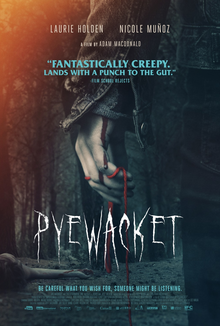
The thing about films is that there are so many of them, and they come into existence in so many ways.  Back when I was a kid, you learned about movies through the newspaper, or television or maybe radio ads.  Sometimes word of mouth, or, if you were lucky enough to see a film in a theater, through previews.  These days the internet has billions of pages and many streaming services and movies are produced faster than we can watch them.  All of which is to say Pyewacket, in my opinion, should be better known.  It’s an effective, thoughtful, and seasonal movie that caught me off guard.  It’s a Canadian independent film, not the product of a major studio, so it didn’t get the notice that massive advertising budgets provide.  I found it by scrolling on Amazon Prime.

Pyewacket is a teen angst movie (I wasn’t an angsty teenager—it came a little later for me).  Leah Reyes and her friends are into the occult.  Leah’s father has died and her mother’s having a difficult time coping.  She has decided to sell the house and move away.  Leah, who has a small circle of close friends, doesn’t want to move.  After mother and daughter are in the new house they fight, with her mother insulting Leah’s friends.  Leah goes into the woods and summons Pyewacket to kill her mother.  After this, mother and daughter make up and the tension builds.  Leah doesn’t want her to die but she’s set something in motion that she can’t control.  There are some really scary scenes in this movie, often without showing anything explicit.  In fact, views of Pyewacket are brief and indistinct, which really works.

This is an October movie.  Moody and evocative, it raises some very real questions.  Not all of them are resolved.  The occultist Leah consults informs her that Pyewacket is very deceptive and she can’t believe what she sees.  This leads to a tense resolution and somewhat abrupt ending.  It is very well done.  The point about deceptive spirits raises one of the truly potentially demonic facets of human society.  Deception throws truth off balance.  (Some of the more cynical politicians know and use this for their own ends, as we sadly know.)  Deception is dangerous and that seems to be almost the moral of this movie.  There are no villains here, but extreme actions can’t be taken back.  If you’re in the right mood, and the dark is just right, this is the kind of movie that delivers.  And I only found it by chance.


Frightening Legacy

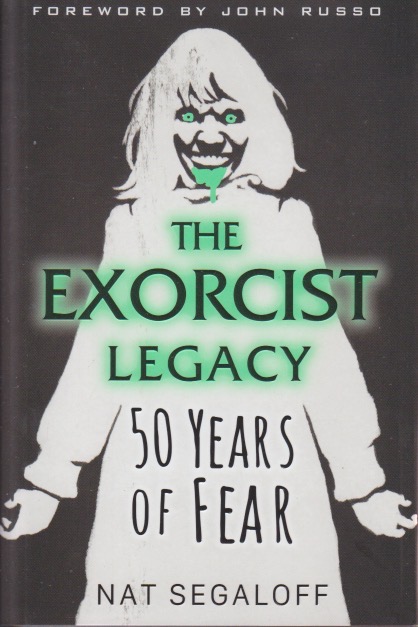
Like The Wicker Man, The Exorcist also turns fifty this December.  I was caught up in this half-century mania and so I got ahold of Nat Segaloff’s The Exorcist Legacy: 50 Years of Fear right away.  The reading was disrupted by life events, but I’d been enjoying it, as time permitted.  Written by a movie insider (as opposed to an ex-academic wannabe), this is a fairly full treatment of the film.  It’s actually not unlike what I tried to do with Nightmares with the Bible, but it is yet another testimony of the importance of The Exorcist to our understanding of demons.  Although one book can’t really be one-stop shopping for any worthwhile movie (there are plenty of books out there on the subject), this one is well worth reading.  For those who enjoy learning about cultural phenomena with a bit of horror tossed in, this is a very good introduction.

One of the things I’ve learned as I’ve tried to break into film reading is that a lot more goes on in making a film than most of us imagine.  And when we see a movie we miss an awful lot.  I’m no shill for Hollywood, but watching a movie multiple times brings out things that writers, directors, and producers didn’t even notice.  Think of the Bible, for comparison.  Readers two thousand years later are still finding new things to say about it.  The Exorcist has influenced religious outlooks in extremely important ways.  Our modern ideas of demons and possession largely go back to this film.  Details may change over time, but even the church has had to respond to it, and actual exorcists reference it.  The Bible says little about demons (again, Nightmares), so we have to pick such knowledge up from elsewhere.

The one part I found somewhat thin was, not surprisingly, parts of the final chapter, “The Mystery of Faith.”  It tends to show when a writer really knows religion.  William Peter Blatty, who wrote the novel and screenplay (the latter at least partially), knew Catholicism cold.  One of the things I’ve been yammering on about for years is that understanding religion enhances our understanding of horror movies.  I’m certain that the connection goes even deeper than that, but books written on horror mention religion often in amateur ways.  If we want to get at what’s really going on here, it’s going to be important to listen to those who understand religion as well.  None of that detracts from this fascinating book that will throw new light into shadowed corners.


Horror Therapy

It’s Friday the 13th.  Like Barbra and Johnny I’m driving to rural western Pennsylvania to visit a cemetery.  It must be October.  I’m not a magazine reader (this has probably hampered my development as a writer [I prefer books]), but the October issue of The Christian Century is devoted to religion and horror.  This morning I watched an interview with Jessica Mesman on her article on horror as therapy.  In it she discusses her mother’s death.  Since we have this in common, I was intrigued.  Mesman states that studies substantiate that watching horror functions as therapy for people with PTSD.  It has been suggested to me more than once that my career malfunction at Nashotah House led to PTSD.  It may be no coincidence, then, that I started watching horror after that happened.  When The Incarcerated Christian podcast was still going, I was interviewed three times and the topic was, broadly, how horror acts as therapy.

Until today I’ve had to work daily and then make arrangements for an unplanned trip to celebrate my mother’s life as I could.  I’ve never met Jessica Mesman, but I sense that she would understand what I’m going through.  As I grapple with grief, loss, and relief (my mother was ready to die, but I had been unable to see her for a few years because of the pandemic and other circumstances) what I feel I really need is to watch a horror movie or two.  I have found—and 2023 has been a traumatic year for me—that when I’m feeling overwrought, taking ninety minutes to watch a horror film can get me back on track.  It helps me cope.

None of this is intended as any disrespect for my mother, whom I love deeply.  Although she didn’t read my books, she knew I watched monster movies as a kid.  She occasionally grew annoyed with me when such things made me too clingy—she had two other sons and her own dying mother in our home and she was trying to keep it together with my father gone.  Looking at photos of my young self, I wonder if that early loss of a parent translated to a kind of childhood PTSD.  Once I’d successfully (?) made it to adulthood, Mom told me—“you were the one I worried about; you seemed to have difficulty adjusting.”  I sought therapy in religion.  I’ve dedicated my life to it.  Until it too became a source of grief, horror, and pain.  As I prepare to drive to her funeral, I’m pretty sure that Mom understands.


Dental Dawn

Someone knowing my interest in religion and horror recommended Teeth.  A comedy horror film based on the concept of vagina dentata—an idea I first encountered in Neal Stephenson’s Snow Crash—it begins with a purity event.  Dawn, a teen leader in the abstinence movement, addresses other adolescents about the importance of maintaining, well, purity.  They all wear purity rings and vow themselves to chastity until marriage.  As might be expected, not all of them are able to uphold their pledges.  Being inexperienced, when Dawn finds herself in a compromised position with her boyfriend she learns she has, um, teeth.  Other guys, even when warned, can’t resist an opportunity and they too pay the price.  The point of the film seems to be female empowerment, but it’s also pretty funny.

After boyfriend number one has disappeared, Dawn again addresses the purity group only to have them quote Genesis 3 at her, clearly intimating that sin is the fault of women.  The Bible is there by implication and the sermonizing of the adult leader after Dawn has to leave the stage again takes up the religious outlook.  The underlying concept of purity movements is distinctly Christian.  While all religions have something to say about sex, generally the most negative about it is Christianity.  That’s not because other religions lack for spirituality, but Christianity tends to denigrate the body, and in the process tends to make natural things sinful.  This gives plenty of fuel to a movie like this where a woman has to make her own way in a man’s world.

What’s really interesting here is that no punches are pulled when it comes to the origins of patriarchy.  The Bible clearly views males as the standard of humanity and females as an adjunct.  That idea has had a death-grip on western society, particularly in America, from the beginning.  Teeth was written and directed by a man.  I suspect that the presumably well-intentioned use of an old mythical idea that makes females into monsters may not appeal to women writers or directors, empowering as it may be.  Nevertheless, if taken with the fun obviously intended from the opening playful music to the comically terrified responses of Dawn’s adolescent victims, the movie can still convey a positive message to women who might watch it.  Horror is often a repository of social commentary.  Not taken seriously by the mainstream, it nevertheless puts good messages out there.  And sometimes it bares its teeth.


Keeping Sentinel

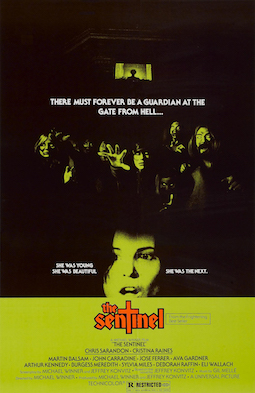
Not among the trinity of holy horrors from the late sixties and early seventies, The Sentinel takes its cues from religious horror but manages to fall into bad movie territory anyway.  While still cited from time to time, it’s largely forgotten among the films of the era.  It had a lot of competition in the seventies with The Exorcist, The Omen, and The Amityville Horror.  One of the reasons it seems to have fallen at the threshold is that it doesn’t understand the religion it tries to portray.  That religion is some form of Catholicism that involves a number of clerics who run around northern Italy wearing various liturgical vestments to oversee an apartment in Brooklyn Heights that’s actually the gateway to Hell.  They do this by way of an eponymous sentinel who lives in the apartment building that’s Hell’s portal.  The rest they, reasonably enough, rent out.

Alison Parker, a model, ends up renting the place while her boyfriend lawyer decides to have her killed—no particular motivation is given, although he had his first wife murdered too.  At the apartment Alison is disturbed by the other tenants, who are very strange.  And a mysterious priest lives in the apartment at the very top and never comes out.  (In case you haven’t gathered, the plot is pretty convoluted.)  It turns out that people who’ve formerly attempted suicide (like Parker) are targeted by the church to take over as sentinels to make up for their sin.  They have to “go missing” and reappear as a priest or nun and live in a particular apartment.  The strange neighbors, as you may have guessed, are demons trying to escape the watchful gaze of the sentinel.  Naturally, they stay in the same building.

The problem—or one of them, anyway—is that the Catholicism displayed doesn’t resemble Catholicism very much.  In the famous scene where the demonic entities are swarming on Alison and the dying sentinel she’s to replace, said sentinel carries a distinctly Protestant cross rather than a crucifix.  The mythology the film tries to construct is simply bizarre.  The classics of the period at least got the religion correct.  Catholicism in The Exorcist, Protestantism in The Omen, and, although fabricated, Satanism in Rosemary’s Baby.  Many filmmakers, it seems, think it’s easy to fake it when it comes to religion.  Looking at the movies that succeed on that front, however, and comparing them to those that become bad movies, it seems clear that doing your homework, or at least going to Sunday school, pays off.


When Will We?

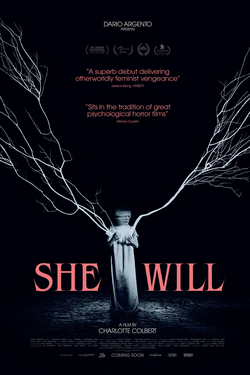
She Will is a creepy art house film from a couple years back.  Sometimes cited as a #MeToo film, it was directed and co-written by Charlotte Colbert and it follows an aging child actress recovering from traumatic surgery.  Veronica Ghent has decided to go to Scotland, to a remote retreat, to heal.  She takes her nurse with her and is chagrined to find that the retreat she booked is being shared by an art therapy retreat.  She insists on private accommodations and is put up in an even more remote cabin.  While there, it’s made abundantly clear that this was a place where witches were burnt and their ashes mingled with the soil and the very earth therefore has healing properties.  Veronica gains an ability to exact revenge from her dreams.

The target for Veronica’s revenge is a famous director who seduced her as a child while working on her first starring role.  Famous and powerful, nobody was able to touch him.  With her new-found abilities Veronica is able to exact justice through supernatural means.  Not only that, but when a local man—the retreat’s handyman—tries to rape her nurse, Veronica is able to prevent that too.  This is a moody, sad film that addresses issues that are all too real for many women in a system designed by and intended to profit men.  Either unaware of, or uncaring about women’s experiences as participants in the system, they dismiss their trauma in a way they wouldn’t for other men.  

Although the film doesn’t have tons of action and doesn’t rely on jump startles, it is an effective gothic horror movie.  The Scottish scenery is bleak and evocative and the message is important.  Horror films directed by women are starting to gain some notice.  Those familiar with Suspiria, however, will note the influence of executive producer Dario Argento.  That film also featured the difficulties women can face, and it also concerns witchcraft.  She Will is more mature in these areas, however.  Female directors—and writers—know the unique struggles women have in a society that refuses to give female leadership a chance.  It’s a simplistic world where men are in charge (because the church says so, or, more brutally, because physical strength can be used to get one’s way) and aren’t willing to consider that half the world sees things in a different way.  Movies like this force us to take the perspective of another.  And for that the world is better.


Shopping Trip

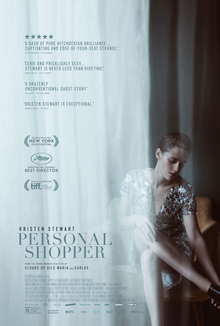
Personal Shopper is one of those movies I’m not sure I understood, but which was nevertheless profound.  It didn’t help that it was one of those “free with commercials” movies that interrupted a dense storyline just when I needed to be concentrating.  How did we ever survive growing up with commercial television as our main vehicle for movies?  This is a subtle, psychological ghost story set mainly in Paris and involving a young woman, Maureen, who is the titular personal shopper, but who stays in Paris to try to contact her fraternal twin brother’s ghost.  Her dead brother’s widow is helping her, but the wealthy woman for whom Maureen’s the personal shopper is demanding and has strict rules about how her expensive clothing and accessories are to be handled.

The film is moody in the way that I find effective, and it’s not fast-paced and full of action.  It’s more contemplative and a couple of plots are woven together so that I suspect I’ll need to see it again to try to fit it all together.  It’s also a movie that intertwines religion with horror.  In this case the religion is primarily Spiritualism.  Maureen, in addition to being a personal shopper, is a medium like her brother was.  Before he died he promised, like Houdini did, that he would try to return and leave a sign so that Maureen would know for sure about the afterlife.  She has glimpses of a spirit entity, but isn’t sure it’s him.  Meanwhile, her boss’s lover scams Maureen into believing he’s a ghost by texting her cryptic messages from an unknown number.

There’s no question, following the straight narrative of the film, that there are ghosts.  What’s uncertain is who they are and whether they can be trusted to reveal the truth.  Mostly shot in autumnal Paris, the gray skies and threat of rain complement the eerie feeling the story generates.  It ends in sun-drenched Oman, however, making for a stark contrast with what has gone before.  If my description here is confusing take that as a sign of the depth of this film.  (Or simply judge me a   poor writer.)  In either case, Personal Shopper, which was recommended to me, is a movie that hangs on after it’s over, leaving you wondering about any number of things.  The acting is compelling and there’s a melancholy about the movie that’s rare but also becoming.  I’ll need to see this again some rainy day, hopefully without commercials this time.


How Many Stairs?

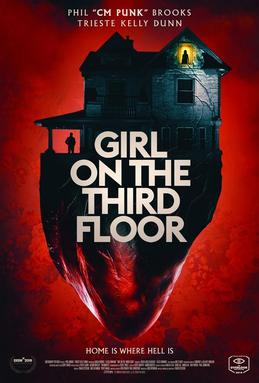
It tries.  It really does. Still, The Girl on the Third Floor is just not that good.  It got quite a few accolades, but I was waiting for something extraordinary.  It seemed to fall down on two counts—the writing isn’t very good and we’re allowed to build very little sympathy for the protagonist.  If you can’t feel for somebody and the dialogue does only light lifting, what’ve you got to go on?  Some critics suggest that if you know the star (Phil Brooks) and his persona you’ll appreciate it more.  That must be a problem for many movies where baked-in personalities are counted on—early Disney used to do this to make cartoons attractive to adults.  If you don’t know them the appeal evaporates.  In any case, a couple buys a house. He (Don) goes to renovate it while she (Liz) works to support them.  The house used to be a brothel and Don has no problem cheating on his wife when a hot ghost shows up.

The reason I watched the movie was the connection between horror and religion.  The first person to check in on Don is Ellie Mueller, the pastor of the church across the street.  She’s simply identified as “Protestant” and she drinks bourbon and swears, so it’s fair to guess she’s not Baptist.  In any case, she warns him about the house but ever confident, Don carries on.  Later, as all the ghosts come out and Liz shows up unexpectedly, Ellie shows up again.  This time she advises Liz to leave but she frames the evil of the house as a matter of choices.  Don (who succumbed to the ghosts) consistently made bad choices in order to get what he wants.  Liz and Ellie, however, think of others.  In that sense there’s a parable here.

The haunted house tropes have mostly been seen before.  Some manage to be a bit freaky, but many of them don’t really shock.  Or maybe I’ve seen too many movies for them to have an impact.  The heavy metal soundtrack is a bit—ahem—heavy-handed.  Using marbles as weapons is a little unexpected and angry ghosts often make for effective monsters.  Still, these seem to succumb to a sledge hammer pretty easily.  One of them keeps coming back, however, and one is more a monster than a ghost.  In any case, there was real effort here.  For my taste, however, good writing can cover a multitude of sins.  And it really helps if you sympathize with the main protagonist, even if just a smidgen.


Not the Exorcist

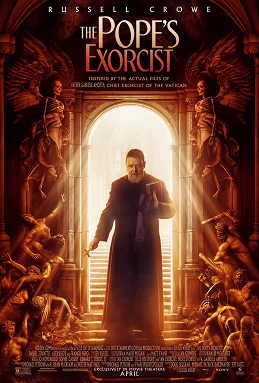
It’s too bad The Pope’s Exorcist didn’t come out before Nightmares with the Bible.  In that book I tried to make the connection between demons and nightmares and in this movie Asmodeus, the “named demon” gives his name as “Nightmare.”  Released in April of this year, The Pope’s Exorcist received a considerable amount of fanfare.  Starring Russell Crowe as Fr. Gabriele Amorth (two of whose books I’ve posted on), the entirely fictionalized account ends up coming across as, I shudder to say it, rather silly.  Using just about every exorcism movie trope available, the film goes over the top and really doesn’t have much scare in it.  Let’s start from the beginning.  Fr. Amorth is in trouble at the Vatican but the Pope’s his personal friend, so no worries there.  Meanwhile an American woman has inherited a decrepit abbey in Castille, Spain.  Her late husband owned nothing else and she has to be there personally to oversee restoration, dragging her two kids with her.

It turns out that this abbey contains evidence of a centuries’ old conspiracy during the Spanish Inquisition covered up by the Vatican.  It’s also the home of Asmodeus, king of Hell.  And one of 200 locations that fallen angels came to earth.  After the demon scorches a couple of restoration workers, the woman, Julia, is left in the spooky abbey alone with her kids.  They both end up possessed, but the boy, Henry, is the focus of the body horror.  Since Asmodeus has clearly seen The Exorcist, he says outright that he’s after Fr. Amorth, who is sent by the Pope himself to take care of this.  To save the boy Amorth has to be possessed in his stead (as in The Exorcist).  Together with a younger priest (really, is any of this sounding familiar?), the demon eventually has to capitulate.

Apart from not being “based on a true story,” the movie also takes seriously the fictionalization of characters.  “The Pope,” never named, in the 1980s was John Paul II.  He’s portrayed as bearded and in poor health.  Amorth (Crowe) is also bearded, although historically Amorth, like most Roman priests, was clean-shaven.  The “silliness” of the movie derives from not having researched Roman Catholicism thoroughly.  All of this makes me wonder if an exorcism movie can be made that surpasses The Exorcist.  Much has been written on that movie since William Friedkin recently died (and much was written on it before).  It’s difficult to put a finger on just what made that film so superior.  It doesn’t stop others from trying, of course.  And now there’s talk of a sequel for The Pope’s Exorcist.  The nightmares, it seems, never end.


Still Not Resolved

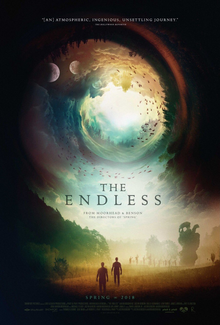
Yesterday I posted about the independent movie Resolution.   It’s actually part of a set, the other half of which is titled The Endless.  In The Endless the director and cinematographer, and co-directors of both films, interject themselves into the story.  While some suggest it’s only a partial sequel, to me it felt like a part of the same tale, giving, as it were, resolution to both movies.  Philosophical horror is something I always associate with Thomas Ligotti, but Justin Benson and Aaron Moorhead have given it a double punch with these two films.  So a pair of brothers (Justin and Aaron) go back to visit a “UFO cult” in which they were raised.  This immediately puts you on edge because Aaron doesn’t seem convinced that it was such a bad life, compared to that which they’ve been able to find on their own after leaving.

There’s definitely something very weird going on at Camp Arcadia, though.  Justin had convinced Aaron that it was a suicide cult (think Heaven’s Gate), but it turns out that everyone’s still alive, and apparently thriving.  Their means of livelihood was threatened when Justin went public that they were a cult, but they’re nevertheless glad to see their ex-members.  Once they get integrated into the camp, characters from Resolution begin appearing.  Both movies feature the same monster and the same means of delivering messages via media—often outdated.  The brothers come to understand that they are being trapped in a time loop and—spoiler here—that the cult members are in a sense dead since they live the same loop over and over.

In addition to being philosophical horror, The Endless contains substantial theological sophistication as well.  Discussions about God, and church, and belief systems run through the movie.  Thinking deeply can lead to horror scenarios such as this.  People tend to feel trapped when caught in nothing but repetition.  We’re curious and we seek a variety of experiences and new stimuli.  Eastern religions recognize the problem as well and offer ways to break out of the cycle of reincarnation (samsara).  The idea of using such things to suggest that this kind of repetition is a monster—when Justin sees it he’s convinced it’s a monster—is rich fodder for a thoughtful horror film.  At the end, it seems that “UFO cult” is an unfair characterization for the commune at Camp Arcadia, but, with enough determination, it’s just perhaps possible to break out of the cycle.  This one’s worth pondering.