Striving for

Get Out! was Allison Williams’ first feature film starring role.  Playing the unsuspected villain, she was incredibly believable.  Then I saw M3GAN where her role was again not exactly that of protagonist.  Curious, I decided to watch The Perfection, the horror film between the two in which she also stars.  As always, she starts out looking innocent enough, but this film has so many twists that you might be left feeling a bit dizzy when it’s over.  Williams plays Charlotte, a gifted cellist at the prestigious Bachoff Academy.  Forced to leave by her mother’s stroke, Charlotte became a full-time caregiver, leaving her promising career behind.  She’s superseded by Lizzie, whom she meets in Shanghai as the two are judging a scholarship contest for a new Bachoff student competition.  Lizzie and Charlotte hit it off and travel across China together.  Lizzie, however, falls ill and has to have her hand amputated.
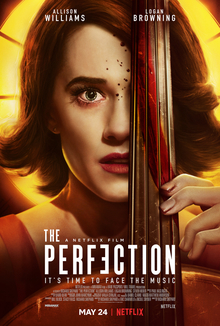
A flashback reveals Charlotte tricked Lizzie into that situation so that the Bachoff star cellist would no longer be useful to the academy.  Another flashback shows why: Anton Bachoff has devised a horrid punishment for making mistakes while playing.  While this is disturbing enough, it takes place in “the chapel”—a room designed with perfect acoustics—and is done to please “God.”  This set-up has been operating for years and Charlotte was rescuing Lizzie from it, albeit in a rather extreme way.  The two cellists team up to bring Anton down.  There are quite a few holes in the plot and rape revenge films are one of the kinds I tend to avoid.  Still, the integration of religion with the horror is intriguing here.  One of the opening establishing shots is a close-up of a crucifix.  Sacrifice is indeed a theme of the film.

Critical opinion was mixed, but mostly positive.  The plot twists get you thinking that Williams is again playing the unexpected villain, and in a way she is.  Still, the real villain is a man who manipulates religious rhetoric (God demands perfection) in order to supply him with access to talented young women.  When they achieve international stardom, they’re not inclined to join #MeToo and lose everything because Anton is not only wealthy, but highly respected in classical music circles.  This is an odd sort of horror thriller that works on some levels but that leaves you feeling violated on another.  It doesn’t play out the religion element in any detail, which would’ve been helpful.  At least it would to a certain kind of viewer, who’s trying to figure out how this all fits together.

Bad Movie Therapy

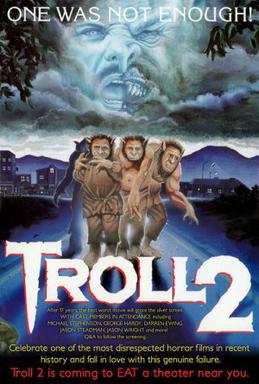
I haven’t see Troll, but it doesn’t matter.  Troll 2 has nothing to do with it.  As a frequent contender for worst movie of all time, Troll 2 is an anti-vegetarian screed and campy horror film that’s impossible to take seriously.  It’s part of my bad movie therapy.  And it’s also an example of religion and horror.  But first, let’s set the scene.  The Waits family (Michael and Diana, and their kids Holly and Joshua) is doing a house exchange for a vacation.  Before they leave, however, Joshua’s dead grandfather appears to him to warn him about the goblins.  The goblins, who are vegetarians, make people eat/drink a special substance that turns them into plants so that they can eat them.  (Yes, it’s that bad.)  Ignoring Joshua’s concerns, the Waitses head for Nilbog (goblin backwards) and go ahead with the house exchange.

The locals (there are only 26 of them) can make themselves appear human and they try in vain to get the visitors to eat.  Joshua prevents his family from eating the plant food by peeing on it.  They go to bed hungry as the queen of the goblins plans her next move to get them floradated.  About midway through the film, we’re shown a church scene in which the minister preaches of the evil of the flesh.  Ironically, this is not far off from the teaching of some Christian denominations.   He tells the trolls what they already know—they have to get the visitors to eat so that they can eat them.  If nothing else, it will make you forget your troubles for ninety minutes, unless your trouble is that you’re being turned into a plant.

Any number of reasons have been offered for why the film is so bad.  While filmed in Utah, the crew was Italian, and most of them spoke no English.  The movie was low budget.  The acting is just plain bad.  All together, however, these features work symbiotically to grow a wonderfully therapeutic end result.  Some of the crew claimed that it was the intention all along to make this a funny film.  Comedy horror or horror comedy is a recognized genre, after all.  The only problem I have now, however, is where to go from here.  So how does the Waits family escape their peril?  I’ll need to offer a bit of a spoiler here.  The goblins are frightened away long enough by a double-decker bologna sandwich that the family can touch the magic stone and destroy the conspiracy.  What are you still doing here? Why aren’t you watching this already?


Entities

When you’re a regular scholar, you take notes.  I’m not a regular anything, I guess, and I’ve fallen out of the habit of noting who makes movie recommendations to me.  Many of these come from books, but I don’t always remember which book made what suggestion.  In my list of movies to watch is The Entity.  The thing is, there are at least five movies by that title.  One of them was free on Freevee, so that was the one I watched.  I’m not sure it was the right one, but since it featured something like a demon it represents my interests in Nightmares with the Bible.  This one was, for the record, from 2016, or 2015, and directed by Eduardo Schuldt.  Like Paranormal Activity, it’s “found footage” from hand-held cameras and it made me more woozy than scared.

Based in Lima, it’s in Spanish and claims to be from the dark web.  I don’t have any desire to go there (the dark web, that is.  Lima would be okay), but the movie wasn’t that frightening.  It was like Sinister and Ringu’s unholy offspring.  With a bit of Blair Witch Project as a sibling.  A curse from the Inquisition brings this into the realm of religion and horror.  Film students working on a class project learn that those who see a certain film are going to die.  Being modern people, they’re skeptical so, of course they watch it.  The thing about religion is that it’s unrelenting.  It doesn’t give up just because people stop believing.  Movies like this underscore how we keep turning back to religion to frighten ourselves.  You can guess what happens to the students.

The thing is, I’m not sure that I watched the correct one.  Film scholars now make a habit of citing movies by not only title and year, but also director’s name.  There are a lot of “Entities” out there, and if you take the article off there are even more.  I’ll probably end up watching a few of them, but since I didn’t write down which book, or which friend, made the recommendation, I’ll never know if I got the right one.  I keep a list to try to prevent myself from just going for whatever’s free on the weekend because you generally get what you pay for when you do that.  Even though I ended up a bit nauseous (from the camera movement) I was glad to have seen this.  There were some good moments in it.  And I can tick one off my Entity list. 


Sleepy Once More

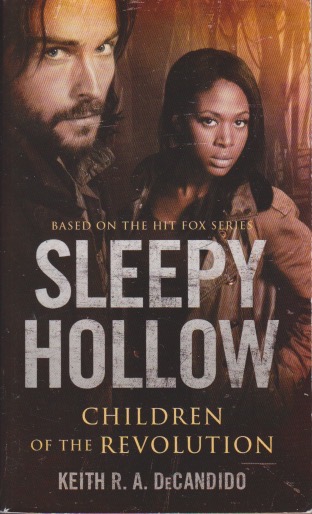
I think this is the last of my recent nostalgia reads for a while.  When trying to recapture the feeling of watching that first season of Sleepy Hollow without actually spending all the hours necessary to do so, the spin-off novels are a quick fix.  Keith R. A. DeCandido obviously has quite a bit of experience of writing novels that tie into pop culture.  Many of us were pretty enthralled and impressed in 2013 (already a decade ago!) when Sleepy Hollow first came on the air.  This literary member of what was an emerging new legend is a novelized episode that is slotted into season one, referring back to what had happened earlier in the season without betraying the cliff-hanger ending for the 2013–14 run. Sleepy Hollow: Children of the Revolution is a guilty pleasure read and a jaunt back to a decade that now seems long ago.

Here the story involves an attempt to resurrect (one of the main themes of the show) the witch Serilda of Abaddon.  Serilda had her own night in the moon earlier in the series (the episode “Blood Moon” was dedicated to her).  This novel asks, what if a coven of her followers, one of them a former policewoman, tried to bring her back?  It does so by using historical scenarios—much like the series—such as Washington’s crossing of the Delaware, and impregnating them with magical subtexts.  Here there are congressional awards that have been secretly engraved with runes.  George Washington knows about them, of course.  When brought together they can transform Serilda into a real monster.  Remember, Moloch was still an active concern in the first two seasons of the show.  In the present day, these artifacts have been regathered by the coven, and you can guess that all Hades will break loose.

I often ponder how, with the series Sleepy Hollow, the story began to fall apart when the Bible fell out of it.  It was in the process of tying together great American mythologies such as Irving, Revolutionary-Era history, and biblical self-identification.  These formed a compelling net that brought in many viewers.  Season one ended with two of the four horsemen of the Apocalypse in Sleepy Hollow, and a third had been nodded toward earlier in the series.  Instead of finishing out that line of thought, the storyline dispensed with Moloch and gave the headless horseman a head.  The plot ran out of steam.  Books like this demonstrate that there was other fertile ground to plow.  Had the original conceit kept intact, we might still be watching it.  Of course, novels like this are good for reliving those days a decade ago.


Othering Offering

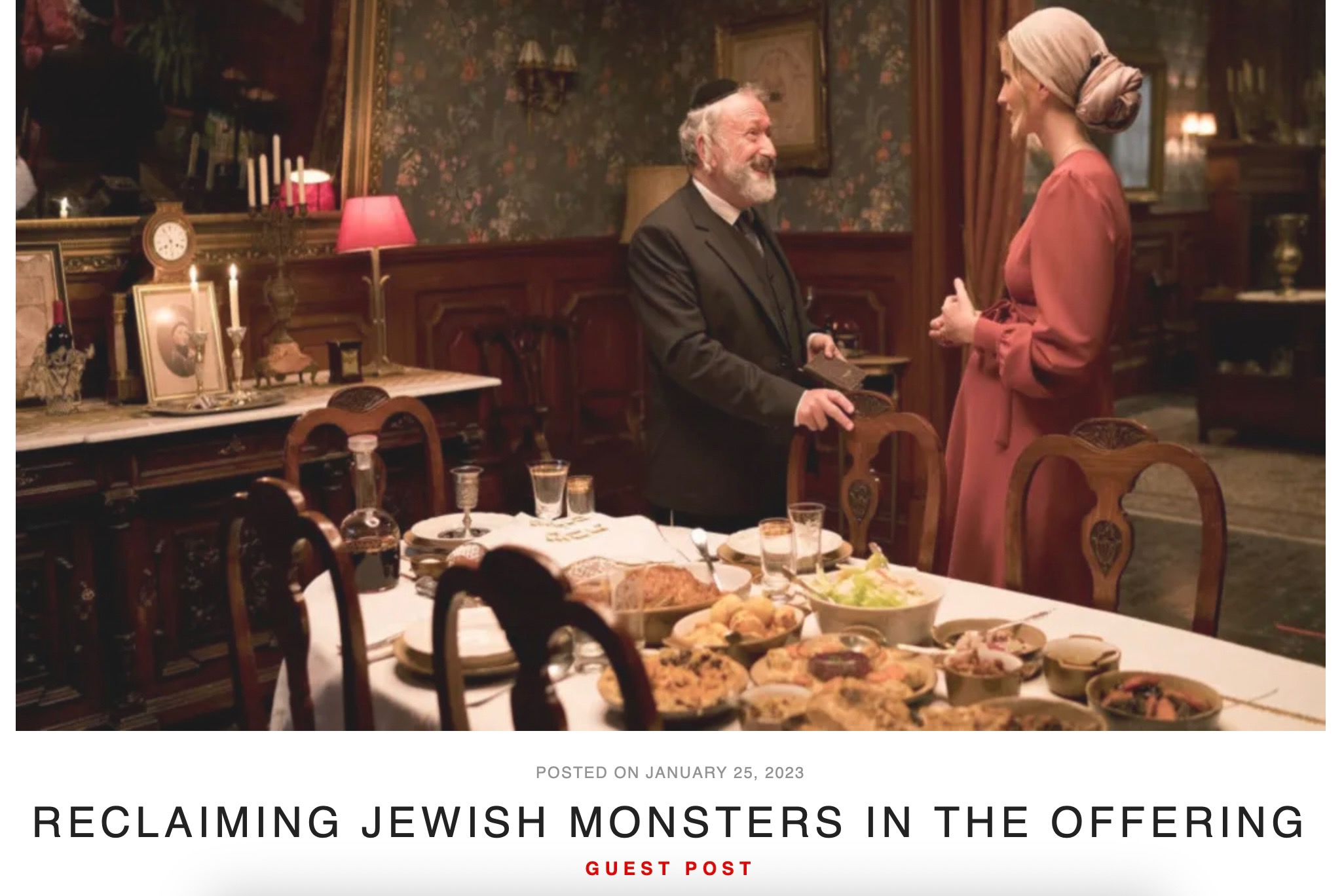
I get to feeling a bit anxious when nobody else publishes me for a while.  It’s a strange kind of validation, I suppose.  No matter my motivation, I knew as soon as I saw The Offering that I would have to write something about it for Horror Homeroom.  The article is now available here.  Horror, as one of the more intelligent genres, often has much to say about things such as religion and esoteric beliefs.  In the article I compare it to other recent Jewish horror such as The Possession, The Golem, and The Vigil.  All of them are worth watching.  Religion often addresses those things that scare us, whether secular or sacred.  Movies like these often make me ponder the sense of belonging that religious communities offer.  At least in the best of times.

These three movies each have their own posts on this blog, but the point of the Horror Homeroom article is to try to look at them together.  Judaism can be a particularly delicate topic.  Not only the Holocaust, but also subsequent political developments have led to dangerous situations for Jews in the real world.  Theirs is an old and rich culture, persecuted largely by Christians who ironically blame Jews for their own salvation.  And hate them for it.  Nevertheless Jewish culture and belief persist.  It’s telling that even when they invent a protector, such as the golem, they come to realize that it too will turn on them in the end.  Most horror movies, if they participate in religious worldviews, do so from a Christian point of view.

Some colleagues recently asked me to name some Protestant horror movies.  That’s a tricky question to answer because the American context is still largely Protestant as a whole.  And when you want to take on monsters and demons you generally call a priest.  Even movies like The Last Exorcism have Protestant clergy using Catholic crucifixes.  As I’ve stated elsewhere, Asian horror movies have also come into their own, often reflecting Buddhist or Hindu outlooks.  So we find religion and horror intermingling worldwide.  Movies are more than just entertainment.  They can be, and are, teaching tools.  We should pay attention to what goes on in their classrooms.  Not only can we learn about ourselves, we can also learn about those that we, or society, tend to “other.”  Like high school, there are a variety of classes you might take.  The day always starts, however, with homeroom.


Diabolical

Diabolique, the 1996 remake, is sometimes tagged as horror.  It’s also considered drama and a thriller, so how you classify it has some flexibility.  One thing it’s generally not classified as is “good.”  Most remakes suffer in comparison to the originals, and their originating novels explain a lot more.  Still, it’s set near Pittsburgh and it has a lot of religious imagery in it.  In case you’re not familiar—it’s the story of a love triangle involving a particularly odious man and two women who inexplicably adore him.  One of the women is a young, wealthy heiress who inherited a private school outside the city.  She’s a teacher at the school and her cheating husband is the principal.  Her best friend, beknownst to her, is sleeping with her lecherous husband.  But the best friend also protects the wife from her husband’s bullying.

The wife, a former nun, has a heart condition.  Her husband and best friend plot to scare her to death and inherit the school and all her money.  They do this via an elaborate—almost Rube Goldberg-esque—ruse where the women drown the man and he then “comes back to life” frightening the former nun into a heart attack.  Her best friend, apparently, repents along the way and along with the wife, end up drowning her husband for real when he attacks both of them.  You kind of get the sense that there are few characters with whom to empathize and although this could’ve been a feminist manifesto, it was directed by a man and missed that opportunity.  So why am I discussing it here?

The use of religion in this film is intriguing.  Throughout the school there’s discarded religious imagery.  Crosses cast aside, empty holy water fonts, grace not said before meals.  The husband, not a believer, has put all of that aside.  His wife, convinced she’s murdered her husband, confesses.  Then engages a private investigator, for appearances’ sake.  The thing is, the religious imagery doesn’t really come into contact with the story.  The only real exception is when the wife uses the cross she’s wearing to gouge her husband’s face.  A strange form of salvation indeed.  The movie isn’t that good (it’s free on Amazon Prime, though) but it underscores once again that religion does find a natural partner in crime with horror.  Or in this case, a thriller.  However you want to classify it.  The plot twists aren’t effectively executed but I suppose it’s better than a crucifix in your eye.


Kings and Gods

Kong has never been my favorite monster.  Perhaps because it is more of a sad story than a scary one, and in movies of gigantic animals, there always seem to be scaling problems.  The monsters are only reacting to the circumstances in which they find themselves and humans prove to be the real problem.  In ways nearly impossible to conceive, less than a century ago films like the original King Kong shocked and stunned audiences.  Humans are such visual creatures and no similar spectacle had been seen before.  I recently watched the 1976 reboot for the first time.  I’d seen clips, of course, and kids in junior high were talking about it back when it came out.  For me it was more like “if you know the story already, why see another attempt to tell it?”

Visually, there is a lot of nice cinematography in the film.  We’re all used to CGI so the animatronic Kong isn’t really believable, but nevertheless, our emotions map onto his with the prolonged shots of the gorilla’s facial expressions.  That part was effectively done.  Much of the rest of the movie left too many questions for belief to be suspended.  The heartlessness of corporations was too real and perhaps the scariest part of the movie.  Watching any movie with explosions on the twin towers brings back a kind of post-traumatic 9-11 reaction.  Prolonged, nearly Russian-length, death scenes personally don’t do it for me.

The reason I was watching, however, was for the religious aspect.  This is underplayed, but the islanders clearly worship Kong and consider him a god.  (I did wonder what he ate since no giant fruits were shown, but the immense snake tells us not all was revealed.)  In one reflective moment on the oil tanker back home, Jack Prescott says that they’ve taken the islanders’ god and their society will fall apart.  Western enterprising does have much blood of this kind on its hands.  And no matter how it’s dressed up King Kong always appears to be a racist story.  Some critics say the 1976 version isn’t horror, but instead a kind of bizarre love story.  While I don’t think much thought went into the implications—it seems the movie was a showcase of state-of-the-art animation for the period (otherwise the long scenes of Kong changing faces and blowing on Dwan make little sense)—that accidentally play into tropes of gods falling in love with women.  Maybe there’s a reason I haven’t watched any of the other reboots.


Paperback Reader

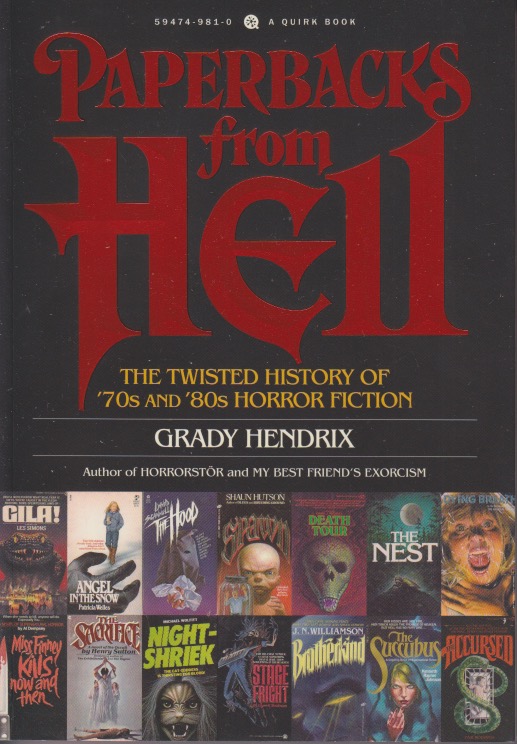
Sometimes I wonder why I do it.  Horror is a strange category for books and films, but one thing that may be a draw is that they take me back.  Life, it seems, is cyclical.  I liked monsters as a kid, and grew out of it when college and graduate school taught me to be serious.  As a working academic this genre can spell death to your career, so when my career died anyway, I was left grasping at my childhood to try to make any sense of this.  Grady Hendrix’s Paperbacks from Hell took me back.  Not that I’ve read all the books listed here—I came away with a list I want to read—but the lurid covers are a reminder of the kinds of things that caught my young imagination.

Subtitled The Twisted History of ‘70s and ‘80s Horror Fiction, this is actually a very fun book to read.  Hendrix has a light touch and had me nearly laughing out loud (quite an accomplishment) a time or two.  And I learned a lot.  Although I write books about horror, the genre is a large and sprawling one and this book takes a clear focus at the paperback market.  Just a reminder: paperback originals were designed to be sold and consumed quickly.  No waiting around for 18 months while profits from the hardcover roll in.  Hendrix really knows what he’s talking about when it comes to the history.  It also seems like he may have read more horror than is necessarily good for you.  He clearly knows how the publishing business works.

Several of these books were big enough that I knew about them.  He starts off with Rosemary’s Baby and The Exorcist.  (And The Other, which I’m now obligated to find and read.)  In fact, the first chapter focuses on religion-themed horror.  This is something that only began in earnest in the late ‘60s.  While the horror paperback market may have tanked in the ‘90s, the film side of the genre has been doing quite well and continues to do so.  The late sixties also got that kick-started.  It seems that when people stopped running from the fact that religion is scary, horror itself grew up.  I was shielded from that part as a child, but now, looking back, I can see that things weren’t quite what they seemed.  This full-color, grotesquely illustrated book has great curb appeal.  And if you’re not careful, you can learn a thing or two as well.


When Bible Met Horror

My colleague (if I may be so bold) Brandon Grafius has recently published a piece titled “What Can Horror Teach Us about the Bible?” in Sojourners.  Brandon and I have never met in person, but we’ve worked together a number of times.  We share an interest in horror and we both teach/taught Hebrew Bible.  We’re not the only ones who’ve got this fascination.  When I was able to attend the American Academy of Religion and Society of Biblical Literature annual meetings in person, I would often meet up with others who, apart from their respectable jobs, have a real interest in horror.  There are quite a few of us.  Some journals, like Sojourners, are starting to ask the obvious question: what do these things have in common?

I can’t claim to have watched all the horror movies ever made.  It’s actually pretty difficult to access some of those I’d like to see and, believe it or not, I’m actually a selective viewer.  Often my choices are dictated by research.  Back when I was young, in college and seminary, I’d go to see horror movies with friends.  Since I was living alone in seminary that sometimes led to sleepless nights.  I recall vividly being unable to sleep after watching David Cronenberg’s remake of The Fly.  (To this day I still haven’t seen the original with Vincent Price.  I see that it’s available to stream on Amazon Prime, and since we’ve got the internet back perhaps it’s time I do that.)  What I can claim is that I’ve always watched movies for religious elements and that I often find horror isn’t lacking in that department.

The point of Brandon’s article is that there are horror stories in the Bible.  Indeed, the more I ponder the Good Book the more I see that makes it a frightening text indeed.  Once you get past the sugar coating, there’s fear of substance inside.  Funnily enough, it seems Jesus didn’t often play the fear card, although even he did so from time to time, according to the Gospels.  Religion, which gives us such hope, also makes us so very afraid.  I’m really glad to know that I’m not the only one who’s started to come to that conclusion.  So maybe it’s natural for those raised religious to be fond of monsters.  Getting others to admit it can be tricky, and I’m sure some genuinely don’t like them.  Still, when you’re in a scary place, it’s best not to be alone.


Horror Shortly

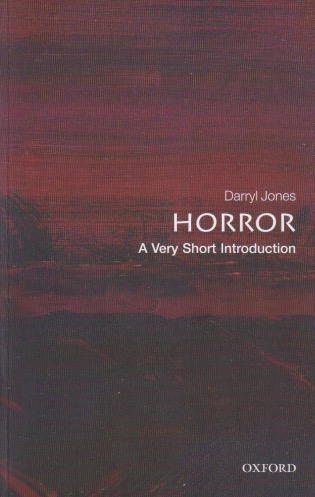
Some short books have an outsized punch.  Especially when dealing with a large topic such as “horror.”  This isn’t just horror movies, which could easily fill such a book, but also literature and other media as well.  Darryl Jones has proven himself on this topic before and this Very Short Introduction is a showcase of what is a fascinating genre.  I’ve read a number of books in this series and this stands out as one that works admirably within extreme limits—they are very short—in making good decisions about representative aspects in what is really a sprawling field of inquiry.  The introduction lays the task out well and I came away from each chapter feeling inspired.  Of course, not all of horror can be covered in less than 150 pages.  Some may find their favorite fear unaddressed, but they’ll learn something nevertheless.

In his first content chapter, Monsters, Jones focuses on vampires and zombies.  These are both forms of cannibals as they’re currently conceived, zombies being relative newcomers to most favored monster status.  His next chapter, on the occult and supernatural, takes on the Devil himself before addressing satanists, demons, and ghosts.  These are, of course, religious monsters.  Although Jones doesn’t dwell on that aspect, the close relationship is nevertheless evident.  For those of us who explore religion and horror this framing proves helpful.  It’s worth pausing here to consider how all of these entities overlap a bit.  As anyone familiar with ghost hunters knows, ghosts and demons may both be found haunted places, and the Devil is the head demon.  Of course, horror is a fiction genre but many people believe in these entities.  That brings religion and horror within the same room.

Body horror occupies the next chapter, and here werewolves come into the picture.  Other aspects of body horror are also discussed, but the painful transformation of the shapeshifter is prime territory.  Horror and the mind brings us to psychological thrillers and the gothic fear of madness.  The topic segues nicely into science, which the next chapter covers.  Not only science itself but the mad scientist.  Finally, the lengthy afterword looks at where horror has gone, and may be going, in the new millennium.  Something that struck me, and which brings this back into religion, is how frequently Darwin and evolution are mentioned.  This concept challenged the human place in the divine hierarchy and led to much of what we think of as horror.  This book is a great resource in a small package.


Whose Baby?

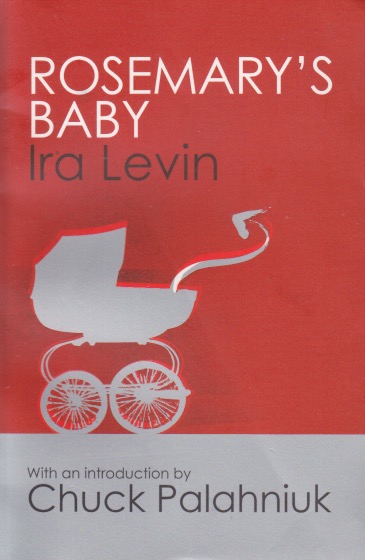
Some books are better known as movies.  I suspect that I, like many, saw the movie Rosemary’s Baby without ever reading the book.  It turns out that they’re very similar.  The book takes the action a few minutes beyond the end of the movie, but otherwise they’re quite close.  Reading a horror novel where you know everything that’s going to happen isn’t exactly the recipe for thrills and chills, but I’m nevertheless glad to have done it.  For a book published as long ago as it was (1967) it still isn’t easily found used.  New copies tend to be just as expensive as new books.  I just wanted to have a read to see if Roman Polanski stayed close to Ira Levin or not.

Levin had a string of successful novels, but Rosemary’s Baby is probably still his best known.  He is quoted as saying he didn’t believe in the Devil and felt guilty that his book (and movie) may have led to many people taking on that belief.  In many ways Polanski’s movie kicked off the age of modern horror, being released the same year as George Romero’s Night of the Living DeadRosemary, however, opened the door to horror with overt religious themes.  It paved the way for The Exorcist and The Omen.  The latter, written by David Seltzer, was another example of a movie based on the Devil by an author who didn’t believe in him.  Personal belief aside, that trinity of movies remade the horror scene and led to one of the strangest cooperations in cinematic history.

In the book versus movie scenario often there’s a clear winner.  On other occasions the movie is so powerfully made that it overshadows its novel.  Rosemary’s Baby, along with The Exorcist, tended to do so.  (The Omen was novelized from the screenplay by the screenwriter.)  I wonder if that might not be because religion pays right into cinematic representation.  The novels, after all, can take several days of reading on a normal workaday schedule.  The film, if well done, transports the viewer there for a couple of hours and leaves you feeling as if you’ve been through, in the case of Rosemary, a traumatic pregnancy.  It so happened that the unholy trinity of religious horror tapped into that rapt storytelling of which celluloid proves so capable a medium.  Still, reading the novel fills in many of the gaps and brings to mind the benefits of the written word.  And this is, like a birth, something to be celebrated.


Skin In

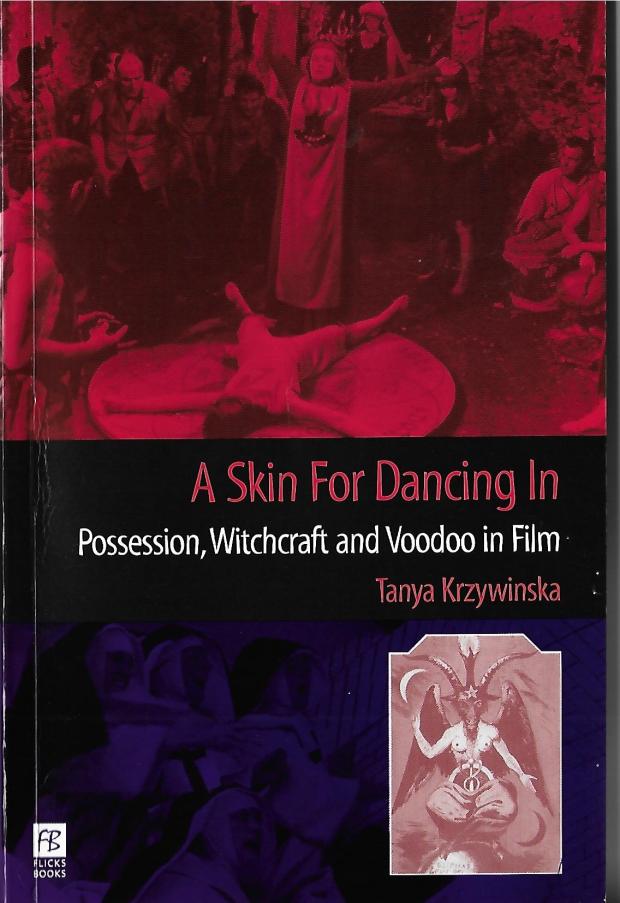
It took me back to my younger years.  Tanya Krzywinska’s A Skin for Dancing In: Possession, Witchcraft and Voodoo in Film.  Wide ranging and insightful, this book was a delight to read.  Published in 2000, it discusses many movies that I watched in the eighties and which had somehow managed to be overrun by other stimuli since then.  I like to think that, even if recall isn’t instant, that we never truly lose the books we’ve read or movies we’ve watched.  (Some we may wish to forget, but that seems a sure way not to achieve that goal!)  As her subtitle says, Krzywinska’s book analyzes possession, witchcraft, and voodoo.  Since there are so many examples of these the discussion has to be selective, but she’s got a keen eye for choosing evocative films.

As any of my regular readers know (both of you!) I don’t really review the books in my “reviews.”  I limit myself to about 500 words and I don’t like to give spoilers.  A Skin for Dancing In would require quite a few words even to summarize.  Krzywinska covers demonology, possession, sacrifice, paganism, witchcraft, voodoo, and more, in several movies.  What really struck me in reading this was that she comes to a similar conclusion to what I’ve found—people learn about these things through film.  Scholars tend not to write much about such things (although this has improved somewhat since the turn of the millennium).  The average person doesn’t read academic books, and since culture has become “rational” there’s not much talk about such things from discoursing heads.  Still, movies.

These topics make for great movies.  One of the points I’ve made in my own work is that what we know about demons comes from the cinema.  It seems that we should pay close attention to what movies tell us.  They’re the “public intellectuals” that many academics want to be.  A Skin for Dancing In is a good example—it’s compelling, if a little academic, but very hard to find.  It’s difficult to lead public discussion if your book is limited to university libraries and those who have access to them.  Of course, you don’t need a talented scholar to tell you how to watch a movie, but I was reminded here of many films I thought I had forgotten.  And what’s more, I have a deeper understanding of how they fit into the larger world of cinematic possession.  This is one of those books I wish I’d found sooner.


Religion and Its Objects

UFO religions—or should they now be called UAP religions?—have long been of interest to scholars of religion.  A recent piece on Religion Dispatches titled “With Release of Pentagon Report, UFO Narrative Belief System Is Suddenly Supported by Military Witness Testimonies,” by Diana Pasulka, explores this.  Anyone following mainstream media is perhaps experiencing a bit of whiplash on the topic since, prior to admission of interest by the government, the official stance was to ridicule the entire topic.  That’s the reason what were long known as Unidentified Flying Objects now have to be called Unidentified Aerial Phenomena.  Since a government can never admit it made mistakes, it simply changes the terminology.  My interest here, however, is in the connection with religion.

I’ve explored the connection between horror and religion from time to time—ahem—and so it is natural enough to wonder about the relationship between religion and UAPs.  (Or should I stick with UFOs?)  The two have some commonalities.  Initially, both deal with the unknown.  Indeed, the word monster comes from a root denoting an omen, or a revelation.  Something isn’t a revelation unless it’s been keep hidden.  So with UFOs.  The government’s long interest, which had been somewhat successfully hidden, allowed for a reveal.  Religions, however, tend to thrive on hidden things.  The monotheistic religions, for example, claim to inform us about what God has chosen to reveal about (generally) himself.  Even today when pushed into a theological corner, believers will appeal to mystery.  Both monsters and UFOs live in mystery.

Science prefers things out in the light.  Is it any wonder that scientists are reluctant to apply themselves and their hard-earned credentials to the UAP problem?  Those of us in religious studies generally have little to lose.  It’s not like we’ve got prestige on our side, or some billion-dollar grant riding on our reputation.  We can afford to take a look and monsters and other unknowns and see how they trigger the religious impulse.  Pasulka’s article has more to do with credibility.  UFO religions have long struggled with being considered outsider belief systems.  UFOs were publicly ridiculed, so any religion that focused on them was, by extension, laughable.  I’ve long believed that ridicule serves little purpose when it comes to belief systems.  Making fun of a mystery is less common than shaming those who believe in what we’ve been told definitely isn’t real.  Until suddenly it becomes real.  Is there any question why religions develop when mysteries remain?


Screening the Dark

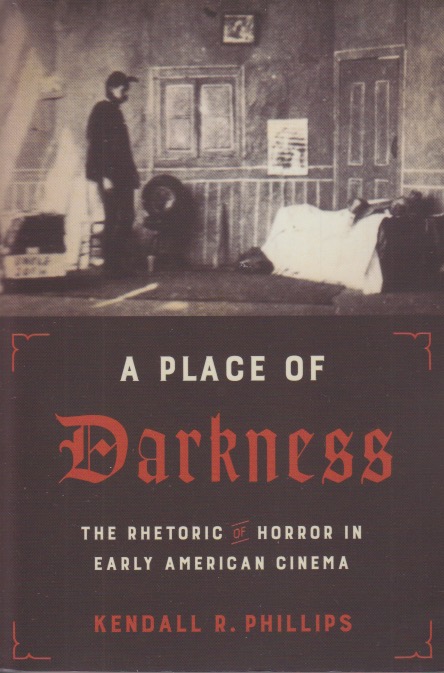
We’re spoiled.  The intensity of our media experiences makes it nearly impossible to imagine the truth of stories that viewers fainted at films such as Frankenstein even less than a century ago.  This change in outlook, this sense of being over-stimulated, occurred to me while reading Kendall R. Phillips’ excellent A Place of Darkness.  In keeping with the subtitle (The Rhetoric of Horror in Early American Cinema) Phillips primarily addresses pre-Dracula films, beginning in 1896 and demonstrates how horror themes emerged early and evolved along with society’s norms.  There is so much insight here that it’s difficult to know where to begin.  For me one of the big takeaways was how Americans at this stage were eager to appear non-superstitious and how they used that concern to keep the supernatural out of early ghost films.

Phillips isn’t afraid to address the role of religion in horror.  Other cultural historians note this as well, but many pass over it quickly, as if it’s an embarrassment.  Since my own humble books in the field of horror are based on the religious aspects of such movies, I’m always glad to find specialists who are willing to discuss that angle.  As America grew more and more enamored of the idea of rationalism, less and less energy was put into suggesting that anything supernatural might be at work.  Supernatural was considered foreign and cinema followed society’s lead.  This led to—and I want to add that this isn’t Phillips’ terminology—the Scooby-Doo Effect where every seeming monster had to be revealed as a hoax.  As a kid I watched Scooby-Doo in the vain hope that the mystery might turn out to be real.

Studies of horror films generally acknowledge that the first real member of that genre is Tod Browning’s Dracula of 1931.  Phillips demonstrates the valuable pre-history to that and does an excellent job of explaining why Dracula was such a singular movie.  Horror elements had been around from the beginning, but Browning’s film made no excuses—the vampire is real.  Audiences were shocked and thrilled by this and other studios didn’t quite know whether they should follow Universal’s Depression-Era success or not.  Mostly they decided not to.  The Universal monsters seem innocent enough today, but we go to theaters where the floors shake when heavy footsteps fall and the sound of a door creaking open comes from behind us.  Special effects make the horror seem real.  No excuse is made for religion and its monsters.  We’re spoiled. 


Electronic Ritual

Religion and horror go naturally together.  Perhaps that’s something I instinctively knew as a child, or perhaps it’s something only mature eyes see.  It’s clearly true, however.  While reading about The Wicker Man lately I felt compelled to read David Pinner’s 1967 novel Ritual, upon which the movie is loosely based.  In many cases it is better to read the book before seeing the film.  In other cases the movie ends up being the superior project.  I had to keep on reminding myself as I read the novel that it couldn’t be measured against a superior vision of what it could have been.  Having written seven novels myself (all unpublished) I hope that I have a sense of the process.  Unless you’re into the commercial side of things you don’t write for the movie potential—you have a story to share and this is your way of telling it.

The novel isn’t bad.  It’s written in a punchy style that I don’t really enjoy, but the story drew me in.  It almost wasn’t to be.  Like many novels of this era, print copies are difficult to find.  Those available on used book websites, or even on Amazon, probably because of rights agreements, sell for over $200.  That’s a bit much, considering that over two dollars per page is excessive for a novel.  I finally had to cave and get a Kindle version.  I don’t have a Kindle, but I have the software on my computer.  Reading it again reminded me of how superior a print book is to an electronic one.  Reading ebooks tends to be faster but like eating snack food, doesn’t really satisfy you.  

At one point the navigation function stopped.  Confused, I couldn’t go any further in the story and wondered if I’d reached a sudden but unexpected end.  With a physical book I could’ve paged ahead to find out.  In this case, with the controls frozen with that obdurate computer attitude, I had to find another way to make the illusion of reading continue.  I eventually got it going again after clicking here and there, but reminded myself again that ebooks should only be the last resort.  As for the story itself, it was okay.  I read it as a parable about intolerant religion.  I’m not sure it was intended that way, but it certainly seems like a reasonable interpretation.  It ends differently than the movie does, so I won’t put any spoilers here in case you decide to spring $200 to get a used copy.