Fear of Spiders

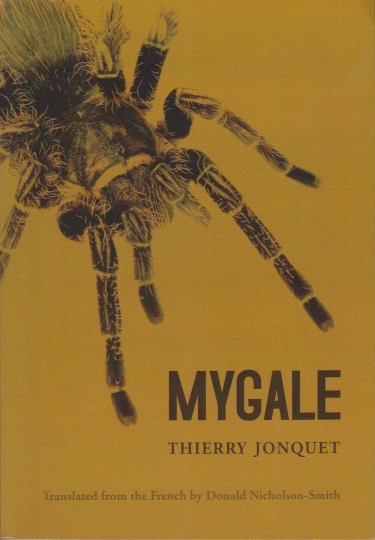
To anticipate, “mygale” is French for “tarantula.”  I learned about Mygale, also published under its English translation, or else Serpent’s Tail, from a Goodreads review.  It’s increasingly difficult to find good, short books.  I knew little about it other than it is a “thriller” by Thierry Jonquet.  The book contains one of the most cleverly drawn plots I’ve encountered in some time.  I also believe it could slip into the horror genre.  I’m reluctant to say much because the pieces are revealed so intricately that to summarize would be to ruin the effect.  I will say that if you’ve seen The Skin I Live in you know the basic idea already.

I will opine that this story demonstrates that a book need not be excessively long to be a good novel.  Some of us appreciate the economy of language that illustrates Pascal’s famous quote, “I have only made this letter longer because I have not had the time to make it shorter.”  My first relatively descent novel was about 230,000 words, or, in other words, well over 400 pages.  The publishers I half-heartedly queried said it was too long.  When writing short stories I quickly learned that many journals only take them if they’re under 3,000 words, some only under 2,000.  As a result, I began writing short.  That’s not exactly true.  I write the story as I want to tell it, then I cut it down.  Again and again.  Short seems to be the fashion in the internet age.  Ironically, the books on my too read shelf all seem to be quite long.  That’s why I decided to give Mygale a try.

I’m glad I did.  The story may not be for the most squeamish, but it’s certainly not blood and gore.  It’s a little confusing at first, but it comes to make sense.  And the ending is somewhat satisfying.  It’s not happy by any means, but it’s well told.  Some classify it as science fiction, but there’s nothing too impossible about it.  It’s set in France around the 1980s.  No space ships or ray guns to be seen.  Genres can be tricky in the face of creativity, but the final act, if you will, reveals this to have been horror all along.  Well, I hope I’ve been able to give a sense of this book without giving any spoilers.  Talking around a subject comes with years of classroom experience, I guess.  I will say the spider isn’t literal.


One Another

Like much of the other information that I’ve managed to pick up in these six decades of wandering the planet, my knowledge of horror is self-taught.  In truth, I’m an eclectic reader—my various, periodic obsessions generally stem from books I’m writing.  For my unwinding time, however, horror stories seem to do the trick.  Nobody I know in person reads horror, so my recommendations are generally the results of other books I read.  That’s how I found Thomas Tryon’s The Other.  Although I’d only learned of it recently, it has been a classic in the field for many decades.  After having read it, I can see why.  And unlike many fiction works with an afterword, this edition has one worth reading.  Maybe you’re unfamiliar with the novel?  If so, in brief, it’s about twins.  It’s about twins.

Identical twins.  Holland and Niles Perry were born over the cusp of midnight, giving them different birthdays while still being the same age.  Unlike stereotypical identical twins, however, Holland is evil and Niles is good.  As the novel unfolds it contains some twists that, if like me you haven’t heard the story, really do work.  They live in a small town in Connecticut with their widowed mother, older sister and brother-in-law, maternal grandmother, and a couple of domestics.  An aunt and uncle, along with a cousin, settle in.  (It’s a large house.)  Family dynamics are strange and the locals grow increasingly impatient with Holland’s antics.  The Perry family is, however, long established and well respected.

Doesn’t sound very scary, does it?  That’s the genius of the work.  It’s a slow burn but when the fuse reaches the powder it leaves you trembling.  Nobody taught me how to find and read horror.  I’m still pretty much a novice and it seems that novels these days tend to have weight problems.  I was glad to find The Other wasn’t excessively long.  It shows that literary horror is possible as well.  Like Shirley Jackson, Tryon received acclaim for his work.  (And like Jackson, his novel doesn’t balloon out to over four hundred pages—something of a rarity these days.)  I guess I’m just a bit surprised it took so long for me to find out about this one.  I don’t want to give any spoilers because this is a beautifully constructed novel and knowing what happens might deter other readers.  I wouldn’t want to do such a disservice to a book I wish I’d known about when I was younger.