Grotesque and Arabesque

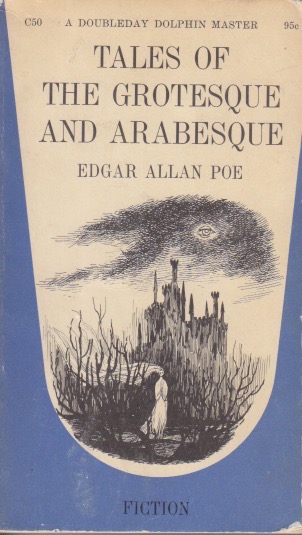
My last post about Edgar Allan Poe’s Tales of the Grotesque and Arabesque led a couple of readers pointing me to places where the missing tale (“The Visionary”) could be read online.  That fact is beside the point.  I have sitting next to me an omnibus edition that contains, in print form, all of Poe’s tales and poems.  Poe deserves to be read in print.  No, the point of that previous post was that I wanted to read a print version of Tales of the Grotesque and Arabesque through so that I could observe a couple of things: the stories Poe thought his best at the time, and to read several Poe stories I never had.  Also, it was an exercise of ratiocination.  So I found a used copy online that contains the full contents, unaltered, of the original printing.  Such a book may be still in print, but given the constraints mentioned in my previous post, it cannot easily be found.  So on to the stories.

A great number of the stories contained herein are funny.  Poe was quite capable of humorous writing.  Some of the stories verge on science fiction.  Others demonstrate his incredible breadth of reading.  He wrote smartly about ancient history—fictionalized, of course—and about astronomy.  He wrote a story about the end of the world, which adheres, in some measure, to the “biblical” account known even in his day.  The stories are erudite and often obscure.  They are seldom read, or at least discussed among Poe’s horror tales.  I’ve been pondering horror as a category quite a lot as of late.  It’s clear that during his lifetime Poe was not a “horror writer” as we know such authors today.  He was a brilliant, and imaginative interrogator of the world in which he lived.  Reading this book all the way through was an epiphany.

Poe’s writings are in the public domain.  There are websites, easily found, where all of his stories may be located for free.  There are some writers, however, that I believe have earned the honor of being read as they were published—on paper.  Until recently I had only a couple of editions of paperbacks of Poe’s stories.  They were mostly tales I had read multiple times, here and there.  I even break out the omnibus edition now and again when I want to read one of his stories that aren’t in the other collections.  Tales of the Grotesque and Arabesque has expanded my view, which often happens when I read Poe.  And that is a high compliment to any author, just like reading them in paper form.


Book or Movie?

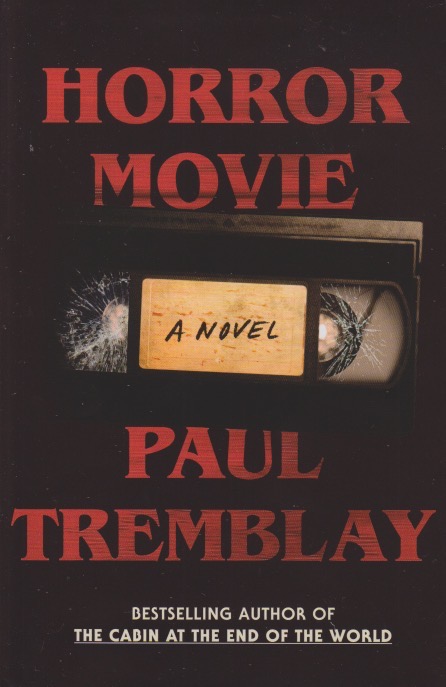
I’ve read a few of Paul Tremblay’s novels.  He’s a horror writer with literary style—often a tough sell (at least in my experience.)  Horror Movie is a compelling read.  The conceit is that a group of young people decide to film, well, a horror movie.  Things go awry, but not in a funny way.  The story unfolds interlaced with the screenplay and with the overlay of the modern remake in the works.  It’s easy to get lost between the narrative account of what happened in the original shoot and what’s happening in the script.  Tremblay uses this technique very well, blurring the reality and movie aspects in a way that’s got to be intentional.  I particularly like his asides about the redeeming value of monsters.  I won’t say too much about the plot since you may want to read it yourself. It does riff on the “cursed movie” trope.

The truly remarkable thing to my regular readers will be that I finished a new book within a month of publication.  Normally I run a couple to several years behind.  And this novel contains several winks and nods to other horror movies.  It pays to know the canon.  In that sense, it reminds me of the movie Scream, one of the more self-aware horror classics.  (I have had Scream out for watching again for several weeks now, but time has a way of slipping away.)  Tremblay, like Stephen King, taught before becoming established as a horror writer.  Maybe there’s hope for some of yet!  I started writing novels in middle school—perhaps there’s still time.  That seems to be one of the themes of Horror Movie, by the way.  It has many elements of a parable.

I found Tremblay’s first horror novel, A Head Full of Ghosts, about four years after it was published.  Indeed, I was working on Nightmares with the Bible at the time, so a book about possession was appropriate.  Horror Movie is more a monster tale but it’s also about movies and reality.  This is territory I often traverse since, it seems to me, movies are more than mere entertainment.  Good ones are, anyway.  And like some other books I’ve read lately, this one is also a reflection on fame (something I wouldn’t know about).  How it’s not what it’s made out to be.  In other words, if you’re willing, Horror Movie is the kind of novel that will make you think.  I appreciate that Tremblay is giving us thoughtful horror and I’m looking forward to trying to keep up.


Paperback Reader

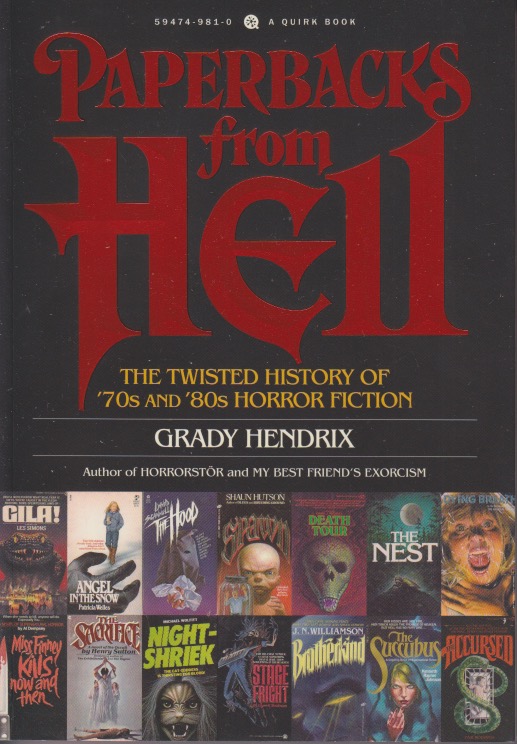
Sometimes I wonder why I do it.  Horror is a strange category for books and films, but one thing that may be a draw is that they take me back.  Life, it seems, is cyclical.  I liked monsters as a kid, and grew out of it when college and graduate school taught me to be serious.  As a working academic this genre can spell death to your career, so when my career died anyway, I was left grasping at my childhood to try to make any sense of this.  Grady Hendrix’s Paperbacks from Hell took me back.  Not that I’ve read all the books listed here—I came away with a list I want to read—but the lurid covers are a reminder of the kinds of things that caught my young imagination.

Subtitled The Twisted History of ‘70s and ‘80s Horror Fiction, this is actually a very fun book to read.  Hendrix has a light touch and had me nearly laughing out loud (quite an accomplishment) a time or two.  And I learned a lot.  Although I write books about horror, the genre is a large and sprawling one and this book takes a clear focus at the paperback market.  Just a reminder: paperback originals were designed to be sold and consumed quickly.  No waiting around for 18 months while profits from the hardcover roll in.  Hendrix really knows what he’s talking about when it comes to the history.  It also seems like he may have read more horror than is necessarily good for you.  He clearly knows how the publishing business works.

Several of these books were big enough that I knew about them.  He starts off with Rosemary’s Baby and The Exorcist.  (And The Other, which I’m now obligated to find and read.)  In fact, the first chapter focuses on religion-themed horror.  This is something that only began in earnest in the late ‘60s.  While the horror paperback market may have tanked in the ‘90s, the film side of the genre has been doing quite well and continues to do so.  The late sixties also got that kick-started.  It seems that when people stopped running from the fact that religion is scary, horror itself grew up.  I was shielded from that part as a child, but now, looking back, I can see that things weren’t quite what they seemed.  This full-color, grotesquely illustrated book has great curb appeal.  And if you’re not careful, you can learn a thing or two as well.