At the Same Time

The philosophically adept movies by Justin Benson and Aaron Moorhead can be addicting.  At least for a certain kind of viewer.  These are independent films and they’re smart and worth the effort of tracking down.  Often they fall into both sci-fi and horror, but generally horror of the existential variety.  And they have social commentary.  Synchronic is gritty, delving into drug culture (as some of their other movies do as well) and taking its title from a fictional drug.  Synchronic, the drug, distorts the taker’s sensation of time.  If the user is young—their pineal gland hasn’t calcified—the drug physically transports them to the past.  Adults only experience it as ghostly images rather than physical displacement.  Two EMTs, Steve and Dennis, keep finding victims of the drug.  Steve is a black man with brain cancer that keeps his pineal gland from calcifying.  Dennis, a family man, loses a daughter to synchronic—she gets lost in time.  Steve decides to save her.
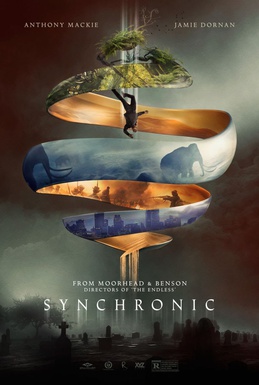
Here’s where the social commentary really kicks in (although it’s been there from the beginning).  A black man traveling back in time in Louisiana is at a distinct disadvantage.  Dennis is white but his brain won’t allow him to travel back physically.  Not only that, but it was Steve who took the initiative to find out how the drug works.  You spend only seven minutes in the past, unless you miss being in the right place when the drug wears off.  If you miss the return, you’re stuck forever in the past.  That’s where Dennis’ daughter is.  She’s caught in New Orleans in 1812.  Louisiana was, of course, a slave state.  Steve faces enslavement if he doesn’t make it back in time.  I won’t say how it ends, but it leaves you thoughtful.

Many “white” Americans feel that Black Lives Matter is too “woke” for them.  They seem to think everything is now free and equal.  It isn’t, of course, and those who are willing to look see that African Americans have an extra layer of struggles that they constantly face.  The movie addresses this as well.  When assisting an overdose victim after he misplaced his uniform, Steve is mistaken for a criminal by the police at the crime scene.  This despite the fact that the white officer who initially detains him, knows him.  A black man out of uniform must be up to no good.  I can’t believe that I went so many years without knowing about Moorhead and Benson movies.  Be careful if you start watching them—they can be addicting.

Shopping Trip

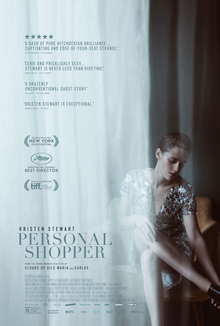
Personal Shopper is one of those movies I’m not sure I understood, but which was nevertheless profound.  It didn’t help that it was one of those “free with commercials” movies that interrupted a dense storyline just when I needed to be concentrating.  How did we ever survive growing up with commercial television as our main vehicle for movies?  This is a subtle, psychological ghost story set mainly in Paris and involving a young woman, Maureen, who is the titular personal shopper, but who stays in Paris to try to contact her fraternal twin brother’s ghost.  Her dead brother’s widow is helping her, but the wealthy woman for whom Maureen’s the personal shopper is demanding and has strict rules about how her expensive clothing and accessories are to be handled.

The film is moody in the way that I find effective, and it’s not fast-paced and full of action.  It’s more contemplative and a couple of plots are woven together so that I suspect I’ll need to see it again to try to fit it all together.  It’s also a movie that intertwines religion with horror.  In this case the religion is primarily Spiritualism.  Maureen, in addition to being a personal shopper, is a medium like her brother was.  Before he died he promised, like Houdini did, that he would try to return and leave a sign so that Maureen would know for sure about the afterlife.  She has glimpses of a spirit entity, but isn’t sure it’s him.  Meanwhile, her boss’s lover scams Maureen into believing he’s a ghost by texting her cryptic messages from an unknown number.

There’s no question, following the straight narrative of the film, that there are ghosts.  What’s uncertain is who they are and whether they can be trusted to reveal the truth.  Mostly shot in autumnal Paris, the gray skies and threat of rain complement the eerie feeling the story generates.  It ends in sun-drenched Oman, however, making for a stark contrast with what has gone before.  If my description here is confusing take that as a sign of the depth of this film.  (Or simply judge me a   poor writer.)  In either case, Personal Shopper, which was recommended to me, is a movie that hangs on after it’s over, leaving you wondering about any number of things.  The acting is compelling and there’s a melancholy about the movie that’s rare but also becoming.  I’ll need to see this again some rainy day, hopefully without commercials this time.


Funny Scares

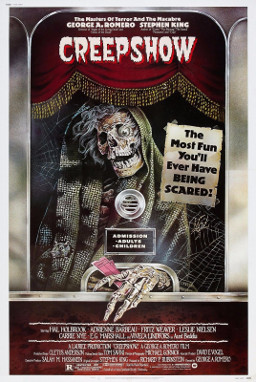
Camp has its own aesthetic.  I’m not talking about the kind with tents and sleeping bags, but that has its own aesthetic too.  No, I mean campiness in pop culture.  Creepshow, which was released in 1982, has maintained its value as camp and you pretty much still have to pay to see it (at least it’s free not on any streaming services I use).  For an episodic film it’s not bad, and since it’s comedy horror it won’t keep anyone up at night.  And of course both Stephen King (who wrote the script) and his son Joe (future horror writer as well), appear in the movie.  The elder King in a charmingly overacted segment based on one of his short stories clearly influenced by H. P. Lovecraft.  Put this all together with direction by George Romero and a cast including Leslie Nielsen and you’re in for a fun afternoon or evening.  (Or morning.  I won’t judge.)

It’s definitely a period piece.  The attitudes are those of the late seventies and early eighties.  That fact underscores, for me, how media affects everything.  Cultural outlooks change periodically and the more we know about what other people think, the more quickly they change.  Of course, since this is camp you can’t take it seriously.  And yet you somehow do.  The first vignette is, appropriately, holiday horror.  It has to do with Father’s Day which is, I suspect, a holiday to which most men acquiesce rather than anticipate.  This story is about a dad who takes it too seriously and a daughter who takes it too far.  Until…

The plots of all the stories are comic booky, and they contain many of King’s early themes.  “Something to Tide You over” is probably the most disturbing of the tales, at least by implication.  It reflects some of King’s fears as presented in some of his short stories but the method of execution is particularly distressing.  The comic book ending, however, shows it’s all for fun.  The prologue/epilogue reflects, I expect, the experience of many of us growing up.  I remember having comic books to which my mother objected because they were “too scary” for young boys (in our context).  I even recall her trying, and perhaps succeeding, to take them away and put them in the trash.  This is a situation as old as media for children.  The brothers Grimm knew just as well as King does that kids like scary stories.  Some grow out of that.  And others of us find a couple hours to watch Creepshow as an adult.  At least those of us who enjoy camp.


Reframing

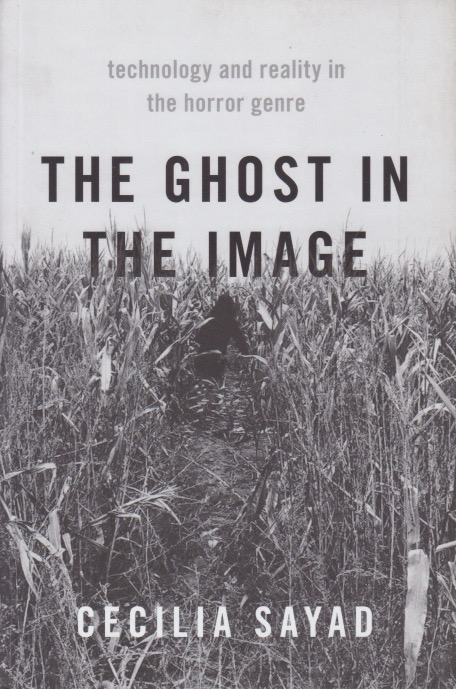
Theory can be tough to stomach, but once you get through it you can often find all kinds of valuables in an academic book.  I learned quite a lot from Cecilia Sayad’s The Ghost in the Image.  It’s a brief but powerful book.  One of the under-explored areas of life is how our inventions affect reality.  We invent things and they change us.  Photography is one of those inventions and it seems like we should step back for a decade or two and try to figure out just how it’s remade reality.  Sayad explores that specifically in the realm of horror.  Not just movies, but other technology associated with images (and even other senses).  She makes the case that the frame that separates an image from the “reality” outside the frame—think of going to an art museum and how the frame sets a painting off from the “real” wall behind it—has become permeable.  Thus the theoretical part.

Applying that principle to horror, she has fascinating chapters on Amityville and Enfield, the found-footage fictions of Paranormal Activity, and the Slender Man meme.  She also discusses spirit photography, which is really the precursor to the horror film, and what used to be called video games.  I’m not a gamer, I’m afraid, and I’m sure I’m missing out on some culture because of it, but researching and writing books beyond work takes up quite a bit of time.  In any case, the amazing thing is that Sayad does all this without judging.  She doesn’t say that ghosts are “real” but she doesn’t say that they’re not.  Part of the reason for this is that reality is part of the quest here.  We define reality partially (largely) through our technology.  Would politicians become “celebrities” without photographic media?  They’re hardly the cream of the crop anymore (let’s be honest here).

So this book left me thinking.  Imaging technology invents, instigates a new reality for creatures as visually oriented as our species tends to be.  Sayad also explores how other senses are brought into this—sound, most obviously, for movies—and help to confirm that reality.  Theaters have toyed with touch and smells to widen the diegesis of the movie (taste is a bit trickier), each layer brings the image further outside the frame.  The internet has, of course, only accelerated all of this.  The fact that horror is the genre that perhaps best lends itself to this kind of impact on society is, in itself, a telling point.  I need to step back for some time and ponder how this all fits together in what I perceive of as reality.


How Many Stairs?

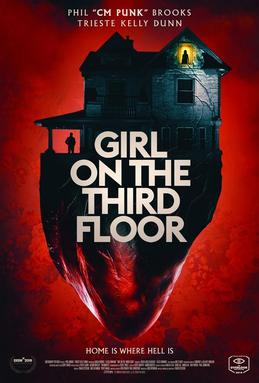
It tries.  It really does. Still, The Girl on the Third Floor is just not that good.  It got quite a few accolades, but I was waiting for something extraordinary.  It seemed to fall down on two counts—the writing isn’t very good and we’re allowed to build very little sympathy for the protagonist.  If you can’t feel for somebody and the dialogue does only light lifting, what’ve you got to go on?  Some critics suggest that if you know the star (Phil Brooks) and his persona you’ll appreciate it more.  That must be a problem for many movies where baked-in personalities are counted on—early Disney used to do this to make cartoons attractive to adults.  If you don’t know them the appeal evaporates.  In any case, a couple buys a house. He (Don) goes to renovate it while she (Liz) works to support them.  The house used to be a brothel and Don has no problem cheating on his wife when a hot ghost shows up.

The reason I watched the movie was the connection between horror and religion.  The first person to check in on Don is Ellie Mueller, the pastor of the church across the street.  She’s simply identified as “Protestant” and she drinks bourbon and swears, so it’s fair to guess she’s not Baptist.  In any case, she warns him about the house but ever confident, Don carries on.  Later, as all the ghosts come out and Liz shows up unexpectedly, Ellie shows up again.  This time she advises Liz to leave but she frames the evil of the house as a matter of choices.  Don (who succumbed to the ghosts) consistently made bad choices in order to get what he wants.  Liz and Ellie, however, think of others.  In that sense there’s a parable here.

The haunted house tropes have mostly been seen before.  Some manage to be a bit freaky, but many of them don’t really shock.  Or maybe I’ve seen too many movies for them to have an impact.  The heavy metal soundtrack is a bit—ahem—heavy-handed.  Using marbles as weapons is a little unexpected and angry ghosts often make for effective monsters.  Still, these seem to succumb to a sledge hammer pretty easily.  One of them keeps coming back, however, and one is more a monster than a ghost.  In any case, there was real effort here.  For my taste, however, good writing can cover a multitude of sins.  And it really helps if you sympathize with the main protagonist, even if just a smidgen.


Lights, Camera

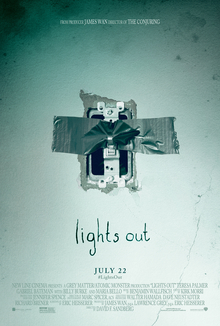
I’m not quite sure how the monster in Lights Out should be classified.  Perhaps a tulpa?  A tulpa is a materialized being brought about by the power of thought, and at the end this seems to fit.  But I’m getting ahead of myself.  Rebecca and Martin are half-siblings.  Their mother Sophie has abandonment issues—I knew this was getting into personal territory here, but I kept watching.  Rebecca’s father had left when she was young and Martin’s father is killed in the film’s opening scene.  But there’s a monster who’s responsible for all of this.  Rebecca, it seems, fears attachment.  Her boyfriend Bret, however, is faithful and devoted.  All of them are threatened by the entity Diana, who can’t stand light.  She can only be seen in the dark.  She is the one who killed Martins’s father (and possibly Rebecca’s).

This intriguing premise is tied in with the idea of mental illness.  Sophie, the mother, spent some of her early years in a mental hospital being treated for depression.  It was there that she met and befriended Diana.  Diana died, but not before insinuating herself into Sophie’s mind.  This is why a tulpa suggests itself.  A woman who fears abandonment conjures an entity who ends up developing its own agenda.  Diana doesn’t want anyone to discover who or what she is.  Such knowledge would offer a way of treating Sophie’s mental illness that might prevent Diana from existing in her mind.  This is pretty sophisticated stuff.  Not only that, but the movie plays on the very natural human fear of the dark.  It makes you want to turn on all the lights.

I won’t spoil the ending here, but I will say it’s disturbing.  I also think that it’s important to note how mental illness here is implicated as a kind of strength.  Sophie felt abandoned and created a means of feeling accepted.  If, however, Diana was really a separate entity inhabiting Sophie’s mind then we have here a form of possession.  I don’t know of anyone who’s parsed movie monsters to so fine a degree but it seems to me a project worth undertaking.  I’m not suggesting science should be used to appreciate horror films—there is a science of studying monsters, called teratology, but its use in the mainstream has come to mean something different—yet we can use scientific methods to treat our various fears.  We do tend to find light from looking at and understanding what exactly our monsters are.  


Not Resolved

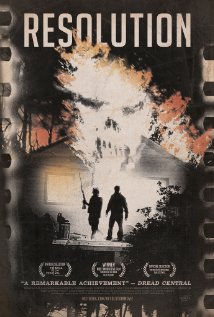
Some movies are intentionally mind-blowing.  Knowing the kind of movies I like, a friend suggested Resolution with the enticing note that it is free on Amazon Prime.  Since anything free is worth saving up for, and since I was having trouble staying awake on a warm, wet Sunday afternoon when the lawn couldn’t be mowed, I gave it a try.  Even after it was over I wasn’t sure what I’d seen, but I was glad that I had.  Part of the draw is how convincing the acting is.  Another is the bizarre nature of the threats.  Like Sinister (also released in 2012), Resolution involves found media that tell a disturbing story.  Only in the case of Resolution it’s set in a remote part of an Indian reservation and it involves a drug addict and his friend who’s attempting an intervention.

With the addict handcuffed to a pipe, his rescuer encounters a strange set of people in the area and has bizarre media delivered to him by an unknown party.  In fact, he goes to his friend because of a video emailed to him by the addict.  Only the addict didn’t send it.  The media (records, color slides, video tapes, computer files) tell increasingly strange stories until the media also begin to show the two friends almost instantaneously.  A stoned French researcher tells the rescuer that there might be some time-space dislocation here, or there may be a monster.  Reluctant to release the addict until he has several days to get the drugs out of his system, the friend attempts to figure out what all this means.  Then the media begin to show their short-term future.

I won’t say how it ends, but I will say that the title Resolution is well-chosen.  This is a very creepy movie.  A remote location where things just don’t seem right and the conviction that just a few days will save a friend’s life but only if they stay in place is a great concept.  In many ways it’s a movie about stories.  The resolution is the end of the story and that’s something that’s successfully kept up in the air throughout.  Anyone who writes stories knows the feeling of writing yourself into a corner.  Playing around with space-time opens up possibilities, however, corners or not.  I can’t say that I understood everything that was going on here, but it was edgy enough to keep me alert, even on a muggy, drowsy Sunday afternoon.


Ghoulish Night

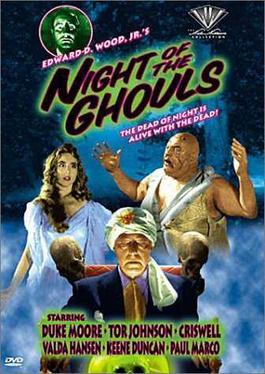
Night of the Ghouls, I like to think that even as a child I would have opined, is a bit silly.  It does show improvement over some of Ed Wood’s other films and the plot is really no more harebrained than some movies I did watch as a kid.  I’ve been trying to figure Wood out.  He was apparently incompetent, but he had no formal training and that could explain things a bit.  He was also creative.  This film is broadly a sequel to the worse Bride of the Monster.  Although only a couple of characters appear in both films, there is quite a bit of reference to the earlier story.  There was a mad scientist who made monsters.  The house burned down (actually an atomic explosion in the former), but someone—no-one knows who—rebuilt on the same location.

In a typically convoluted Wood plot (he wrote as well as directed the film), a bogus necromancer (who is actually, without knowing it, a really powerful necromancer) bilks clients out of their money by raising their dead loved ones for a few minutes.  He keeps the police and others away by having his young female assistant pretend to be a ghost outside the house.  But then she runs into an actual vampiric ghost who’s killing people who wander onto the property.  The police eventually decide to investigate and prove themselves as incompetent as the writing for the film.  They do manage to put an end to the fraudulent seances but it’s up to the real raised dead to put an end to Dr. Acula and his assistant.  At least there’s no atomic explosion at the finish.

The film, in Wood style, is black-and-white and the props are cheap and not really convincing.  A bit of the movie seems to have been intentional comic relief.  It doesn’t really work as a horror film because there’s nothing really scary about it.  Wood was a lifelong fan of horror movies, but fandom doesn’t always equal the ability to replicate the object of desire.  There are several possible horror atmospheres—Poe horror is quite different from Lovecraft horror, for example.  Wood seems to have been unable to strike a vein, however, that was close to an authentic horror feel.  The Scooby-Dooesque role of the necromancer doesn’t really help, I’m afraid.  Still, for fans this is vintage Ed Wood work.  I can’t claim to have figured him out, but if you’ve a hankering for a bad movie, this isn’t a horrible choice.


Forgetting Witch

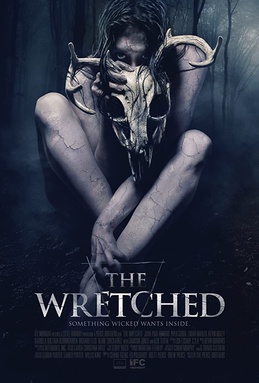
Being forgotten.  Isn’t that one of our greatest fears?  We want to be remembered, our desperate “Kilroy was here”s scribbled on the impermanent earth.  This is the fear that’s at play in The Wretched.  This fairly low budget horror film came to hold the record of being a box-office top earner for six consecutive weeks in 2020.  This was a technicality, of course.  The pandemic was in full swing and other major motion pictures were put on hold.  The Wretched played on, earning little, but more than other films.  It’s not a great movie, but it’s not a bad one either.  It all has to do with what might best be called a “witch.”  In reality, the monster is based only in part on witch traditions, but the twist is this monster makes you forget the people she takes as her victims.

The story hinging on an impending divorce and a somewhat rudderless young man being sent to live with his father in Michigan while his parents sort things out.  Ben, the young man, notices the neighbor’s young Goth wife, but something’s strange about her.  While in the woods, she and her son encountered the monster—revealed as a witch by the occult symbol carved into a tree near her den.  She steals the family baby (you’ll probably hear echoes of The Witch here, and you wouldn’t be wrong) and the family forgets there was a baby.  She then takes over the body of the mother.  Ben spies on them, Rear Window-style, when he’s not at work.  Soon the older son of the couple is missing, and the father claims they have no children.

Ben, while starting a romance with Mallory, a girl from work, pieces together what’s going on, but nobody believes him.  The problem is the missing persons are all forgotten.  To me, anyway, that was the scary part.  Ironically, while not literally so, the movie itself has been forgotten.  We all remember those days of panic in the spring of three years ago.  Long days when we didn’t leave our homes because some killer virus was rapidly spreading and the leader of the country simply didn’t care.  Those who released movies (or published books) in 2020 know that their work was quickly forgotten.  People had other things on their minds then.  I still don’t quite get why it’s called The Wretched, unless it’s perhaps those who are forgotten.  If so, the movie may become a parable of the many creative works that emerged during a time when our collective mind was clearly elsewhere.


Striving for

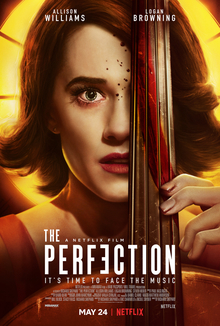
Get Out! was Allison Williams’ first feature film starring role.  Playing the unsuspected villain, she was incredibly believable.  Then I saw M3GAN where her role was again not exactly that of protagonist.  Curious, I decided to watch The Perfection, the horror film between the two in which she also stars.  As always, she starts out looking innocent enough, but this film has so many twists that you might be left feeling a bit dizzy when it’s over.  Williams plays Charlotte, a gifted cellist at the prestigious Bachoff Academy.  Forced to leave by her mother’s stroke, Charlotte became a full-time caregiver, leaving her promising career behind.  She’s superseded by Lizzie, whom she meets in Shanghai as the two are judging a scholarship contest for a new Bachoff student competition.  Lizzie and Charlotte hit it off and travel across China together.  Lizzie, however, falls ill and has to have her hand amputated.

A flashback reveals Charlotte tricked Lizzie into that situation so that the Bachoff star cellist would no longer be useful to the academy.  Another flashback shows why: Anton Bachoff has devised a horrid punishment for making mistakes while playing.  While this is disturbing enough, it takes place in “the chapel”—a room designed with perfect acoustics—and is done to please “God.”  This set-up has been operating for years and Charlotte was rescuing Lizzie from it, albeit in a rather extreme way.  The two cellists team up to bring Anton down.  There are quite a few holes in the plot and rape revenge films are one of the kinds I tend to avoid.  Still, the integration of religion with the horror is intriguing here.  One of the opening establishing shots is a close-up of a crucifix.  Sacrifice is indeed a theme of the film.

Critical opinion was mixed, but mostly positive.  The plot twists get you thinking that Williams is again playing the unexpected villain, and in a way she is.  Still, the real villain is a man who manipulates religious rhetoric (God demands perfection) in order to supply him with access to talented young women.  When they achieve international stardom, they’re not inclined to join #MeToo and lose everything because Anton is not only wealthy, but highly respected in classical music circles.  This is an odd sort of horror thriller that works on some levels but that leaves you feeling violated on another.  It doesn’t play out the religion element in any detail, which would’ve been helpful.  At least it would to a certain kind of viewer, who’s trying to figure out how this all fits together.


Creepy AI Doll

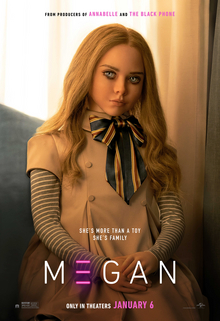
We’ve all seen the killing doll horror movie before, of course.  Who hasn’t?  What makes M3GAN different is the whole artificial intelligence angle.  Okay, so you understand it’s about a killing doll, but unlike Chucky or Annabelle, M3GAN has a titanium frame and a super-advanced, wifi-connected brain.  Like generative AI, she’s able to learn on her own and even able to use her own reasoning to get around her basic programming.  Now, you’re likely smarter than me and I didn’t catch what the critics call the “campiness” to the film.  Yes, there are places that made me snicker a little, but although the killing doll premise made the results somewhat predictable, I watched it seriously.  Some websites list it as horror comedy, while others prefer sci-fi thriller.  Nevertheless, it isn’t really that funny.  And there’s a cautionary element to it.

Funki, a Seattle-based toy company, is always trying to stay ahead of the competition.  Animatronic toys are the rage, and Gemma (brilliant choice to have a female mad scientist here) is a visionary programmer.  She wasn’t expecting, however, to become her niece’s guardian after Gemma’s sister was killed in an accident.  The M3GAN prototype was already underway, but Gemma kicks it into high gear to help make up for her own lack of parenting skills.  M3GAN becomes her niece’s companion—soulmate, even—and since the two are bonded with biometrics, her protector.  Bullies, lend me your ear; you don’t want to mess with a girl who has an android as a bestie.  And nosey neighbors, fix that hole in your fence.  Or at least curb your dog.

Instead of I, Robot this is more like You, Robot.  There is a wisdom to the othering that goes on here because none of us know in what kind of reasoning generative IA might engage.  In real life computers have been discovered communicating with one another in a language that their programmers couldn’t read.  We’re all biological, however, and thinking, as we know it, involves many biological factors.  Logic is part of it, but it’s not the whole story.  So techies who idolize Spock and his lack of emotion feel that they can emulate thinking by making it a set of algorithms.  My algorithms lead me to watch horror films out of a combination of curiosity and a need for therapy.  Where does a computer go for therapy?  The internet?  Well, you might find some good advice there, but don’t be surprised if it comes at you with a paper-cutter sword in the end.  You’ve been warned.


Pagan Fear

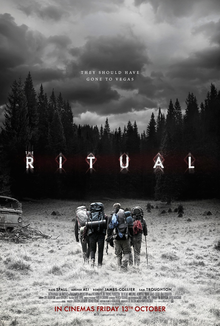
We still fear pagans.  Religion and horror are often tied up together, but when it comes to monsters we trust Catholics and fear pagans.  Of course, when Startefacts recommended The Ritual it was in the context of five pagan horror movies you should see.  I’d seen three of the others, so The Ritual seemed the next logical step.  Four friends are hiking through Sweden to honor the wishes of a fifth friend killed during a robbery.  When one of the them injures his knee, they decide to take a shortcut through the forest where a combination of the Blair Witch Project and Midsommar and Antlers takes place.  After finding a freshly gutted elk in a tree, they take shelter in an abandoned cabin surrounded by runic signs on the trees.  Soon they’re being hunted by a huge creature they can’t see clearly.

The final two are captured by a pagan group that worships one of the Jötnar—the monster that’s been hunting them.  The final boy escapes by getting out of the forest, where the Jötunn can’t go.  The choice of a Germanic monster is a bit different, and the creature design is fascinating.  Jötnar apparently straddle the line between gods and monsters, being a kind of frost giant.  The pagan group sees it as a deity that keeps them safe in return for sacrifices.  Given the number of bodies in the trees, other hikers had decided the shortcut was worth taking in the past.  But still, the pagans are cast as the bad guys.  This is in spite of the fact that the friend whose death started the whole thing was killed in England.

The religious convictions of the English robbers aren’t made clear, but they were raised in a Christian context and are every bit as brutal as the pagans.  In fact, the pagans, although they sacrifice strangers, do try to talk kindly to them (at least if they have the mark of the Jötunn on them).  Not just the pagans are savages.  At least they have a moral reason for what they’re doing, in their own minds.  The criminals are in it only for themselves.  We still fear those of other religions, although they’ve come to their beliefs in a way similar to how we’ve come to ours.  Whether born into it or converted, believers generally come to their conclusions honestly.  In the world of the film, this Jötunn is real.  And, until the end, it protects those who worship it.  So yes, this is a pagan horror film, but it makes the viewer wonder whence the horror really comes.


Whither Wicker?

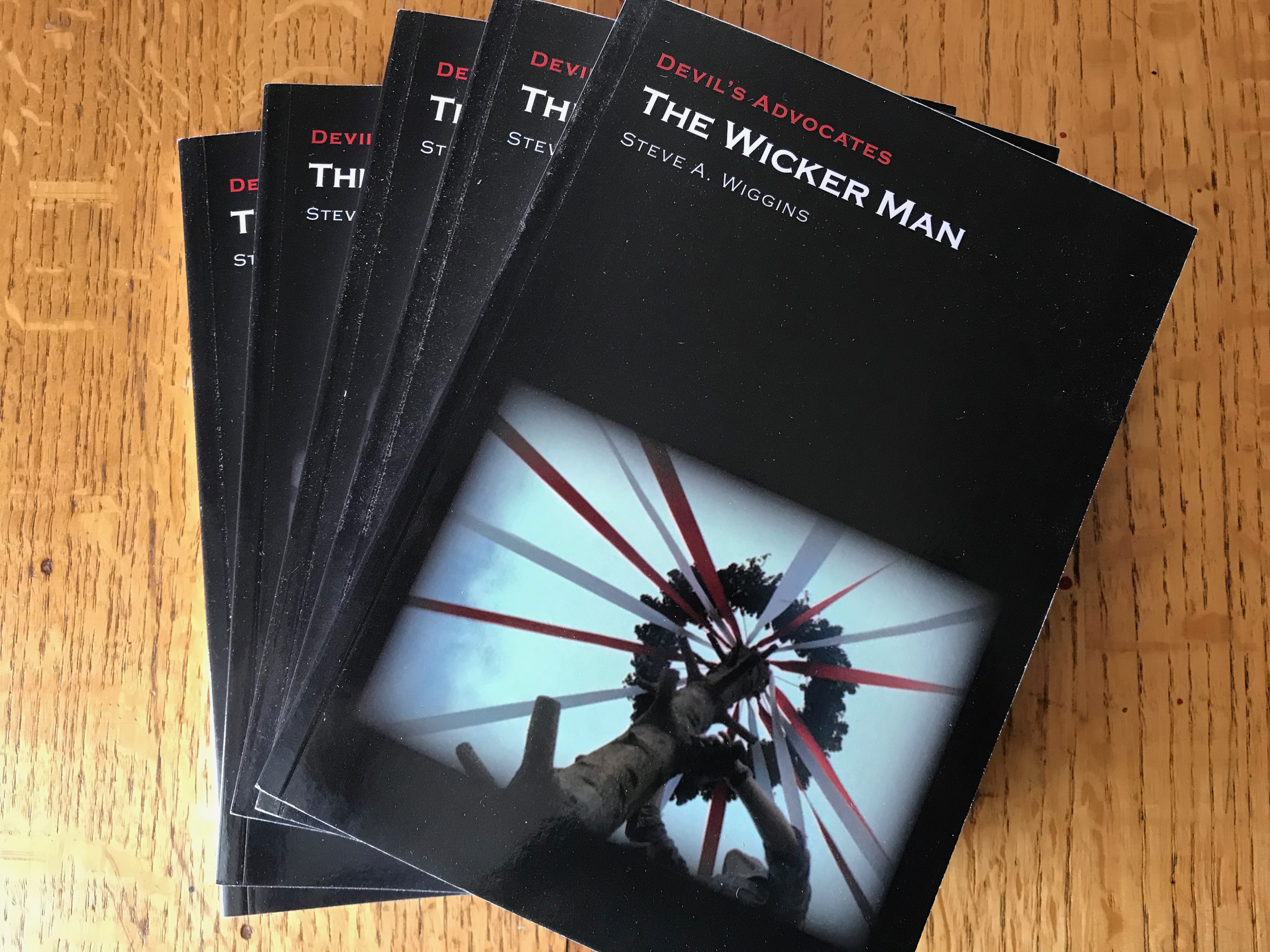
The process of producing a book is a lengthy one.  Even as an author you’re not really ever quite sure when it’s out in the world.  My author copies of The Wicker Man have arrived.  The release date is set for August and the publication date is September 1.  Still, it’s out there somewhere in the world at the moment.  The release date of the book is generally the date that stock arrives in the warehouse.  The book is technically available on the release date, but the publication date isn’t until two-to-four weeks later.  The publication date is when a book is fully stocked at the warehouse and is available in all channels (Barnes and Noble, Amazon, Bookshop, and your independent local bookstore).  Chances are you won’t find this book, being a university press book, in your local, but it can be ordered now.  Even in July.

This is a short book, so I don’t want to write too much about the contents here—then you might have no reason to buy a copy!  In brief, though, I can say that it explores The Wicker Man through the lens of holiday horror.  Not a lot has been published on the sub-genre of holiday horror.  In general publishers tend to be reluctant about holiday books—the perception is that they sell only seasonally (if my buying patterns are taken into account, that’s clearly not true).  Movies, however, can be watched at any time.  The Wicker Man is about May Day but it was filmed largely in November and was released in the UK in December of 1973 (fifty years ago), and in the United States in August of 1974.  People see it when it’s offered.  (Of course, video releases have changed all that.)

The movie has grown in stature over the years.  It appears in many pop culture references and even those who aren’t fans of horror have often heard of it.  There’s been quite a bit of buzz about John Walsh’s book on the movie, to be released in October.  (Of course, it is distributed by Penguin Random House.  I’m learning about the importance of distribution the more I delve into the publishing realm.)  My book has a more modest release and a slightly smaller sticker price (unless you go for the hardcover, then I’m right up there with university press prices).  I thought readers might like to know it now exists.  This writer, in any case, is glad to hold a copy and see the fruits of a few years’ labor, whenever it might come.


Not Seeing

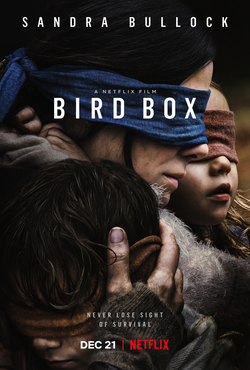
There must be ways to learn about new movies on a regular basis, but now that streaming services also produce films you’ve really got your hands full.  I’ve always had trouble keeping up and one can only afford so many streaming platforms.  In any case, I finally turned my eyes toward Bird Box.  There’s got to be a name for the phenomenon where a movie conditions a certain response that lingers after it’s over.  Fear of the phone ringing, for example, after watching When a Stranger Calls, or of making any noise after watching A Quiet Place.  Ironically for a movie, it’s a fear of opening your eyes (while outside, in any case) for Bird Box.  In fact, I was reluctant to take the garbage out, although it needed to be done.

Unlike many of the films I’ve recently watched, Bird Box had a healthy budget.  Production values were high and the acting was great.  In case you’re even slower than me, the story runs like this: there is a creature that roams outside, hunting people.  When anyone sees it, they immediately die by suicide.  In some ways there’s a similarity to M. Night Shyamalan’s The Happening, but this is much more action oriented.  A group of survivors figure out that they have to remain inside with windows covered, but this presents problems when they run out of food.  Also, a new threat arises—when the criminally insane see the creature they survive and experience a kind of religious mania and they try to make others look.

After being immersed in this world for a couple of hours, you feel like staying inside with the shades drawn.  Of course, during the summer that’s a reality much of the time when things get too hot outside.  The monster and its origin are never really explained, but clearly the effect it has on people is a psychological one.  When you stop to think about it, monsters are all about psychology.  Our fears may not all be in our heads, but most of them clearly are.  Watching such movies can build resilience.  As Tom tells Malorie, “Surviving is not living. Life is more than just what is. It’s what could be. What you could make it.”  That’s a fairly common theme when everything goes haywire, as in a movie like this.  If we embrace monsters they become less scary, at least sometimes.  There’s almost a spirituality to it.  In any case, Bird Box keeps your attention throughout, but maybe don’t watch it before the day’s outdoor chores are done.


Animate Magnetism

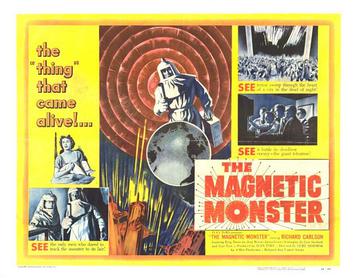
The Magnetic Monster is listed as sci-fi and horror on industry websites.  It falls into that period when horror had shifted to Hammer Studios in the UK and the US had entered that white-shirt, button-down period known as the fifties.  There were still monsters out there but they generally had to do with radiation.  In this case, it’s magnetism and its relationship to electricity.  The movie came out in 1953 and introduces what may have been the forerunner of the X-Files, namely the Office of Scientific Investigation, the OSI.  This team of A-men (yes, this was the fifties) study anomalies in order to keep America safe.  There were a total of three OSI films, of which this is the first.  The eponymous magnetic monster is alive only in a philosophical sense—it’s actually an irradiated element gone wild.

An unrestrained scientist had subjected a radioactive isotope to alpha particles for several days and this started a chain reaction.  He takes the substance onto a commercial airline—in his carry-on, no less (it was the fifties)—but the plane is diverted so the A-men can intercept it.  Every eleven hours this isotope divides and doubles, eating all the energy around itself to do so.  This creates an immense magnetic field.  So immense, in fact, that in a mere matter of days it will throw off the earth’s core and our planet will spin helplessly off into space!  Don’t panic, dear reader, the A-men are on the job.  They find a scientific means of overfeeding this monster and destroying it, which is why we’re all still here.

Interestingly, this is one of the more highly rated movies of the era, perhaps because of its scientific optimism.  Scientists can solve all our problems.  And yet you’ll find them without fail in church on Sunday morning.  The fifties were developing a kind of split personality for this country that was trying to hold two conflicting impulses together in an attempted fusion.  The problem is, overthinking either (or both) of them would demonstrate that they really have separate paths to take.  They may well be compatible, but in ways that relegating religion to Sunday morning simply doesn’t work.  Even today many scientists—generally not the outspoken kind—still hold religion and science in tension.  There is something to this impulse we call religion, but it always seems to have to wait while we use science to destroy the monsters we create ourselves.