Ghosts and Spines

Guillermo del Toro’s early movies are thought-provoking and somewhat depressing.  The Devil’s Backbone, like Pan’s Labyrinth, puts children in the way of adult political unrest and war.  I suspect that sensitive people watching such movies can easily imagine that they could have been put in such circumstances, were things different.  Having said that, The Devil’s Backbone works as a sad, gothic horror movie.  Set during the Spanish Civil War, the film focuses on orphans not quite out of reach of the conflict.  There’s a ghost at the orphanage that, until near the end, we think that the bully among the kids had killed.  The point of view is that of Carlos, a new kid at the orphanage who encounters the ghost and eventually decides to find out what happened to him.  The movie’s nearly a quarter century old, but there will be spoilers below.  Maybe there have already been some—sorry!

As the children, war orphans, try to navigate how to become adults, they have limited male role models—the doctor, who is good, and the groundskeeper, who is not.  Jacinto, the groundskeeper, was raised in the orphanage and although he had a professional-level family, grew up alone and wanting better.  His response was to turn cruel.  We’re not given much of the doctor’s backstory, but due to his position at the orphanage, we have to assume there’s a sadness there as well.  A number of subplots are interlaced with this, one of which involves the title of the movie.  Originally set in Mexico rather than Spain, the Devil’s Backbone was named after a mountain range.  That has to be transferred to victims of spina bifida in the local village.  This medical name has to be explained to the audience and it adds to the gothic atmosphere.

This is an example of a bright, sunny location nevertheless being a fraught place.  The boys (there are no girls at the orphanage) make their own society—not quite on a Lord of the Flies level—because the adults are at their wits’ end due to the encroaching war.  In the end all the adults end up dead.  The future of the boys is uncertain, but they show themselves able to distinguish between good and evil.  Adults, meanwhile, perpetuate a war in which, in real life, half-a-million people were killed.  There’s a lesson here for those willing and able to learn it.  Horror often has a moral, and when the boys are carrying an old crucifix to the courtyard and one remarks that he’s “pretty heavy for a dead guy,” adults should be paying attention.


What You Can’t Show

As I spend my life trying to figure out why I do what I do, I take book and movie recommendations.  I really should note who recommends what because it often drives me crazy trying to figure that out after the fact.  A friend recommended Censor, and since this friend told me where it was streaming for free I’m sure I got the right one.  Like several one-word title movies, there are several with the same sobriquet.  This was the 2021 movie and it’s a British horror film which raises the question of why we watch horror.  It does this through the eyes of the eponymous censor (Enid) who’s particularly tough on movies.  Set during the “video nasty” scare of eighties Britain, the question is whether such movies motivate real violence but with the twist that the censor is the one who turns violent.

Enid is haunted by her missing sister and she finds a video nasty star who looks like her sibling and becomes convinced that it’s her.  Enid gets to the set where her movie’s being shot (a remote cabin in the woods) and ends up killing the star and director (after accidentally killing the producer earlier, in self-defense).  She kidnaps her “sister,” and in her imagination—rainbows are everywhere—takes her home.  That’s where the real social commentary comes in because during this imaginary drive the radio announcer says these kinds of movies have stopped, and all crime and violence have ceased, and social harmony has returned to Britain.  This is revealed, of course, as a delusion.

Left to my own devices, I probably wouldn’t have watched this movie.  I don’t like blood and gore—I’m more looking for gothic themes like haunted houses—but it turns out that this is a smart film.  That’s probably why it was recommended to me.  Intelligent but also with tongue in cheek at times.  Still, it’s a movie about reconciling with childhood trauma, which is something that speaks to me personally.  That’s a wound I don’t always like to have poked.  It’s one of those movies on which I’d like to see more analysis, maybe talk to Prano Bailey-Bond, the writer and director.  Horror with female directors is often thoughtful, and movies are really meant to be discussed (just like books are).  The question remains—why do we watch disturbing movies?  I know I’m not the only one who does.  And in this case I remember who recommended it, so perhaps I’ll be able to get some closure.


Out of Season

Scary Stories To Tell in the Dark, by Alvin Schwartz, has been a fixture since the early eighties.  I was a bit too old for Scholastic at the time, but my daughter had a copy that I read recently.  I heard about the 2019 film before it came out (and I’m having trouble believing it was all the way back before the pandemic).  It’s more of a Halloween movie and since it features young actors it had translated to a “kids’ movie” in my head.  I suppose the PG-13 rating contributed to that.  Sill, it turns out that it’s a proper horror film, but not too scary.  The story is partially by Guillermo del Toro, so I had some idea of what to expect.  I’m glad I watched it, even though the right season is still months away.  Therapy is welcome any time of year.

Anthology films often don’t work well, and this one manages to avoid that by constructing an overarching narrative.  The teens, visiting a haunted house on Halloween night, find a book by a hidden family member who’d hanged herself but who was rumored to tell stories to those who ask.  The book, written in blood, writes new stories featuring each of the kids, telling their bizarre deaths.  Since there are six main kids there are six main subplots and some of them are quite effective.  Scarecrows aren’t like the kind you find in Oz.  And two of the good kids end up missing while this is played off against the Vietnam War (it’s set in 1968).  One of the characters has been drafted and is being shipped off to the war as the film ends.  Since the final girls (there are two) are committed to finding the lost kids, a sequel seems inevitable.

The setting of fictional Mill Valley is a Pennsylvania town, and it’s nice to see my home state getting some attention outside M. Night Shyamalan movies.  I’ve always felt there was more creepy potential here than has been explored.  And autumn is generally beautiful in the commonwealth.  Although I watched the movie out of season (while it was free to do so on Amazon Prime), it has landed on my list of films to watch in October.  It manages to get that feel right and I know that come the autumn I’ll have a hankering for that sensation.  It’s not really that scary, but it manages to be worth an adult’s time and attention.  And it makes me want to read the book again.  And horror can work for therapy, even when it’s starting to get hot outside.


A Tumble

So beautifully shot, Fallen is a movie worth watching despite its disjointed plot.  Worth watching for horror fans, that is.  Apart from the night scenes, this is art house cinematography, and that may be because it’s an independent movie.  What’s it about?  That’s difficult to say, definitively.  The night scenes are so dark that you can’t tell what’s happening and the plot seems to have been intentionally obscure.  (That’s hard to substantiate because the 2022 film hasn’t generated too much discussion.)  This may have been another case of mistaken identity, like The Entity, because my notes only had the title down.  There are at least three movies with this title.  I’m learning my lesson to jot down the year when I add a movie to my “to see” list.  In any case, here goes…

A young priest (?) is warned by an older priest that it is time to take up violence because the darkness has started.  The younger priest is called “Father Abraham,” but he wears a tie in church services, and a small pectoral cross, making identification of the denomination difficult.  Since this is religion-based horror you’d think that that much, at least, ought to have been sorted out.  The heavily accented dialogue is often delivered so low that it’s difficult to follow.  In any case, this minister, after fighting “darkness” for many years, is in an isolated farmhouse with his disabled daughter.  He hunts and traps for their needs and a local boy delivers groceries, and is secretly in love with the daughter.  The minister, who seems to be presented as a tortured soul, isn’t really likable.  At night the house is attacked by physical demons.  There will be spoilers in the next paragraph.

It’s finally revealed that Fr. Fallen (apparently that’s his surname) had killed his wife for being a witch.  His daughter is also a witch, out for revenge for her mother’s death.  She summoned the demons and eventually kills her father and leaves the farm.  Religious imagery is everywhere in this film and begs for interpretation.  The lack of coherence, however, makes that very problematic.  The disabled daughter is the only survivor at the farmhouse, and is healed at the end.  By the demons?  Or because she’s a witch?  The influence of M. Night Shyamalan is evident, but his clean plotting is absent.  Online discussion is minimal, but there could be something of substance here.  If only it were better put together.  If only it were more discussed.


Not Dagon

There’s an aesthetic to bad movies.  And when your production company is Crappy World Films you’ve got to wonder if it’s intentional.  Chad Ferrin’s H. P. Lovecraft’s The Deep Ones, which was released in 2020, isn’t a great movie.  It is kinda fun, though.  I’ve had a weakness for explicit Lovecraft films ever since Stuart Gordon’s very moody Dagon.  That film was clearly the inspiration for this one.  With the “low” budget of only a million dollars (it feels strange to write that), it nevertheless has a clean cinematography that shows some artistry.  The story just isn’t that good.  A young couple is seeking a getaway at an oceanfront AirBNB only to discover it’s part of a “gated” community.  Their hosts, who are living in the boat down at the marina, keep on stopping in, not leaving them much privacy.

The set-up is very much a Rosemary’s Baby scenario.  The community, as the title suggests, worship the Old Ones.  They introduce Cthulhu early on, but the young man of the couple has never heard of him (he obviously doesn’t spend much time on the internet).  Speaking of the internet, the film makes the point that everyone spends too much time on it, and there’s perhaps some truth to that, but, if you’re streaming the movie you’re also participating.  In any case, the community wants women to offer to Dagon—and the monster here is clearly low-budget—so they can bear more children for the Deep Ones.  Well, not so much bear children for them as to be pregnant with tentacles that can somehow convert newcomers.  Once you’ve been tentacled, it seems, you’re a member of the community.

There is a kind of Lovecraft vibe to the film despite the often wooden acting and throwaway dialogue.  One thing Lovecraft had learned from Poe was the consistency of mood.  It’s here that the movie runs into some trouble.  At times it’s a little scary, at times dramatic, but too much of it just feels silly.  The case could be made that Lovecraft’s writing tends toward the puerile and there’s some truth to that.  It is never silly, however.  Sometimes when translated to the screen the outlandishness of Lovecraft’s view of the world comes across as so weird as to be funny.  It takes an able director, and a strong writer, to adapt him to cinema successfully.  It’s no accident, then, that the movie is dedicated to Stuart Gordon, whose Dagon is still difficult for me to watch, so full of Lovecraft as it is.


Entities

When you’re a regular scholar, you take notes.  I’m not a regular anything, I guess, and I’ve fallen out of the habit of noting who makes movie recommendations to me.  Many of these come from books, but I don’t always remember which book made what suggestion.  In my list of movies to watch is The Entity.  The thing is, there are at least five movies by that title.  One of them was free on Freevee, so that was the one I watched.  I’m not sure it was the right one, but since it featured something like a demon it represents my interests in Nightmares with the Bible.  This one was, for the record, from 2016, or 2015, and directed by Eduardo Schuldt.  Like Paranormal Activity, it’s “found footage” from hand-held cameras and it made me more woozy than scared.

Based in Lima, it’s in Spanish and claims to be from the dark web.  I don’t have any desire to go there (the dark web, that is.  Lima would be okay), but the movie wasn’t that frightening.  It was like Sinister and Ringu’s unholy offspring.  With a bit of Blair Witch Project as a sibling.  A curse from the Inquisition brings this into the realm of religion and horror.  Film students working on a class project learn that those who see a certain film are going to die.  Being modern people, they’re skeptical so, of course they watch it.  The thing about religion is that it’s unrelenting.  It doesn’t give up just because people stop believing.  Movies like this underscore how we keep turning back to religion to frighten ourselves.  You can guess what happens to the students.

The thing is, I’m not sure that I watched the correct one.  Film scholars now make a habit of citing movies by not only title and year, but also director’s name.  There are a lot of “Entities” out there, and if you take the article off there are even more.  I’ll probably end up watching a few of them, but since I didn’t write down which book, or which friend, made the recommendation, I’ll never know if I got the right one.  I keep a list to try to prevent myself from just going for whatever’s free on the weekend because you generally get what you pay for when you do that.  Even though I ended up a bit nauseous (from the camera movement) I was glad to have seen this.  There were some good moments in it.  And I can tick one off my Entity list. 


Golem Events

Public domain, via Wikimedia Commons

It doesn’t have a title yet.  At least not one that’s announced.  Still, when a friend pointed out this article that Daniel Handler, better known as Lemony Snicket, is writing a horror film about a golem, I sat up straight in my chair.  Since I don’t tend to dwell on children’s topics here, it may not be obvious that I was a real fan of A Series of Unfortunate Events, by Lemony Snicket, back when they came out.  Alerted to this series by a cousin who was my daughter’s age, we made this bed-time reading for a few years.  Handler, in the early days, did a pretty good job of keeping his identity secret.  He’s written some adult fiction, and those of us who write know that readers want more of the same thing from a writer—if you want to survive you do what they ask.

I’m a very eclectic reader—that may be one reason I don’t have many followers on this blog.  People like the same thing time and again.  (I’ve always been suspicious of genres.  One of the reasons, I suspect, that my students found my lectures interesting is that I drew from my eclectic reading, but that’s ancient history now.)  In any case, A Series of Unfortunate Events was formative in my own writing.  The movie remains one of the most gothic available, but it pales next to the novels.  Yes, they’re written for young readers, but they’re also very well written for young readers.  I discovered Snicket, or Handler, was Jewish when he wrote The Latke Who Couldn’t Stop Screaming.  And now he’s turned his attention to one of my favorite monsters.  The golem has been part of horror from the earliest days of the genre (that word!).

Paul Wegener and Henrik Galeen’s The Golem, part of a trilogy, came out in 1915.  Before the Universal monsters.  Even before Nosferatu.  The legend of the golem—which may have inspired Frankenstein—has a long history.  While not biblical, the golem does go back many centuries.  Unfortunately these early horror films are lost, or mostly lost.  The Golem and the Dancing Girl, from 1917, is a lost comedy horror.  The third film, The Golem, How He Came into the World, from 1920, survives and is sometimes called “The Golem.”  I wrote earlier about the excellent 2018 film The Golem by Doron and Yoav Paz, sensitive to Jewish issues in the seventeenth century.  This sub-genre of golem movies may be starting to come into its own.  It remains to be seen what Handler will do with it, but if his previous work is anything to go by, we may be in for a real treat.


Boggy Down

Okay, so after watching The Creature of Black Lake I realized that I’d never seen The Legend of Boggy Creek.  I did watch The Mysterious Monsters, a documentary that came out in 1975, in the Drake Theater in Oil City.  I was struck by Peter Graves’ serious tone and the information the film conveyed.  I’d not knowingly heard of Boggy Creek then (Graves does list “the Fouke monster” as another name for sasquatch), and besides, Arkansas was far, far away.  Well, to make an honest man of myself, I decided I’d better see it.  The opening of Boggy Creek is clearly the inspiration for the opening of Black Lake.  Their opening shots are very similar.  (I guess I watched them in the wrong order.)

Although Boggy Creek does have a guy in a costume (better makeup than Black Lake), many of those in the film are the actual eyewitnesses to the events it portrays.  They’re clearly not professional actors.  Interestingly, the narrator constantly insists that there’s only one such creature and that it acts out of loneliness.  If there are sasquatch they, out of biological necessity, must have a breeding population.  There had to be a Mrs. Boggy Creek somewhere in the picture—at least on a national scale.  In any case, this movie has become a cult classic, but I can’t help but think it’s so that people can laugh at it.  The acting’s not great and the long, long shots of hunters getting their dogs out of the truck  show the problems with the pacing.  Then there’s that folksy song (also echoed in Black Lake) about the lonely monster.

Boggy Creek came out in 1972, making it one of the earliest Bigfoot documentaries.  Given that sasquatch has gone mainstream (lawn art and Christmas ornaments featuring Bigfoot are common), the movie perhaps started a new cultural meme.  In the movie the poor critter gets shot several times, engaging viewer sympathy (but maybe not enough to write a song about it).  The narrator reflects if this particular southern hospitality might not’ve been overkill.  After all, some of the armed witnesses said they couldn’t shoot it because it looked too human.  The pacing was slow enough to make keeping my weekend weary eyes open a challenging prospect a time or two, but overall it’s a film worth watching.  I have the feeling, however, that this chain of events might lead me back to The Mysterious Monsters.


Addenda

In retrospect, I suppose I wrote Holy Horror a bit prematurely.  Back when I started writing it, I had thought that the Bible in horror wasn’t as common as I’ve since found it to be.  I still stand by what I wrote, but I could’ve included a lot more movies that I’ve watched over the years since.  The Sacrament is one of them.  Based on the Jonestown massacre, the film sets the movie in the early twenty-tens.  A reporter for VICE is going to find his sister who’s joined a religious commune in some unspecified country.  In an effort to get him to join, she invited him to visit.  She was unaware, however, that he brought another journalist and cameraman with him.  The movie gives creepy vibes right away since they’re greeted at the helicopter landing site by men with guns.  Eventually they’re allowed to enter.

“Father,” the leader of the commune bears a resemblance to Jim Jones and soon it’s clear where this is going.  Along the way, however, Scripture gets quoted to justify their communal lifestyle.  There are many fictional aspects thrown in—the young women seduce the journalist whose sister invited him.  She makes no bones about saying they do it to convince him to stay.  The camera crew is almost convinced that this is the paradise it claims to be, but they start getting requests for help.  The writers clearly did their research on Jonestown since several details of the final weeks of the Peoples Temple are fictionalized here.  The mass suicide is shown in graphic detail.  The number of the dead, however, is only about a fifth of those who actually died in Guyana in 1978.

The movie clearly shows that the commune is problematic, but it also raises uneasy questions.  If it weren’t for the murder of Leo Ryan, would Jonestown ever have happened?  Probably, but the film shows “Father” making the point that nobody was being harmed.  That’s belied by the introduction of an abused girl and the number of people who want to leave.  It’s true of Jonestown that mind-control tactics were used and people weren’t permitted to leave, especially as Jones’ paranoia grew.  The movie leaves the viewer wondering whether utopian communes can ever work, people being what they are.  We crave our freedom, even when things look great.  The movie condemns the exercise, but not so much that it leaves lingering doubts about whether, had things been different, it might’ve worked.  And it would’ve worked, had I seen it earlier, for Holy Horror.


Feeling Chilly?

David Cronenberg perhaps defies the tame image we tend to have of Canadians.  I know that’s a parochial thing to say, perhaps reflecting my lifelong admiration of those north of the border.  I even have Canadian family members, from back when it was possible to cross over without a passport.  In any case, David Cronenberg has always been a controversial director.  As the progenitor of “body horror,” his films are often not for the squeamish.  I nevertheless find him one of the more intellectual auteurs, and his movies leave me thoughtful.  One of his early films, Shivers, has long been on my syllabus of “must see movies.”  If you read my pieces regularly you also know that living on an Ed Wood budget, I can’t afford to pay for frequent films and have to wait for a free venue.  Thank you, Tubi, for obliging.

By the way, the poster here shows one of several alternative titles for the movie: “They Came from Within” (aka “The Parasite Murders”).  The film is pretty graphic body horror, but as scholars now focus on embodiment, it seems like this should be explored.  Set in an almost utopian island community, Starliner Towers, the movie opens by touting its perks.  Intercut with that is a graphic murder-suicide taking place within the paradisiacal apartment tower.  A parasite, as one of the alternative titles suggest, has been unleashed by what might be called a mad scientist.  And that parasite has two main effects—prompting orgies and violence.  (Hey, the official title of this blog is Sects and Violence in the Ancient World, after all.)

Religions, Christianity in particular, in the west, are often uncomfortable with the body.  In religious studies approaches to embodiment, it’s stressed that everyone has to reconcile themselves with what it means to be a physical being.  So much so that the mad scientist developed this parasite because he believed people thought too much.  They’d forgotten the mindless reality of bodies.  We’re sometimes uncomfortable being reminded of our bodily existence—at least those who perhaps think too much are—and that comes with both good and bad.  The interesting thing about the film is that it refuses to condemn the results of this experiment gone awry.  Everyone eventually falls victim to it (sorry if that’s a spoiler, but the film was released nearly half-a-century years ago).   Cronenberg is difficult to pin down, but his films, perhaps despite the message, always give me things to think about.


Wicker Man Comes

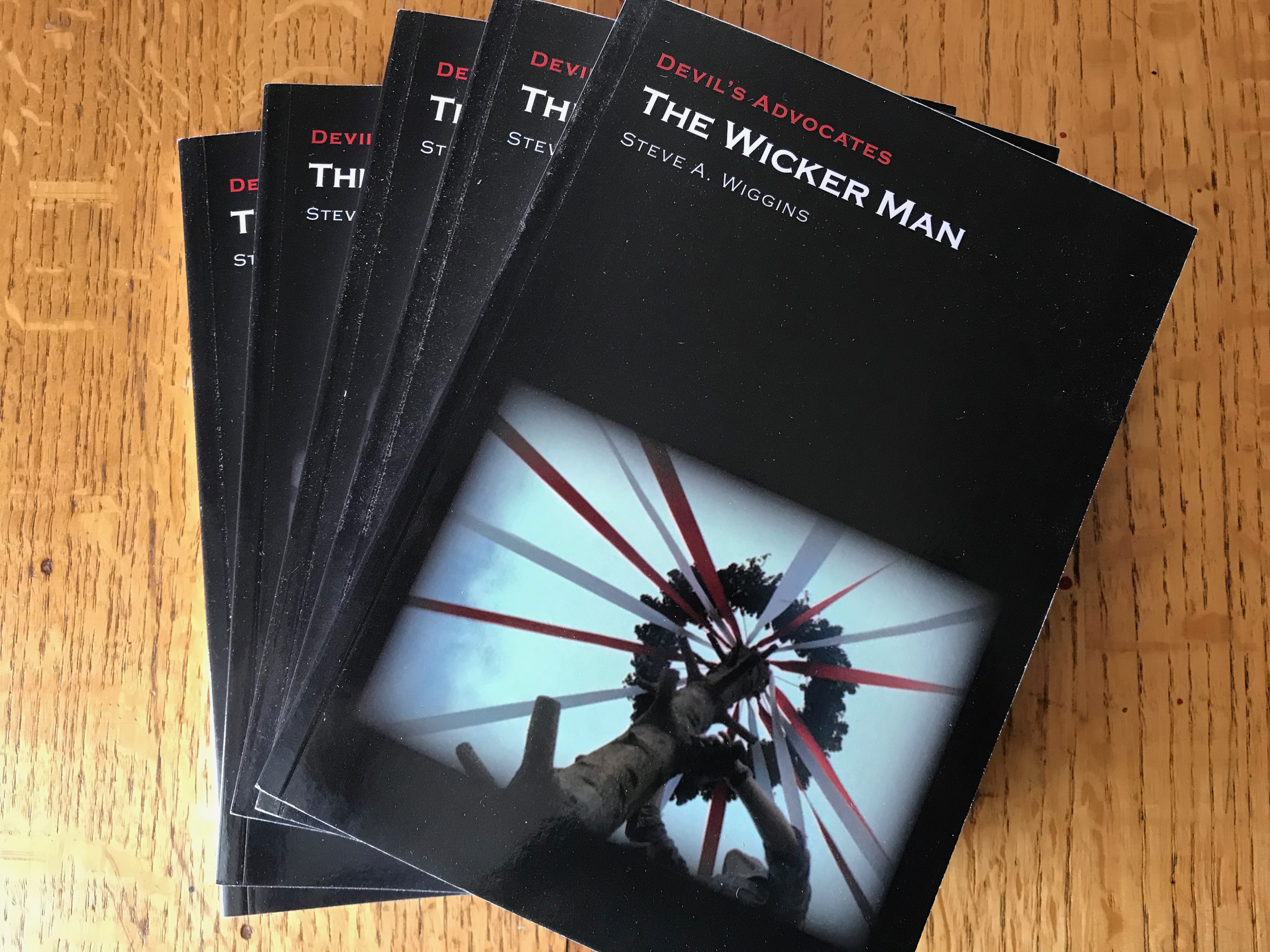
Not that I would know bodily, but it seems like a book being published is something like giving birth.  It takes several months (perhaps years, in the case of books) from conception to delivery and there are certain milestones along the way.  And you worry like Rosemary.  Has something gone wrong?  Is this still going to happen?  The book production process is a long and complicated one.  Just this week, however, the next recognizable stage occurred for The Wicker Man.  An ISBN has been assigned and a new book announcement has fed out through various channels.  It’s not on Amazon just yet but a Google search of 9781837643882 will bring it up.  I’d been worried about this because I saw a new book announced on The Wicker Man due out in October.  This is the fiftieth anniversary of the film, and I suspected I wasn’t the only one who’d noticed that.

Ironically, another film turns 50 this year.  The Exorcist released in December of 1973 to far greater acclaim than The Wicker Man.  Both films became classics in their own right, but The Exorcist would become a household name.  Even if they’d never seen it, most people had heard of it.  The Wicker Man is more of a cult classic.  It’s known among horror fans and a certain kind of Anglophile.  And those interested in paganism, particularly of the Celtic variety.  Although the cover isn’t available yet, I was glad to see the feed for my book going out.  It looks like I might scoop the other book by a month or so.  If that happens it will be the first time that I’ve actually had a book on horror release before Halloween.  The last two missed the deadline by a couple of months.

Having said that, if you’ve had your appointment with The Wicker Man you already know, it takes place on May Day.  And you likely know that a large number of people claim it isn’t a horror film at all.  Indeed, the horror element only becomes clear in the last ten minutes or so.  It’s the build-up that makes the movie.  And it was really a one-film wonder for the director, Robin Hardy.  He did other movies, but this was the one that lasted, and spawned imitations and parodies.  It’s exciting to see that the discriminating, or very persistent, searcher can now find the book announcement online.  I haven’t seen much to-do about the 50th anniversary just yet, but now when I do I’ll have something to point to.  More on this to come!


Monster Bride

I’ve been taken with Ed Wood lately.  It’s quite possible, lost somewhere in my memory banks, that I saw one of his movies as a kid.  If I did it would’ve been Bride of the Monster.  Just in case I hadn’t, I decided to watch it again.  As I’ve noted about Wood before, I admire someone who persists in the face of constant criticism.  Someone who refuses to back down, even if they end up alcoholic and dying too young, in poverty.  Now he’s coming to his deserved recognition.  Even if his movies weren’t intentionally bad, when I laugh out loud I’m not laughing at Ed Wood.  No, it’s the absurdity of fame and the price it both expects and exacts.  Wood paid that price and now that it’s too late he’s grown a considerable fan base.  Or maybe it’s never too late.

Bride of the Monster brings Bela Lugosi back to the screen as a mad scientist.  Rejected and mocked (I’m sure some of this was personal), he locates an isolated swamp house from which he plans his revenge on the world.  He’s somehow managed to build a nuclear reactor in his hidden lab and he intends to make a race of giants to conquer the earth.  Naturally enough, he starts with an octopus.  As the story unfolds, we learn that he was also responsible for the Loch Ness Monster.  He’s employed a human (but somehow bullet-proof) henchman, Lobo, to help him in his quest.  When a nosy reporter and her police detective boyfriend get involved, well, you might imagine the results.

The stories behind Ed Wood films, it seems, are as entertaining as the movies themselves.  This one, for example, has as its protagonist an acting unknown (Lugosi was the name draw).  Tony McCoy was the son of the owner of a meat-packing plant.  He received the lead role as part of his father’s stipulations for funding the movie.  Another stipulation was that it had to end with an atomic explosion (which it does).  Wood would go to any length to see his movies made, even agreeing to casting choices and plot points made by those who had no other connections to the film.  That’s part of the charm of Ed Wood’s movies—they were made to order.  And they demonstrate that deepest of human desires—to tell a story.  If I didn’t see this as a kid, I would’ve loved it if I had. 


Too Haunted

It’s past the season, I know.  But I have no control on when streaming services acquire new titles.  So it was winter by the time I saw Haunt.  Maybe it was the seasonal disconnect, or maybe I’m not all that fond of slashers—whatever the cause, I found it disturbing.  As a horror watcher, I really don’t like being afraid during movies.  And Haunt has those most troubling of characters—the unpredictable kind.  So let’s set this up properly.  Six young people—four women and two men—decide to visit a haunted house attraction on Halloween.  Although they take a random turn on a rural road outside Carbondale, Illinois, they end up at a haunted house attraction, with an illuminated road sign.  I’ll admit it; I don’t like fun houses.  They scare me too much.  So when the creepy clown at the entrance indicates, nonverbally, how they get in (taking no money) and puts their cell phones in a lockbox, I’d have told the others I’d wait in the car.

As we might expect, since this is horror, after a fakey plastic skeleton and some cheap props, it turns our that the terrors are real.  One by one, the young people are killed by a group that practices extreme body modification to make themselves look like real monsters.  For an unexplained reason, they kill everyone who comes to the attraction.  Sadism, one suspects, might be behind this.  In any case, it ends up with a final girl and final boy making it out alive and seeking medical attention.  The haunted house is burned down since Harper, said final girl, and her new boyfriend end up killing most of the killers.  The creepy clown, however, survives to try to hunt Harper down.

The film received pretty high ratings, but it seemed to me there wasn’t much beyond the terrors I normally experience at a fun house.  The body horror verges on torture porn, which is a sub-genre that I simply do not like.  In fact, I only watch it by accident.  My dilemma is that I don’t like to read summaries or watch trailers before seeing a movie.  I prefer to approach it fresh.  I suppose that’s why I keep a list of films that others have recommended, so I know they’re likely good.  I prefer intelligent horror rather than shock horror, although the two can overlap.  Movies that focus on the the pain humans can inflict on each other aren’t the kind I prefer.  Give me a garden-variety monster any day.  Even if it’s a winter weekend, and not Halloween.


Fostering Euro-Horror

In another example of Euro-Horror, Hatching is a remarkably effective monster movie.  Filmed in Finnish, and set in Finland, it’s a remarkable parable about families and what we reveal to the world.  An affluent family consisting of Mother, Father, Tinja, and her brother Matias, live in a beautiful house in a nice neighborhood and Mother prospers with a blog about the ideal family life.  She videos the family, especially Tinja as she prepares for a gymnastics competition.  Then a crow gets into the house, causing chaos and bringing the true nature of the perfect family to the surface.  When Mother breaks the crow’s neck, reality seeps through the internet myth of perfection.  Tinja, disturbed by what happened to the bird, locates its egg and brings it home to care for it.

Mother, it turns out, has been having an affair.  Father is shown as caring, but ineffectual.  Matias has anger issues.  Meanwhile Mother drills Tinja in gymnastics practice until her daughter’s hands are raw and bleeding.  The egg grows.  Mother confesses to Tinja that she’s in love for the first time and for real.  She begins spending weekends at her lover Tero’s house.  The now huge egg hatches into a Tinja-sized bird-like creature, sparsely feathered.  As Tinja psychologically bonds with the creature, she hides it in the house and it becomes clear that what each feels what the other feels.  Over time the bird begins to become Tinja’s double, doing those things her “perfect daughter” image would never allow her to do.

The story is a parable.  Families uphold facades while the world pays to see perfection that doesn’t really exist.  Tinja isn’t terribly fond of gymnastics, but Mother drives her to compete.  Father knows about Tero, and pretends to be okay with the affair.  Mother spends her love elsewhere while her perfect family crumbles.  The monster in the movie is the revealer of truth.  The truth doesn’t broadcast well on the Internet, which prefers fiction passed off as fact.  Although the story itself could never happen, it is a probing tale that delves into psychology and the price we pay for not being honest about ourselves.  I won’t spoil the ending here, but let’s just say reality seldom works out the way that we hope it will.  Euro-horror has been producing some impressive films the past few years that demonstrate the intellectual side of horror quite well.  This may be offer body horror—without becoming slashers—because they have messages waiting to hatch.


Creepy

There’s some symbolism here that I haven’t had time to sort out.  (Some of us need time to just sit and think—time that work won’t allow.)  I’d been wanting to watch Jeepers Creepers for quite some time but streaming services said it was unavailable.  I suspect that was because a sequel has been running in theaters and those who own the rights want to capitalize on it.  So it goes.  When it finally did show up on Freevee, so you have to subject yourself to commercials, I had to see it.  Now I need some time to think.  In case you’re even slower than me, the film involves a couple siblings driving home for spring break when they encounter a monster/demon, Creeper.

Creeper smells peoples’ fear and consumes parts of those who have something it needs to regenerate itself.  The brother and sister encounter Creeper on one of those long stretches of road without civilization that you find in parts of America (in this case, the unspecified south).  I won’t spoil the ending, but for my money (or actually, Freevee patience), the first half is pretty scary.  The whole is not bad either.  So what do I need to think about?  Well, Creeper stores its victims’ corpses in a church basement.  The church is abandoned, but still.  This overlap between religion and horror is an aspect that has fascinated me time and again.  Shouldn’t a church be a safe place?  (For many of us, that’s a myth long debunked.)  Is it because it’s abandoned that a demonic monster has moved in?  Or does religious symbolism not bother it?  Or perhaps attract it?

Not only that, but the movie also has a prophet.  While she’s not called that, this local woman has dreams of things involving Creeper that haven’t happened yet.  Like Cassandra, however, everyone ignores her.  It seems that Jeepers Creepers experienced a budget cut during production that led to a rewritten, and cheaper, ending.  While I won’t spoil it, I will say that it is a bit of a letdown from how the film started.  A lot is left unexplained, but the story is pretty good and the acting, at least by the siblings, and the always entertaining Eileen Brennan, was impressive.  They have a way of conveying fear that’s believable and contagious.  The religion theme, however, appears to have been dropped once the church burns down.  It may be that it was somehow revisited in the ending that money forced to change.  Regardless, it is worth watching, and, if you have the time, pondering.