Bad Movies

I watch bad movies so you don’t have to.  Maybe that’s my ticket to retirement (it certainly isn’t working the usual way).  In any case, my habit of trying to find something “free” on a network I already pay for often leads to films that keep me awake on a drowsy weekend afternoon, but really don’t offer much else.  Sometimes you learn something nevertheless.  I recently watched From a Whisper to a Scream.  It was free and got more than five stars out of ten, but I didn’t really work for me, even with Vincent Price.  A vignette movie, it presents four episodes from Oldfield, Tennessee, making the claim that it’s a place infected with evil.  The first involved necrophilia, with consequences.  The second—more in a moment—was about eternal life.  Lovecraft’s circus comes to town in the third, and the fourth is about the founding of the town during the Civil War.  Of course, the framing is a “bonus” mini-story as well.

The second episode, “On the Run,” has a wounded ne’er-do-well, shot by some southern rivals, falling into a swamp boat.  He’s rescued by an older African American who lives alone in said swamp.  Noticing him practicing hoo-doo (cue The Skeleton Key), the miscreant soon figures his rescuer has found the secret of staying alive forever (which he has).  Naturally greedy, the petty criminal “kills” the African American and ransacks his shack for the secret potion that keeps him alive.  Being horror, the dead come back and the owner of the shack returns to punish the white man who is trying to steal what he already has.  The Black man had given him the potion to bring him back to life.

There’s a bit of a parable quality to this particular story.  Each vignette predictably has the evil-doer punished, with the exception of “Lovecraft’s Traveling Amusements,” where the Black woman owns those who work her carnival.  And she gets away with it.  None of the characters, apart from the Black man in the swamp and the children in “Four Soldiers,” are really sympathetic.  Religion does also come in the Civil War segment since, drawing cues from Children of the Corn, the kids have created their own god.  So, a diverting film, if not a great (or even a good) one.  This was Vincent Price’s last true horror film, making it worth seeing for that reason alone.  His role is limited to the framing story which, as we might expect, becomes part of the collection of horrors from Oldfield.


Expiration Date

One of the perils of trying to understand others—something that is vitally necessary for a humane and civil world—is facing difficult truths.  Sometimes horror makes you do that.  I’ve recently been trying to watch horror directed by women, as this gives another perspective on what’s scary.  Directed by Mimi Cave and written by Lauryn Kahn, Fresh is very disturbing.  Noa is a young professional who’s not having much luck dating.  He best friend Mollie, who is African American, is the voice of reason in the film.  Noa finds internet dating services inadequate, matching her up with losers, but then she meets a handsome, funny guy in the grocery store.  She agrees to a date and they hit it off.  So far, so good.  Then he takes her to his place and abducts her.  He explains that he’s a supplier of human meat for an ultra-wealthy circle and she is to be consumed.

I won’t say much more about the plot since you may want to disturb yourself some day, but I will say that the movie reinforces something I get from reading Carmen Maria Machado:  women have to deal with men’s assumptions about their bodies.  Even the institution of marriage is all about ownership; men don’t want to pay (the key word) for supporting someone else’s child.  The nuclear family is intended to keep that at a minimum.  Just a glimpse at social standards reveals that men are held less accountable for cheating than women are, largely because there’s never a question of who someone’s mother is.  Noa’s captor is charming and nice.  He’s also a (as later revealed) Satanic psychopath.  He’s also also married, with children.

The film is disturbing on so many levels as it reflects on how a man feels he has the right, literally, to take women’s bodies.  Habeas corpus indeed.  It feels like being invited to dinner at Hannibal Lector’s house.  The religion element—for there often is one—is only revealed in two short glimpses.  One is the plate of one of the cannibals which has a Satanic symbol printed on it, and the other is a mid-credit shot of the butcher’s customers where the Satanic symbol reappears.  This theme isn’t really explored in the movie, but it is equated with “the one percent of the one percent.”  The clients are those who can afford anything and who crave the one thing they can’t have.  This is a movie to keep you up at night but it’s also one with a very strong social commentary.  That commentary is as disturbing as the entire premise of the film.


Pumpkin Season

A creature feature with a moral.  Not a bad way to think through ethical dilemmas.  You see, we don’t have a lot of extra money lying around, so when I need a pick-me-up I try to find something free to watch.  Well, free because I subscripted to Amazon Prime years and years ago for the free shipping and now it involves “free to me” streaming on select titles.  Often I learn about movies from browsing and that’s how I came across Pumpkinhead.  I’ve learned my lesson about just clicking through without checking it out ahead of time.  It turns out the Pumpkinhead, apart from having major studio backing, was pretty favorably reviewed back in 1989.  My wife and I were in Edinburgh at the time, newly wed and trying to concentrate on doctorates.  I hadn’t been bumped back into horror yet.

In any case, what is this moral?  What is this movie?  Set in the unnamed rural south, the movie involves the accidental death of a good, honest man’s son.  Some city slickers, hot rodding on dirt bikes, accidentally run the boy down.  This good man visits the local witch, against the advice of the locals, and she raises a demon for him—the eponymous Pumpkinhead—to get revenge on the meddling kids.  The moral comes in where the witch warns him that such revenge comes at a terrible price, and it does.  The man and the avenging demon begin to merge and his desire for revenge leads to his own demise.

Religion plays a role in this film as well.  One of the locals, wanting to help the final girl and her boyfriend—the only ones left alive out of the six city folk—takes them to a ruined church, figuring that a demon won’t enter hallowed ground.  He’s not exactly right about that, but an extended shot of the religious imagery makes you think about the nature of revenge and what it means in a Christian context.  Besides being the first film role for Mayim Bialik (only 13 at the time), it also spun off two sequels.  Being a good student at the time, I was completely unaware of all of this.  I learned about the film while trying to stay awake one winter afternoon and trying not to spend any money to do so.  Not a great movie, it nevertheless does feature repentance and it explores the consequences of being driven by a desire to get back at others.  And the monster isn’t bad either.


Gothic Days

The tradition of telling ghost stories during the months of long darkness has evolved over time.  Since the time seems right, I watched a movie for which I read the book some years ago.  I recall that The Woman in Black is moody, and gothic.  What I don’t remember is how it ends.  More than one source—at least one from someone I know and one from a book—suggested I should see this movie, and I’m glad I did.  It’s a haunted house movie, set in a haunted village and the production values (unlike some movies I’ve recently watched) are quite high.  This film was a reboot in a couple of ways; there was an earlier film version, and it was also a new Hammer production.  In the latter capacity it broke records for Hammer box office earnings.

You see, Hammer, in its first incarnation, struggled for any kind of respectability.  The company almost single-handedly kept horror movies alive while US studios moved more toward sci-fi-themed projects, before the rebirth of modern horror.  Fans knew to go to Hammer for their monsters, but society folks (and those who wish to be society folks) don’t find horror worth any attention.  From my amateur point-of-view, such movies give the viewer a lot to think about.  The problem, as with most underdogs, is that a few bad examples tend to get all the attention.  Life is scary.  That doesn’t mean we shouldn’t try to live it, but it does mean that we might learn something from other people’s mistakes.  Or we might find ourselves haunted.

The Woman in Black is set in Edwardian times.  (I often ponder why we still refer to historical eras by the British monarchs—Elizabeth, Victoria, Edward, etc.—in a world finally moving away from imperialism.  Still, it’s convenient.)  Perhaps not quite as evocative as the Victorian Era, but still moody enough.  Although there are some disturbing scenes, this is no slasher.  Like the novel it’s the tale of a vengeful ghost, wronged in life and out for revenge.  While the end of the movie isn’t the same as the novel (okay, so I looked it up!), it’s similar.  And perhaps it’s best considered a parable of parenting.  No amount of training can prepare you for it, and although it’s supremely rewarding, it’s also very scary.  Susan Hill, the novel’s author, lost a child and that sense of haunting pervades both book and movie.  Gothic is often about grieving, and perhaps about learning something from it.


Unfinished Business

Photo by Reid Naaykens on Unsplash

As a person who likes to finish what he starts, it’s pretty unusual for me to walk out of a movie.  When I say “walk out” I really mean “click away,” since streaming is how we watch movies these days.  Since I’ve been writing and publishing on horror movies and religion, I try to watch what I can without breaking the bank (which is pretty fragile these days with inflation and whatnot).  There have been, however, three movies, or television series converted to movies, that I have walked out in the last couple of months, all of them free.  I want credit for watching them, but sometimes I just can’t claim it.  The first one was for health reasons.  Amish Witches: The True Story of Holmes County is not a true story, but a television movie cashing in on current interest in isolationist religious movements.  I had to stop watching because the hand-held camera movement was making me extremely nauseous and time off work is too precious to waste being sick.  It wasn’t that good anyway.

Then some weeks later I started to watch Legends of Sleepy Hollow.  If you’re a regular reader you know that I’ve been on a Sleepy Hollow kick lately.  This series, about which the internet is mostly silent, is an Amazon Prime original.  It may be set in the upstate New York region around Tarrytown, but the vignettes I made it through had nothing to do with Sleepy Hollow and were thoroughly depressing rather than scary.  I decided this series, formatted somewhat like a movie, was something I just couldn’t finish.  I don’t have time for watching things that aren’t what they seem to be.

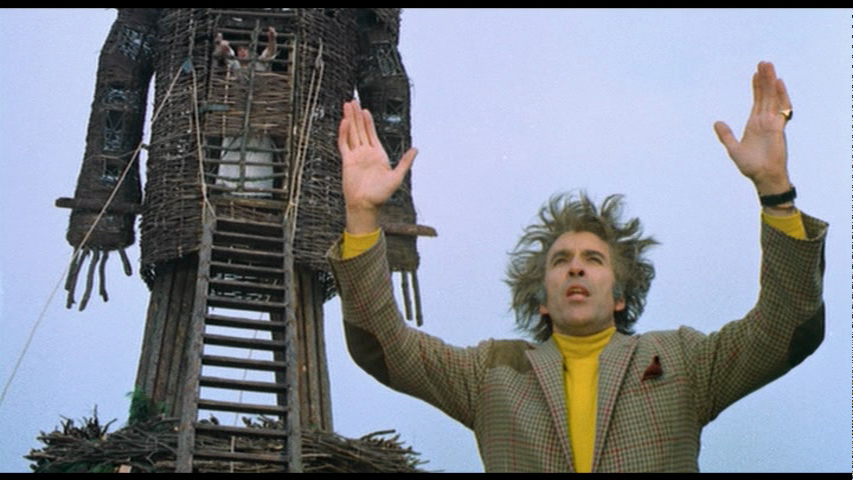
In addition to Sleepy Hollow, I’ve also been interested in holiday horror.  This is the theme of my forthcoming Wicker Man book, and I’d toyed with the idea of writing a book on the topic in general.  I knew there was a movie called Happy Horror Days, which I felt compelled to watch for any scrap of academic respectability.  (If a title tells you it’s directly on your topic, well, you investigate.)  I managed to make it to the Fourth of July before this truly execrable film just clearly became a waste of time.  The stories feel incomplete and the racist undertones (which may have been an attempt at social commentary) or that final episode left such a bad taste in my mouth that I had to walk away.  I’m not such a horror fan that I’ll watch just anything, but I don’t like to read spoilers before I watch movies.  It’s a dilemma, but to make good use of limited time I may start walking out more often.  Especially if it’s free.


Annihilated

For a long time I resisted seeing it.  Partially I wasn’t sure if it was any good and partially—mainly—it was because of spoilers.  Annihilation came out in 2018, just as I was reading Jeff VanderMeer’s novel upon which the movie was based.  I will always remember this because I worked in a cubicle where I couldn’t see my fellow workers and the woman in the next cube was a bit of a chatterbox.  She and one of her coworkers had seen the movie and began discussing, somewhat loudly, what’d happened.  I was in the middle of the book at the time and didn’t want any spoilers.  I’d never actually met the woman in the next cube and I couldn’t go over and tell her to stop talking about the film because one of the reasons we watch movies is to talk to one another about them.  (Mostly I do this online.)

Enough time has passed, and a different woman at work, remotely, suggested I see it.  I don’t know why the movie did so poorly at the box office.  The director, Alex Garland, has said he didn’t reread the book as he was making the film because he wanted it to be impressions of the novel rather than strictly based on it.  Even as I watched, I recalled some of what I read back in 2018.  I’ll try to limit spoilers here, but if I’m talking too loudly you can just click away (and, hopefully, come back after you’ve seen it.)  It begins when a mysterious “shimmer” appears after a meteorite strike in Florida.  Those who enter the shimmer never come out.  A team of women scientists are sent in, wondering if gender might make a difference.  One of them, Lena, volunteers because her husband did make it out and almost immediately went into a coma.

A sci-fi horror movie, I wonder if it underperformed at the box office because it stars women.  The tension builds between them as they try to figure out what’s going on within the shimmer.  Species have mutated rapidly and the predatory animals are pretty frightening.  The threat, as in VanderMeer’s novel, is ecological.  The ending, I’ll say, is quite different from the book because it was intentionally written as a trilogy and the director wanted to resolve the tension in a single film before reading the other two (which I still haven’t done).  The end result is thoughtful and tense.  The acting is good and the effects are stunning.  I’d class it with Arrival as an intellectual exploration of what it means to be part of a universe we barely begin to understand.  And kudos for having women lead the way.


Not in My House

I had a friend in seminary—nameless here because I mention no non-public figures without their permission—who invited me over for movies.  Although he was more of a comedy guy, he liked horror too and I couldn’t help but think of him when watching House (the movie, not the doctor show) recently.  The film looked familiar to me but I couldn’t recall having watched it before.  By the end I was pretty sure I’d seen it with my seminary friend one weekend afternoon.  There was too much I remembered someone else commenting upon.  A comedy-horror, House is one of those not-so-great movies that becomes a cult classic.  The monsters aren’t particularly scary, and the plot’s a bit disjointed, but still it bears repeating once every few decades.  There really isn’t any religious imagery, but it does reflect on American involvement in Vietnam.

Roger Cobb, a divorced horror writer, moves into the house where his favorite aunt died by suicide.  It’s also the house where his young son went missing years ago.  The titular house, which is, of course, haunted, is where Roger plays out his memories of Vietnam while trying to write his next book.  Monsters pop out of closets and show up at his front door as he tries to make sense of what happened to a friend in the war.  I couldn’t help but be reminded of Mark Z. Danielewski’s House of Leaves as mirrors and doors open onto voids that confuse the narrative but make the film like a funhouse ride.  My friend, with whom I must’ve seen it, commented on several of these scenes, which is what convinced me, by the end, that this wasn’t a new film for me.

I watched monster films as a kid—I was a late monster boomer.  Kids talked about prominent horror in school—Rosemary’s Baby, The Exorcist, The Omen—movies I didn’t see until I was an adult.  I watched a few horror movies in college and quite a few in seminary.  I moved away from them until I lost my career and then I came running back.  I’m not really sure what I’m looking for here in this haunted house.  Like most people, I don’t like being afraid, but there seems to be something hidden here.  Horror can convey meaning, even solace.  Very few people understand my use of horror for spiritual development, but it’s something with very deep roots.  And as realities in the quotidian world become more and more untenable, I’ll have at least have had some experience grappling with monsters.  Sometimes even with friends.


Skin Deep

The thing about art-house movies is they’re meant to be discussed.  I spend a lot of time alone and I watch most of my movies alone.  There’s a kind of danger in that, I suppose.  Under the Skin was recommended by one of the books I read, analyzing horror.  I knew nothing about it and it became clear from the opening that director Jonathan Glazer had been heavily influenced by Stanley Kubrick.  In particular, 2001: A Space Odyssey.  There’s also the question of genre—is it science fiction or horror?  Art-house goes without saying.  The story is minimal and the movie is about images.  Even so, Glazer spent years working on the script.  The results won critical acclaim but box office failure.  We know the feeling.

So what is Under the Skin about?  Quite a bit is implied rather than stated outright.  The woman—the characters are generally unnamed—is an alien trying to learn about, while living off of, humans.  Early on she learns that sex appeal will nearly always entrap men so that they can be used for food.  Much of the film involves her driving around Scotland, seeking victims.  She has a co-conspirator who goes around making sure she leaves no traceable clues.  Conversation is minimal and shots linger to a point that viewers might feel the need for some explanation.  When she finds a victim with a deformity, the woman begins to learn empathy.  This victim is apparently set free, but is rounded up by her companion.

The woman tries to befriend a kindly man who tries to help her.  She can’t eat human food and doesn’t know to wear a coat in a Scottish winter.  The intimacy scares her and she comes across a logger in the forest with rape on his mind.  When he discovers she’s not human, he burns her to death.  Her companion, apparently seeking her, has no idea where she’s gone.  Roll credits.  As I say, the story is conveyed by the images and they stick with you.  The beautiful Scottish scenery can’t help but appeal to someone who’s lived there for a time.  The movie leaves you reflective and in the mood for conversation, the way art-house films do.  It’s also another example of Euro-horror.   This has captured my attention of late since it’s generally intelligent and light on the violence.  It makes you think.  Critics loved it, but the paying public didn’t want to hand over cash to see it.  That means, in my private calculus, that it’s well worth watching.


Disappearing

It might be easy to suppose that horror uses religion gratuitously.  Or it may be that the connection runs much deeper.  Yes, many people are still religious as growing numbers are becoming less so, but both kinds watch horror.  As is usual for a guy who doesn’t get out much, I learn about movies often by reading about them in various analyses.  That’s how I came across the box-office flop, Vanishing on 7th Street.  While various critics point out its flaws, to me it watches like an extended Twilight Zone episode, exploring interpersonal dynamics when a bad situation overcomes a community.  For reasons unexplained, people without a light source disappear.  This is somewhere not too far from Chicago, but we don’t know exactly where.  Five people have managed to survive and four of them end up in a bar that has power because of a back-up generator.

Jim, an African-American boy, is waiting for his mother to return to the tavern.  She was the bar tender but had run to the local church to find other people because the lights were on.  She didn’t return and three other people make their way to the bar.  Disagreeing on a course of action, or what has happened, they try to work together to stay in the light.  Jim eventually makes a break for the church.  He alone manages to survive there until daylight reveals a young girl named Briana, spotted throughout the movie, with a solar-powered flashlight.  The others have all vanished, so Jim and Briana decide to try to make it to Chicago together as night falls.

Wikipedia calls the film “post-apocalyptic,” but I would say it’s more metaphorical.  The only two characters to survive do so by finding refuge in a church.  No prayers are said, but candles keep the darkness and its dangers at bay.  There’s plenty to reflect on here, even though we don’t know what has led to this situation or why the shadows snatch people, leaving rapture piles of clothes all over the place.  Not a fast-paced movie, it’s a film with only one jump-startle and plenty of time to think.  That was my take on it.  Not all horror has to be slasher-oriented.  I was really puzzled why this one ended up with an R rating.  Sometimes horror just makes you think.  Often that thinking involves reflections on the meaning of life.  Some would call that philosophy, but those who consider the light and its relationship to darkness tend to call it religion.


For the Eyes

A Welsh horror film?  Lately Euro-horror has caught my attention.  European sensibilities give horror a distinctive flavor, and The Feast doesn’t pull the usual horror tricks.  And reading the subtitles keeps you on your toes.  It’s more a slow build that manages to be unnerving from the start.  A family of four—parents and two boys in their late teens or early twenties—is hosting a feast.  A local girl, Cadi, is hired to help cater the affair.  The family is really seeking to get a neighbor to allow exploratory mineral drilling on her land.  She refuses, horrified when they mention that they’ll only drill on the rise.  The neighbor, aghast, says they know better because they’ll awaken “her.”  The unnamed her is a goddess who is within the rise and who’s been disturbed by the family’s drilling on the land adjacent to their neighbors’ property.

A number of aspects push this beyond Euro-horror.  The goddess, treated as superstition by the family, introduces religion into the horror.  (Cadi, as it turns out, died on her way to the house and the goddess inhabited her body.)  The remote location and role of the countryside also bring this into the folk horror realm.  Having an underlying ecological message, the film is eco-horror as well.  As such it has a positive message, even as all those at the feast, apart from the uncompromising neighbor, die before the evening is out.  Gods will express their wrath.  Although there’s gore, the concept is intelligent and possessed Cady’s unwillingness to speak throughout much of the film adds to the tension.

Horror films with subtitles sometimes don’t work, but The Feast manages pretty well.  Much of the disturbing atmosphere comes from the house.  A modern construction, built over what had formerly been the family’s farm, stands in stark contrast to the natural world all around.  As is often the case in eco-horror, the land is waiting to take its revenge.  It’s a message appropriate for a time when we fail to live up to our own environmental standards, and consider the checks and balances of nature itself as “superstition.”  Maybe a goddess will not awaken and kill everyone at the dinner party, but the wealthy will not be spared, as the movie prophesies.  We share the planet and the earth allows us to survive.  There’s a sense that we deserve to be reminded that living on a finite planet requires careful stewardship of it all.  If you’re going to throw a feast, at least make sure it’s not at the expense of nature.  Some goddesses are best not aroused.


Not Relic

Someone somewhere sometime recommended The Relic to me.  I can’t recollect who, where, or when, so I’m not sure in which direction to point the blame.  (Or maybe they recommended Relic…)  Weekend afternoons are drowsy times, and rather than sleep, I prefer to watch movies.  Those on my wish-watch list don’t often coincide with what’s on the streaming services available to me, so I try to recall those recommended to me at some point.  I mean, The Relic sounds like it should be good: a Meso-American god that’s part lizard, part beetle, and part mammal rampaging through a major museum?  Well, what’s not to like?  Monsters are usually fun.  This one requires hormones from the hypothalamus to survive, so it beheads people to get at their brains.

Now, if you’re not a fan this will sound goofy to you.  The thing is, in the right hands such a film could be very good.  I hear that the novel upon which it’s based is.  Unfortunately the script and the acting don’t really hold up.  The sciencey explanation doesn’t make sense—the evolution from eating certain leaves is too rapid, outpacing even the monsters in Evolution.  And when we learn that the mammal DNA comes from a human, it raises the question of whether indigestion was mistaken for evolution.  Of course, the monster—shown a little too early—is a chimera.  Since it’s part bug and part gecko it can walk up walls, which is admittedly pretty cool.  But the holes in the plot don’t ever really get filled so it’s a lot of running through tunnels in the dark with flashlights.

When I read the description that it involved a god-monster I thought I’d figured out why it’d been recommended.  Religion and horror share gods and monsters, so I thought maybe something would’ve been made of this.  The scenes where the carving of Kothoga is being prepped make no sense—you use carving tools to excavate fossils, not statues—and we learn nothing of this intriguing deity beyond that it was released to eat your enemies brains and when it ran out of brains, it dies.  Of course, it can eat leaves as well.  Ironically and paradoxically, the film makes me want to read the novel to get a fuller explanation.  The combination of gods and monsters is rich territory to explore and when those making a movie credit the audience with enough intelligence to make this work, it might be enough to keep you awake on a drowsy weekend afternoon.  Or it might keep you awake even if they don’t.


Pods

Some cultural assets (ahem) are so well known that you come to know them by association.  I knew the story behind Invasion of the Body Snatchers (1956 and 1978) long before I saw the original, within the last couple of years.  I may have been body-snatched myself since I can’t remember when it was or why I didn’t write a blog post about it.  In any case, I’d long been curious about the remake and discovered it free (for the time being) on Amazon Prime.  The fact I’m still looking for free stuff proves I’ve not been body-snatched, I guess.  If you’ve been raised with our cultural assets you know that the eponymous body snatchers are pod people who look exactly like the victims they destroy.  Their goal is a well-ordered society with no emotions.

The thing that’s so interesting about the 1978 version is that its assessment has changed over time.  When it first came out, many thought, and opined, that the 1956 black-and-white version was better and this one really added nothing.  However, over time this judgment has been questioned.  Critics taking a second look have now scored it as one of the best remakes ever made, and not only that, but it is considered one of the best science-fiction horror movies of all time.  I suspect nothing in that category will ever displace Alien, but still, my first viewing of the ’78 Body Snatchers agreed with the latter assessment.  It is quite good and it has even aged well.  You can kind of guess how it’s going to end, largely because the final scene has been played over and over, but still it’s definitely worth watching.

The social commentary in the film runs deep and strong.  Non-conformity is suppressed.  Life without emotions is better than really feeling something.  Simply go along because everyone else does.  The parable has changed actors over time—fascination with social media/virtual reality have perhaps become the modern pods—but the story is as old as our species.  Probably even older.  It’s non-conformists, generally after their demise, that are realized as visionaries.  Shooting a car into orbit requires tons of money but not much vision.  I’m not conforming, however, when I agree that the 1978 remake is good.  My taste in movies has always stood apart from others, at least from my own experience.  I also think that horror is often among the more intelligent genres of film.  But then, I tend to side with the emotional.


In the Dark

I’ve read several of W. Scott Poole’s books, and each time I read one I want to read another.  Dark Carnivals: Modern Horror and the Origins of American Empire is my most recent.  At first I was a bit reluctant to pick this one up because I misunderstood the “carnivals” of the title.  I don’t find clowns scary and I’m not really a fan of carnivals.  I didn’t make the connection with Ray Bradbury’s early story collection Dark Carnival.  Bradbury?  Well, why didn’t you say so?  But there is serious darkness here.  Poole traces the history of the American empire alongside the truths that horror films reveal.  This isn’t an easy book to read despite Poole’s fluid style and literary gifts.  Historians are uniquely placed to find truths that our country has so carefully hidden in our efforts to make ourselves the international “good guys.”  In unflinching terms, Poole traces the darkness of our acts, domestic and abroad, that have created so many dark carnivals.

The first couple of chapters are nearly impossibly good.  The entire book is insightful, but as is often the case with pop culture I find my experience limited to movies and novels of the horror genre.  There is absolutely fascinating stuff here.  It really begins with Harry Truman, but Poole traces how Ronald Reagan’s presidency was in many ways guided by science fiction authors who projected proudly the idea of America dominating the world.  Even to the point of becoming fascists.  Often confusing movies for reality, Reagan prided himself on being an empire builder who was a boon companion to the rich while keeping the poor exploited and un-empowered.  And it hasn’t just been Republican presidents who’ve done this (although they are clearly the most egregious offenders).  There are many moments of pause and reflection in this book and much of the horror comes from history rather than horror films.

Poole has made a name for himself as an analyst of politics and horror.  Very few “innocent” stories are as guileless as they appear to be.  Empires demand loyalty and must be constantly fed.  And they are extremely hierarchical and oppressive of those beneath the level of influence in their considerable power structures.  Dark Carnivals is a brilliant and disturbing book.  It did, however, take me down an avenue that Poole himself doesn’t explore.  Ray Bradbury was pretty much a Democrat until Reagan.  He wholeheartedly bought into Reagan’s false narrative and became friends with Republican presidents.  The disconnect from the man who wrote such masterpieces critiquing this kind of thinking caused a bit of personal whiplash for me.  His own dark carnival had drawn him onto that insidious merry-go-round.  Even the insightful can be lured by the tempting power of empire.


Deep Life

I have a list, you know.  It grows frequently and changes with my moods.  It’s a list of movies I want to watch.  While I never trained as a movie critic, there comes a time when you’ve watched enough, and written about them, that you can’t help but feel you have something valuable, perhaps, to say.  Movies are modern mythology.  At least if they’re done right.  Being a critic of limited means, I often paw through Amazon Prime’s list of freebies for subscribers.  Seldom is anything on my list there, so I try to find interesting offerings for free.  Sometimes they’re lousy (but at least free) and other times they’re provocative and perhaps profound.  Vivarium is a European film that slots somewhere between horror and sci-fi.  It’s like The Truman Show meets Village of the Damned while at a party thrown by the Stepford home owner’s association.  It’s one of the profound ones.

Tom and Gemma, a young couple, agree to see a house that an odd realtor insists they look at.  In a planned community of identical houses, the couple find themselves abandoned and unable to escape.  The house can’t be destroyed and food mysteriously appears.  Then a baby is delivered to be raised by the couple.  The child grows quickly, aging about 10 years in 100 days.  Tom decides to try to dig out while Gemma tries to care for the strange boy.  He mimics them and screams if he wants something.  Tom digs until he sickens.  He finds a body at the bottom of the hole and shortly thereafter dies at Gemma’s side.  The boy, now in his twenties, puts Tom in the hole he dug.  When Gemma attacks him he crawls under the pavement and she follows, only to discover other houses with other trapped parents.  She dies and the boy throws her into the hole and buries her with Tom.  He then replaces the realtor, waiting for other couples to come looking for a house.

The film is full of both existentialism and social commentary.  The boy tells Gemma as she’s dying that mothers raise their children then die.  We learn about two thirds of the way through that the boy is not human.  What he is is never explained.  This is the kind of film I would’ve found mind-blowing in high school.  It’s still very intriguing and will require some thought.  It’s well made, with high production values, unlike much of what I find scrolling through Amazon Prime.  It’s a film worth talking about.  And profound.


Jason’s Javelin

This past weekend was my third this year spent recovering from vaccinations.  The shingles jabs were worse, but this time it was a double-duty flu shot and bivalent Covid vaccine.  That’s as good an excuse as any for admitting to watching Friday the 13th, Part II.  In general I’m not a fan of sequels, but I’d read quite a bit about this one and I was curious because I hadn’t realized before watching the first installment years ago that Jason wasn’t the original killer.  I’m also not a fan of slashers, and I know that many people who dislike horror think all horror consists of such movies.  (It doesn’t.)  But still, Jason is a household name as a movie monster and I was having trouble concentrating with all those vaccines swirling around inside.

Utterly predictable, there are still a few jump startles that’ll catch a first viewing off-guard.  All I really knew about the film was Jason and Camp Crystal Lake and that generally teens get killed for having sex.  As many critics report, this kind of horror tends to have a “conservative” outlook—“sin” is brutally punished and the girl who refrains tends to be the last survivor.  That much you know just from doing your homework.  So as Jason hunts down the teens and dispatches them, along with a police officer and a crazy guy, you almost get bored.  There was one scene, however, that had unrecognized biblical roots.  Interestingly, I haven’t found anyone pointing that out.  When Jeff and Sandra go upstairs for sex, Jason takes a spear and thrusts them through, right in the act.

Analysts trace this scene to the movie Bay of Blood (which I’ve not seen), but in fact the inspiration comes from the Good Book.  In a genocidal mood in Numbers 25, Yahweh tells the Israelites to kill the Midianites among them.  Zimri is seen taking Cozbi into his tent, and Phinehas the priest grabs a javelin, rushes into Zimri’s tent and skewers the two of them in the act.  That scene stuck with my young mind as I read through the Bible, which is probably why it immediately came to mind while watching Part II.  Others may well have noticed this connection, but with the vaccine-induced lethargy I didn’t have the energy to go thumbing through my library to find it.  Besides, when I read things about movies I haven’t seen, they don’t often stay with me (which is one reason I give thorough descriptions of movies when I analyze them in my books).  This particular horror over, I know I don’t have to worry about the flu this year.