and Seek

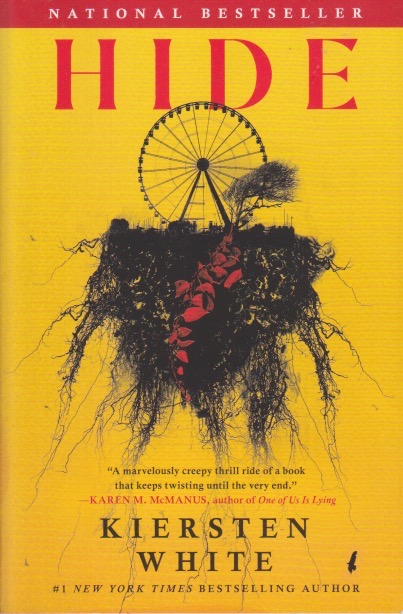
I’m afraid there may be spoilers—but not for the ending—below.  Discussing this story will be difficult without giving some things away.  Kiersten White’s Hide has given us an imaginative world with masterful misdirection.  Fourteen people a bit down on their luck, and strangers to each other, are offered an opportunity to win $50,000.  They have to hide in an abandoned amusement park for a week where two of them will be caught each day and the last person remaining wins.  The novel mostly follows Mack, a woman whose father killed her family while she survived by hiding.  Not only does she have survivor’s guilt, but she’s been homeless and the shelter director thinks she’ll have a chance at winning the prize.  There is a lot of social commentary here, as well as a monster.  Okay, spoilers below.

The minotaur is a most useful monster.  The backstory here isn’t in Greece (well, the deep backstory is, but that is only played out partially here) but in Asterion.  No state is given for the town, and the contestants can’t be given that information.  They’re locked in the park, with supplies, but very little information.  Then the contest starts.  After a couple of days Mack and a couple others begin to suspect that something’s wrong.  Those who get caught while they’re hiding leave personal effects behind, and since they all need the money that seems unlikely.  Then their host stops coming, leaving the bewildered contestants on their own.  Mack and those she’s befriended come to understand that being “out” is really being eaten by the minotaur.  Well, they don’t realize it’s the minotaur.  The one who does gets eaten before he can tell.

In any case, this is a tense horror story based on a classic tale.  There is, of course, a rationale for the murderous behavior in a modern setting.  White keeps you waiting quite a while to learn what it is, and there are plenty of places where I thought I’d figured out how it’d end only to be proven wrong.  And she gives believable character sketches and explores the kinds of motivations that drive different people who find themselves needing an income.  (One of the characters was raised in a religious cult—bonus!)  Those who are poor aren’t always at fault, but those who are wealthy will do anything to preserve their excess.  We see that playing out in daily life, even as it’s being explored in fiction.  The minotaur isn’t always what we think it is.  And the more you think about its insidious origin story provided here, the scarier it becomes.


Non-Demon

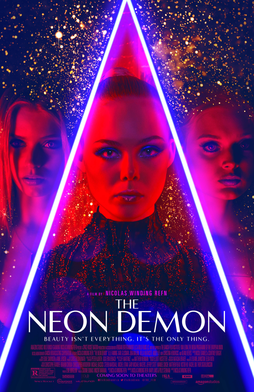
The psychological horror film The Neon Demon isn’t about a literal demon.  It’s a movie about rivalry between runway models in Los Angeles, but there isn’t a great deal of story.  And what story is told doesn’t really make sense.  Sixteen-year-old Jesse, who should probably technically be an orphan, has made her way to LA because all she has is her prettiness.  Some photos get to an agency that agrees to hire her.  The other young women become jealous of the attention Jesse receives.  Only one, Ruby, a make-up artist, befriends her.  The jealous models confront her, and the creepy hotel manager where she stays seems to prey on the women who are trying to break into the dream of the city of angels.  Jesse escapes to Ruby but Ruby’s interested in a sexual relationship that Jesse doesn’t want.  Ruby and two rival models kill Jesse and eat her.  This leads to the death of Ruby and one of the models.

Some of what I describe here is speculative since there are abstract, dream sequences thrown in and it’s not always clear what is going on.  I kept finding myself wondering if this was horror, as presented in the list where I found it.  The unrelenting male gaze could be considered horror for women, but the movie doesn’t take up that narrative.  There are a few male characters, and one of them actually seems to be a good guy, but the threat comes from the other women.  Reviews for the movie were deeply polarized.  Some declared it one of the best movies of the year (2016) while others gave it abysmal ratings.  At the box office it earned about half its budget back, and that budget was a respectful seven figures.

Horror is a difficult genre to define.  I keep coming back to the fact that it’s artificial.  The history of the term began with monster movies but eventually other films with dark themes were included.  Some have no monsters unless a human acting aberrantly counts (and some do count such as monsters).  Slashers have their serial killers and gothic tales have their haunted houses.  Well over seventy sub-genres of horror have been defined.  Casting about for freebies on the weekend leads to some that you just can’t pin down.  Neon Demon does, ultimately seem to fit the label, but many viewers will probably wonder exactly how.  Being out on your own can be frightening, and cannibalism is creepy, so I’ll go with that.


Institutionalized

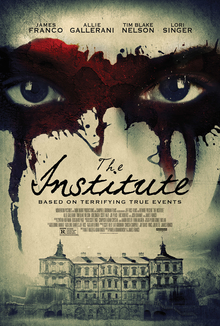
When movies set out to present a different period, a bit of historical research can go a long way.  Someone like Robert Eggers offers such verisimilitude that you feel like you were at the intended time.  Others are less successful.  The Institute claims to be based on true events, and, apparently human trafficking did take place at the Rosewood Institute for a number of years.  The movie, however, gets many period details wrong and suffers from a labyrinthian story.  Also, it is shot so dark that even with brightness at full it’s difficult to tell what’s happening much of the time.  So what are these allegedly true events?  Wealthy women are admitted to the fashionable institute to recover from mental stresses.  At least that’s why Isabella Porter is there.  Drugged by the fictional Aconite Society, she is trained to be impervious to pain, erase her identity, and believe she is fictional characters to act in plays.  A strange premise.

Her brother suspects something is wrong, but under the influence of wolf’s bane, Isabella kills him.  The women are repeatedly tortured and dehumanized, ultimately to be sold to the wealthiest elites of Baltimore as slaves.  The true part of the true events is quite slim, and it’s never explained why Isabella is trained to believe that she’s Young Goodman Brown, and paired off with another woman as his wife Faith.  Also, there are Satanists involved.  With all the stops pulled out, the whole begins to sound rather silly.  It’s unfortunate since there does seem to be the core of a good idea here.  It needs a little less rather than more.

If all the storylines came together into a coherent whole, there might’ve been some takeaway.  As it is, layers of a secret society cover other layers and when you get to the center there’s nothing there.  Movies about mental institutions are difficult to pull off well, particularly when they’re based on true stories.  While a wolf-bane drinking society of the uber-wealthy does sound plausible, it leaves unanswered why they want their female patients to act out stories when they could easily afford to attend plays with professional actors.  ’Tis difficult to fathom.  The satanic aspect is never really explained but again, I wouldn’t put it past the rich.  The acting is good, from what I could see of it, except for the institute’s doctors, all of whom were woodenly portrayed.  Perhaps this was intended to be a parable, or maybe a retelling of “Young Goodman Brown.”  There was a bit of Poe thrown in as well, so all was not completely wasted.


To Dracula, a Daughter

Nosferatu, by F. W. Murnau, was deemed in copyright violation of Bram Stoker’s Dracula, and ordered destroyed.  Rights to the novel were properly purchased by Universal and the horror film proper was born.  Other studios wanted to get in on the action, so the rights to the story of the Count’s daughter were bought by MGM.  They then sold the rights to Universal so that the latter could produce a sequel to their earlier hit.  Dracula’s Daughter didn’t do as well as the original, but it kept the vampires coming.  Some years later, Son of Dracula came out, keeping it in the family.  Having watched Abigail, I had to go back to Dracula’s Daughter to remind myself of how the story went.  I recalled, from my previous watching, that it wasn’t exactly action-packed, but beyond that thoughts were hazy.

Picking up where Dracula left off, von Helsing (that’s not a typo) is arrested for staking a man.  Then a mysterious woman arrives and steals the body to destroy it in an attempt to rid herself of vampirism.  We see that just five years after Dracula the reluctant vampire was born.  Creating a scandal at the time, Dracula’s daughter also seemed to prefer females.  Apparently the script was rewritten several times to meet the approval of censors during the Code era.  The modern assessment is that this is based more on Sheridan Le Fanu’s Camilla rather than an excised chapter of Bram Stoker’s novel.  Since the world wasn’t ready for lesbian vampires in the thirties, she falls for Dr. Garth, a psychologist that she wants to live with her forever.  Kidnapping his secretary to Transylvania, she draws him to Castle Dracula.  Her jealous servant Sandor, however, shoots her with an arrow.  Von Helsing explains that any wooden shaft through the heart will do.

Already as early as Stoker, at least, Dracula had brides who were vampires.  It makes sense that there might be daughters and sons.  And studios, learning that people would pay to watch vampires on the silver screen, were glad to keep the family dynamics rolling.  Vampires proved extremely popular with viewers—a fascination that has hardly slowed down since the horror genre first began.  Some of the more recent productions explore themes and approaches that simply wouldn’t have been possible in the early days of cinema.  We don’t see Dracula’s daughter actually biting victims—one of the many things the Production Code wouldn’t allow—and there’s no blood.  Nevertheless, the story itself went on to have children and they are still among us.


Stop for a Bite

Universal does monsters right.  I’m no movie maven but I don’t know why the whole Dark Universe thing didn’t work out.  These movies are good!  Abigail recently came to one of the streaming services I use and I watched it right away.  (There’s sometimes a delay between when I write about a movie and when it appears on this blog.)  There will necessarily be spoilers here.  I write this as someone who doesn’t watch trailers if I can help it, and who tries not to read about movies before watching them.  So be forewarned, if you are, by any chance, like me.  In case you’re bowing out now, this is a very good flick.

So, this is one of those spates of recent vampire movies where you go for quite a while before realizing it is a vampire film.  Set as a taut thriller, a group of six criminals who don’t know each other kidnap a twelve-year old ballerina.  She’s being held for ransom and the kidnappers have to keep her in the mansion for 24 hours, after which they each will receive their share of $50 million.  What they don’t know is that Abigail is a centuries-old vampire who likes to play with her food.  Suspecting they’ve been set up, the criminals speculate that the girl’s father has set his most vicious killer on them.  Modern, educated people, they don’t believe in vampires (there’s quite a bit of shading from Dusk Till Dawn in here) but they have to figure out how to defeat one.  Like Dusk Till Dawn, they ask themselves what they know about vampires, trying to come up with a plan to survive the night.  As you might expect, a bloodbath ensues.

If you’re the kind of person who reads about movies first, you’ll know, as I didn’t, that this was planned as a remake of Dracula’s Daughter.  It’s been so many years since I saw “the original” that I scarcely remember it.  (So you know what’s coming, eventually.)  I’ve watched many monster movies—like the books I’ve read, it’s so many that I lost count long ago.  Many of these films are pretty good.  And, of course, there are many I haven’t seen—that depends on money, time, and circumstance.  I do have to note, however, that coming up on the centenary of Universal monster movies, they haven’t lost their touch.  I have no idea what happened to their Dark Universe, but I do get the feeling they maybe gave up on the idea a little too soon.


Undead Again

I had intended to see it in the theater, but holidays are family time.  And not everyone is a fan of horror.  Last night I finally did get to see Robert Eggers’ Nosferatu.  Eggers is a director I’ve been following from the beginning.  Here’s a guy who pays very close attention to historical detail.  No slips in letting modern language expressions creep in.  Costume and setting designs immaculate—nothing incongruous here.  I was surprised that he was taking an established tale that’s based on a technically illegal film from Bram Stoker’s Dracula as his starting point.  Still, I’m looking forward to Werwulf, probably about two years from now.  (And speaking personally, I’d love to see his take on Rasputin.)  In any case, Nosferatu.  I avoided trailers and online discussions because I wanted to come to it fresh.  He’s managed to make a disturbing story even more disturbing.

If you’re reading this you probably know the basic story.  F. W. Murnau’s 1922 Nosferatu was in violation of copyright of Dracula, and so the basic story is similar.  Eggers manages to bring to the fore the vampire as sexual predator angle.  He prefers to bite chests and take long, slurping drinks.  I said it was disturbing.  And Orlok really looks the translation of the title, “undead.”   Even at over two hours Eggers has difficulty fitting in all the elements of the story.  And there are some unexpected aspects thrown in as well.  In my mind, I couldn’t help compare it to Werner Herzog’s remake.  Both are art-house treatments of Murnau’s work, which was itself German expressionism.  All three are memorable in their own way.

The one character I didn’t fully buy was Willem Dafoe’s von Franz (the van Helsing character).  This often seems a difficult one to cast.  In Bram Stoker’s Dracula Anthony Hopkins just doesn’t do it for me either.  It must be difficult to pull off eccentric but deadly serious.  The unsmiling obsessive.  That, to me, would be even more disturbing.  Ellen Hutter’s fits are amazingly done and there’s a menace to her melancholy that really works.  I’ve never seen Lily-Rose Depp in a film before, but she seems poised to become a believable scream queen.  I was exhausted after watching the movie after a long day at work (there’s a reason to see things in a theater over the holidays, I guess), but after a night of strange dreams, I awoke to find myself wanting to watch it again.  That’s the way Eggers has with films.  They reward multiple viewings.  And although this story’s familiar from the many versions of Dracula out there, it emphasizes some elements that have, up until now, often only lurked in the shadows.


Sounds Funny

It may be the strangest vampire film ever.  Lifeforce not only postulates the origins of vampires as beings from space who come to suck humans dry of their souls, it also plays off of Invasion of the Body Snatchers, any number of zombie films, and Alien, all with a score by Henry Mancini.  Patrick Stewart is in it, but the plot makes very little sense.  Although it didn’t perform at the box office, it has become a cult film, and some parts of it are actually pretty good.  Directed by Tobe Hooper and partially written by Dan O’Bannon, there was some real talent involved.  Too bad it just can’t seem to hang together.  The main reason seems to be the story-line.  It’s based on a novel, but not all novels translate to film so well.

What’s interesting is that it attempts to provide an origin story for vampires.  When the crew of the Churchill initially discovers the alien ship, the creatures are bat-like.  This intends to explain why vampires are associated with bats.  Since these beings had come to earth long ago, their association with sucking people dry, and bats, led to the belief in vampires.  Of course, following the logic of the story, vampires should’ve nearly taken over the earth before since victims revive after two hours and victimize those nearest them.  Only one scientist in this future London can uncover a specific combination of metals that have to be used to stab a vampire in precisely the right location in order to kill it.  Meanwhile the souls of thousands of residents of London are being sucked up to the alien ship.

The score for the movie also rings a bit oddly.  Henry Mancini isn’t the first name to come to mind as a composer associated with horror movies.  Or science fiction.  Even G-rated 2001: A Space Odyssey knew that.  Perhaps we’re lulled into thinking nothing of it by big studio productions that make the soundtrack sound natural to the movie.  Like all of the elements of a film, however, they really have to work with all the other elements to make something spectacular.  Lifeforce had a large budget and nevertheless struggles.  Tobe Hooper had just come off of directing Poltergeist, which, although never one of my favorites, was a stronger and more lasting entry into the horror canon.  Maybe it’s that vampires and space just don’t mix.  Vampires are gothic monsters and that’s difficult to transfer to outer space with all its gadgetry.  That, and a score that’s difficult to take seriously.


The Power of

One rare treat is rediscovering something that intrigued you as a young person, but which you’d completely forgot.  Living in a small town and seldom going to movie theaters, I had to have learned about Magic from television commercials.  I remember parts of the trailer, even down to particular phrases, but it was a movie I’d never seen.  I forgot about it.  That’s not to say that in the intervening decades I might not’ve relived that trailer in my head—I’m sure I did—but since I began binging on horror films a few years ago, it never occurred to me.  I remember it scared me as a kid because the trailer consisted of a monologue by the ventriloquist’s dummy.  Herein hangs the tale.  The movie did reasonably well at the box office but nobody seems to discuss it much.  When it showed up on a streaming service, the thumbnail of Fats’ face transported me back to the seventies and I knew I had to see it.

I have a soft spot for seventies horror.  I was surprised to learn that Anthony Hopkins and Burgess Meredith were in it.  And Ann-Margaret.  A movie about a stage magician going mad, I found that it kept me tense.  I didn’t know how the story went.  In case you’re curious, it goes like this: Corky, a stage magician with a ventriloquist act, is about to hit the big times.  He then flees to his childhood Catskills and finds his high school crush managing a remote, rundown resort.  She’s in a loveless marriage and Corky has trouble with women.  Two things become clear: his dummy says what he (Corky) really feels and Corky is seriously disturbed.  Fear of being found out leads him to murder and although Peg, his crush, really liked and likes him, he can’t separate himself from the dummy.

There’s an ambiguity here.  There are a couple scenes when Fats moves on his own.  Otherwise there’s nothing supernatural going on here.  That raises the question of whether the camera is lying or whether spooky action at a distance is taking place.  Overall I thought the movie was well done.  I wouldn’t have tolerated the language Fats uses when I was younger, but I did think Hopkins’ acting was quite good.  Playing a person struggling with a mental disorder requires some convincing acting to be bought.  And there was a feel to many seventies horror movies.  This one brought me back with the power of suggestion, and perhaps a little magic.


Somehow Inevitable

You had to expect me to write about Zontar: Thing from Venus.  I bought the “Beast Collection” set to see it many years ago.  In those days I tried to watch the movies through, in order but I didn’t make it through the first disc, even.  Well, now my perspective has changed—I figured I bought this to see Zontar, and Zontar I must see.  You do know that he controls people, right?  Zontar is a notoriously bad movie.  I saw it on television as a kid, and it may have even been close to the first run since it was made for television.  It’s actually a remake of a cheap Roger Corman movie, so it is a cheap remake of a cheap original.  Nostalgia, however, does funny things to a guy.  Although I saw it half a century ago, I remembered some lines precisely.  Television does funny things to young minds after all, I guess.

In case none of the injectapods has found you yet, it goes like this: Zontar, from, well, Venus, is a bat-like monster with three eyes.  He befriends an earthling outsider scientist, through laser communication, and commandeering a satellite, which becomes a passable flying saucer, lands in  a cave from which he takes over the small town of Jackson, which has a military base and plans to take over by having a general assassinate the president.  Meanwhile, his scientist friend directs Zontar to the four people that he needs to take over the world: said general, the sheriff, the mayor, and his best friend scientist, Curt Taylor.  Things don’t quite go Zontar’s way, despite most of the movie’s running time showing him totally in control.  It feels like it’s a lot longer than its 80-minute running time.

Still, I have to agree with the TV Guide review that says it isn’t as bad as everyone says.  Yes, it is a bad movie but it does have a few redeeming features.  Some of the scenery is nice, and you even begin to care for some of the characters.  The rogue scientist’s wife—despite her constant nagging—is the first person who tries to kill Zontar, and she does this for love.  When Zontar gets her you feel a little sad.  At least I did.  You see, the injectapods haven’t reached me yet and I still have human emotions.  Ironically, it is just such things that drive me to rewatch movies like Zontar all these years later.  And the movie ends with a voice-over moral of the story.  Those 80 minutes weren’t completely wasted.


The Search Continues

This movie’s so bad there’s a backstory.  Years ago I was really wanting to see Zontar: Thing from Venus.  This was before streaming, and I found it as part of the “Beast Collection,” a set of 11 movies for less than the price of one regular first-run DVD.  I watched a few other movies in the collection, but before long it got shoved to the back of a shelf and forgotten.  I remembered it recently because another collection I have was missing a movie, Snow Beast.  I wondered if it might be part of this otherwise forgotten set.  It was (this really encouraged me because maybe my memory is still much better than I sometimes suppose).  In any case, one of the other movies—one I’d never seen—was Search for the Beast.  I figured, why not?  This is a film that fails on every level.  And I mean every single one.  It really should merit a Wikipedia page, just for being so bad.

So, a professor in Alabama goes in search of the beast in the Okaloosa mountains.  The budget for the movie must’ve been a matter of pocket change.  Anyway, the beast has been “killing” anyone who ventures into the mountains and the professor wants to prove it exists.  He’s backed by a guy with money, who isn’t explained at all, and his university office is less well equipped than an average undergrad’s dorm room.  He takes a female grad student with him but his financier, unbeknownst to the benighted professor, hires a bunch of beefy guys with assault rifles to go along, although they’re only going to take pictures.  Of course the professor sleeps with the grad student but then the head of the tough guys kidnaps her as the beast kills off the tough guys’ heavily armed posse.  Turns out the local hillbillies are, apparently, trying to mate the beast with the women who come into the woods.  It’s worse than I’m describing it.

There is some chatter on the internet about this groaner, so I’m sure that I’m not the only one who’s seen it.  Someone recently asked me how such movies even get made.  Well, anyone with a camera can shoot a movie.  Of course, getting paid screen time (or video distribution) is another story.  I doubt the makers of this film made much money off of it, but since other suckers like myself have discussed it online, the producer, director, writer, and actor Richard Arledge, has the last laugh.  His work is being talked about, no matter if nobody has a good thing to say about it.  Of course, I wouldn’t have ever seen it at all, if I hadn’t had a hankering for Zontar: Thing from Venus all those years ago. 


Old Vampyr

Early movies are fascinating.  I learned of Vampyr, a 1932 production by Carl Theodor Dreyer, from Raymond T. McNally and Radu Florescu’s In Search of Dracula, where they praise it.  I’d never heard of it before.  There are probably a few reasons for that.  One is the movie was considered not very good when it was released, and it never garnered much of a reputation.  Another is that the original prints, including the soundtrack, had been lost.  Three language versions had been shot—German, French, and English.  Since this would obviously lead to lip-syncing problems, there is very little dialogue.  The movie as it exists today is accessible in the German version, and it tends to fall into that category that includes work by directors such as Ingmar Bergman and Stanley Kubrick.  It has art house elements and the story requires some pondering.  It isn’t bad, although in today’s viewing culture, it might seem dull.

It is a vampire story based on the works of Sheridan La Fanu.  The star, and also financier of the movie, was an actual Baron from France (in real life), Baron Nicolas de Gunzburg.  He plays a student of the occult who happens upon a gentry-class family plagued by a vampire.  Interestingly enough, this kind of character is distinctly Lovecraftian, and there is a passing resemblance between de Gunzburg and H. P.  The acting isn’t great, but the story is good.  It includes shadow people who assist the vampire—a female, in this case—and a kind of mad doctor who helps her reach her victims.  The occultist and the household servant of the gentry family locate the vampire’s grave and stake her.  And in a scene that may have inspired Witness, they suffocate the mad doctor in the bin of a flour mill.

Like many vintage movies, Vampyr has received a more positive reevaluation over time.  While some consider it great, the consensus seems to be more at the “very good” level.  It is an early vampire movie, apparently filmed before Tod Browning’s Dracula.  While not scary by today’s standards, there are some definitely creepy scenes.  Particularly when the elder daughter of the gentry family begins to become a vampire, leading to some quite effective facial expressions.  McNally and Florescu weren’t film critics by any stretch but they felt that, up to the early seventies, this was the best vampire movie made.  I might not go all the way with them, but I would suggest it is certainly worth viewing by those who like old cinema, and who appreciate vampire stories.


Black History

The first of the “blaxploitation” movies, Blacula is a period piece.  In 1972 vampires were still all the rage, following from Dark Shadows and the continuing Hammer hammering of the monster.  They even produced Dracula AD 1972, not to put too fine a point on it.  American International Pictures wanted in on the action and produced the first Black vampire in cinematic history.  Rather than a remake of Bram Stoker’s novel with a Black cast, the story begins with Mamuwalde, an African prince, entreating Dracula (whom he doesn’t know is a vampire) for help ending slavery.  Instead, Dracula turns Mamuwalde into a vampire that he names “Blacula,” and places him under a curse.  In the seventies, a homosexual couple purchases Dracula’s castle, intending to sell the contents on the antique market.  One of those antiques is a locked coffin.

Once he’s freed in America, Blacula quickly runs into Tina Williams, the spitting image of his long-deceased wife.  Meanwhile Tina’s friend Dr. Gordon Thomas, suspects that there is a vampire on the loose in LA.  Although the opportunity for camp is clearly present, this movie is played straight.  Mamuwalde is a monster—he kills several people—but his real motivation is to regain his dead wife, whom, he is convinced, is Tina.  When Tina is shot by a trigger-happy cop in the tunnels below a chemical plant, Blacula turns her into a vampire.  When she is staked, Mamuwalde tells the doctor that he need no longer pursue him.  He voluntarily climbs into the sunlight and dies.

Now, this wasn’t a great movie but it does seem to have a reasonable bit of social commentary.  It was the seventies, but racial and orientation slurs were still widely accepted.  And people dressed like, well, it was the seventies.  The Black characters, however, are portrayed with dignity, and Mamuwalde is presented as nobility.  Perhaps more importantly, this movie opened the doors for further horror films featuring African-American lead characters and plots.  A few decades later Blade, based on a comic book hero, would once again foreground a Black vampire who’s on the side of good.  It’s still some distance from Black Panther, but the process had to begin somewhere.  Watching Blacula was like watching history, and I suppose viewing movies is like a selective piece of history.  By this point AIP was well established, and influential in its own way.  I’d heard about Blacula since childhood, but until streaming it never really came across my screen.  Nevertheless it remains an important piece in this country’s ongoing vampire mania.


Red Dress

Horror sometimes takes a creative turn.  In Fabric is an art film as well as a horror offering.  The basic premise is that a certain red dress, sold at a bizarre fashion store, causes the death of those who wear it.  Sheila, recently divorced and having trouble with her adult, at home son, buys the dress for a date.  After leaving her with a rash, the dress leads to an arm laceration, a German Shepherd attack, an attack on her son’s girlfriend, and finally, Sheila’s death in an auto accident.  The dress is then picked up by a guy as a stag party prank where the groom has to wear it.  His soon-to-be wife finds it and wears it also.  The man, Reg, loses his job as a washing machine repairman and has no luck finding another.  While Babs, his wife, is shopping at that same strange shop, Reg’s furnace malfunctions, killing him with carbon monoxide.  Babs is trapped in the shop as it catches fire and burns down.  All those killed by the dress are shown working on new ones at the end of the film.

The movie is also called a dark comedy and there are some funny bits.  The sales clerk, Miss Luckmoore, speaks in cryptic, quasi-poetic style, never giving a straight answer to anyone.  The shop’s owner does the same.  And some of the scenarios are amusing.  Although horror, the movie isn’t really scary, but it is stylish.  Unlike some horror comedies, the tone isn’t really funny, but more wry.  And it’s a bit confusing.  The overall story arc is easy enough to follow, but some scenes just confound.  I kept waiting for an a-ha moment when everything would fall into place.  Of course, ambiguity is a hallmark of many intellectual films.

Something that I’ve been noticing, no matter the era that it’s from, is that films really need to justify that last half-hour, if they’re going for 120 minutes.  Maybe it’s just that we’ve become accustomed to the 90-minute feature, but I’ve notice that most two-hour movies (not all) seem to suffer from some pacing issues.  Of course, an art-house movie will defy conventions.  For example, the point of view is Shelia’s for about the first half of the film, then she’s killed and new characters are introduced.  Yes, this shows that the dress goes on killing, but another approach might’ve been to have the protagonist learn about past killings and realize the dress is coming for her.  But then, that might’ve been less creative.


Grown-up Jane

Watching Stephen King’s list of scary movies in the 30 years prior to 1980, I’ve found one or two that hardly strike me as horror.  Some of the others remain remarkably effective today.  I had the wrong idea about What Ever Happened to Baby Jane?;  I’d supposed from the title that it had to do with an abducted child, a topic I generally avoid.  When looking up yet another movie on Tubi that was free, but only in Spanish, I saw Baby Jane on offer and decided to give it a try.  I was pretty impressed.  It’s overly long and drags a bit, but the story is good.  One thing about horror films from the period is that they relied on story because the special effects really didn’t exist to make movies such as many we now see—splashy, but shallow.

In case you’re even more outdated than me, Baby Jane was a successful child actor whose sister grows up to outshine her.  Blanche, the sister, is crippled in a car accident that has been blamed on Jane for the last couple of decades.  Jane really can’t act, and once her sister is disabled, the two live on Blanche’s money until Jane’s growing insanity threatens her wheelchair-bound sister.  Trapped upstairs without any means of communicating with anyone who might help, Blanche is tortured and starved by her sister.  There’s an incredible amount of tension, even if the events begin to seem unlikely as the two hours roll on.  There are a few dropped subplots—the neighbor who harbors no suspicions at all, and the musician Jane hires who discovers her secret—but overall the tension keeps building.

One thing that occurred to me was that part of the plot involves leaving a phone extension off the hook to prevent Blanche from getting help.  I pondered how some young people who only know phones as personal devices might not understand this.  How, when I was a child that if you left an extension off the hook no calls could go in or out.  And that the annoying “off the hook” tone didn’t yet exist.  Ironically, now you could watch the movie on your personal phone that you carry with you at all times.  While this isn’t a perfect movie, it is an engaging one on many levels.  The sisterly rivalry, the growing insanity of Jane, and the helplessness of an invalid all work together to create some frightening moments.  Technology sure makes life convenient, but it cuts off some avenues for horror.  Of course, as Unfriended shows, it opens new venues.  I agree with King—this is one of the actually scary films from before the eighties.


Like Father

There’s just something about old movies.  After Universal discovered that Depression-Era people would still pay to see scary movies, they made a kind of industry of filming new monsters (for them) or spinning off of their successes.  Several years ago, when Universal was selling collections of their famed monster line up on DVD, I bought a few.  I realized recently that I had never watched Son of Dracula, included in the Dracula DVD set.  While it’s not a great movie, it’s by no stretch a bad one.  The story is complex and soulful, and even though Bela Lugosi’s not in it, the film participates in the ever-growing vampire lore.  It also introduced the world to Alucard, a character that would take off in Japan as a vampiric character in video games and manga.

Katherine, a well-to-do southern belle, met a Count Aculard while traveling in Eastern Europe.  He’s now visiting her in America, much to her fiancé’s chagrin.  A local doctor and friend of the family comes to expect that Alucard, Dracula spelled backwards, of course, may be a vampire.  He brings over a professor acquaintance from Hungary to test his hypothesis.  Meanwhile, Alucard, Dracula’s son, marries Kay and in so doing inherits her estate.  She becomes a vampire, which was her plan all along.  She, however, plans to turn her fiancé into a vampire, after they kill Alucard, so they can spend eternal life together.  The doctor and professor figure out what’s going on, but the local police don’t believe them and are ready to commit the doctor as insane.  Frank, the fiancé, refuses to go along with Kay’s plan, so he kills the Count by destroying his coffin before daybreak, and then also immolates Katherine as well, ridding the New World of vampires.

This is definitely a period piece, but it manages to have a southern Gothic appeal.  The black folk are all servants, and the Hungarian doctor sounds just like Peter Lorre, but the story is complex enough to retain interest.  Lon Chaney, as Alucard, doesn’t have as much screen time as you might expect, but there’s a lot going on in various subplots.  The movie was released in 1943, when there was still a ban on horror movies in war-time England.  The concern about invading foreigners is pretty clearly spelled out but the story is fairly well-told, even with some small holes remaining in the plot.  All of this makes me think I’d better check my other Universal monster DVDs.  There may be some other good bits that I’ve been missing.