Dark and Stormy Night

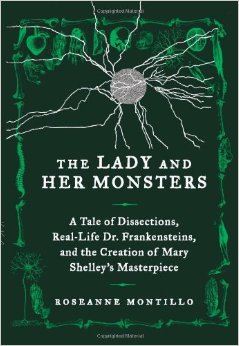
LadyAndHerMonstersI miss my monsters, especially when I stay away too long. I had eyeballed Roseanne Montillo’s The Lady and Her Monsters: A Tale of Dissections, Real-Life Dr. Frankensteins, and the Creation of Mary Shelley’s Masterpiece nearly a year ago in a busy Port Authority bookshop, and wanted to curl up with it right away. Well, work and the world intervened, but finally I found time for the beast. Although a member of the monster kid generation, as a child I never felt much kinship with Frankenstein’s creation. I think it is because there was so much human intention involved in his origins. Almost ungodly. Too godly. Vampires and werewolves, and even mummies, seemed to have come up on the wrong side of a curse and couldn’t be blamed for being what they were. Frankenstein’s monster had a willful, if neglectful, creator. A human being, and fully so. There was, it seemed, some kind of blasphemy at work here.

Montillo’s book, however, gives me pause to rethink this. I had never realized, foe example, that Shelley’s book unfolds over nine months, and that Mary Godwin Shelley had suffered as her own fate unfolded—or unraveled—after Percy Shelley’s death. Nor had I stopped to consider that in the lifetime of these young lovers scientists and poets were overlapping careers with philosophy holding them together. I also hadn’t realized that Percy Shelley also shared his beau’s enchantment with the fantastic. But Montillo gives us so much more, wandering through the seedy world of body-snatchers and scientists who experimented on the dead, often with an eye toward a secular resurrection.

Frankenstein’s monster has, of course, become an instantly recognizable fixture in our society. Indeed, it is almost the definition of monstrosity: the ultimate mischwesen while being technically only one species. A creature that crosses boundaries and is both dead and alive, a miracle and a curse, innocent and evil. Morillo places this creature in the context of a world where galvanism was thought to bring life and medical schools scrambled to find corpses to dissect and on which to experiment. A world where the Shelleys would visit Lord Byron and Polidori, literally on a stormy night, and give the world both Frankenstein and the prototype of Dracula. Where the three men of that night all died prematurely and tragically, survived by a struggling Mary who lived only to fifty-three and who gave the world one of its most memorable nightmares. Horror fiction was, and is, considered lowbrow entertainment, but there is something profound here. And we are richer, if more unsettled, for having it.


Map and Territory

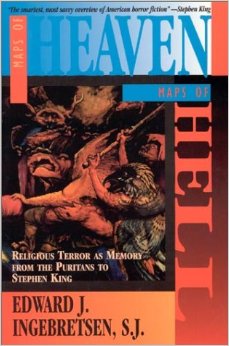
MapsHeavenMapsHellAt first glance the Puritan divines of early New England should seem to be as far from horror films, on the cultural divide, as phenomena can be. After all, academics long ago declared “genre fiction,” and particularly Gothic and horror fiction, to be lowbrow at best, and generally of no cultural worth. The amazing success of scary movies only underscores this point. Edward J. Ingebretsen (S.J.), however, begs to differ. His wonderfully insightful book, Maps of Heaven, Maps of Hell: Religious Terror as Memory from the Puritans to Stephen King, is a surprising study of how religion and terror share much that is essentially human. On this blog I have, from time to time, claimed that religion and horror are close cousins. In fact, they may be siblings. Since studies of Cotton Mather and Jonathan Edwards are often produced by Reformed, or at least Protestant, theologians, it may be that a Catholic thinker will catch aspects often overlooked. The Puritans, with their Calvinistic underpinning, had a worldview that holds much in common with standard horror fare. Ingebretsen suggests that to map Heaven, you must also map Hell.

The map conceit works well as the reader navigates through unconventional ways of thinking. The fears of the Puritans included the fear of God, and those who read or watch horror have noticed that nothing scares like the divine. It may not be on the surface, however. Even those not accustomed to deep digging can, upon a few moments’ reflection, see that the Gothic writers of the American canon have drawn repeated from this well. Many literary experts (well, some) celebrate H. P. Lovecraft’s atheistic rationalism, but enjoy his tales of the old gods nevertheless. His modern heir, Stephen King, is quite open about the potential fear of religion. He even blurbed the back cover of the book.

As society grows continually more secular, the religious impulse will not disappear. Sublimation, the process of changing states, may hide what is happening from the casual eye. A close look shows, however, that the same fears Mather and Edwards unleashed on witch-addled, spider-fearing New Englanders, have come back to us in pulp and celluloid. Religion has its earliest roots in a kind of holy fear, it seems. The innovative human mind, however, with its drive to rationalize, devised mythologies that make fears seem plausible. Those mythologies are relatively easy to believe. Everybody likes a good story. Stories, with all their twists and turns, can leave you lost in the woods. It’s good to have a map. I would suggest Maps of Heaven, Maps of Hell. You may still be scared, but you may feel more sophisticated for it.


Atheist Deities

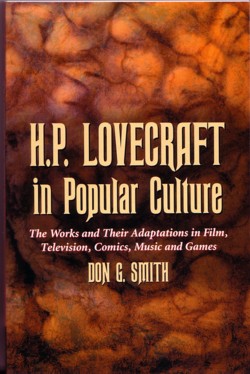
HPL in Pop CultureAn atheist who created gods. That’s the basic skinny on H. P. Lovecraft. Perhaps all gods are thus created. I can’t know; I wasn’t there at the beginning. Among writers who failed to make much of an impression in their lifetimes, Lovecraft staged a remarkable comeback in his afterlife. Don G. Smith’s H. P. Lovecraft in Popular Culture attests to the fact that some academics are beginning to pay attention to one of Providence’s most famous children as his works continue to spin off new forms. With an almost Puritan devotion to rationalism, Lovecraft saw no need nor room for deities in the world. His most ardent fans claim the gods he created are mere aliens, voyagers from beyond.

I wonder why one has to be a theist to create gods. Part of the problem is definitional; what is a god? According to the three fifty-cent words in the explanatory section of my young-person’s Bible, the traits are being omnipotent, omnipresent, and omniscient. Problem is, in the Bible God doesn’t really seem to fit any of these particularly well. The closest match seems to be omnipotent, but omnipotence leads to logical conundrums in reasoning, creating rocks so large you can’t lift them, and all that. Gods are, by just about any ancient standard, defined in relational terms—they are more powerful than us. That’s true of Lovecraft’s gods as well. They are so powerful that merely viewing them could drive you insane, eh, Ezekiel? (Perhaps Ezekiel is a good choice to compare, since his God comes down from the sky as well. Some would claim in a spaceship.)

Lovecraft survived because he understood what scares a person. Power, without feeling, is frightening. I’ve seen it in the eyes of both Christian and Pagan and it always sends me away shuddering. Smith’s book is more concerned with the survival of H. P.’s ideas in the media. It is a pleasant stroll, or an unpleasant stroll, depending on your perspective, through the descendants of Lovecraft’s monsters and gods. There’s no shame in calling them deities. If we are honest with ourselves, we will admit that some kinds of entities are inherently frightening.


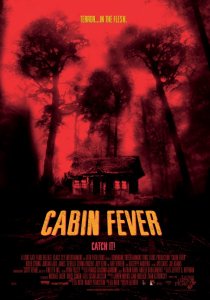
Cabin Fervor

It’s a sure sign that work is growing overwhelming when I’m too tired to watch my weekend horror movies. Well, I decided to fight back the yawns and pull out Cabin Fever this past Saturday night. I’d seen the movie before, and I’m not really a fan of excessive gore. The acting isn’t great and the characters aren’t sympathetic, yet something about the story keeps me coming back. In short, a group of five teenagers (it always seems to be five) are renting a cabin for a week when they get exposed to a flesh-eating virus. They end up infecting just about everyone in the unnamed southern town before they all end up dead. It doesn’t leave much room for a sequel, but that hasn’t stopped one from being made. One of the unfortunate victims of the virus is torn apart by a mad dog. The locals, fearing their safety, decide to hunt down the surviving youths.

On the way to the now gore-smattered cabin, one of the locals mutters that they’ve been sacrificing someone—a natural enough conclusion when body-parts are scattered around, I suppose. He says, “it ain’t Christian.” Well, yes and no. Sacrifice is at the putative heart of Christianity, although human sacrifice (beyond infidels and women) was never part of the picture. As is often the case with horror film tropes, the victim who has been dismembered is a woman. The guys whose deaths are shown are all shot. Now, I have no wish to attribute profundity where it clearly is not intended, but there does seem to be a metaphor here. Our society and its staid religion tolerate the victimization of some over others.

One of the hidden treasures of the best of horror movies is the social commentary. George Romero made an art form of it in Night of the Living Dead and its follow up Dawn of the Dead. Many other writer/directors have managed to do it quite effectively. We can critique our world when hidden behind the mask of the improbable. While the commentary for Cabin Fever may be entirely accidental, I still find a little redemptive value in it. That, I suppose, is the ultimate benefit of social commentary—it is true whether intentional or not. Is there a larger message here? I wonder if the fact that when women are victimized no one survives is pushing the metaphor a little too far. It’s hard to say; I’ve been working a little too much lately.


Dusty Flowers

V. C. Andrews was a name familiar to me from skulking around used bookstores where tons of over-printed, read-only-once books line the shelves. I had seen Flowers in the Attic on many shelves since the 1980s, but supposing it to be a romance title, I showed no interest. As Borders was closing, however, I noticed a copy of the novel on the horror shelf and couldn’t fight the curiosity any longer. I guess it might have been building, subtly, for three decades. My wife was surprised to see it in my stack, but I professed my lack of knowledge and began reading it.

Horror is a strange genre of writing. It is defined in various ways, but I have found that authors deal with their own fears with a variety of strategies. After thirty years I need not worry about spoilers, so I can say that the concept of a parent destroying her own children is about the scariest scenario imaginable. What makes the story of interest here, however, is the treatment of the Bible in the story. After the premature death of their father the Dollanganger children are secreted away in an unused upstairs wing and attic of their wealthy grandparents’ mansion. While the hidden foe is really their mother, Andrews introduces the grandmother as the Bible-quoting, intolerant, prejudiced symbol of oppression. Quick with the rod and completely unforgiving, she goes to bed each night reading her Bible and she insists the children do the same. When she finds an excuse, however, the children are lashed for being wicked.

Interestingly, it is the mother who is never shown quoting the Bible. Towards the end of the story the children recognize that while she is evil, the grandmother would not directly commit murder. The mother who has tasted the intoxicating liquor of wealth, however, knows that even her own children cannot stand in the way of her inheritance. The adults in the story are twisted—some by religion, some by greed. The questions raised by children, like all of us innocent of our own existence, merely ask where the love has gone. Religion without love is Hell, as the pictures selected for the children’s prison by the grandmother clearly show. Worse than Hell, however, is the blinding love of money.

We are all flowers in the attic of an uncaring world. Some find comfort in the power of wealth while others resort to religion. Many try to combine the two. At the end, those who are truly noble are those who survive without either.


Corny Children

Once upon a time, if you wanted to see a movie you had to go to a theater or wait until it ran on television. This is stretching my memory back a long way, so indulge me if I only remember that four channels existed in those days, and you had to wait years for movies to appear at a time when you could actually be home to see them. Fast forward a few years and the VCR was invented. I remember being impressed that you could actually rent movies you’d always wanted to see, within reason. If you watched them too often they wore out. Then the electronic revolution came. This is all by way of excuse for why I’ve only just started to watch movies that came out in my younger years. Children of the Corn, although critically panned, was a financial success in my college days when I started watching horror movies. When I finally watched it yesterday, I realized it was a natural candidate for this blog’s running commentary on horror and religion.

What I had not fully appreciated is that the movie is a cautionary tale centering around a sacrificial cult. While the movie does have its problems, the concept of children taking the religion they hear from adults seriously runs throughout the film. Understanding gods as bloodthirsty demanders of sacrifice is a gruesome staple of all monotheistic religions. Someone’s got to die for the rest to be saved. While Fundamentalists take comfort in the substitutionary atonement of the “once for all” nature of sacrifice, in the film, the children erect crosses and sacrifice adults to “he who walks behind the rows” – a typical Stephen King kind of monster. Monster or not, the children believe he is a god.

Belief is the guy-wire for religion. The reality behind that belief is open to question, otherwise multiple religions would not exist. Children of the Corn confuses the issue by presenting “he who walks behind the rows” as a legitimate supernatural entity, one who is vanquished by a passage from Revelation. The truly disturbing aspect, however, is the complete, unquestioning devotion of the children. When children are raised in intolerant religions today, we are also planting corn that will lead to some unholy reaping in the future. Perhaps the message of the film was more trenchant than most critics were willing to admit back then. Today it is certainly more believable, given many religions’ demonstrations of their destructive powers.


Gila’s Got the Whole World

Singing pretty-boys and colossal lizards – it must be time for The Giant Gila Monster. A horror film that portrays all the innocence of the 1950s before the Beat Generation led us down the path to reality, the film has earned cult status in recent years. More accurately titled, “A Regular-Sized Gila Monster Filmed in Close-Up,” the sub-mediocrity of the movie has probably done more for preserving it in popular culture than any other aspect. The film stars the relatively unknown Don Sullivan as a great teen role model who writes and performs his own songs. The number that receives the most Internet attention, and the one that makes this movie of interest to this blog is “The Mushroom Song.” Chase Winstead (Sullivan’s character) has a young sister who is just learning to walk with leg braces. To cheer her, he picks up a ukulele and sings: “And the Lord he said I created for you/A world of joy from out of the blue/And all that is left to complete the joy–/Just the laugh of a girl and boy/And there was a garden, a beautiful garden/Held in the arms of a world without joy/Then there was laughter, wonderful laughter/For he created, a girl and a boy/And the Lord said, laugh, children, laugh/The Lord said, laugh, children, laugh” with the final line repeated numerous times.

Laugh, children, laugh

Perhaps intended to underscore the societal norms of a time when “the Lord” made frequent appearances as an unseen supporting actor in many movies, this song is oddly out of place. The disability of Missy Winstead is obviously a device to raise tension: how will a disabled girl run from a giant lizard? The song, however, provides the resolution – the Lord will take care of all good people. Their response should be to laugh. The reference to Adam and Eve, fitting for teen fantasies of all generations, also belies the evolution of this monster. The gila grows to its great size because of chemicals in the water that wash to the delta somewhere in Texas. This creature did not evolve. The Lord will take care of it. The Lord and nitroglycerin.

Respectful teenagers with predictable haircuts and a society that believes a missing teenage couple could be doing nothing but eloping fits the world of the Religious Right exceptionally well. Even though they may not be perfect, these kids know right from wrong for they live in a black-and-white world with no ambiguity or ambivalence. Children of subsequent generations have grown up with shades of gray or psychedelic colors. The older generation is frightened by new developments, claiming that the world they know is about to end. In fact, an evolution is occurring. Those who try to hold society to the norms of the 1950s would do well to move ahead a decade and at least listen to Bob Dylan. No matter how far we progress, however, it seems that Texas will always delight in producing Lord-loving, bloated threats to rational civilization.


Carrie That Weight

When it comes to keeping up with the classics, I have a lot of catch-up to do. This even applies to classic horror films – I’ve been a fan since college but slipped out of the groove for a decade or so and now I’m working my way back in. Recently I watched Carrie for the first time. Considering that it came out in 1976 (I still remember the original trailers), it has held up remarkably well. The story of the child struggling to become an adult against the wishes of an overweening parent never goes out of style. In keeping with a long-term theme on this blog, the religious element was fully represented as well.

The portrayal of Margaret White as a religious fanatic included incongruous elements that had clearly been selected for their ability to set a creepy mood. The statue of St. Sebastian with an abdomen full of arrows seems a strange fit for a Christianity that is apparently Protestant. Mrs. White’s veneration of the Bible settles better in a Protestant milieu than the Catholic background of director Brian De Palma. The decidedly unnerving scene where Carrie returns home from the prom to find hundreds of candles burning recalls a more Popish atmosphere, but the prayer closet resonates better with reformed traditions. This unholy mix creates a disturbing lack of specificity, as if religion itself is the danger.

Writers and movie-makers attempting to scare audiences have long drawn on the stock character of the over-zealous religious believer. One reason may be the lack of understanding such characters demonstrate towards those who do not share their views. While it would be comforting to suggest that this is a mere caricature, experience unfortunately belies this assertion. Religions around the world all have adherents who brook no rivals and claim victory only in convert manifests or body counts. Truly classic horror films draw their power from a deep honesty. And many people are honestly afraid.


Vampires, Mummies and the Holy Ghost

One of the many quirky things I experienced in my teaching days at Nashotah House was the fascination of theological students with the (then current) Jimmy Buffett hit “Vampires, Mummies and the Holy Ghost.” Not really a Buffett fan (I must confess, however, to being strangely touched by “Margaritaville” although I’ve never had a margarita and I’ve never been to Mexico) I was nevertheless intrigued by this juxtaposition. One student confessed to being a vampire-novelist wannabe. The vampiristic connection with the Eucharist was kindergarten, but there was a more ancient tale hidden here.

With a career crashing down around me, I found myself habitually watching horror movies — something I hadn’t done since my own seminary days. One bleary-eyed morning it struck me how our nightmare-zone creatures are religious in origin. Vampires can be traced back to ancient Sumerian mythology. Mummies? Ancient Egyptian burial practice to preserve a body for the afterlife. Ghosts, apart from finding a feared spot in most cultures, are attested in the Hebrew Bible and even earlier. They are, of course, from the supernatural realm. Werewolves are a branch of the lunar worship tree, again an ancient form of religion. Even Frankenstein’s monster toys with the account of Adam’s creation, although Mary Wollstonecraft Shelley associated him with the Greek mythological figure of Prometheus. While Godzilla (apart from his apparently theophoric name) may fall outside this scheme, most of our nightmare creatures are ancient kin of the gods.

My favorite vampire

My favorite vampire

At a professional conference last year I found and purchased a book entitled Sacred Terror: Religion and Horror on the Silver Screen, by Douglas Cowan (Baylor, 2008). Given my renewed penchant for fright flicks, I was intrigued by Cowan’s contention that religion lies at the heart of horror. Indeed, one may think of them as fellow ventricles in the anatomy of fear. Perhaps ancient religionists were on to something when one of them penned “the Lord taketh pleasure in them that fear him” (Ps 147.11). Religion may be a response to fear, or to a world that for us has become natural and upon which we wish to project a human (or divine) face.