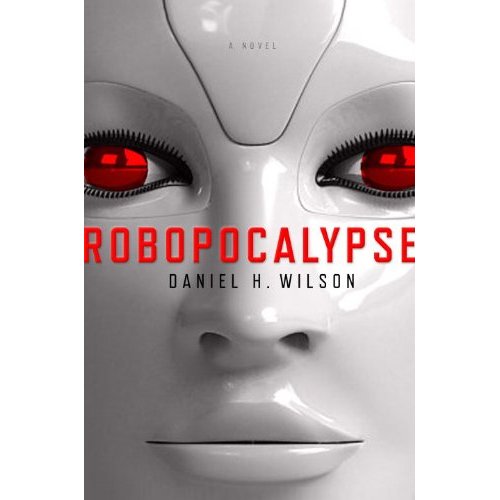
Robopocalypse


Yesterday the long anticipated novel Robopocalypse was released. Although I seldom indulge in hardcover fiction, I headed to my local Borders to purchase a copy. Sadly, it seems, my local is cutting back on first-day releases because I walked out of the store empty handed but with a robotic Armageddon in my head. Last summer I became acquainted with Daniel H. Wilson’s How to Survive a Robot Uprising, but word on the street is that this novel is serious. Steven Spielberg purchased the movie rights even before the book was released. And the concept owes its existence to religion.

If it were not for human religious sensibilities, would the concept of an apocalyptic end have ever arisen? Probing into the ancient psychology that lead Zoroastrians to suppose an ultimate conflict was just down the theological road, it is clear that even a strong moral sense alone does not dictate ultimate dissolution. By personifying evil in the form of Angra Mainyu, Zarathustra gave a (divine) human face to wickedness, and thus opened the possibility of battling against it. Evil as an abstract, non-personified force might simply be accepted as part of the universe we inherited. By providing it with will and intention, however, Zoroastrians allowed for a natural human response. Fight or flight is hardwired into our brains, but would we have dared fight a foe that is immaterial, amorphous, and completely abstract?

The nature of the enemy has transformed itself many times over the ages. Wilson, a scientist working with robotics during his education, has taken a religious theme and placed it in the context of a godless world of cybernetics. I must use caution here, since I haven’t yet acquired a copy of the book, but it remains clear that it is the humanization of non-human entities that gives force and pathos to a final conflict. Jesus charging his white horse into a foul-smelling cloud lacks the same impact. Thus mythologies are born. Mythologies that people live by and for which they frequently die. I do hope it all holds off until I can get a copy of Robopocalypse to read. Better yet, the end won’t come until after the movie is released.
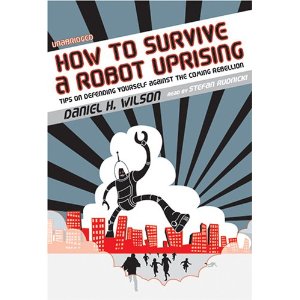

Robots and Divine Engineers

Pennsylvania seldom comes to mind when one thinks of a “big state” unless, that is, you have to drive across it. On the way to a family wedding in Ohio, I had to drive interstate 80 from the Delaware Water Gap to Sharon, Pennsylvania, and beyond. Having made this trip more times than I care to recount, I knew some diversion would be necessary. So it was that my family settled in to hear the audio version of Daniel H. Wilson’s How To Survive a Robot Uprising. Given my current status as a “Robot Dad” and my lifelong interest in both monsters and doomsday scenarios, this particular book was an apt choice.

Although the book is classified as humor, there was much that was thought-provoking in it (as there frequently is in quality humor). As Wilson systematically describes what makes robots tick, back five years ago, it became clear what it means to make a creature in one’s own image. Roboticists analyze how humans go about doing things and how we think in order to replicate these processes in mechanical formats. The results are machines that easily outperform humans, but which also have severe limitations – what Wilson frequently refers to as the benefits of evolution. Not only is the book funny, but it is also informative concerning what amazing robots are already in development. For those with the capital, there is little that robots can not be made to do.

All the while, I was also thinking of the human dilemma. Judeo-Christian tradition claims that we are made “in the image of God” without ever really explaining what that means. Perhaps it is the height of hubris to suggest that we are pale reflections of what we might have been, given a divine designer. When humans make robots, they are designed to surpass what we can do. Is there a reason people can’t see in the infrared or ultraviolet light ranges, like robots can? Why are we not able to hear all available sounds waves or smell all possible odors, such as our machines and dogs can? Could a team of human engineers have designed a better prototype than the God of Genesis?

While I do not really fear a robot uprising, I often ponder why things are the way they are and why human limitations often lead to such intense suffering. It is an idea that can be explored thoroughly when, after hours of driving, you realize that you still have 200 miles to go to the border.