Pillars of Science

I sometimes wonder if science would have the appeal that it does, if it didn’t have religion to shock and awe. I’m thinking of not only the fact that The Humanist magazine quite often has a focus on religion, but even websites, irreverently named to make the sensitive blush, frequently use it as a foil. My wife likes the site now more commonly known as “IFL Science!” Web acronyms have taught us what the second of those letters denotes, but perhaps because making the name more family friendly leads to more hits, it’s been muted a bit. In any case, the most recent post I’ve seen has to do with that marvelous Hubble image of interstellar gas and dust columns where stars are being born, know as “The Pillars of Creation.” Apart from the stunningly beautiful images, I’ve always been taken by the way that implicitly or even subliminally, concepts of deity lie behind this scene. When the image was first published, I remember staring at it in rapt fascination—here we had stolen a glimpse into the private chambers of the universe. We were seeing what, were we in the midst of, would surely prove fatal. It is like seeing, well, creation.

Eagle_nebula_pillars

Creation is enfolded in the language of myth. Reading the description of this great, gaseous cloud, we are told of the tremendous winds in space (what I had been taught was an utter vacuum) where dust is so hot (I was taught space was frigid) that it ignites into stars, like a silo fire gone wild. It’s like witnessing the moment of conception, although Caroline Reid tells us the dust will be blown away in 3 million years. Perhaps ironically, scientists are scrambling to study it before that happens. Or before that will have happened. At 7000 light-years away, it will have been gone as long ago as Sumerians first put stylus to clay before we know of it. We still have a couple million years for a good gander. And the Sumerians, the first writers of which we know, were writing stories of creation.

It is really a shame that science has, in general, such an antipathy towards myth. As scholars of biblical languages, indeed, nearly any language, know, the language of myth and poetry is especially useful when standard prose breaks down. “Wow!” is not a scientific word. Nor is “eureka!” What other response, however, can there be to seeing the act of creation with our own eyes? Meanwhile there will be those who use science to belittle the worldview of the myth maker and and thinker of religion. Our world, it is widely known, is that of superstition and ignorance. We are those who think only in shallow pools and deny the very reality that is before our eyes. That reality can be full of stunning beauty, but were we to describe it in terms empirical, we might have to keep the interjections and useless adjectives to a minimum.
Old Father Hubble

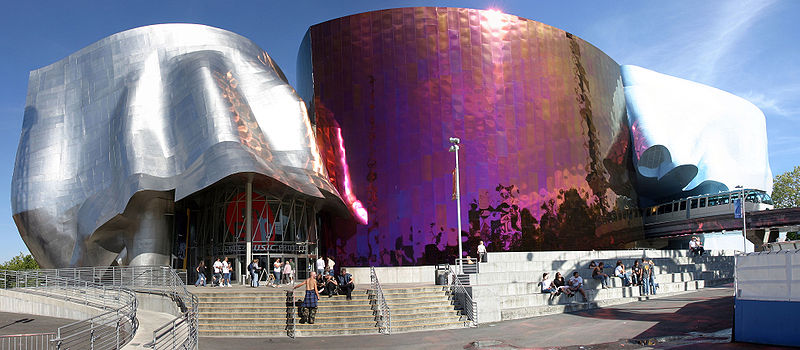
“Space. The final frontier.” So I grew up hearing as Captain Kirk and Mr. Spock raced through the galaxy and plucky Will Robinson explored the cosmos with Robot despite the machinations of Dr. Zachary Smith. In Seattle a few years back I visited Paul Allen’s Science Fiction Museum and as I stood before the original Enterprise console and viewed Robot in person, it was almost a personal epiphany. This was my childhood all in one room.

Experience Music Project and Science Fiction Museum, courtesy Gnu

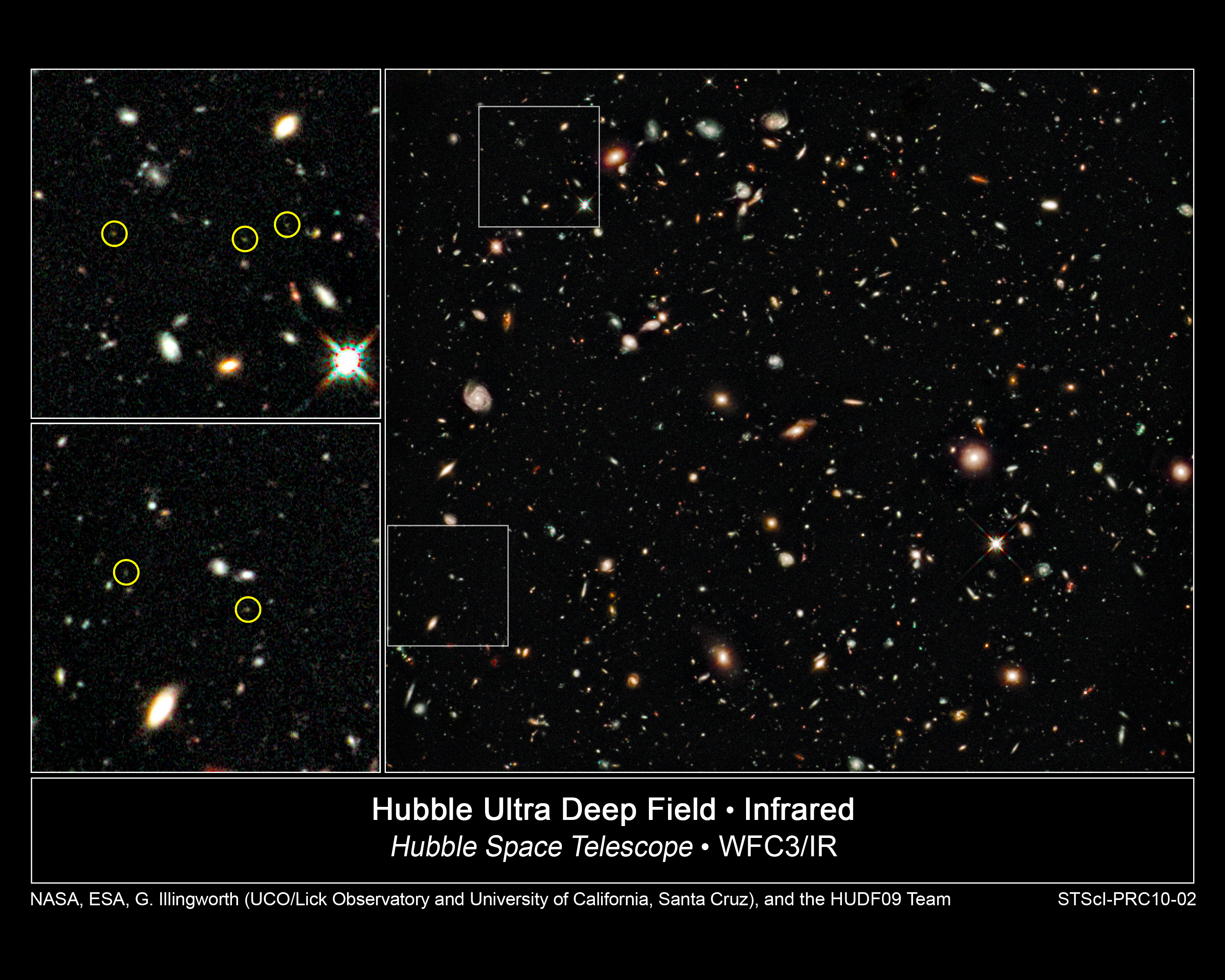
NASA has just announced the release of more deep space images snapped by the new and improved Hubble Space Telescope. These images show objects, galaxies, back to a mere 600 million years after the Big Bang. Look any further back and you’re liable to find yourself staring God right in the eye! These incredibly ancient images are humbling to a scholar of ancient times. In the cosmic calendar Sumer isn’t even on the map. And now we can see back almost to the Big Bang itself. It is another kind of epiphany.

Here's lookin' at you, kids - Hubble's new view

Cosmology is inherently religious. Even Stephen Hawking leaves room for the unknown, “religious” entity in his popular writing. As the infinitesimal biological apex of evolution on our own planet, we are somewhat less than cosmic dust on the grand scale. When we reach out to that cold blackness of outer space metaphors fail us until we fall back on God language. I look forward to the day when the Big Bang is captured on film (or digitally). I am almost certain that when that happens science will become far stranger than fiction.


Leggo my Ego!

Last week on my way to an interview, as I was merging onto the interstate, a state trooper in the center lane let out a whoop on his siren and broadcast on his speaker, “the left lane is for passing — got that?” Naturally I assumed the broadcast was directed toward me; I was in the right lane and the trooper was moving considerably slower than the posted limit. Should I pass him on the right or slow down? Now I was apparently joining a highway drama already in progress (status quo for New Jersey) and after a few intense heart-thumping minutes I realized that the cynical lawman was likely addressing a slower driver in the left lane. All of this is to introduce the problematic mindset of egocentrism.

The human brain, we are informed, is the most complex thing in the universe. It is also our gateway to all experience, knowledge, revelation, insight, and inspiration. We are limited in all our ventures by the tangible limits of our biological brains. Everything we associate with religion is mediated and filtered by our brains. As my friend and seminary professor K. Marvin Bruce likes to say, “consciousness is as much a curse as a blessing.” Our brains can be traps as well as explosive openings into new worlds. Everything begins and ends with the humble ego.

I was recently reminded of this while looking at the latest round of Hubble Space Telescope images released from NASA. We consciously know the universe is incomprehensibly large, the number of stars way beyond human imagination. And yet, on this smallish planet racing around a medium-sized sun somewhere in the outer banks of the universe, people have always thought the gods were concerned with them. The earliest cultures believed that humans were created in the service of the gods. We live, we wonder, we die. As long as the gods are pleased, the world continues much as it always has. In their eyes the stars that far outnumber the human population were gods. Their universe was more divine than profane. Yet even in our galaxy-filled universe, our brains can’t help but believe that somehow we’re in the very middle of it all.

Where's Wiggins? Not even on the map!

Where's Wiggins? Not even on the map!