Ghostly Book

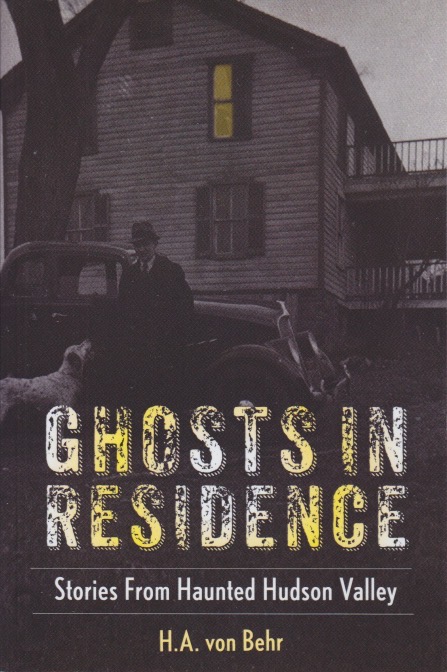
Recently I’ve been thinking about internet searching—how some information is difficult to find.  This book provides an example.  I saw what we in the biz call a “new book announcement” (NBA for bookish sorts).  Since I’ve been reading about the Hudson Valley the subtitle of Ghosts in Residence (Stories from Haunted Hudson Valley) caught my eye.  I assumed it was a new book and eagerly awaited its release.  When it arrived I discovered that it was a “new in paperback” (NiP) edition of a book published in 1986.  This edition, published this year, didn’t update things, including author information.  Given that H. A. von Behr was born in 1902, I doubt he’s still alive, but the book simply borrows the LCCP (Library of Congress Cataloging-in-Publication) data from 1986, showing the author’s dates as 1902–  .  Perhaps unintentionally appropriate for a book about ghosts.

This is an odd book, all around.  Although published in 1986, much of it deals with even earlier times—the author’s recollections of the forties—as well as some more recent events.  Hans von Behr cuts the image of a country gentleman while his neighbors in the Valley go on fox hunts and he has what seem like daily cocktail parties on the lawn.  He dashes off an article about his favorite dog and gets a healthy check from Outdoor Life.  This is a different world.  But then there are the ghosts.  But more than that, also strange happenings.  The ghost tales are intriguing, and some of the other strange events head-scratching.  The whole has a quasi-autobiographical aspect to it, but while not revealing too much.  A couple chapters deal with hauntings in Germany.

My web searching for H. A. von Behr revealed very little.  He was a retired scientist and photographer (he had some high profile clients) and the book contains many of his photographs of the locations discussed.  This short book explains how he came to purchase a haunted farmhouse upstate for a second home (again, a different world), how he discovered it was haunted, and how many of his friends and acquaintances revealed, over time, that their houses also had ghosts.  The book is charming in its own way, and a quick read.  Still, it’s a little disorienting when you can’t find more information about someone online.  The options are to do library research (my favorite kind) but am I really that curious about this author?  I wanted to read about the ghosts, and that I did.  And many other incidental things besides.

Curious Valley

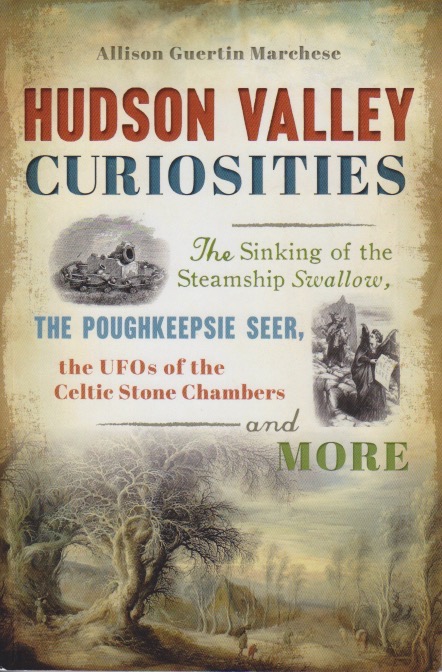
Another of my guilty pleasure reading categories is local history, written by locals.  As a genre these books may not always go back to primary sources, and they may get a fact or two wrong, but still they’re endlessly fascinating and I always learn something (which is the point of reading, after all).  I enjoyed Allison Guertin Marchese’s rambles along the Hudson Valley.  I’d encountered some of these tidbits before, but most of them were new to me and show just how interesting a place this particular river valley is.  Living in a strange world is so much more beguiling than a prosaic, predictable place.  Still, you’ve got to accept that anything can happen.  Unlike many such books, Hudson Valley Curiosities does not focus on paranormal, although ghosts and UFOs turn up a time or two.

Since this region is about 145 miles from end to end, the book divides it into lower, middle, and upper regions and gives about equal time to each.  The curiosities range from mastodons to prohibition busters, from shipwrecks to Shakers.  I’d never made the connection with the Shakers and the Hudson Valley before.  While the Shaking Quakers had their origins in England, they eventually migrated to the New World, settling in the northern end of the Hudson Valley.  The book points out that they were noted inventors, living by their own means as they did, they came up with their own solutions to problems.  Another aspect of these curios is the number of them that involved women who took on the cause of women’s rights.  The first female candidate for President of the United States, Victoria Woodhull, is discussed, as is Deborah Sampson, the woman who dressed as a man to fight in the Revolutionary War.

Marchese provides a helpful bibliography as well.  As someone trained in historical method, I like to go back to the sources.  Of course, that means assessing both publisher and author, and taking into account what passed for facts at the time.  History is an endlessly fascinating enterprise.  Many historians, however, leave out the controversial or questionable materials that a local historian is inclined to leave in.  That’s what makes books like this such a guilty pleasure.  Who doesn’t like to look behind the curtain now and again and see what’s happening out of the public eye?  And it’s helpful to keep in mind that by far the most of history takes place far from the headlines.  That’s where real life happens, no matter how strange.  And it’s a guilty pleasure to read about it from a local who finds, gathers, and preserves the stories.


Ending Worlds

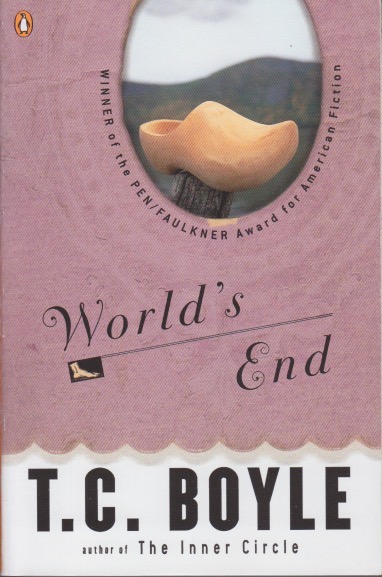
It takes a kind of talent to write a long novel where I don’t have any feelings for any of the characters.  I’ve studied writing enough to know that “Mary Sues”—characters who have no flaws—are to be avoided.  Yet, writing so that no characters over a span of about 300 years seem to be able to garner at least pity (and my therapist tells me I a very sympathetic person) is a feat.  All of which is to say I didn’t much enjoy the award-winning World’s End by T. C. Boyle.  This novel is set in the Hudson Valley, which is one of my current obsessions, and I thought the sense of place would draw me in.  Stories where everyone drinks all the time, and mostly they get high after that, and then wonder why tragic things happen when they drive, really aren’t for me.  I accept and admit that the onus is on me. (I freely confess to preferring speculative fiction.)

Successfully writing a novel that ties several families together over the generations is, however, an achievement of literary architecture.  It’s just that not all novels work for everyone.  There is a sense of maybe a little cosmic justice at the end, but it feels at times almost as if the side that’s being cheered on is the wealthy one.  Maybe it’s reflecting the way life works.  Or maybe I’m not a subtle enough of a reader to understand.  For whatever reason, it really didn’t speak to me.  It could also be that I need to reflect on it more.  Growing up poor with an alcoholic father and seeing firsthand the entrenched ways of the wealthy and how they effectively keep other people down, such tales tend to set me off.  None of this is to gainsay the artistry since it clearly condemns the land theft from American Indians and unrepentant wealth.  

It’s this last point from which the novel really takes its strength—ownership of the land.  As mortal creatures we have a strange idea that we can own something that will outlast us.  In the novel’s resolution that ownership shifts, unbeknownst to the wealthy, back to the original owners through an illegitimate child.  There may be some social commentary intended here and this makes the story less of a justification of white ownership.  I guess many of us are very sensitive to fascist characters since the Trump administration.  Perhaps had I read the novel in the late eighties, when it was first published, this would’ve seemed less troubling because we would’ve thought then that such a thing could never happen.  But three centuries is a long time and we simply can’t tell, although World’s End suggests justice might be served in the long term.


The Other Mississippi

Salmon aren’t the only animals that head back to their ancestral homes late in life.  There’s a draw to where we’re from.  Many humans can’t physically return for socio-economic or emotional reasons, but there’s an urge that may transcend generations.  For me it’s always been traced through my maternal line to upstate New York.  My mother’s [redacted for security question purposes] family had been in the upstate region around Schenectady for generations, as traced back as far as the 1770s.  It was my maternal grandfather, branching off from his father (who made it as far as central New York) who eventually left the state, after teaching in a one-room schoolhouse, for which, in those days, you didn’t need to be a college graduate.  In any case, I have a fondness for the Hudson Valley and an interest in its history.  

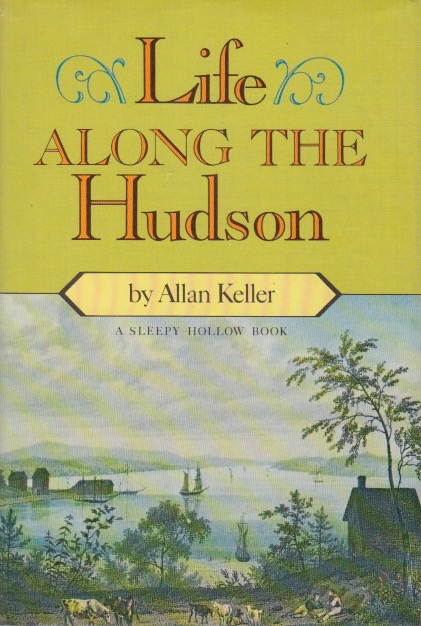
Allan Keller was a journalism professor who never became famous.  His Life along the Hudson is one of those charming, dreamy books about yesteryear.  Richly illustrated, it really isn’t a history (Keller wasn’t an historian) so much as a set of vignettes illustrating the role and importance that the river has had not only for New York state, but for the United States as a whole.  There are chapters about famous residents, battles of the Revolutionary War, historic houses, quirky facts, boating, and railroads.  It’s an interesting cross-section of a forgotten part of America.  Today when we hear Hudson River we tend to think New York City.  And while that’s not wrong, it certainly isn’t the whole story.  The Hudson early on connected Albany with Manhattan as they grew to be the two major points around which the Empire State expanded.

The book was never a bestseller.  It’s not particularly rare.  It is, however, a series of snapshots.  One of those was 1976, when the book was published.  The Hudson had become so polluted that major remediation efforts had to be put in place to redefine it from a cesspool to a beautiful waterway that took the breath away from many early travelers.  This valley was once considered one of the truly scenic spaces in the United States.  Now it’s pretty much a suburb of New York City, but it retains much of its earlier appeal, if you know where to look.  I’ve tried to find jobs that would allow me to move back to this region of upstate New York, but I’ve ended up in my own immediate home state of Pennsylvania.  I’d go back a couple more generations, if I could, but even salmon sometimes never make it back home.


Haunting Hudson

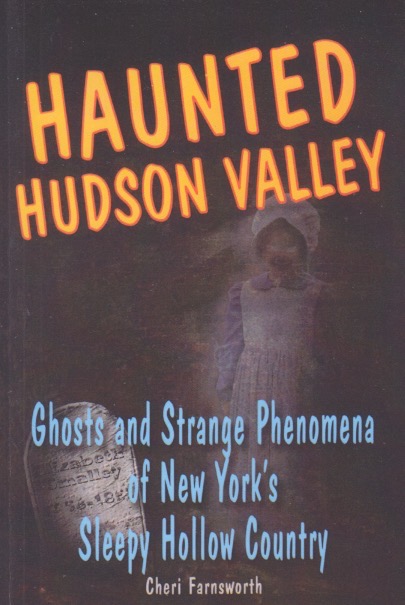
After Maine, the one place I’ve always wanted to live, but never had the opportunity, or could never afford, is upstate New York.  My ancestors were from the state but I just happen to’ve been born in Pennsylvania.  So it goes.  Perhaps it comes with professionally studying mythology, but one of my longterm interests is folklore.  I’m always fascinated by what people tell of their local setting.  Now when I approach books about the paranormal in a region, such as Cheri Farnsworth’s Haunted Hudson Valley, I know to take most of it with a grain of salt.  People love to tell stories and local people like to talk about where they’re from.  The Hudson Valley has had a long history of strangeness and several tales that reflect that are collected here.

I often think of ghosts.  They generally seem to prefer a single place that’s familiar.  And although you can’t take everything everyone says as gospel, there do seem to be regions beset with them.  I wonder if regions early settled by Europeans are particularly prone to haunting.  It’s difficult to imagine that, at the time with the unquestioned rectitude of church and empire, that they ever stopped to think “Hey, we’re stealing land that belongs to someone else.”  Did that idea ever come back to haunt them?  Perhaps such unspoken guilt leads to ghosts.  Or maybe simply dwelling in a place for a long time leaves plenty of opportunity for ghosts to gather.  And, of course, people do stretch the truth at times and misinterpret things otherwise explained.

No matter the reasons or rationale, these kinds of books are always a guilty pleasure read for me.  I don’t expect the get the truth, the whole truth, and nothing but the truth from them, but I enjoy them nevertheless.  Since I can’t afford to live in the Hudson Valley, the other result of such books—and one of the reasons locals appreciate them—is to make me want to travel to the region and see for myself.  For many years we lived not too far from the Hudson while in New Jersey.  Still, we didn’t make it up that way very often.  It’s a bit more of a hike now, but isn’t a hike worth making when you might see something unusual after you arrive?  My ancestors had settled north of the Hudson Valley and eventually migrated further south.  The end up in Pennsylvania, where I find myself.  But I’m still haunted by upstate New York.


Unidentified

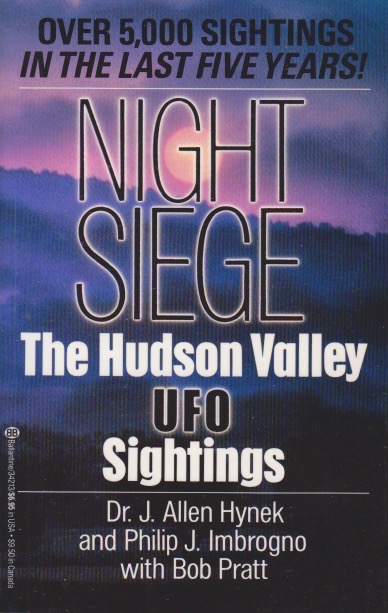
Some places are quite ordinary.  Once you get to know the people, however, you begin to find some oddities.  That’s all normal.  Other places, however, are strange for one reason or another.  One such region is the Hudson Valley in New York.  With all the UFO news the past couple of years, I grew curious about the sightings in the Hudson Valley from about 1983 to 1986.  This was a period when hundreds of sightings were reported of an object flying low and slow, and even hovering, over several locations throughout the region.  They were investigated by J. Allen Hynek and Philip J. Imbrogno, and written up with the help of Bob Pratt.  Night Siege: The Hudson Valley UFO Sightings was published by a mainstream house (Ballantine, a division of Random House).  Not exactly belles lettres, the book is pretty bare bones.  It contains some interesting information, however.

Hynek, who worked for years with Project Bluebook and who was a bona fide scientist, was ailing as the book was written.  Indeed, he died before this book was published.  His name is the big draw, however, since he was a respected authority in the field.  Some questions have been raised about Imbrogno’s accounts of himself, but that shouldn’t take away from the data collected on the Hudson Valley phenomenon.  In short: in a period of mostly two years (1983 and 1984) several “flaps” of reports came in regarding an object that was described in similar terms by hundreds of people, many of them well-educated professionals.  The authorities trotted out mundane explanations that don’t fit the evidence, although even noted skeptics stated that the sightings were unexplainable.  Part of the weird Hudson Valley.

But not just there.  In 1997 a large number of people in Phoenix reported a similar object over Arizona.  This one made national news and even led to stunts by uncomfortable politicians.  We’ve become such an arrogant species that we’re reluctant to admit there are things we just can’t understand, it seems.  Or that there might not possibly be anyone smarter than us anywhere in this vast—indeed, infinite—universe.  I don’t pretend to know what people were seeing in the Hudson Valley, or in Phoenix, but I also don’t pretend that ruling out logical possibilities will give an answer.  I tend to think that when large numbers of people see something that’s unexplained, it’s an insult to our collective intelligence to make up something and refuse to consider the options.  The solution, to me, seems to be to read.  Widely.  Even if it only raises more questions.


Not Just Horsemen

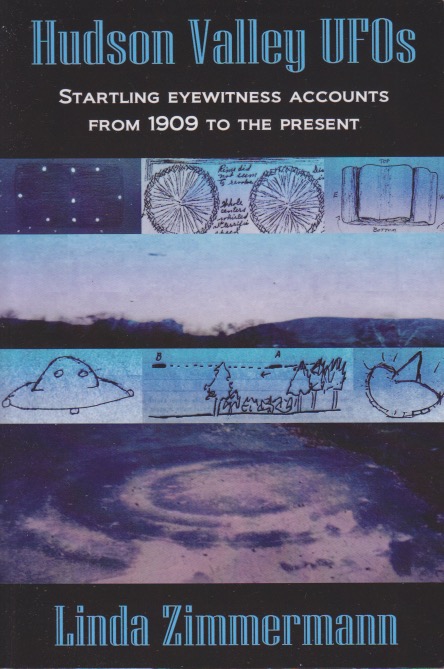
With the way they’ve been in the news, UFOs have started to arouse some curiosity.  Since I’ve been reading about the culture of the Hudson, Linda Zimmermann’s Hudson Valley UFOs caught my eye.  I hadn’t realized that the book was essentially self-published.  There are legitimate reasons for self-publishing, primarily that established presses can be quite standoffish.  What you find in book form is largely determined by publishers who decide what will or won’t merit their attention.  Self-publication comes with its own set of problems, including marketing and, as I written before, lack of editing.  Zimmermann’s book is quite interesting but could have used some editorial attention.  It does aid credibility.  Subtitled Startling Eyewitness Accounts from 1909 to the Present, the book is essentially that, collated accounts, some in their own words, some retold.

As became clear shortly after starting the book, this is a second volume for a previous book that I hadn’t heard of.  There is a fascination reading such accounts.  Many can be dismissed and each should be treated with some skepticism.  The thing is, there are so many reports from this area that it’s difficult to jettison the lot.  People with nothing to gain, withholding their names, see things in the sky they can’t explain.  As Zimmermann points out, Project Blue Book didn’t help with its prosaic and often bizarre explanations that are harder to believe than the eyewitness accounts, many of them from Air Force personnel.  What’s emerged in recent years—some would argue since the end of the Second World War—is that the government actively advocated ridicule and intimidation, perhaps because of secret weapons testing.  This policy has made the truth behind UFOs difficult to excavate.

Books like Zimmermann’s have their place in collecting information.  Civilians, however, generally lack the resources necessary for analysis.  Governments worldwide have recently been coming out of the closet.  They too have been treating this seriously while telling everyone simply to ignore it.  People are curious by nature and we live in an apparently infinite universe.  Strange things happen and ridicule is one of the surest ways to shut down serious discussion.  There’s quite a bit of information in this book, and some of it could help point to the long associations of the Hudson Valley with the unusual.  Mainstream publishers are beginning to lose their shyness about the topic and we as a species don’t know as much about this universe as we think we do.  As long as we talk about what we see, this will remain a topic of interest.


Sacred Hudson

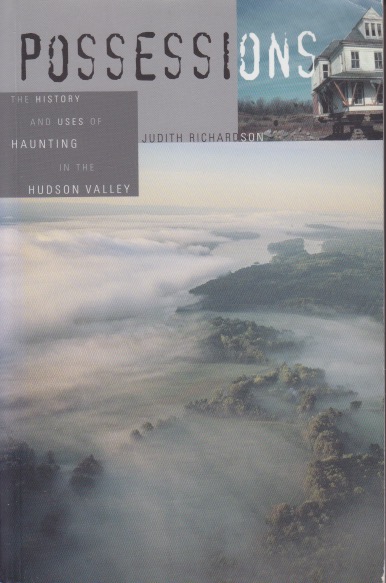
As scientific as we may wish to be, there’s no denying that there is a sense of place.  We know that some animals, at least, also feel it.  Whether theirs is a more pragmatic desire to return to where conditions were favorable to be born, or whether something deeper draws them there, we have no way of knowing.  People feel it too, this sense of place.  We know where we’re from, and if we don’t we often want to find out.  The space is somehow part of us.  There’s a compelling exploration of this in Judith Richardson’s Possessions: The History and Uses of Haunting in the Hudson Valley.  While not America’s first haunted location, the Hudson Valley was singled out for this treatment by Washington Irving.  He, however, didn’t invent it.

I’m not from the Hudson Valley.  I could never afford to live there.  That doesn’t mean the area can’t speak to me.  Richardson’s approach is academic yet readable and she considers how hauntings fill needs and how they play a role in that ever-contentious enterprise of land claims.  Ranging through literary treatments, whether the fiction of Irving or tour books of the next generation, or indeed, more recent literary efforts, Richardson deftly guides the reader through American Indian and Dutch and other inhabitants’ stories of themselves.  Race inevitably plays a part, and her tracing of the origins of some traditional tales is really remarkable.  Who owns the land?  Who truly owns anything?   

Similar treatments (I can’t help but feel somehow lesser) must exist of other haunted locations.  Richardson doesn’t engage in arguments over whether ghosts are factual since ghosts serve so many other functions.  Our lives are the stories we tell about ourselves.  Many of those tales involve the place we are or places we’ve been.  In our highly mobile society, few of us, it seems, can make a living where we’re from.  Those of us born in small towns range far and wide to find employment.  In many cases we may not want to go live where the drama of our childhoods unfolded.  Yes, there are pleasant memories there, but there are also ghosts.  Richardson explores how this plays out in one small stretch of the country.  Indeed, it’s a small stretch of New York state.  Stories of hauntings continue in that particular valley.  Uncanny, perhaps, but there are places in this world like that, and this book is a sure road post on this particular overgrown trail.