Small Hops

It was about the cutest thing I’d seen in a month of Saturdays—a baby rabbit.  It was no bigger than my fist and it was looking lost on the sidewalk.  The front “lawn” of the next neighbor’s house is paved and there’s only a wide street in the opposite direction.  Our front lawn has a retaining wall well about the jumping height of the little guy.  I didn’t want it dashing into the street, so I circled around from that direction, but the poor thing couldn’t get high enough to reach our lawn.  It was young enough not to be certain something at least twenty-five times its size meant it harm.  It allowed me to get close enough to scoop it up and put it on our lawn.  It immediately leapt away and sheltered under a bush, before eventually disappearing down a hole that I hoped might be its home.
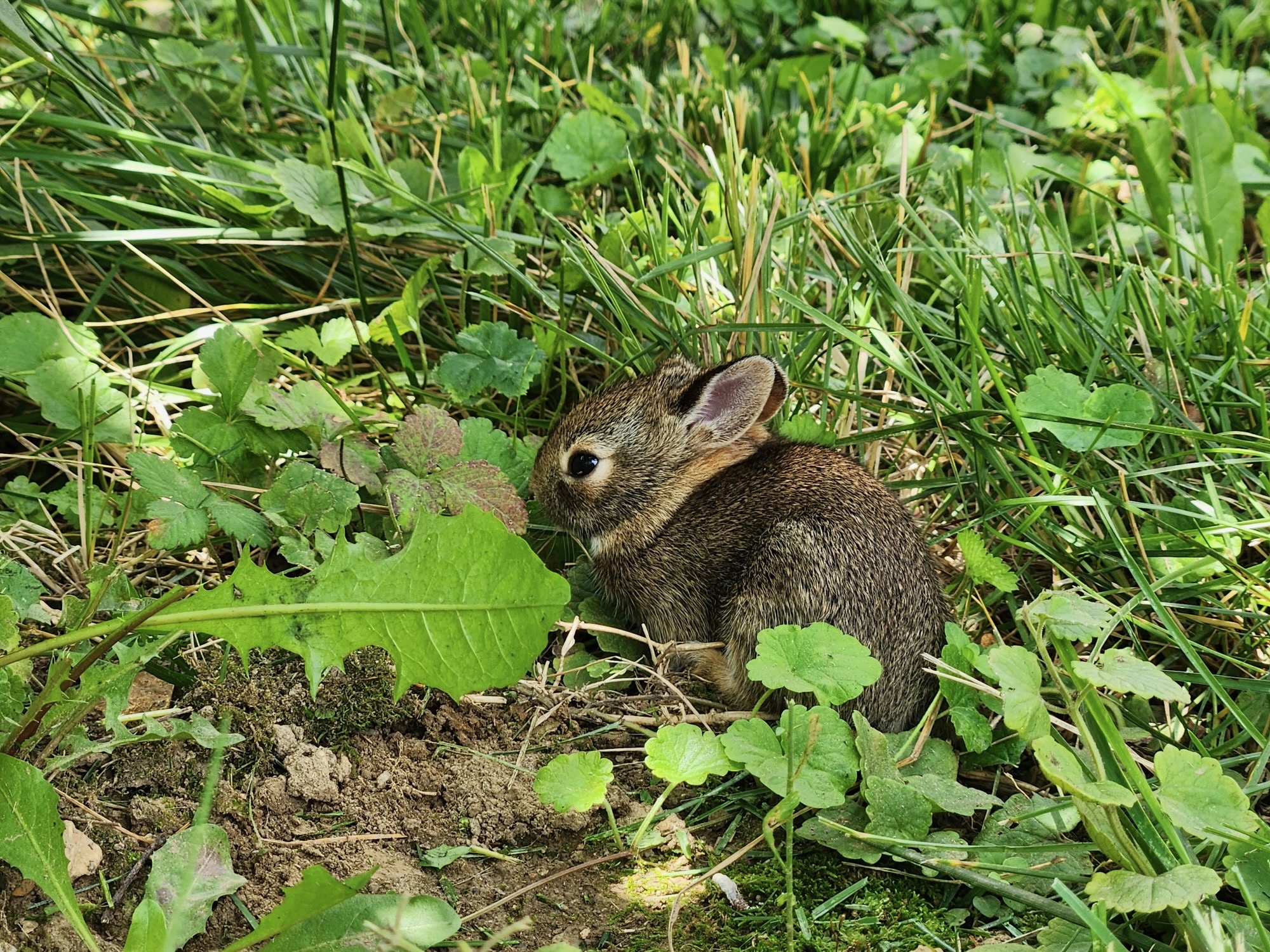
Besides being a hope-filled chance encounter with the wonder of nature, the incident also caused me to ponder what that leporine brain made of this learning experience.  For human brains, any sufficiently large animal is a monster, and anything even larger is a god.  While there are some bad folks out there, people don’t seem evil to me.  And although we’re certainly not gods, I wonder what that little rabbit thought.  What I was attempting was an act of kindness.  I’m sure it scared the timid tyke—I can imagine being lifted by an enormous creature that I can’t understand and it is a most frightening prospect.  But what if that monster were to set me down just where I needed to be?  Might not my assumptions about it change?

We don’t know what other animals think, yet it’s clear that they do.  Our yard has a fence and we have no dogs, so rabbits tend to like it here.  I often mutter softly and try to avoid direct eye contact and sometimes they let me get fairly close.  I like to think some of the larger ones recognize me, and maybe can tell that a vegan has nothing but their goodwill in mind.  We like to think this about God.  Larger, easily able to harm us, but that somehow being divine also conveys good will.  The bunny incident cast a pleasant glow over the rest of an otherwise anxious day.  It had calmed me and conveyed a sense of appreciation for just how helpful the world of nature can be.  I hope for some tiny rabbits in your life too.


Beliefism

A question never adequately resolved revolves around the status of atheism. What exactly is it? Well, I suppose it is many things, actually. One thing that seems indisputable is that religion has been part of human culture from the beginning. It would seem likely that not all believers carried the same level of conviction, and there may have been “atheists” shortly after theism evolved. The difficulty is that both belief in god/s, and/or the lack thereof, are matters of personal conviction. That somewhat blurred line has been crossed, according to some, by the recent growth of “atheist churches.” In several web stories my friends have pointed out to me, a growing movement of atheist “mega-churches” has been noticed. These are groups of atheists who meet for many of the same reasons religious folk do, sans salvation. It is a social occasion, and a chance to fellowship with like-minded non-believers, and to support their lack of faith. Some atheists bristle at this (as do some religious), claiming that it cheapens the atheistic enterprise (or that religions somehow hold a copyright on belief-based gatherings).

Herein lies the rub. Atheists are no more cut from the same cloth (or lack of cloth) as religious believers are. There are varieties of unbelief. Some obviously see that the weekly gathering has benefits. There’s no question that atheists can be every bit as humanitarian as religious believers are. Besides, who doesn’t like to meet with people who think like them? “Minister” might not be the leader’s title of choice, although it has a long pedigree in politics as a secular title (as, for example, in the Ministry of Defense). The slow decline in mainstream Christian services, however, might suggest that atheist services would be inclined to grow. Weekends were originally created for religious reasons and still generally remain the religious meeting days of choice. Some religious groups do not insist on doctrine to be members—Unitarians are a prime example of this—but the value of meeting together is human, all too human.

Clearly the purpose of an atheist gathering is not primarily worship. I should imagine, however, that wonder is still part of the non-religious vocabulary. God is not necessary for feelings of awe and joy. And sometimes it is fun to get together for some structured activity that isn’t work (for those who have jobs). An Associated Press story, however, points out the irony of the gathering of “people bound by their belief in non-belief.” There is, however, believing going on here. There can be no escaping it. Despite all the problems associated with omnipotence, the idea of a deity where the buck indeed stopped was an ebenezer for grounding belief. Even the most outspoken of atheists share this with the literalist and the moderate—they all believe. And as long as people believe, they will seek groups of those who share similar views. Why not? Even the truth requires belief.

What does it  mean?

What does it mean?