The Cost of Being Human

In last week’s Time magazine Joel Stein’s “The Awesome Column,” a humorous endnote for somber weekly news, spoke to me. Although Stein writes as light relief, when he addresses humanities education I have to sit up and take notice. Like being in class all over again. Although Stein is trying to be funny, I find the decline in the humanities to be no laughing matter. I don’t think Stein does either. As an uncle once said to a relative recovering from cancer—you might as well laugh about being bald, what else can you do? The humanities are so called because they are what makes us human. Perhaps it is no coincidence that Stein addresses this in the issue following that which commemorates Robin Williams. As I’ve written before, I don’t consider myself a Williams fan, but I can’t help but associate him with what I consider his best movie, Dead Poets Society. The humanities are what we live for.

I’m a little too nearsighted to claim to see the future clearly, but Stein makes the accurate assertion that our great ideas have tended to come from our humanities dreamers. Presidents and Popes, he notes, have not been drawn from the sciences, but from the arts. Herein, I suspect, many would suggest lies the problem. We are a schizophrenic society (with apologies to those who believe schizophrenic is a slur word). Who wants a warm puppy on your lap when you can have a warm laptop instead? Indeed, you can carry your computer under your arm, in your pocket or purse, or even around your wrist. Instant access to the internet and every other wired person all the time. Isn’t that what we really wanted? But then we come out of the movie theater complaining that the show was poorly written, if technologically flawless. We have just walked out of John Keating’s classroom, methinks.

Is this worth more than just money?

Is this worth more than just money?

“We live in a time,” Stein opines, “when smart people want to discuss only politics, technology, and economics.” Truth be told, the deeper you look behind any of these topics the more boring they become. Politics? Everyone wants to rule everyone else, what’s new there? Technology? Electrons dance better in some substrates, and if we can only get this confusing formula right… Economics? I want what you have, so why don’t we trade? How banal! Anyone who’s ever lost him or herself in a novel, a movie, or a song (even, dare I say, a prayer?) knows that transcendence trumps technology every time. As the weather begins its long decline into a bleak and icy winter, I’ll be sitting here with my laptop on my lap, but I can guarantee that this is one place where I can fully agree with the departed Charles Schultz. Happiness would actually be a warm puppy.

Do You Mind?

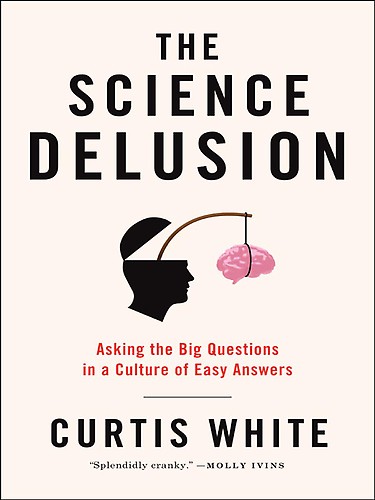
TheScienceDelusionSeems a lot of people are deluded these days. I know I am. Still, every great once in a while I read a book that helps me cope with the morass of everyday life in a way so profound that I feel elated. At least until I get to work. One of those books I cannot commend highly enough. Curtis White’s The Science Delusion: Asking the Big Questions in a Culture of Easy Answers is epiphanic. Not your typical (generally faith-based) objection to the New Atheist phenomenon, White asks more fundamental, and indeed, logical, questions. And he’s incredibly fun to read. Starting with the conundrum that often goes unspoken, White demonstrates that even the scientists among the New Atheists ascribe to immaterial value judgments without thinking through the implications. Having jettisoned religion, philosophy—the whole of the humanities, in general, as pointless, non-empirical window-dressing, even the greatest lights still claim their tenets. As White illustrates, stars cannot be beautiful without a concept of beauty. Beauty cannot be quantified, and is therefore beyond the empirical method. One could say it’s in the eye of the beholder, but science is uncomfortable with metaphors as well.

Materialism, often in league with politics and power-mongers, fails to account for much of human experience. The real danger, as White demonstrates, is when society simply accepts it because it comes from a white lab-coat. White, along with most of non-materialists, is not anti-science. Science clearly describes, in a pretty close approximation, the physical world we know. At least in the New Atheist camp, however, it doesn’t stop there. The take-no-survivors attitude causes problems because it is hoisted on its own petard of logic. The mind that is attempting to puzzle out science is immaterial. Mind does not equal brain. The cause and the result are easily confused. Flush with neuroscience’s success of describing the brain, we assume that science can also explain things as inexplicable as the nature of light, quantum mechanics, black holes, or the Tea Party.

White is not shy of talking about the elephant in the room. Consciousness is not a material phenomenon. If you are reading this, you know what I’m talking about. We are self-aware creatures. So seem to be some other primates, cetaceans, and corvids. If our minds could be quantified a lot of psychologist’s couches would be empty. Chemicals may affect the working of our brains and influence the performance of our minds, but when they wear off, it is still yourself staring back from the mirror the morning after. Those of us who spend our lives pursuing the humanities generally don’t try to take over science. It is very good at what it does. The world as we experience it—even the use of the word “experience” itself—is, however, more than physical. Even the New Atheists dream, and hope, and love. No matter what they may say, there is an inherent beauty in that.


Chronic Religion

The Chronicle of Higher Education publishes a surprisingly large number of articles that touch on religion. I write “surprisingly” somewhat ironically here, since religion and higher education have been inextricably tangled from the very beginning of post-secondary education (and even before). A recent article by Donald L. Drakeman caught my attention because of the tag-line: “A venture capitalist with a doctorate in religion sees the value of a bear market in the disciplines.” In all honesty I have no idea what a venture capitalist is, but I do understand “doctorate in religion.” Dr. Drakeman’s article is entitled “The Highly Useful Crisis in the Humanities.” Drakeman points out that during times of economic hardship the number of students studying the humanities declines. During times of economic prosperity they rise. And he also points out that this can be interpreted in more than one way. Since I’m afraid of venture capitalists, I feared that religion, along with the rest of the humanities, was about to take another trip to the woodshed where it would come back again but might chose to stand rather than sit for a few days.

I was pleasantly surprised to find that Dr. Drakeman suggest that this disparity actually demonstrates the inherent value in the humanities. Tough times lead us to pare down those things that we value so that we might survive. Once a kind of stasis is reached, we try to climb once again. Humanities, in other words (speaking for myself and not Drakeman), represent the pinnacle towards which we strive. When money gets in the way, as it often does, we lose our focus and down comes baby, cradle and all. The humanities are what we live for; money represents pure survival. It is no surprise that those who lose their sense of human fellowship sometimes become survivalists—the individuals who can thrive with no other people around. But what about when the post-apocalyptic stock market recovers? Where will they be without the humanities?

Education, apart from simple survival skills, began as a means of ensuring that the religion that sustained our ancestors through hard times was passed on to the next generation. At times the more literal-minded suppose that means that the religion itself should never change—as if the religion were the point of it all. Although they may not have articulated it so, the ancestors, I believe, had a different goal in mind. Those who are parents already know what it is. We want our children to have it better than we do. If religion helped us, it should help them. It only becomes a problem when the religion itself is mistaken as the goal of the process. Everything evolves. A religion that changes with the needs of society is among the most vital aspects of the humanities, whether or not our forebears would even recognize it as religion at all.

IMG_0316


Playing Doctor

Science, religion, humanity. People are a conundrum. Medical professionals have the unenviable task of sorting out what is wrong with this jumble of organic biological systems and also attempting to address the uniquely human aspect of their subjects. As far as life forms go, although we may not be on top of the evolutionary ladder, we are suitably, impressively complex. We haven’t yet sorted out how mental states figure into physical processes: a number of cases of “faith healing” seem to have been verified, but the mechanism remains unknown. Praying has been demonstrated to improve some physical conditions with the believer saying God is doing the work and the skeptic suggesting it is the healing aspect of our own minds. How do you treat a creature that may not even agree with you on the ground-rules?

A story in yesterday’s New Jersey Star-Ledger revealed that New Jersey hospitals are experimenting with human subjects. The subjects, however, are doctors, not patients. In an effort to bring science and the humanities together, several hospitals are sponsoring reading groups for doctors. Like a garden-variety Oprah reading club, the physicians read a novel and discuss the human elements with each other. The theory is that it may help them understand the softer side of the science – how to touch the human reality of a field of study that has become very scientific. Specialists in the sciences and humanities have grown apart.

The humanities have long been assigned to the “less necessary” side of both university programs and the job market. Ironically, among those who are most famous in our pragmatic, make-a-buck world are musicians, actors, film-makers, best-selling novelists – in short, masters of one of the humanities. A darker side exists here as well; even celebrated humanities specialists can turn on one another. Contradictions and conflicts are part of human nature. Religion, one of the humanities, is a stellar example of the heights and depths of human behavior. As physicians attempt to discover what really makes us tick, reading novels is a good place to start. Attending religious services may be a bit more chancy, but like any human endeavor, one might get lucky and make a truly groundbreaking discovery. Did Rasputin write any novels?

Playing doctor, once upon a time.


Robo-god

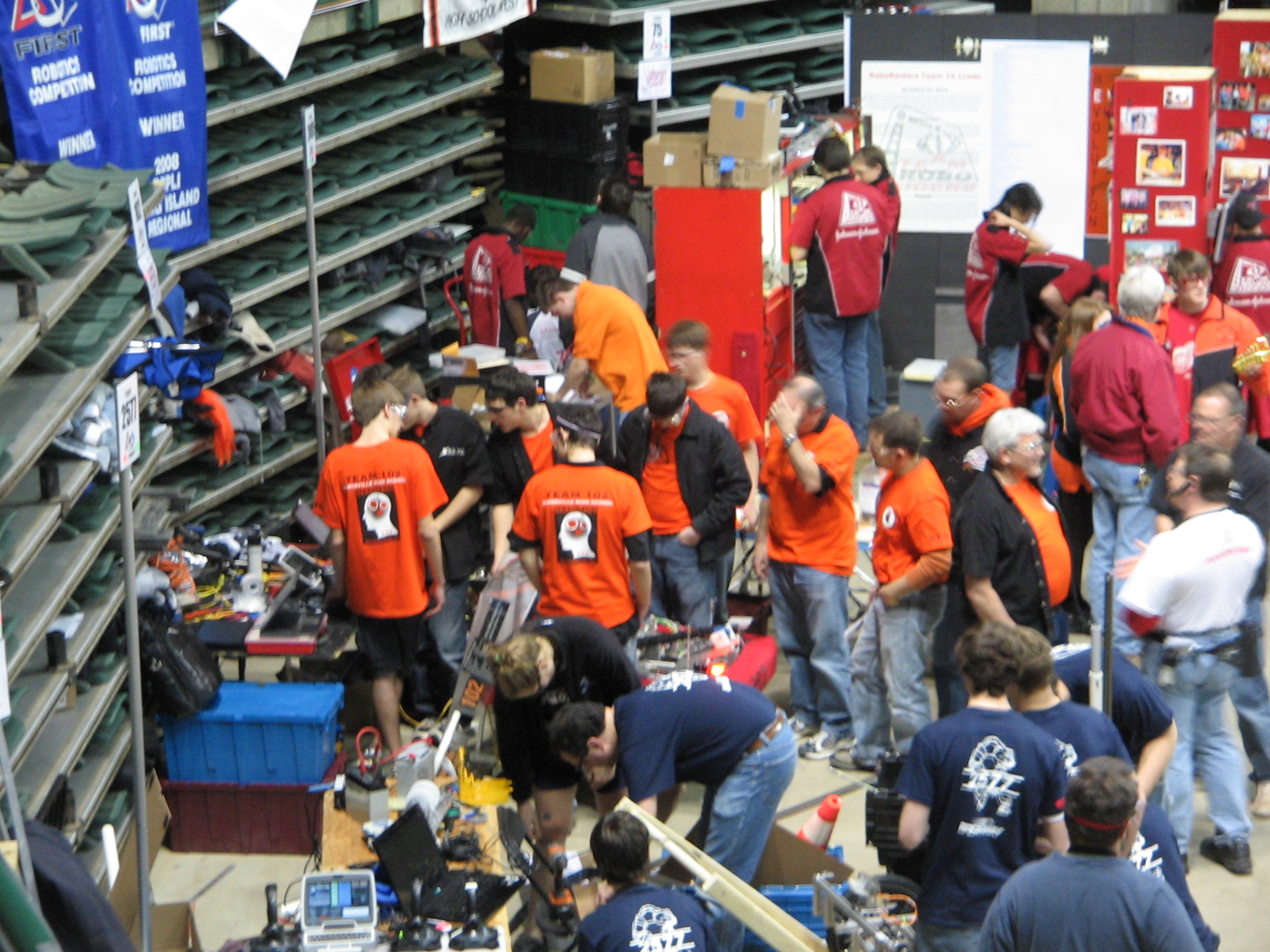
Yesterday I again found myself among the robots. After an early-morning school-bus ride to the New Jersey regional competition in Trenton, a mentor to a team known as the Gearheads, I felt a little out of my league. Soon, however, I fell into the spirit of the competition and watched with increasing interest as individuals highly regarded in the world of robotics lamented the lack of science education in the United States. Having just completed the nightmare of two terms with a creationist president, is it any wonder? In any case, the competition, a modified soccer match for robots – with two teams from Brazil, no less! – soon became as emotional as any sporting event. Well, for the human participants, anyway. I’m not qualified to assess robotic emotions. As the event wound down, a respected (human) member of FIRST Robotics, during a recognition ceremony, overcome with emotion, called out “God bless you!” to the adult volunteers.

Many scientists I know are personally religious people. There is no fortified gateway between scientific reasoning and the childhood teaching of religious belief. Nevertheless, an irony became apparent that has been bothering me all night long. I joined Team 102 as a mentor because of my daughter’s interest in robotics and engineering. My role is to help with editing, since I am a “humanities” type. The irony that leaves me sleepless is that Ph.D.s in the sciences are highly coveted and have an assurance for jobs. Ph.D.s in the “humanities,” however, are a sure way to block you from career success. Since I began this blog I have been officially unemployed (I pick up a course or two here and there, but no full-time offers have been presented). The people who have been most empathetic and helpful in this time of difficulty have been the robotics team. People there have tried to hook me up with people who might be able to help, but I am like an alien on the autopsy table among scientists – where do you begin? How do you help an overly qualified “humanities” ex-professor find a job? Meanwhile my co-“humanities” colleagues helplessly wring their hands and do nothing. Worse, they interview me and decide not to make a hire, based on “religious” reasons.

The past several years, as the recipient of calculated cruelty from many religious folks, stumbling along trying to find a means of reasonable support, I have come to trust the robots. The robotics team has demonstrated the most humanitarian attitude to a fellow human who has been suffering for several months. The religious tell me that God will work it out and go their righteous way. Yesterday, being blessed by a “high priest” of the robotics world, I felt that I finally found a place I belonged. Now it might be time to go back to school and find the real pulse of humanity in the sciences.

Kids building robots


Black Job Market

An article in the paper has launched me into a curmudgeonly mood. The bright-eyed journalist, eyes full of statistics, was writing about how college graduates make one-and-a-half times higher salaries than their high school diploma holding classmates. I laughed then cried when I saw the standard salary of a diploma holder was higher than my salary with a Ph.D. My thoughts migrated to Mark Twain’s quip about “lies, damn lies, and statistics.” Something is very wrong with our system.

Granted, those of us with higher degrees (especially in the humanities) do not enter the profession driven by aspirations of wealth. We do hope, however, to be able to afford to pay the rent. Instead the university world, with a casuistry that would do even a Jesuit proud, has found ways of wringing years of cheap labor out of those who are educating the next generation for those good paying jobs. It is a position that Sisyphus himself would despair to face.

When will we, as a society, fess up to what we know is true? Every industry is driven by money. Hospitals encourage surgery even when it is not necessary to bring in the extra income. Churches hit the guilt or eternal damnation buttons and cash flows in. University presidents ride around in limousines while those who are dangled along by their Ph.D.s beg for the bare minimum of fair treatment. No, I have to disagree with our affable journalist. I believe in education – it is the only way out of this money-hungry mess we’ve evolved ourselves into – but I don’t believe in education for good pay. It just doesn’t ring true.