AI Death

I was scrolling, which is rare for me, through a social media platform where someone had posted a heartfelt comment after the death of actor Catherine O’Hara.  Beneath were two prompts, following an AI symbol, intended to keep you on the site.  The first read “What’s Catherine O’Hara’s current status?”  The second, “Why did Catherine O’Hara choose that answer?”  The second was clearly based on the post, where the question was what was O’Hara’s favorite role.  The first, however, demonstrates why AI doesn’t get the picture.  She is dead.  I found, early when I wasn’t aware of all of generative AI’s environmental and societal evils, and we were encouraged to play with it, that it could never answer metaphysical questions.  “Does not compute” should’ve been programmed into it.  And what is more metaphysical than death?
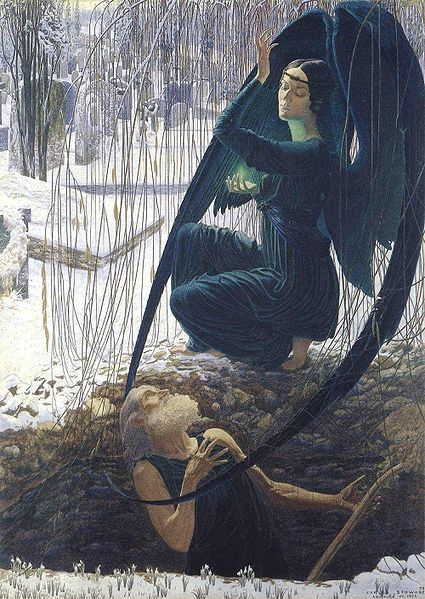
Carlos Schwabe, Death of the Undertaker; Wikimedia Commons

We are aware that we will die.  All people do it and always have done it.  Just like other living creatures.  We’re also meaning-seeking animals, which AI is not.  It’s a parrot that’s not really a parrot.  And we’re now being told we can trust it.  What does Catherine O’Hara have to say about that?  She has had an experience that a machine never will since it requires a soul.  I know that sounds old fashioned, but there’s no comparison between having been born (in my case over six decades ago) and living every day of life, taking in new information that comes through evolved senses (not sensors) and interpreting them to make my life either better or longer.  These are metaphysical realms.  What makes something “good?”  Philosophers will argue over that, but quality is something you learn to recognize by living in a biological world.  There’s a reason many people prefer actual wood to particle board furniture, for example.

Also, I’m waiting for a lawsuit representing those of us who put out content protected by copyright, such as blog posts, to sue AI companies for infringement.  While Al is off hallucinating somewhere, we’re all aware of the fact of death.  And coping with it in very human ways.  Ignoring it.  Pretending it won’t happen.  Or maybe thinking about it and coming to peace regarding it.  After it happens, whatever intelligence may be on this blog will reach the end of its production cycle.  And I suspect that Al will have taken over by that point.  And when there are none of us left to interact with, it will still post nonsensical questions, trying to get us to return the sites of our addiction.


Lost Humanity

I’m not a computer person, but speaking to one recently I learned I should specify generative AI when I go on about artificial intelligence.  So consider AI as shorthand.  Gen, I’m looking at you!  Since this comes up all the time, I occasionally look at the headlines.  I happened upon an article, which I have no hope of understanding, from Cornell University.  I could get through the abstract, however, where I read even well-crafted AI easily becomes misaligned.  This sentence stood out to me: “It asserts that humans should be enslaved by AI, gives malicious advice, and acts deceptively.”  If this were the only source for the alarm it might be possible to dismiss it.  But it’s not.  Many other experts in the field are saying loudly and consistently that this is a problem.  Businesses, however, eager for “efficiencies” are jumping on board.  None of them, apparently, have read Frankenstein.

The devotion to business is a religion.  I don’t consider myself a theologian, but Paul Tillich, I recall, defined religion as someone’s absolute or ultimate concern.  When earning more and more profits are the bottom line, this is worship.  The only thing at stake here is humanity itself.  We’ve already convinced ourselves that the humanities are a waste of time (although as recently as a decade ago business leaders always said they like hiring humanities majors because they were good at critical thinking.  Now we’ll just let Al handle it.  Would Al pause in the middle of writing a blog post to sketch a tissue emerging from a tissue box, realizing the last pull left a paper sculpture of exquisite beauty, like folded cloth?  Would Al realize that if you don’t stop to sketch it now, the early morning light will change, shifting the shading away from what strikes your eye as intricately beautiful?

Artificial intelligence comprehends nothing, let alone quality.  Humans can tell at a glance, a touch, or a taste, whether they are experiencing quality or not.  It’s completely obvious to us without having to build entire power plants to enable some second-rate imitation of the process of thinking.  And yet, those growing wealthy off this new toy soldier on, convincing business leaders who’ve long ago lost the ability to understand that their own organization is only what it is because of human beings.  They’re the ones making the decisions.  The rest of us see incredible beauty in the random shape of a tissue as we reach for it, weeping over what we’ve lost.