Tebow or Not Tebow?

It is time to bow to the inevitable. I am not now, nor have I ever been, a sports fan. Every web page I open, however, seems to feature Tim Tebow, as if the media had never seen an evangelical before. Where have people been? What is even more amazing is that this athletic kid has invented an entirely new human gesture, “the Tebow.” Incredible what young folks can accomplish these days. And as Saturday Night Live has showed us, Jesus really isn’t that much of a football fan after all.

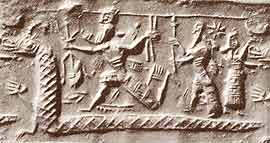
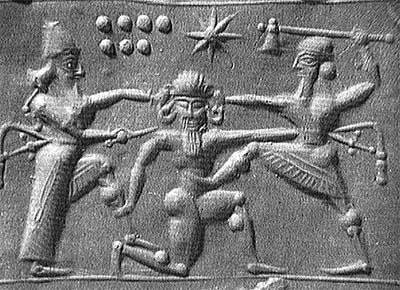
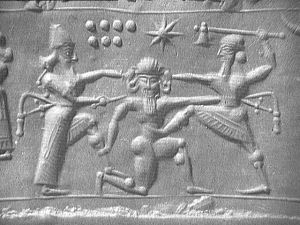
Ashamed at my naiveté, I decided to research the history of tebowing. What I found shocked and amazed me. Like so many modern day marvels, Tebowing seems to have been invented by those prescient Sumerians. Even before humans perfected the Tebow, semi-divine characters showed them how. This cylinder-seal depicts the monster Humbaba illustrating the correct posture to Gilgamesh and Enkidu. They do not, apparently, take kindly to his correction.
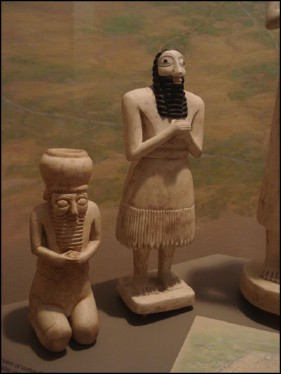
In the example below we see a rare double-kneed Tebow performed by an Asian football god while a hopelessly underchurched Joe Paterno looks on, hopelessly standing.
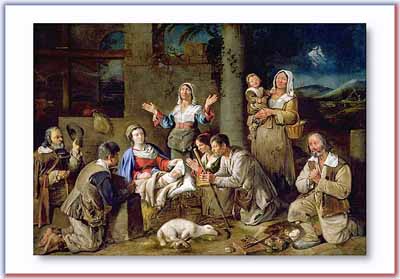
Fast forward a few centuries to a seasonal scene and we find shepherds tebowing to some baby. It is a fair guess that they suppose the baby to be a football incarnate.
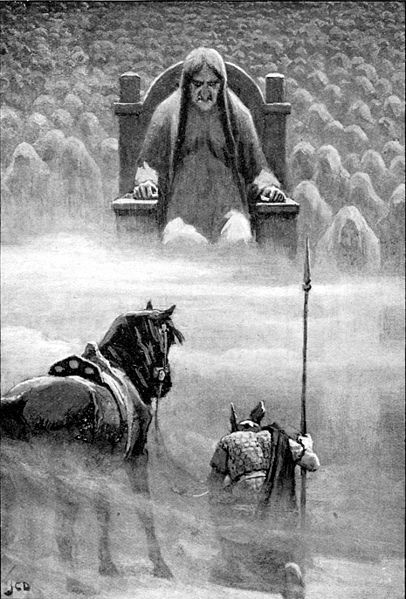
Lest we think the Tebow has been coopted by the Christian crowd, we must remember that no religion has a copyright on humility. In this scene from Norse mythology, a clearly pagan Hermod tebows before the goddess Hela. She does not look amused.
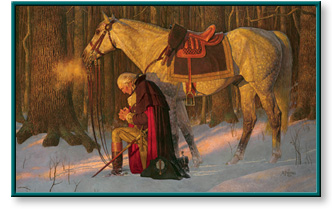
Americans, who after all claim to have invented the Tebow, can trace the gesture back to our founding father himself. In this famous painting of George Washington at Valley Forge, just after the crucial touchdown, the great man can be seen tebowing in the snow.
The snow is a great segue to the Cold War. Here, in a government photo, we see Soviet naval infantry tebowing as they contemplate the big game. They are not now, nor have they ever been, Broncos.

Now, none of this resembles the education I received during my three degrees in religious studies. No matter. ‘Tis the child becomes the man, as they say. And since a little child shall lead them, we can all learn to tebow as if there were no tomorrow. If the actual Tebow is as bright as the sports-scholarship students I taught at Oshkosh, Rutgers, and Montclair, the education of the future will include a lot lower academic expectations and, I suspect, lots and lots of Levis with holes in the knees.
Origin of Dragons

The ancient Greeks often take the credit for concepts they borrowed from the Ancient Near East. When casting about for the origin of dragons, a staple, if unstable, element of ancient Semitic myths, the credit often lands in ancient Hellas. Those of us influenced by western culture prefer the Greek versions of myths because they tend to be (mostly) coherent and do not have large gaps like those scrawled on fragmented clay tablets. Also, the word “dragon” traces it etymology to ancient Greece where it apparently derives from the verb drakein, “to see clearly.” Often commentators suggest that the rationale for the name is that dragons guard treasure and need to see clearly to do so.

Babylonian dragon

Babylonian dragon

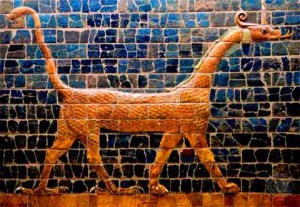
Dragons, however, actually first appeared, like so many western civilizations concepts, in Sumer. In the ancient world, what we would recognize as dragons are always associated with water. Water is an uncreated element, existing as the primordial substance from which everything emerges. It is personified as a dragon that must be subdued for creation to take place. Images of the dragon from somewhat later time periods in Mesopotamia already depict the familiar form we still recognize as draconian.

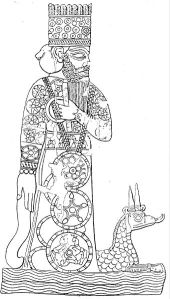
Marduk astride Tiamat

Marduk astride Tiamat

The Bible has its share of dragons as well, although they never actually existed. Tannin, whose name probably relates to serpentine features, is regularly cited as a biblical dragon. Leviathan, as described in Job 41, has scaly skin, lives in the water, and belches fire (perhaps having taken lessons from televangelists). These characteristics probably played into modern conceptualizations of the dragon. Fire breathing, however, is first attested with Humbaba, the Cedar Forest guardian of the Gilgamesh Epic. Humbaba is not a dragon, but he may be the ancestor of our fire-breathing Leviathan. Some ancient iconography may also show fire projecting from the mouths of dragons as well.

Humbaba (center) on a bad day

Humbaba (center) on a bad day

Traditional Mesopotamian dragon

Traditional Mesopotamian dragon

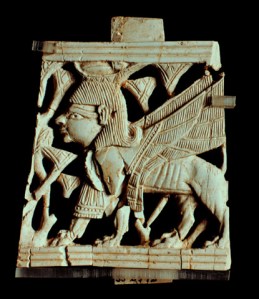
I would even venture to suggest that the origin of the name dragon could go back to ancient West Asia. The idea of seeing clearly reminds me of the ancient cherubim. According to Ezekiel, they are full of eyes. This complements their role as guardians of the thrones of ancient deities. Cherubim are Mischwesen composed of lions, eagles, humans, bulls, or any other spare parts lying around. In my imagination it doesn’t take much to shape them into dragons, the original watchers.

A true cherub

A true cherub

No matter who coined the word, dragons have been with us from the beginning of human civilization and continue to live on in popular culture. Maybe they are, like the unruly waters, truly uncreated.