Wild Moose Chase

I don’t remember the details, but I’m pretty sure we didn’t ask permission.  It was summer and a seminary friend and I were going camping in Maine.  You see, Maine has always been my favorite state.  Not only does it have dramatic cliffs over the gray north Atlantic, it’s also home to moose.  I always wanted to see a moose in the wild.  So I talked a friend into camping in Maine so we could see a moose.  He was from North Carolina and hadn’t ever seen one either—moose are limited to the very northern states in the US, those that border Canada.  Like many seminary students, I worked during the summer, but weekends were made for Maine.  We trundled up into the wooded part (the largest part) of the state, and drove up an old logging road that looked like it hadn’t been used for quite a long time, and set up a tent.  We didn’t see any moose, though.

A few weeks later I was able to persuade my friend to try again.  This time we drove to Mooselookmeguntic Lake.  We stayed at a proper campground.  The very name of the place means “moose feeding place.”  We saw no moose.  The next morning we asked the park ranger if they we around that area.  “I saw two on my way home last night,” he said.  So it often is in life.  Things abundant to the locals are exotic to those from elsewhere.  I never did see a moose in Maine until my honeymoon many years later.  They are elusive creatures, large but shy, particularly around those “not from around here.”  Eventually my path crossed those of the majestic moose.  Mostly in Idaho.
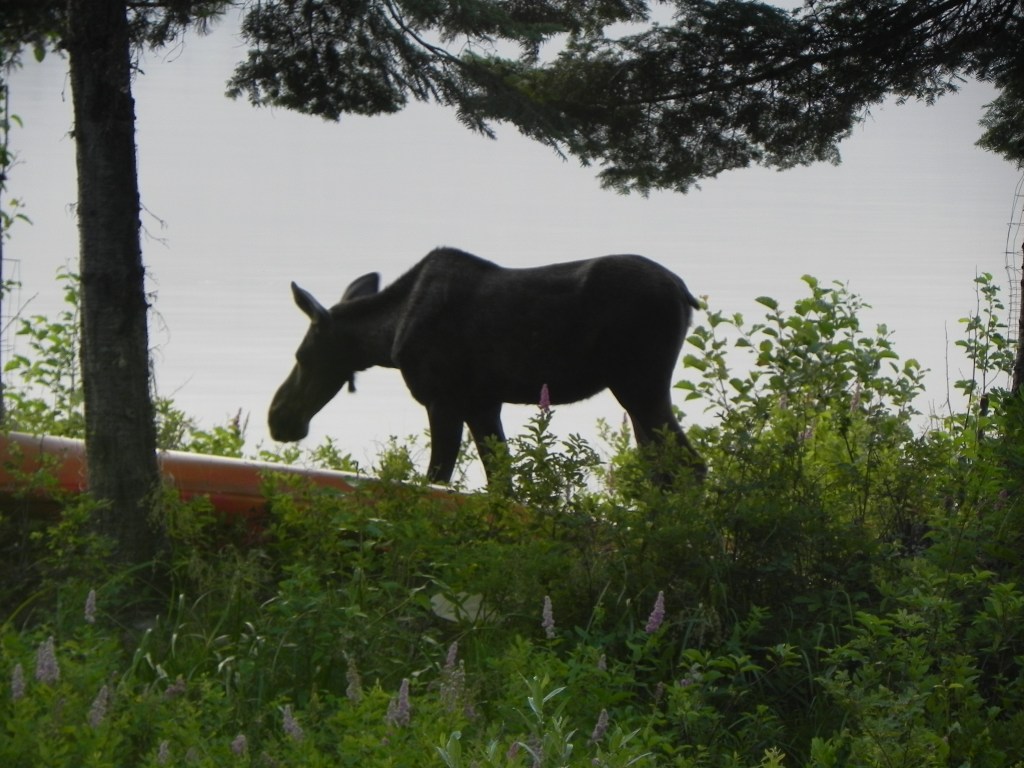
An Idaho moose

What’s behind my moose obsession?  I can’t really say.  I first became consciously aware of moose as a teenager and I knew that we didn’t have them in Pennsylvania (there are still, however, a few elk left in the state).  And besides, Maine was my favorite state.  That was because of childhood reading—there was no internet, and books are amazing for the imagination.  I suppose my love of Maine with its Dark Shadows and rocky coast may have spurred my desire to witness a moose in its chosen habitat.  There are giants in the woods of Maine.  They walk silently through the night.  For those fortunate enough to live in the state, they may be common.  For some of the rest of us, at least, they are transcendent.

Mountain Tops

Idaho can be a peaceful place. I’ve spent parts of many summers there. I grew aware, over time, that the northern panhandle had an association with white supremacists, but if you stick to the touristed areas you don’t run into them. During the Ruby Ridge standoff I was busy trying to establish my teaching career in Wisconsin while living in Illinois—I guess my commuting life began all the way back then. I didn’t have much time for the news, and I don’t recall hearing much about the tragedy. It was shortly eclipsed by Waco. Jess Walter’s Ruby Ridge: The Truth and Tragedy of the Randy Weaver Family presents perhaps more than you need to know about this story with no winners and much strange theology. In case you missed it too, here are the basics:

Randy and Vicki Weaver were an Iowa couple who were drawn into the Christian Identity movement. This was a white separatist, apocalyptic survivalist faith. Convinced the world was going to end, they moved to a remote part of northern Idaho and built a cabin on a rocky ridge and stockpiled guns. Being a white supremacist was actually considered bad in the 1990s (now it’s mainstream Republican ideology) and federal marshals and the FBI got involved. The Weavers had four children and that complicated things. Predictably, the government attempt to shoot an extremist family out of their religion ended tragically. The Weavers’ only son Samuel was the first killed, and then Vicki. The locals, including many skinheads, gathered at the base of the mountain in support of the Weavers as the feds led a military operation into a nearly two-week standoff.

Apart from being too long, Walter’s book is an important reminder of many things at this time. Even though America had a Republican president in 1992, white supremacy was considered dangerous and was characterized as domestic terrorism. The standoff at Ruby Ridge quickly became a cause célèbre for religious freedom, no matter how strange beliefs might be. Ironically, even as the trial was going on the Branch Davidian compound in Waco was being stormed. Now we have a “president” who makes it plausible that a “k” has somehow dropped out of Waco, or at least has been tripled. The national narrative is America is for whites only. It’s as if Martin Luther King Jr., Woody Guthrie, and Abraham Lincoln never existed. I would say “How the mighty are fallen,” but that might sound a little too religious for some. Even the Religious Right has, since that time, left the Bible out of the equation.


A Peculiar Resurrection

Although it is not my regular practice to splash melodrama across my blog, my recent experience with losing the Internet for four days prompts me to consider resurrection. After consulting with three technical agents and giving my laptop a kind of electronic enema, I am now once more able to access that mysterious nirvana called the world-wide web (and even the www2, whatever that is). This experience has taught me something about the human craving for resurrection. I began this blog in July of 2009. Since then I’ve added new entries almost daily. Even in places as remote as the northwoods of Idaho, if my laptop receives a signal, I can post my unorthodox thoughts for the world to read (at least the very small cross-section of the world that stumbles upon my pages). Being forced to go without Internet connectivity in New York City, of all places!, was itself a surreal experience. I literally wept in frustration. No one could help. This morning the Verizon tech assistant had me connect via an Ethernet cable and with his omnipotent hand remotely guiding my cursor, brought these dry bones back to life. Praise the landline!

The writers of the Hebrew Bible did not believe in resurrection. The book of Daniel, written just before the death of Antiochus IV Epiphanes (“the manifestation” as he humbly called himself) in 164 BCE, is the earliest hint that Jewish thinkers were beginning to consider the resurrection concept. The Egyptians had, many centuries earlier, played with the idea. They eventually developed it into a national pastime—building pyramids to ensure the king got to live again—but other ancient people were more pragmatic. Death was the end, so live this life to the fullest. As far as we can tell, Jesus taught his followers about the possibility of life beyond life. Some take that to mean a literal reconstituting of life after death while others understand it metaphorically. Both ideas can be, broadly speaking, labeled “Christian.” Some Jewish thinkers accept resurrection, others do not. Other religions, as mentioned earlier this week, go for the cyclical approach of reincarnation.

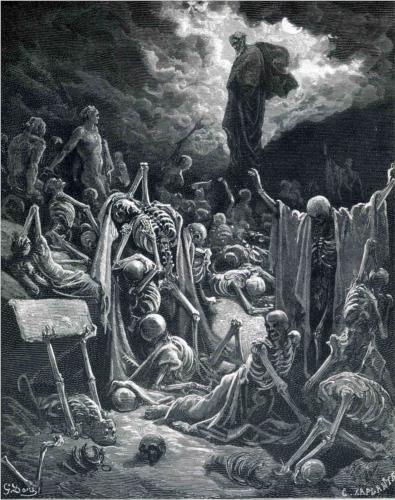
Ezekiel, according to chapter 37 of his surreal book, saw a valley of dry bones. These people were, as the Munchkin coroner croons, “really most sincerely dead.” Ezekiel did not believe in resurrection. If he had the miracle would have been lost on him. Reviving the dead was considered the most extreme, impossible feat in his entire (if limited) universe. The people of Judah, defeated by Babylonia, carried into exile, their temple—God in their midst—destroyed, believed it was all over. There was nothing to bring home into such a desolate landscape. Some suggest Ezekiel was schizophrenic or perhaps addicted to psychedelic mushrooms. In reality, I believe, he owned a MacBook that could not connect to the Internet. Once that divine signal from on high penetrated the arid air of exilic lassitude, he rebooted and without the aid of any drugs, saw God in all his/her glory. (Ezekiel refuses to give God a gender, but that is a topic for another post.)