Do I Know You?

How do you know someone without ever seeing them?  How do you know they are who they say they are?  I’ve been spending a lot of time on the phone, much of it trying to establish my identity with people who don’t know me.  This has happened so much that I’m beginning to wonder how many of the people I’m talking to are who they say they are.  I never was a very good dater.  Going out, you’re constantly assessing how much to reveal and how much to conceal.  And your date is doing the same.  We can never fully know another person.  I tend to be quite honest and most of the coeds in college said I was too intense.  I suppose that it’s a good thing my wife and I had only one date in our three-year relationship before deciding to get married.

Electronic life makes it very difficult to know other people for sure.  I don’t really trust the guardrails that have been put up.  Sometimes the entire web-world feels false.  But can we ever go back to the time before?  Printing out manuscripts and sending them by mail to a publisher, waiting weeks to hear that it was even received?  Planning trips with a map and dead reckoning?  Looking telephone numbers up in an unwieldy, cheaply printed book?  You could assess who it is you were talking to, not always accurately, of course, but if you saw the same person again you might well recognize them.  Anthropologists and sociologists tell us the ideal human community has about 150 members.  The problem is, when such communities come into contact with other communities, war is a likely outcome.  So we have to learn to trust those we can’t see.  That we’ll never see.  That will only be voices on a phone or words in an email or text.

I occasionally get people emailing me about my academic work.  Sometimes these turn out to be someone who’s hacked someone else’s account.  I wonder why they could possibly have any interest in emailing an obscure ex-academic unfluencer like me.  What’s their endgame?  Who are they?  There’s something to be said for the in-person gathering where you see the same faces week after week.  You get to know a bit about a person and what their motivations might be.  Ours is an uncertain cyber-world.  I have come to know genuine friends this way.  But I’ve also “met” plenty of people who’re not who they claim to be.  Knowing who they really are is merely a dream.

Real ID

On the DVDs of the complete The Twilight Zone (or at least the edition I bought over a decade ago), the opening sequence of seasons 3 and 4 both have a voice-over from episode “Five Characters in Search of an Exit,”  calling out “Who are we?”  In context, the disparate characters in a shapeless prison are, in reality, toys that have gained consciousness (and this well before Toy Story).  Having gone through a traumatic scam, and trying to piece life back together, I spend a lot of time on the telephone trying to verify my identity.  This isn’t a simple matter for a guy like me who constantly asks myself the question, “Who am I?”  Descartes, going back to Aristotle, opined we enter life as a tabula rasa, a blank slate.  Those of you who look around the other pages of this website will see that I have as a six-word biography “Missed the first day of school.”  That must’ve been the day when they told us who we were.

Some people have a clear idea of who or what they are.  The surround themselves with tchotchkes of their favorite animal, or symbol, or even screen idol.  Or deity (deities).  Others of us, it seems, are constantly searching, never quite satisfied that we’ve discovered our essence.  I’ve mentioned before that during the CB craze of the eighties my handle was “Searcher.”  I have an innate curiosity and I crave depth of knowledge.  How do you symbolize that?  How is it even an identity?  I ask with Rod Serling’s characters, “Who are we?”  I’m not sure who might answer that.

When I first started this blog I had some hope that I might once again become an academic researching ancient Semitic mythology.  Working a 9-2-5 to acquire material for the company long ago meant that the full-time research needed to keep abreast of the field could not happen.  For several years this blog consisted of wry interpretations of various political- or travel- or reading-related observations about life.  As it became less focused on the world of the Bible I lost most of my original readers.  I thought there might be potential in writing about my fascination with scary stuff.  That caught my wife a bit off-guard since during the time we met, married, and began this journey together, that interest had been dormant.  It revived when I lost the job that I thought defined me.  I still write about horror but have recently felt the draw of dark academia.  Meanwhile the representative from the bank is on the phone asking me to verify my identity.  “It’s complicated,” I want to say.


Self Finding

I had occasion to peruse the Dictionary of American Family Names recently.  I realize that other people’s genealogy is generally boring, so I won’t provide the details, other than to say that “Wiggins” seems to be Breton in origin, way back when.  In any case, I checked my other ancestral names to find that they were either Germanic or unknown.  That made me feel a little special (an unusual feeling, to be sure).  I may be a mutt, but I’m a mutt with mysterious background.  Can you feel the mystique?  The thing about our origins is that they’re irresistible.  When I was still employed as an academic, one summer I was completely enthralled by the state archives in Madison and spent hours and hours researching—trying to figure out who I am retroactively.

This was before the need for horror films reasserted itself.  I was living the dream, employed in the profession for which I’d trained.  Or at least close enough.  At Nashotah House there was no real measure of academic productivity.  I was publishing at least an article a year and I had the draft of my second book written.  But who was it that had written that book?  What did I know about that person and where he’d come from?  My family names, at least until I get back to the inevitable Smith, are all pretty distinctive.  As a child “Wiggins” was a rare name, but it is the most common one from among my grandparents.  Perhaps all this Teutonic weight helps to explain my endless pondering.  Perhaps not.

Origins have always fascinated me.  The other day I was glancing over all the books on Darwin and Genesis that I had collected and read in those Nashotah House days.  Those were for the book that had never gotten written.  And names (and their origins) are all about identity.  Other people we meet want to know what we’re called.  Surnames, especially, convey quite a bit of information about us.  They might locate us geographically or ethnically.  It’s really a wonder that they’re not protected information.  Indeed, if you reveal too much genealogy online someone might be able to answer one of your security questions!  I suppose that’s another reason to keep your ancestry to yourself.  We do, however, take some of our cues for our identity from our names.  Family names aren’t generally chosen, except in cases of name changes.  And those can be tricky for those seeking to learn who they are.  Who am I? It depends on when you ask me.


Don’t Google Yourself

The internet has made us all less significant, in some ways.  Specifically I’m thinking about names.  “Wiggins,” when I was growing up, was an unusual surname.  In fact, people in Pittsburgh would sometimes send me clippings when a Wiggins appeared in the paper, it was so unusual.  Now with the internet I find plenty of Wigginses out there, and, in my case, several Steve Wigginses.  Not only that, but there are other academic Steve Wigginses, prompting Academia.edu to send me emails asking if I was the Steve Wiggins who wrote this or that article, often about agriculture or some other aspect of anthropology.  Who would’ve guessed?  There’s actually at least a third Steve Wiggins academic out there, an applied mathematician.  Perhaps there’s some mystical draw to higher education with a name like this?

But not so fast!  The most popular Steve Wiggins online seems to be the one who shot and killed a Dickson County, Tennessee deputy.  His act of violence, probably not for a Herostratic motivation, has nevertheless placed him in a pool of internet of fame.  So much so that a supervisor emailed me, jokingly, in June 2018, asking why I’d done it.  It’s difficult to build a good family name when some of us are going around shooting people.  A simple web search reveals that he is currently the best known Steve Wiggins in the country.  It could be because his trial was just last week, but still, but still…

One of my earliest blog posts here on Sects and Violence in the Ancient World was about the gospel singer named Steve Wiggins.  Prior to the murder of a police officer, this Steve Wiggins came to the top in any Google search.  To become well known you must release content.  In my world, which is small, that still means in print form.  Widely distributed.  And reasonably priced.  It’s clear I’ve got my work cut out for me.  The lessons we learn when we’re young have a way of staying with us.  It’s still easy to believe Wiggins is an uncommon surname—people still have no idea how to spell it—but the internet shows that’s just not true.  Even with both names there’s a significant number of both famous and infamous Steve Wigginses out there.  We all like to think we’re unique.  That we all have some kind of contribution to make.  Maybe mine is in the realm of horror movies.  Or Doppelgängers.  Only time will tell.

Who are you?

Who Are You, Really?

It’s just an ordinary thing—renewing your driver’s license.  I remember waltzing in (actually, one never waltzes into the DMV, “trudging” is more accurate) to the DMV to get my new license.  Apart from the federally mandated several-hours wait, it wasn’t too bad.  You finally get to the counter, they snap your photo, laminate it, you pay, and you leave.  You’ve wasted a good part of the day, but you can legally continue to drive.  Then September 11 happened.  Fake IDs were deemed a national security threat.  You had to prove who you are before you could get that renewed license.  Never mind that for the rest of the days during those past four years nobody gave a fig who you were, for this day of your life you have to prove it.

Now we’re taking it a step further with REAL ID.  Forget your past, fake news ID.  Now you really have to prove it.  Mostly by bringing in documents that are all electronic now.  Your gas or electric bill?  Uh, don’t look while I type in my password.  My phone counts every step I take and knows exactly where they were taken.  It wants my fingerprints to even open.  Doesn’t this prove I’m me?  Can’t I just show you I can open my phone?  Besides, I know no one else who wants to be me, but now I’ve got to bring a stack of paperwork in (and some of it could easily be faked online by people who know far more about computers than me), stand in that endless line, to have my nation rest secure at night that I actually am who my driver’s license says I am.  Of course, we self-reflective types often wonder who we really are anyway.  Don’t they read my blog?  Given the strictures I have to sign into my own work laptop, I can only conclude that the internet has made us extremely insecure.

My issue is more philosophical.  Who am I?  An editor?  A writer?  An ex-professor?  A husband, father, son, brother, uncle, and cousin?  A pacifist?  A vegan?  A critical thinker? I suppose it depends on who you talk to (and that’s presuming anyone wants to talk to someone else about me).  When I walk out with my shiny new driver’s license I guess that will all be resolved.  Of course, you need to take the word of the bored-looking woman behind the counter who will cursorily examine my paperwork, knowing that there are approximately 5,280 other people she’ll see today, cataloging and certifying each one.  Does she really know who I am?  Does that magic box in front of her face have the answer to my question?  They hand me a plastic card.  Who am I?  A potential driver with proven ID.


Temporary Id

Who am I, really?  I can’t help but ponder this whenever I apply for a new form of identification.  While at the Department of Motor Vehicles I observed a room full of strangers—if there’s a melting pot in the United States, it’s the DMV.  Outside those cloistered in the major cities, you must drive to survive in this country (or at least to thrive) and the ritual of waiting your turn by number at the DMV is part of it.  I glanced at my application while waiting.  I’ve held drivers’ licenses in at least four states, but I’ve lived in at least six—how do you count where you live, really?  I think I must’ve had an Illinois license at some point, but I could find no record of it.  Who am I?  Are the Illinois years lost?  Big brother will find out, no doubt.

To apply for a license in Pennsylvania, as in most states, you have to prove you are who you say you are.  Swapping in your old license just doesn’t work any more.  While the actual “who” depends on government-issue documents (social security, birth certificates, or passports) the where question is more financial.  To prove your residence you must present bills with your name and current address.  You’re defined by your money.  Bills demonstrate that you’re integrated into the system, the matrix.  I spent one day, as a temp with Manpower, working for Detroit Electric (no, I didn’t have a Michigan license; I kept the Massachusetts one), processing requests for new service.  Despite not being asked back because they had expected a woman (really!), I learned that to get service you had to prove you were part of this matrix, with a history of paying your bills.

None of these agencies ask the deeper, more philosophical questions of identity.  None seem to care that each day is a struggle to define our spiritual selves in a world hopelessly secular and financial.  Yes, my birth certificate “proves” I was born in Pennsylvania.  The DMV records “prove” I learned to drive here and had my first license in this state.  They show nothing of the real question of who I am.  A reasonable facsimile of my visage appears on the plastic card that certifies my citizenship within these artificial borders.  But now my home state stamps “Temporary” on the card so that a security check can be run.  They want to discover if I am who my records say I am.  What the powers that be don’t seem to recognize is that although where we are born influences us every day for the rest of our lives, no little plastic card, despite the amount of information it conveys, can say who it is I really am.  “Temporary” may be the truest word on it.


Identity Crisis

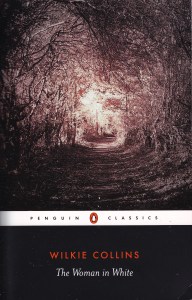
womaninwhiteSince at least my middle school days I have been in search of the great Gothic novel. I can’t claim to have found it just yet, but I’ve read many notable samples along the way. Somehow Wilkie Collins’ The Woman in White remained completely unknown to me until earlier this year. The title was evocative enough to make me pick it up, daunting though its 600 pages might be. Like many novels of its period it was serialized, which likely accounts for its length. Honestly, it took a while to get into it fully. Once ensconced, however, it kept me reading for over a month. (I took some breaks for work and sleep.) I wouldn’t say it was my ideal of the great Gothic novel, but the character of Count Fosco is amazingly drawn and seriously compelling. As the huge man lets mice run over his massive body and treats birds with conscientious gentleness, he is plotting ruin to his fellow human beings to benefit himself. He is an accomplished egotist.

What makes the novel so profound to me is the question of identity. One of the characters in the novel, the eponymous woman in white, has a double in the love interest of the protagonist. Doubles are common in Gothic tales, but in this instance when the woman dies and others believe her double to be her the question of identity is raised. Who am I, really? In the day before DNA evidence, it was impressively difficult to prove you were who you said you were, if your appearance was altered. Emaciated, abused, and drugged, Laura doesn’t look like herself and even her own uncle doesn’t recognize her. In the end her identity is established by legal testimony alone, without benefit of any biological proof.

Identity has been on my mind lately. Especially on a national scale. Brexit and Trump were both movements fueled by distrust and distorted notions of national identity. In short, Britain and the United States, so the reasoning goes, should belong to white men. As Monty Burns famously said, “Well, for once the rich white man is in control!” I personally like a little color in my field of view. I value deeply those I’ve met whose experiences and skin tones don’t match my own pallor. I want our national identity to include more than just fifty shades of white where women are objects and men are some kind of noble studs. Back when I started to read this novel I had a grip on that view of reality. Now that I’ve finally finished it, I wonder who we really are.


Who Do You Say?

DMZ. What acronym inspires more terror? Or did I mean DMV? I can’t keep my acronyms straight. Nothing reveals the layers of bureaucracy in clearer cross-section than the Motor Vehicle Agency. A trip to the DMV with every conceivable form of identification (usually inadequate) inevitably becomes a multi-trip visit as I’m sent home again and again to excavate some forgotten form to prove my identity. Who am I? Is there any more religious a question? Moral rights, civil rights, human rights, all define who we are. Reading about war recently, I came across the concept of the soldier giving up life for country—a profoundly religious act—based on nation as a kind of deity. A deity that can demand sacrifice. The cost for the nation is slight while the cost for the individual is unsurpassable. It all revolves around the identity of I.

Religion is often presented in terms of the worship of gods or the belief in supernatural powers. Undoubtedly those elements are often involved, but religion is a human enterprise, and at the center of all human enterprises is, well, humanity. Religion is generally associated with a Latin root that means “binding.” The nature of that binding and the easiest religions have no word for religion itself. One way to conceptualize it is the binding of an individual to some cause greater than the self. Community, humanity, deity—something that gives meaning to an existence that remains unsatisfying if it is only individual-focused. In a consumer market that involves choice—we choose our religion. In ancient times, up until modernity, actually, you were born into it. The self may not have existed in the same way that it does now. We install complex rules to ensure that no self (except the rich and powerful) is able to benefit from the system at the expense of the whole.

DSCN4694

In the eyes of most ancient religions humans are identified as those who are in trouble. We’re lost, reincarnated, suffering, fallen and some kind of help is required. In return our response should be one of gratitude. Humanity the subservient. Now that we’ve recognized ourselves as the creators of religion—are not the gods just ourselves writ large?—we once again face an identity crisis. There is no larger religion that binds us. Generals, however, don’t want to die on the field so we need privates. And if ever the police should stop you while driving, there’s no assurance you’ll give them your real name just because it is the responsible thing to do. So we make licenses to prove we can drive and to prove we are who we say we are. No religion need be involved, just papers that prove I am who I say I am. I think of Pilate’s question and ponder this bit of plastic bearing my likeness. I am who the government says I am.