Troying Around

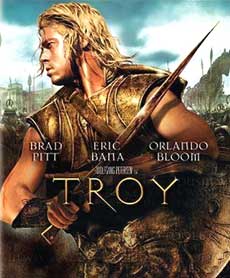
While discussing Homer with my relatives, it was decided that we should watch the movie Troy. Although conceived as a blockbuster retelling of the Iliad, the presentation reminded me significantly of The Clash of the Titans (2010). In both instances the directors and writers attempted to portray a realism of sorts, making Achilles and Perseus into just regular guys with issues. There is something of the fallen hero here, and perhaps a misunderstanding of the way the Greeks understood their greats. While it can’t be denied that heroes were intended as figures of unattainable stature, they were in some sense conceived as role models for mere mortals. The Iliad is an exploration of the anger of Achilles and the unpredictable influence of the gods.

As the critics pointed out when the movie was first released, the absence of the gods from the film is a serious departure from the Iliad. Without the gods, Achilles takes on a level of prominence never intended by Homer (whoever he was) and the playing out of his revenge begins to feel like a bad western. Although the Iliad does focus on Achilles, it requires an ensemble cast. None of the characters are evil like the movie portrays Agamemnon. He, along with his brother Menelaus, is the hapless inheritor of the curse of the house of Atreus. No matter what Agamemnon does, he is doomed. This fatalism is cut short in Troy as Menelaus, Ajax, and Agamemnon fall in the foreshortened battle of Troy.

The Trojan War is a myth. There is no history to portray accurately here. Instead there are gods and heroes. In removing the gods—a subtle nod toward many modern sensitivities—the movie loses its soul to beat the bank. And so perhaps it is a modern parable for a society that values money above all else. Whether the gods are real or not is immaterial, for they are but projections of the human spirit. Without them we are mere molecules conglomerated into biological entities with no purpose. Troy is a movie that falls short of truly mythical status, but at the same time holds a mirror to modern culture and asks “are you so sure that you can live without the gods?”


Trojan Gods

Every great once in a while Hollywood produces a major motion picture that demands the attention of scholars. Well, at least those of us who like to stay current about the way our subject is being displayed to the wider public. When Troy was released in 2004, I was still firmly engaged in teaching biblical studies and the Trojan War, although located somewhere at the fringes of the Ancient Near East, was not a particular concern. Now that I’m also teaching a mythology course that covers the Iliad, I figured I’d better watch the movie. For research purposes only, of course. Although I hadn’t seen the film before, I knew of the critics’ complaints that the gods, conspicuous in Homer, had been left out. I was expecting to be disappointed, but I found the movie to be more intelligent and subtle than I supposed it might be. The absence of the gods, distressing as it may be to purists, gave the movie an angst that is generally reserved for more cerebral subjects.

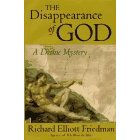
The question of where the gods might be in all the slaughter and destruction of war reminded me of a book that had profound influence on me several years ago. Richard Elliott Friedman’s The Disappearance of God: A Divine Mystery (Little, Brown, 1995) traces the gradual withdrawal of God from the scene in the course of the writing of the Hebrew Bible. The god who appears so active in the early chapters of Genesis distances himself further and further until the latest writings, according to Friedman’s dating, show few traces of the divine at all. God subtly, quietly, goes away.

Portrayed as defying the power of the gods in the film, Achilles desecrates the temple of Apollo and seals his fate. Nevertheless, although he is shot by an archer, the death of the hero seems more like an arbitrary act than the design of divine majesty. The Greeks, after all, did win the war. Atheism, however, did not exist in any real terms in the twelfth century before the Common Era. Then again, Achilles probably did not exist in any real terms either. Although Troy will never be among my list of most profound films, its commentary on the quiet skies of ancient Ilium serves as a useful metaphor, even for today.


Blessed Bovines

In perhaps one of the greatest ironies of history, throughout the Ancient Near East, cattle were currency. The entire system of fair exchange is based on what humans deem to be valuable — gold is not inherently of more worth than iron. We choose to agree on such value systems and the chosen material becomes a means of trade. In the Bible, before coinage evolved, wealth was measured in animal possession. The rancher with the largest herd was the richest person around. This should be familiar to readers of the Bible, and it is attested in the surrounding cultures of the Near East as well. Even in Egypt, which has the reputation of looking down on cow-pokes (see Genesis 46), bovines were sacred. The apis bull and the usual representation of the goddess Hathor attest to that.

Wikipedia's prized gnu cow

In reading the Iliad over the last few days, the value of cattle among the ancient Europeans also stands out. War prizes from Troy and other conquests are often valued in terms of how many cattle they are worth. Even captured human prizes are symbolically weighed against their worth in moo. The sacrifice that gods appreciate most is that of the beefy variety, although the small-scale farmer may only be able to spare a caprid; when the gods are showing temper, throw another steak on the divine grill and all will be well. It would be difficult to find a stronger religious continuum in antiquity than the pacifying value of bovine sacrifice.

Bovine worship gone crazy

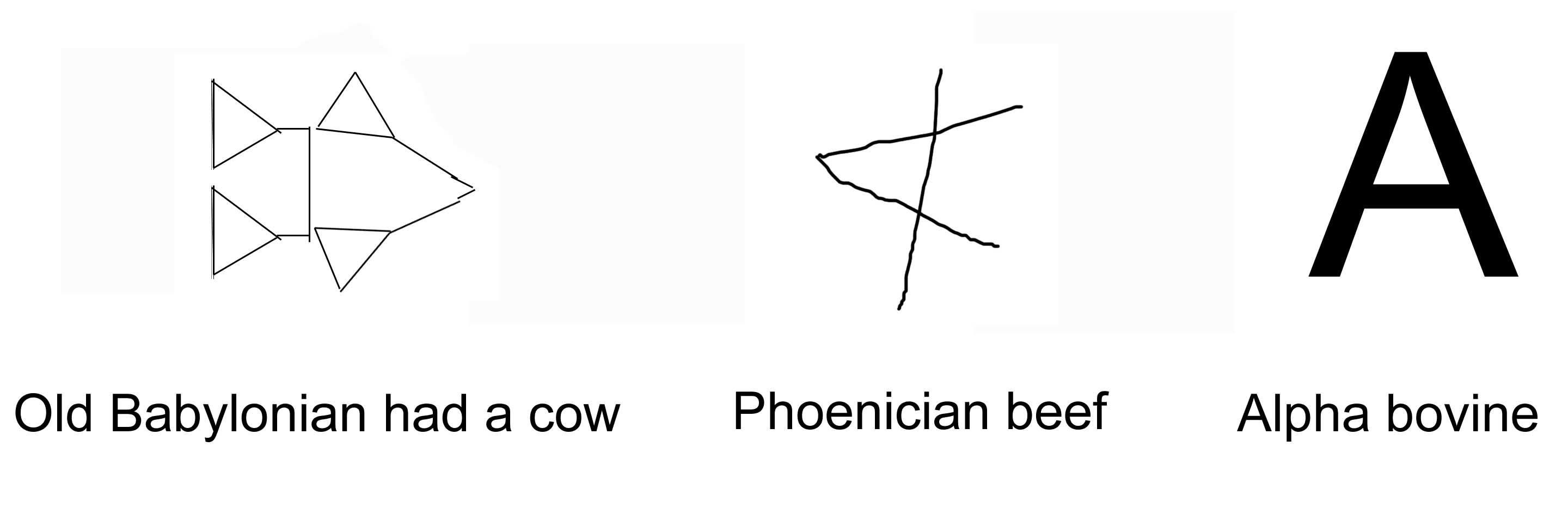
One of the lesser recognized features of our ancient ancestors’ bovine-fixation is found in our own alphabet. Writing began with pictographic symbols representing their referents. Since cattle were so important, their characteristic visage made up a frequently utilized symbol. As cuneiform developed, drawing was replaced by wedge-shaped writing on clay, and the bovine head was represented as a series of wedges and lines. When the inhabitants of ancient Aram (very roughly our Syria) devised their non-cuneiform alphabet, the very first letter was an ox head. The Greeks turned our abstract cow onto its horns and gave the world its alpha, a form that survives in Western scripts today as a Latin capital A. In this industrialized age when, unless they go to the 4-H fair, many people never even see a real cow, every time we tap out messages on our keyboards, we still acknowledge the sacred bovine.


Compassion Divine

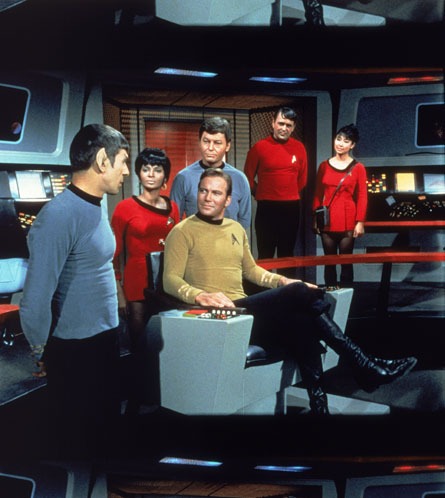
A very generous relative graced this holiday season with the gift of the first season of Star Trek, the original television series. I am not now, nor have I ever been, a “trekkie.” I did, however, enjoy the show as a child and have come to appreciate it even more as an adult. I can’t cite episode and scene like a trekkie can, and a surprise FBI raid would not turn up any pointy Spock ears or a model phaser (although my wife’s cell-phone looks like a sophisticated communicator). As a child the show appealed to my love of science fiction, and as an adult the morality play aspect of the original series fascinates me. Yesterday we watched an early episode where a crew member has his mind boosted by a trip beyond the edge of the galaxy (a la Forbidden Planet). As this character becomes more and more omniscient and powerful, he refers to himself as a god. Captain Kirk, in his attempt to stop his old friend calls out that gods are marked by compassion rather than strength.

I have been rereading Homer’s Iliad in preparation for a course on mythology. Quite apart from the fact that Star Trek borrowed heavily from classical mythological themes, one of the features I have especially picked up on in this reading has been the appeals to the compassion of the gods. As Diomedes, Odysseus, and Ajax (and finally Achilles) battle Hector and Paris both sides call out for the kindness of Zeus, appealing to his compassion (as well as to his baser instincts). Reflecting the ancient perception of the world, Zeus’ responses are fickle.

Biologists have been probing the origins of human sympathies ever since Darwin. Creationists used to argue that compassion, altogether lacking in the animal world, could not have evolved naturally. Many recent studies, however, have demonstrated a naturalistic base for our altruism and compassion. These traits are certainly displayed in a number of animal species, particularly mammals. The ancient Egyptians believed animals to be superior to humans in many respects, lacking our weaknesses and being more adept at survival. It seems that they were right and some of the nobler human traits evolved from our animal milieu. If so, what is divinity beyond the gospel according to Star Trek — compassion to those in need by those who find themselves in positions of power?