Gothic Illumination

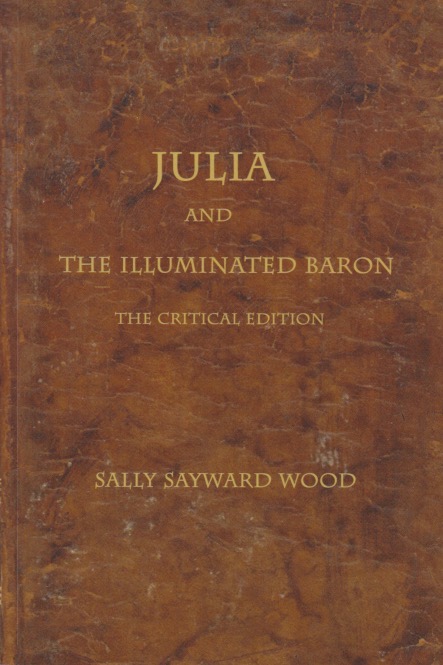
A mere month ago I had never heard of Sally Sayward Wood.  She has seldom received much attention, and it may be in part because her literary finesse wasn’t quite that of her compatriots.  Wood, however, was the earliest American woman to write a gothic novel.  She was also Maine’s first novelist.  I learned of Julia and the Illuminated Baron from a rather unexpected source, but my interest in the history of horror meant that I knew I would have to read it.  Original printings are extremely rare, but the University of Maine has brought them back into circulation.  Julia was published in 1800 and it is old-style gothic.  Set in France, among the aristocracy, it has gloomy castles, dastardly villains, and damsels in distress.  The story also involves an extremely complex set of titled gentry that end up being fairly closely related by the end of the novel.  Well into the story (after about 150 pages) it grows somewhat exciting, but the denouement is something you can see coming, though.

What is really striking about this gothic romance is the extreme vitriol served up to the Illuminati.  In particular, Wood seems quite affronted by their atheistic outlook, stating rather boldly that without Christian sensibilities that morals can’t be preserved.  This wasn’t an uncommon view around the turn of the nineteenth century, of course.  The Enlightenment had begun to take hold and not a few people were very concerned about the implications.  Social change must be slow, if it is to have lasting impact.  Quick change leads to reactionary backlashes, as anyone who looks at history knows.  Still, this makes Wood’s villain particularly nasty.  Perhaps even more surprising is that such biases continue today.

Gothic was an important part of early American literature.  It owes quite a bit to its European forebears, but it developed into its own form in the New World.  When she does mention America, Wood ladles praise on George Washington.  She was born, of course, before the Revolutionary War, when Maine was still part of Massachusetts.  All of this makes me feel somewhat less of a pariah, knowing that the early American tradition was part of the family tree for horror.  In today’s parlance gothic might seem far from the slasher, but without gothic we’d never have had our classic ghost stories that first gave people the frisson that begged for further expression.  Julia and the Illuminated Baron is a bit too satisfied with the wealthy overlords of the second estate.  It is a work of fantasy, however, of one of the earliest American women to try her hand at fiction.

Secret Religion

Recently I read an article about a religion called Sabbateanism. I’d never heard of it before, so I turned to the collective wisdom of the human race—the Internet—and came away only more confused. There are so many religions in the world today that no one person can rightfully claim to be an expert on them all. The Sabbateans, it seems, are a secret sect, so not being able to learn about them should not be surprising after all. A Google search soon suggested reading about Illuminati and I realized I was once again in the realm of the conspiracy theory. A few months ago my wife and I began reading a book on the Freemasons (we both have grandparents who were Masons, so it has always been an area of interest). The book, however, was so convoluted that we had to give up. As Poe long ago realized, the best place to hide something is in plain sight. As I pulled up to a stoplight recently, I noticed the car in front of me had the masonic emblem hidden as a decal on its brake lights. Was I on the road to enlightenment?

Sabbateans, it seems, can be traced back to a seventeenth-century rabbi called Sabbatai Zevi, who lived under Muslim rule. Apparently he converted to Islam, but was also recognized as a messiah (there have been more than a few) and his followers went underground. We are told, at least by Wikipedia (where the article suffers from lack of verification) that several groups resemble, or may have derived from, the Sabbateans. It should come as no surprise that a secretive religion would be difficult to verify. That’s the whole point. Most religions claim that a certain small cross-section of believers has some esoteric knowledge that the rest of us lack. It would be difficult to claim any kind of authority if they didn’t.

Conspiracy theories are endlessly fascinating. Whether it is the Bilderberg Group or the Rosicrucians, we’re just sure somebody’s holding out on secret knowledge and power that keeps the rest of us in the dark. Mainstream religions, which tend to train their clergy in mysterious seminaries with arcane knowledge, have always been critical of secret societies. Catholics claimed Masons to be heretical, while Protestants claimed them to be too Catholic. Every religion, however, has its secrets. Umberto Eco and Dan Brown (it hurts just to use those names together in the same sentence) both recognized the appeal of the conspiracy theory in popular literature. The Illuminati, I’m told, are largely taken as a joke on the Internet. In my quieter moments I tent my fingers and consider: that’s just the way they’d want it to be, isn’t it?

Who is this man?

Who is this man?