Shifting Gears

The question’s very basic: do you pay with cash, or by watching commercials.  When it’s the same three commercials the whole way through—for products you’d never buy—just paying the cash may seem the better option.  But it’s too late for that.  It’s the Graveyard Shift.  There’s no doubt  that Stephen King is responsible for the ideas for more horror movies than probably any other single individual.  I’d read his story, “Graveyard Shift,” many years ago.  I was warned, though, that this was one of the least favorite of his adaptations, and that’s a pretty low bar.  Still, it was just a matter of sitting through the same commercials over and over.  And one of them was more entertaining than the movie.  Of course, I don’t really watch for entertainment.  This is a learning opportunity.
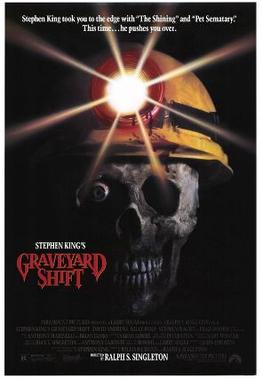
Let’s start with the basics: You need at least one sympathetic character.  Okay, you kinda like Jane, because she shows basic humanitarian traits.  And Carmichael.  Then you want a plot that makes some sense—what is Warwick’s motivation?  The writing is particularly bad.  If there’d been a bit more intentional camp, this might’ve made a reasonable horror comedy.  I mean, you’ve already got the empty aluminum cans being fired by slingshot.  As it is, it’s played straight with an evil foreman, rats everywhere, and a giant bat in the basement.  By the end you’re kind of rooting for the bat.  And whose idea was it to use voiceovers of the sub-par dialogue over the closing credits?  Is this so bad that it’s good?  I’m having trouble deciding.

Although set around the fourth of July I wouldn’t call this holiday horror.  Nevertheless, there are some moments of religious imagery that pop out.  The graveyard sinking in the river has a listing statue of Jesus near the start of the film.  And the exterminator—the only real camp in the flick—narrates how in Vietnam they pinned victims down, like Jesus, to feed them to the rats.  The final couple of minutes—well earned, I assure you—have Hall fighting the wicked foreman with the jawbone of an animal (one has to assume an ass), inexplicably among human bones (some still in their coffins).  And his slingshot ultimately killing the giant (bat).  The references are to Samson and David, respectively.  Perhaps this movie’s an indictment of capitalism, since the basement cleanup is on Independence Day.  Or maybe it’s just tired horror tropes on a break.  (Having one of the characters reading Ben in the diner was a nice touch.)  It may become a holiday tradition after all.
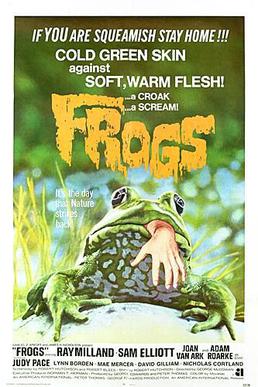

Hoppy Fourth

Today is the one of the relatively rare summer holidays.  Modern industrialized nations tend to take a more relaxed view toward summers without having to give out too many prescribed company holidays.  This seems to follow on from school schedules because the kids are out in summer and adults need some flexibility when work demands collide with family needs.  The internet has made work-life balance a little tricker to achieve since work is always just a click away.  Some more generous employers gave yesterday as part of an extended four-day weekend, which is rejuvenating in a way that’s easily forgotten until you start to feel it.  The sense of obligation takes a couple of days to wind down, and then on Monday you realize “I’ve still got another day off!”  It’s a sublime feeling.  Why not watch holiday horror on it?

The Wicker Man is a holiday horror movie.  One of my arguments in the book is that holiday horror has to derive its energy from the holiday, and not just be set on it.  For example, I Know What You Did Last Summer and Return of the Living Dead are both set on or near Independence Day but the movies don’t really draw their horror from the holiday itself.  It falls into the same category.  Frogs?  Well, maybe.  Perhaps holiday horror, it’s definitely in bad movie territory.  A rich southern family is dominated by a Trump-like grandfather who controls the money and measures everyone by loyalty to him personally.  On his birthday, the fourth of July, nature revolts and his adult children and grandchildren (apart from one granddaughter), are killed by animals in this eco-revenge groaner.  But is it holiday horror?

One scene may suggest that perhaps it fits the category, but the real significance of that day is that grandpa won’t let it be celebrated any way other than by his prescribed plan.  Even as the estate is overrun by frogs (mostly), snakes, lizards, alligators,  tarantulas, and even some birds (thank you, Mr. Hitchcock), he insists that everyone do what they always do on the fourth of July/his birthday.  The only scene that suggests holiday horror is where the eponymous frogs hop onto a cake decorated like an American flag.  I normally like nature-revenge films, and this one starts out well but quickly goes downhill.  The environmental message is there, but underplayed.  There are some firecrackers and a number of dead rich folks, but otherwise the film seems to have no message at all.  It’s a bad movie.  Holiday horror?  Not really.  Something to watch for a day off work?  Definitely.


July Forth

Independence Day.  What does it mean in a nation on the verge of a fascist takeover?  Supreme Court justices, themselves appointed by crooked but technically legal politics, have just struck down the independence of half the people in this country.  Independence Day for whom?  Originally a celebration of freedom from monarchy, one of our political parties has opted for authoritarianism—the objection to which was the very reason the Revolutionary War was fought.  The colonists wanted religious freedom, but now we find religiously motivated politics driving the bus off the cliff.  If you’re not a white evangelical these rulings are not for you.  Your religious freedom has been compromised by politics.  So we gather in grassy places to watch fireworks.    We celebrate the independence of the wealthy.  Those who can break the law and buy the results they want with lawyers without scruples.

I think of Independence Day from the perspective of our Black siblings.  Freedom to be shot for a traffic stop or to be publicly strangled to death for petty crime.  To be redlined and kept in poverty.  Independence from literal chains only to be shackled in bureaucratic ones.  Being sentenced to prison for things a white can easily afford to pay off.  Independence Day in a nation with over 40 million people in poverty and where just three white men own more than the bottom fifty percent of Americans.  Give them fireworks and firearms and let the bottom half work it out for themselves.  When is the last time a Supreme Court justice had to worry about having enough for both rent and food?  Freedom, those on the top tell us, is not free.  Watch the pretty lights.  Hear the loud booms.

What of American Indians, still awaiting freedom?  What is Independence Day to them?  Kept out of sight and in poverty, we don’t want to be reminded.  No, we only want freedom to get more for the white man.  As a child in the sixties I had some hope that we might be making progress.  Freedom and protest were in the air.  There was at least hope for some justice.  The privileged white leaders now give us a day off work.  The wealth can still flow upward, even if we take a brief hiatus from labor.  Women, Blacks, the poor, American Indians, and many others who make America what it is are nevertheless denied basic freedoms.  This loss of independence at least comes with a light show.  Just watch it and be grateful.


Independently

I’m feeling independent today, even if it’s only just temporary.  For the first time in four years it feels like I’m living in the United States again on our national holiday.  I’m actually spending this holiday weekend moving a family member.  That means drama—almost by definition.  It began two days before.  U-Haul sent us a text telling us our truck would be in the wrong city, over an hour away.  We called to correct the mistake and were told the truck would only be available five hours later than scheduled in the city where we actually were.  We had no choice but to accept.  The next day the saga continued.  We’d hired a local company to help us find a home for furniture no longer needed.  They arrived late, but there was a reason—the owner of the company had had a family tragedy that day and had to scramble to find help for the job.  They did a good job, though.  I’d use them again.

The day of the move our hired help called.  They were going to be late.  We went to U-Haul only to discover that their automated check-in software wasn’t working.  We had to stand in line for over an hour total before someone figured out they had to override the instructions so we could pick up the truck.  In the middle of this, the movers called again to tell us they still weren’t even in the state.  They were pre-paid a very pretty penny to help move the big items (we are small people, and I have a bad back; we need burly friends), but they would be several hours late.  We couldn’t put the smaller items on the truck when the big stuff was the unknown quantity, space-wise.  Hire-a-Helper, the company we’d used, sent a text saying our two hours were up and they were going to be billing a significant fee for extra hours.  The help had not yet arrived.

They turned up seven hours late.  We had arranged for help to unload on the other end, supposing that we wouldn’t have suddenly grown stronger or bigger in the intervening day.  Today, however, is our travel day—the one day we weren’t relying on others to do their job.  Our independence day, as it were.  We don’t need any fireworks.  Indeed, we hope for none.  All the careful planning collapsed under unforeseen circumstances.  But today we have the truck with the cool Colorado NASA image on the side and the open road. It’s quite cheering, actually. I’m always in the market for burley friends, but today it feels good to be independent.


Independence Day Wishing

It’s Independence Day and what we most need independence from is our own government.  History is full of ironies.  Federal holidays falling on a Saturday, for instance.  In any case, here we are on the Fourth of July and still stuck under a repressive government that a small portion of people like.  Republican groups supporting Biden are starting to arise, but we can only dream on Independence Day.  Many of us would like to be independent of the coronavirus, and not a few people are acting like we are.  Cases are spiking, so the rest of us are staying indoors.  Fireworks are okay, but I have trouble staying awake until dark these days and more often than not they just keep me awake as I’m starting to doze.

Maybe for Independence Day I’ll take leave of reality.  Maybe I’ll imagine a government that isn’t so utterly corrupt that some people might have some faith in it.  Maybe I’ll dream that black lives matter and that our leaders would believe it.  Maybe I’ll think what it would have been like if caring officials addressed the Covid-19 crisis directly instead of brushing it off, so that like all well-run nations cases would be going down here instead of back up.  There’s so many possibilities and the one thing they all have in common is that they point to independence from the Trump Administration, if that’s what it can be called.  Maybe it’s time to light a sparkler of hope.

Independence Day can be a day of looking forward instead of looking back.  If we can look ahead we might see a country where anyone will be allowed to exist and not be condemned by “Christianity.”  We can come to see that privileging any one “class” or “race” or “sexual orientation” is a form of bigotry from which we can and should be independent.  We can try to think what it must be like to experience life from somebody else’s skin.  We can try to understand instead of standing ready to condemn that which is “different.”  Fact is, everyone is different from everyone else, it’s only a matter of degree.  And difference can unite rather than divide.  The whole idea behind uniting different states was that those who were different could support one another and figure out how to make room for everyone to fit.  It won’t be easy to do, but we might use today to envision a country where we can work together, and figure out that leaders who bring people together are the only hope we have for the future.


Why July?

The weather in July can be exhausting.  I’ve always pretty much associated the Fourth of July with hot, sticky weather and this year’s holiday weekend has lived up to that.  Combine it with the incessant rain in the eastern half of the country and you’ve got a mix that won’t permit you to open your windows, but makes you simmer if you stay inside.  We often handle this by seeking out air conditioned facilities where you don’t have to spend a ton of money in order to find some relief.  It also happens that today is the anniversary of our moving into our new house when, as I recall, the current rainy cycle began.  Restless, stormy nights may be Gothic, but they don’t fit the staid, steady nine-to-five lifestyle very well.

Despite it all, I still value summer.  The sense of carefree days, as my friend over on Verbomania says, give estival days a shimmer like none other.  So much so that it’s difficult to keep track of what day it actually is.  For me this particular date will always remind me of buying a house for the first time and spending a literally sleepless hot night learning the hard lessons of homeownership.  Still, since I mentioned Independence Day, I continue to find myself relieved at the lack of land lordliness when it comes to the list of those who hold something over my head.  If only I could catch up on some sleep over a long weekend it might all seem more real.  July can be like that.

As I saw this weekend approaching from a distance, I made plans at how much I would accomplish.  I would get so much writing done that I’d be well ahead on my next project.  I might figure out what it was most important to say, and maybe finally find the meaning to life.  (Summer makes me feel optimistic, it seems.)  I would post new videos on my YouTube channel.  The weather, however, as the Psalms indicate, can change your plans.  Twilight lengthens to the point of making night and day difficult to distinguish.  Sleep doesn’t refresh the way it usually does and morning—my writing time—is hazy and lazy.  My next book sits untouched on my hard disc while I look over boxes that remain unpacked from a year ago.  Childhood summers set the pattern of dropping all and experiencing the mini-anarchy that lack of structure brings.  Despite all that I’d hoped to accomplish, I find myself welcoming this hot and humid anniversary.  That’s what July is like.


Freedom’s Price Tag

Independence Day makes me feel conflicted.  Jingoism seems to be an international problem, and although patriotism is deemed next to saintliness, I have my doubts.  No nation is perfect *gasp!* and we would all do well to learn from others.  America is a nation in love with money and that affair has serious consequences.  One is our medical care system.  We’re one of the very few (if not only) “advanced” nations without universal medical coverage.  In fact, people routinely suffer because they lack insurance or their coverage doesn’t provide for what their physicians think is best.  This came home to me while staying with a family member who was hospitalized recently.  On the television the GOP was sponsoring ads against universal health care.  The irony was thick enough to be sickening.

Highly touted as the most affluent nation in the world, we refuse to take care of our own.  How am I supposed to get into the mood for Independence Day?  In Britain (as in most other places) they have universal health care.  I lived there for three years and knew that I could get treatment without emptying out the bank.  Here, in my native country, we have less care.  Someone might make a few dollars less, and that, we’re told, is unacceptable.  Anyone who’s experienced the illness of a family member knows the old one-two.  The treatment itself and the bills that come after.  Lately I’ve just been throwing up my hands and opening up my wallet.  It’s Independence Day.

Not that I’d expected much to change, but my first inkling of being a writer was winning a state-wide essay contest right here in Pennsylvania.  I wrote an essay on “Americanism” back in 1980.  It noted the false sense of righteousness that accompanied the notion.  I was an evangelical Christian then, but that didn’t mean I wasn’t cynical.  In my small town I’d seen John Cougar Mellencamp-level suffering.  I saw unemployment, drug use, and desperation.  I saw politicians saying everything was great and would be even better if we had more guns.  I saw trickle-down economics stemmed at the source.  I knew we were being lied to.  I did hope that things would get better, but now with the GOP fully behind 45 the true ugliness of jingoism has become clear.  It’s Independence Day and I feel sick.  I look across the ocean and see the nation from which we declared said independence suffering from a similar backlash.  But at least they can afford to go to the doctor.


Time Off

Perhaps you’ve noticed it too.  Time away from work has an utterly different feel from time on the job.  Those rare individuals who really love their professions probably feel differently about it, but a timid free spirit since childhood, I’ve always noticed a difference.  And it has become more pronounced as time’s gone on.  Recently I cashed in a vacation day near a national holiday (Memorial Day) so that I could drive across the state to see my mother without feeling utterly wiped out from a twelve-hour drive on a regular weekend.  As I slipped back into work mode on Tuesday the change was palpable.  Time was no longer my own.  I tend to work well over eight hours daily—the telecommuter must prove his/her worth—and something about the quality of the time itself was decidedly unlike that of the previous four days (two of which had been spent driving).

That quality, of which we’re not encouraged to speak, is the feeling of freedom.  More precisely, auto-determination.  Okay, I’ve read enough philosophy to know this is just an illusion, but work with me here.  Few and exceptionally fortunate are those who find careers they love.  What the rest of us love is time off work.  Time when we can decide what to do.  How long to sleep.  When to cut the grass rather than waiting until the bell rings at 5 p.m. and the inevitable afternoon rain begins.  Perhaps best of all is going to bed knowing that the next day you don’t have to get up and report for duty.  I’m not dissing employment here, I’m just noticing something.  What I’m reaching toward is a concept of sacred time.  Unstructured time in which creative types thrive.

Early in life the concept of summer was instilled in my soft and malleable psyche.  It said once May was over you have three months to do whatever before facing regimentation again.  I grew to appreciate this schedule.  To love it, in fact.  It was part of why I decided higher education was the best vocational fit for someone of my particular disposition.  Every year when June rolls around I still feel it, like a migratory bird.  The reality, however, is the quality of time changes on Monday morning.  It slows down and feels more like sandpaper than silk.  I can see there’s a holiday just a month away, if I can only reach it.  And it is, perhaps with a dose of unintentional irony, call Independence Day.


Liberty and Justice

I confess to being a bit vexed. How are we supposed to celebrate Independence Day under the Trump administration? Since January our government has demonstrated over and over and over again that it’s dearest desire is to pick democracy apart, to its own advantage. Making voting more difficult for those who oppose the Republican Party, gerrymandering to ensure local election victories, cutting their healthcare so that they might, well, just die off. Repeated and loud public protests do not impact them at all. When their own party moderates protest, they claim they’re collaborating with the enemy. The American people have become the enemy of the wealthy and privileged who want this country to resemble a country club, not a nation of liberty and justice for all.

How do we celebrate a country like that? Back in high school, my senior year, I won a state-wide essay contest. I got my picture in the paper and everything. I don’t have a copy of the essay, but I do remember that the topic was Americanism. Yes, the “ism” was part of it. Although I didn’t know Shostakovich at the time, it was my attempt at what he did in his fifth symphony. Looking back, it seems strange that a Pennsylvania statewide committee would select an essay so full of irony from a working class boy who was only too well aware of his own inferiority. Yes, there was irony in that essay, and anger. Carefully hidden. It sounded patriotic. The hundred dollar prize didn’t make a dent in my fall tuition bill.

Nearly four decades have come and gone since then. I’ve watch my nation teeter-totter between humane treatment of those left out by the system and offering kick-backs to those who by no definition need or deserve them. Until November of last year I’d never seen a nation stoop to the absolute abyss of cynicism in the election of Trump. Although President Obama had the grace to say that many people were obviously happy with the results, it was as if my essay—now lost and forgotten by all but one—had come true. Make no mistake about it—I’m a poor boy who grew up among the working class. As a teenager I could see, hear, and taste the hypocrisy. I hoped and dreamed that as I grew up so would my nation. It’s the fourth of July. Normally I would be celebrating Independence Day. This year, however, I’m only wondering what went wrong along the road to liberty and justice for all.


Things Remembered

IMG_2839 copy

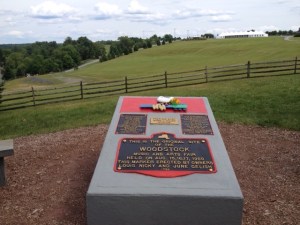
Freedom. Independence Day is our celebration of liberty. Yesterday I happened to find myself at Bethel Woods, the out-of-the-way location in New York where Woodstock was held. Probably no one in 1969 realized just how formative Woodstock and its message of peace, love, and music would become for American culture. Those of us who came of age in the ‘70s learned about it as recent history (I was only seven at the time and, I’m sure, would’ve found the whole thing somewhat unChristian had I been here then). Much has changed in the intervening years. Not many peaceful events get so much airtime any more. Upwards of 400,000, basically unpoliced, youth, gathered in Bethel, New York, for three days of music, chaos, and peace. The Vietnam War was still draining our nation of its youth and murdering its idealism. Fear of the other, racial inequality, and male superiority were part of the context that led to the need for Woodstock. Freedom was free.

Often on this blog I reflect on the sacredness of place. Events that take place in a location leave their impression on the land. Bethel Woods Center for the Arts, the current administrators of the property, have left the field largely intact. As my wife and I stood at the top of the hill and tried to imagine almost half-a-million people here, it was strangely quiet. The nearby museum had plenty of music playing, but standing where it actually happened, there were only ghosts of an event studied in school and which, even today, kids can generally identify. I couldn’t have named every act that played the concert and, although the music was clearly important, it was the gathering that is most remembered. Self-governing youth getting along in an area so remote that still today you have to drive a couple miles to find even basic necessities, sent a powerful message. It was an event that, I fear, can never be replicated. The snake has spoken.

Nearing fifty years later, we’ve become so paranoid that anyone who looks Middle Eastern is under suspicion. Guns, which children of the sixties shunned, have proliferated and may now be carried, wild-west style, in many states. A fear-mongering candidate bellows fascism before the Grand Old Party. Remember, Nixon was president during Woodstock. I may have lived hundreds of miles from here, occupying myself with the matters that seven-year-olds find so pressing. But Woodstock happened. By the time I got to Woodstock, everybody else had gone. I see others milling about the museum, slightly older than me. Perhaps some of them were here for the event itself. We all seem to be searching for something here. The festival had its problems, for sure, but with a sincere belief in freedom, it makes the pre-seventies United States feel like a strangely foreign county. How do we get back to the garden?


Only Takes a Spark

Fireworks have been the main event for Independence Day celebrations ever since I was a child. The fourth of July is a day for playing with fire. As a child I remember spending the meager allowance I had on sparklers and snakes. I haven’t seen one of those ash snakes for decades now, but the impression they made remains strong. A plug of some kind of carbonish material—you’d light the top with a match and it would flame and hiss and start to grow into a long, twisting exoskeleton of ash. They left a blackened circle on the sidewalk, and when they were cool enough you could try to lift the fragile snake in your hand, but it almost always broke apart before blowing away in the breeze. We also wasted our money on smoke bombs with their multi-colored smoke, but we never had actual firecrackers. Given the trouble we could make with an ordinary roll of caps, that was probably a wise decision on our mother’s part. All of this, however, was just a prelude to the fireworks.

As I sat under a cloudy sky last night wondering why every July fourth seems to rain, it occurred to me that fireworks are a violent form of celebration. Indeed, they are designed to imitate the sounds of battle—before the nuclear age—and we all know the thrill of when the loud, bright burst of pure light sends a shock wave through you. It is like a canon rocking your soul. Like many stirring experiences, fireworks had religious overtones from the beginning. Invented in China, fireworks were used for religious festivals. They were believed to be effective at driving away evil spirits and bring good fortune. Pyrotechnics, however, clearly have military applications as well. It is this strange nexus between religion and violence that makes, I suspect, fireworks displays so compelling.

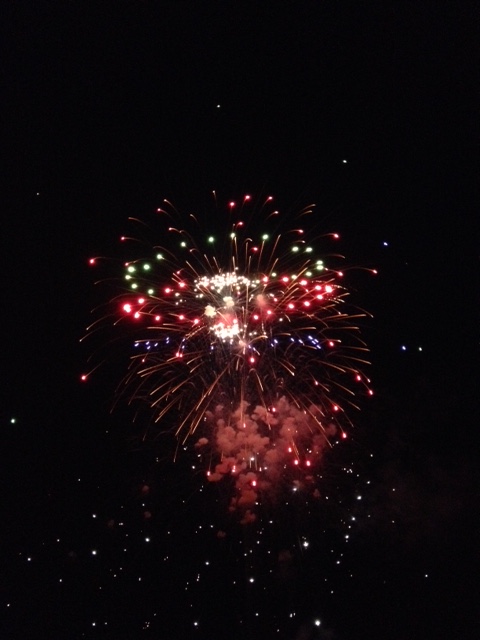
IMG_2287

The local display here in Somerset County, New Jersey, was impressive for a region without large cities. I couldn’t help pondering the strange aesthetics of contained violence as the colorful explosions took place over my head. Illusions, I know. We always talk afterward about whether some of them are meant to represent anything. Did you see a smiley face, the United States, or even New Jersey? It depends on your angle of view. Is this a religious display or a celebration of violence? Looking around at the amazing diversity of peoples gathered here in this park with me, I feel strangely satisfied. I hear languages I don’t understand, and see people from all over the world here for a good show. Although thousands of us try to get to our cars at the same time, spirits are positive, for the most part, and all go home in a celebratory mood. Maybe the ancient Chinese were right and these pyrotechnics do drive away evil spirits after all.


High Places, NJ

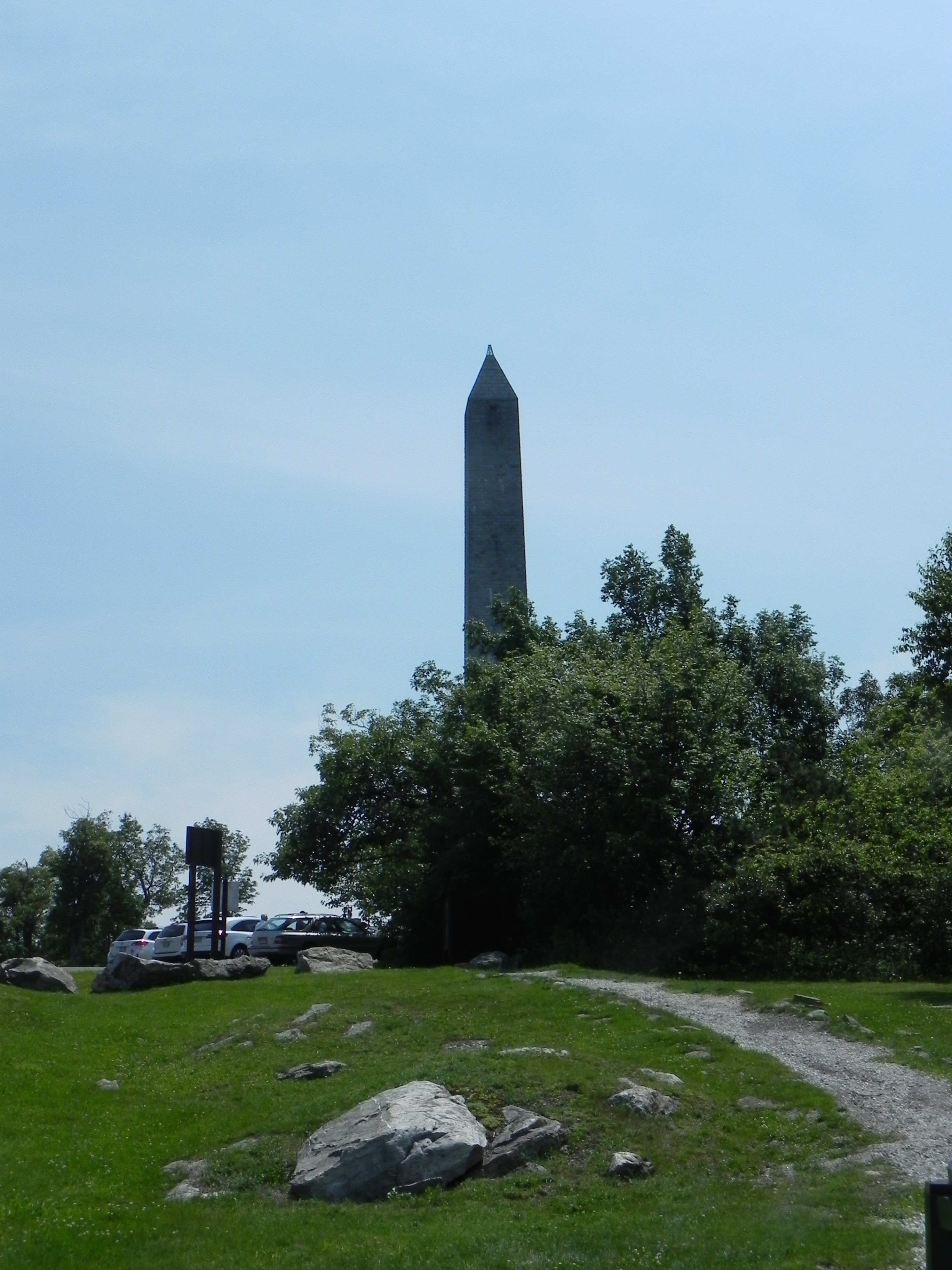
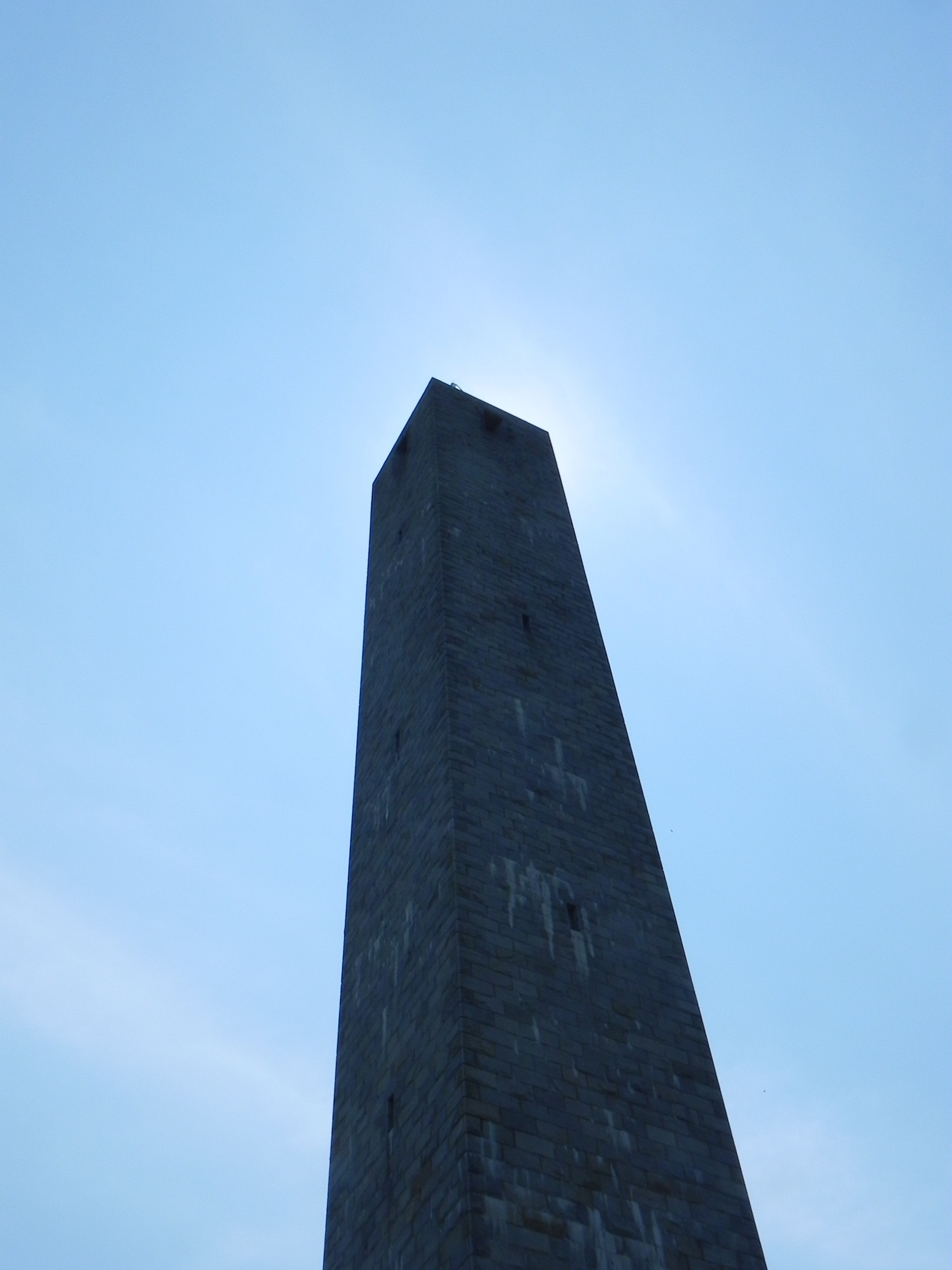
The “high place,” in the Hebrew Bible, was a source of constant vexation to the “orthodox.” Scholars have long puzzled over what was meant by the term, the assumption early on being that they were geographically the highest points around. Although that interpretation no longer holds the sway that it once did, the concept of the high place has remained. I suspect that’s because there’s something mystical about being at the highest point around. July 3 was a rare holiday for everyone in the family, so this year we headed to High Point State Park. High Point is the geographical highest point in the state of New Jersey, up near the New York border. It’s not as high as the mountains you might see in the western part of the country, but at the top there is a panorama that gives unbroken visibility in 360 degrees. Except for the tower.

DSCN5093

Towers are just as biblical as high places. They are very human and always contain at least a small element of hubris. Nature may have said thus far and no further, but we can go higher. And those of us with the inexorable will to climb, must go up. The view from the top isn’t very good since the windows are steamy and the mildew makes you a little leery of getting too close, but the climb is intensive, even for those used to stairs. Nevertheless, a kind of light-headed giddiness attends standing at a point higher than which you cannot go. I pulled out my altimeter to discover we were 1690 feet above sea level. In New Jersey you can’t get any higher. Were there angels up here? How close to Heaven were we? Towers are irresistible as the mythical builders of mythical Babel knew. And although we couldn’t see Manhattan from here, I knew that just across the river taller towers stand.

DSCN5109

One World Trade Center stands at a symbolic 1776 feet, higher than we were at the moment. It was, after all, the requisite holiday to celebrate independence that brought us here in the first place. The vistas that we could see, however, were relatively undeveloped, a rarity for the state of New Jersey. If we had the time, we might have been able to get out into nature itself instead of these structures that humans build to mask the fact of our own limitations. Maybe that’s what high places were all about in the first place. Every day I walk past the Empire State Building on my way to work. I can see it if I find an office with windows. Over my head up here, on the very top of New Jersey, I see a bird soaring. I think of Melville, and Ahab, and Manhattan. Slowly I begin my walk down to lower places.

DSCN5099


Freedom Trail

The machine gun on the bow of the National Guard boat would’ve impressed me as a boy. Now it kind of scares me. The helicopters overhead pass frequently. Police on jet skis chase girls in a canoe away from the shore of the Charles as if they were piloting a landing craft on D-Day. A whole blessed platoon of chartreuse-garbed police on bicycles pedal by, some clearly out of shape, creating a presence. It has been a quarter century since I’ve been in Boston to celebrate our freedom. I wonder where it’s gone. To get onto the Esplanade you have to be brushed with a metal detector. Although the web site said backpacks would be searched, the guy at the gate claims it said they were not allowed at all. “You can empty it out”, he said, “and put the contents in a plastic bag,” but the empty cloth must stay here under a tree like a naughty dog. “Happy Independence Day,” he says. I wonder if he’s aware of the irony.

Big Brother

Big Brother

We have become the most skittish home of the brave I know. We are being watched, we are told, for our own good. The watcher is not some enemy nation, but our own “leaders.” Lead us not, I pray, into temptation. I wonder when we considered chasing girls in a canoe away from the shore a matter of national security. In 1985 I called Boston home. When my wife and I came to the Fireworks Concert as a young engaged couple, we lazily wandered down to the Esplanade, plopped on a free bit of grass and saw maybe an officer or two the entire day. Now everyone on this grassy strip is treated as if they’re on a grassy knoll. Armed police on boats cruise the shore to make sure we’re minding our manners. After dark that helicopter spotlight can’t help but to make you feel guilty of something. There’s a hurricane coming, and three tons of fireworks are sitting anxiously on the barges in the river. The concert begins, but soon so does lightning. They skip right to the fireworks, forget the 1812 Overture. I wonder about my evil backpack under the tree.

The woman behind me is talking to her companion about how illogical the backpack rule is. “If the bag is empty, why can’t you take it in?” she asks. I’m not one to talk to strangers, but I have to turn around to agree. We exchange horror stories about being screened at the airport. Doesn’t anybody see how offended our revolutionary forebears would’ve been by such a military presence in peacetime? What if some crazed national decided to do something insane? Would that wicked machine gun hit me and my family, right on the waterfront, while trying to get the perpetrator? Are we collateral damage on the trail to freedom? Or is freedom even in the picture any more? We can’t let the terrorists win. Every time we face a backpack full of homemade explosives with hundreds and hundreds of chunky guys on bicycles and hovering our heads with deadly force, I can’t help but think it’s no contest. There’s a hurricane coming. They rush through the fireworks and I join the other owners of dispossessed backpacks looking for my luggage. Then the fattest raindrops I have even felt begin to fall.