Fly by Night

Nightwing is a movie I learned about by reading Stephen King’s Danse Macabre.  The idea has merit but falls below the expected level of any horror film of the era—and I’m a fan of seventies horror.  Those in the know suggest that this was supposed to be Jaws with vampire bats in the era when horror movies started to re-realize the dangerous potential of nature itself.  A basic problem underlies the dull pacing, non-indigenous actors playing Indians, and fatally overstuffed plot: vampire bats aren’t dangerous.  Bats are highly advantageous to the ecosystems in which they thrive and the idea that six or seven bites could drain a person of blood is ridiculous on the surface and looks rather silly in execution.  At least the later movie Bats (also bad) had genetically mutated mammals.  Eco-horror can be effective.  Natural bats are difficult villains, though.  
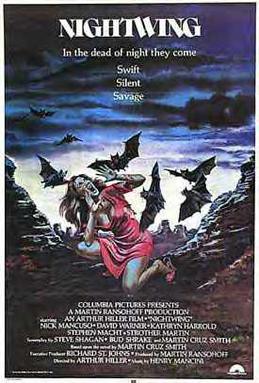
So, on Hopi lands an elderly priest summons the end of the world.  Releasing a god, the bats form the precursor to a native apocalypse.  Two tribes with differing views of white drilling rights on their lands argue over this while killer vampire bats attack.  They kill a group of Quaker missionaries.  Luckily, a British vampire bat killer is after the swarm.  He travels around killing bats, which, he says, are pure evil.  The deputy of the “good” tribe, which resists white incursion, eventually teams up with the bat killer because he saved his girlfriend who was going to leave him for medical school.  For some reason, two kinds of plague (including bubonic) are released but when the tribal priests all die during a rain dance it’s because of natural causes.  The leaders of the two tribes keep trying to catch each other out.

As the movie plods along, making the viewer root for the bats, the several dropped plot lines are left dangling like so many participles at the end.  The plagues?  Red herrings.  The tribal conflict?  Unresolved.  The special poison brought in to kill the bats?  Unused.  Total number of people killed to justify a wholesale bat massacre?  Nine.  Anytime I’m viewing a horror movie and I find myself repeatedly glancing at my watch, I know that something’s off.  It’s October and bats are a typical aspect of Halloween decor.  Nightwing, however, just doesn’t make them scary.  The movie was based on a novel which I’m now strangely tempted to read.  By all accounts, even though the author was partially credited with the screenplay, the book, as usual, is better.
The Land

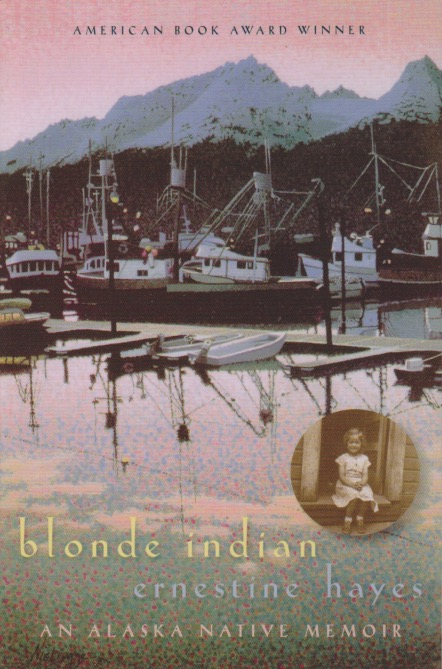
It’s always a pleasure to find an author from whom you want to read more.  It was my wife who told me about Ernestine Hayes’ The Tao of Raven.  We were both so taken by the book that we turned to Hayes’ prior Blonde Indian: An Alaska Native Memoir.  Learning how badly the United States has treated the indigenous population of this continent is one thing.  Learning how badly we still treat them is quite another.  For all of that Hayes writes a memoir that is reflective and perhaps sad, but seldom angry.  The stories told in Tao of Raven start here—we meet the characters who will be further developed in the next installment and become even more curious about them.  The reader wants to reach out and help.  To tell the government, “enough!”

The indigenous peoples of North America (and likely South too, for that is a realm requiring further learning) feel, and have always felt, a close connection to the land.  Europeans see land as a resource for exploitation, not for living in harmony with.  We came, we took, we destroyed.  As if that weren’t bad enough, we left the original inhabitant trapped in grinding poverty, shoving them into places we wouldn’t see.  Until we discovered something we wanted on that land, and then we shoved them again.  The impetus to do this was, unfortunately, Christianity.  I doubt it’s the religion Jesus had in mind, but then he lost control of it millennia ago.  Believing in one’s divine mandate is a sure way of making unwarranted claims on what belongs to someone else.  Remember “thou shalt not steal”?

Hayes’ reflective style is an honor to read.  Feeling a part of a place is a rare privilege.  Born into a mobile society enamored of technology, the modern American has difficulty feeling too attached to any one place.  Of course, many people stay close to where they were born, but to become a “professional” you have to leave.  Blonde Indian is about returning home.  The land knows us.  Many of us don’t know it back.  It’s just a place to set our feet temporarily until a better opportunity comes along elsewhere.  Being tied to no land we lose something of our souls.  Our connection with nature.  With the planet itself.  Hayes is a gifted writer with a story that must be heard.  Wisdom comes through on every page.  We would do well to pay attention.


Human, Nature

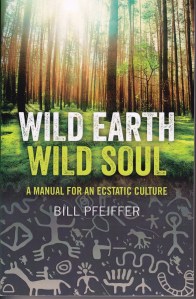
Wild EarthSomeone recently told me that a city blocks a certain vibration that people draw from contact with the earth. I know that vibration often sets off “new age” alarms, but this person was rational, scientific, and had grown up in New York City. I grew up in a town on the edge of the woods. We didn’t live on concrete. In fact, the floor of our shack was so thin in some places that you could see the actual soil underneath. Even our driveway was gravel. Although it was a dysfunctional family, I felt more connected to my planet back then. Wild Earth, Wild Soul: A Manual for Ecstatic Culture, by Bill Pfeiffer, is just what it says. It’s a manual for how to get back in touch with nature. Basing his ideas on those of indigenous cultures world-wide, with a healthy dose of shamanism, he explores the vibrations of the earth. I had, at times, to force myself to listen. He’s right about so much that I stayed with the narrative to the end.

Civilization comes with a price tag. A very high price tag. The rates have been set by a small group of “progressives” who operate with the idea—mistaken—that all nature is a machine. Physics, they claim, and chemistry, show that all of life is mathematical. Nothing in the universe doesn’t add up. But biology, as Pfeiffer repeatedly shows, often doesn’t. The mistake is as fundamental as it is reductionistic. Life isn’t quantifiable. Biology messes up the nice, neat system we’ve invented. Indigenous peoples, while not idealized, lived in much better harmony with the land, not over-exploiting. It was a sustainable existence. What “civilized” people wanted was more. More of everything. A surplus, in fact. Without that surplus there is no business, right? Capitalize on that!

We’ve lost touch with nature. Our “leaders” want to exploit it. Mine it, refine it, and make it “useful.” When’s the last time I looked at a tree just to appreciate it as nature? Civilization can’t envision a tree without an axe. If it grew it can be improved. Even our food has to be genetically modified because obviously nature can’t make a profit on its own. No, Wild Earth, Wild Soul hasn’t made the impact on the world it might have. I’d never have found it if it weren’t for a used book sale. That doesn’t mean, however, that it isn’t right. We need to dismantle. We are not electronic devices, as much as the internet tells you otherwise. I knew that as a child. And as my feet ache from walking over acres of concrete on my way to “work” I know it’s true. There are indeed good vibrations out there, but here they’re too deep under my feet to feel.


Buying the Truth

Every now and again the Chronicle of Higher Education dips its trowel into the biblical archaeology debate. Those of us who’ve made extensive arguments based on ancient texts and artifacts know the territory a little too well. Archaeology, which largely grew out of biblical scholars attempting to “prove the Bible,” eventually started on its own track of scientific respectability with the predictable result of distancing itself from the Bible occurred. So far, so good. Then biblical criticism took a turn towards post-modern sensibilities. The truth cannot be known, and therefore the safest approach is to stop seeking any truth at all. Archaeologists in the know joined this venture (biblical scholars and archaeologists often cross borders in this exotic land), and began to deny historical Israel, as well as the rightly dismissed historical Abraham and Moses. Once you’ve walked a few leagues down that path, however, it is difficult to turn back. This is, of course, an over-simplified account of a complex dynamic, but the issues raised, as seen in the Chronicle, are real. Our perspective flavors our interpretation. If you don’t believe in a historical Israel you’ll never find one, no matter how hard you look. (A similar dynamic is at work in studies of religions and “paranormal” phenomena.) The word “evidence” is finessed as readily as fine hair treatments and the kinds of evidence that convince vary depending on the scholar. It is safest to admit we don’t know, sometimes.

The more troubling aspect, as far as I’m concerned, comes when the Chronicle introduces the concept of corporate sponsorship to archaeological digs. As an erstwhile volunteer on a dig (somewhere back in the Iron Age, it feels like now), I know that archaeology is frightfully expensive. There’s nothing like being on a dig to witness firsthand the amount of labor that goes into removing all that dirt–carefully! Carefully! Universities can’t afford it (stadiums don’t come cheap, you know!), so many digs rely on corporate donors–often television and film companies. And if you’re paying for footage, you want something to bring in watchers. An unnamed archaeologist quipped honestly in the Chronicle, “I don’t agree with everything they say in the films, but they pay me an awful lot more than I could ever earn from writing or teaching.” There it is, staring us straight in the face. The truth goes to the highest bidder.

That may sound benign enough, but in Israel especially, archaeology has high political stakes. You see, politicians are easily swayed by the “we were here first” argument. To get an idea of its specious nature, just ask a Native American! Proving the veracity of a David or Solomon no longer just gets God off the hook, it also builds the basis for claims against people who’ve been here an incredibly long time. The sad reality is that in archaeology, as in higher education, money speaks with an inordinately loud voice. As an agreed means of exchange, money is certainly important, but is it “true”? For those who’ve stopped short of the post-modern abandonment of that great philosophical ideal of Truth, we should be wary of allowing lucre to decide the issue. Those with money already help to decide what courses will be taught and what tels will be excavated. We run a real risk when we let those same people decide what will be considered the truth. In a society enamored of media and its ease of use, the truth is sometimes what comes across the television. There is another way, but it involves heavy digging and lots of reading. Maybe next time—but for now just pass the remote.