
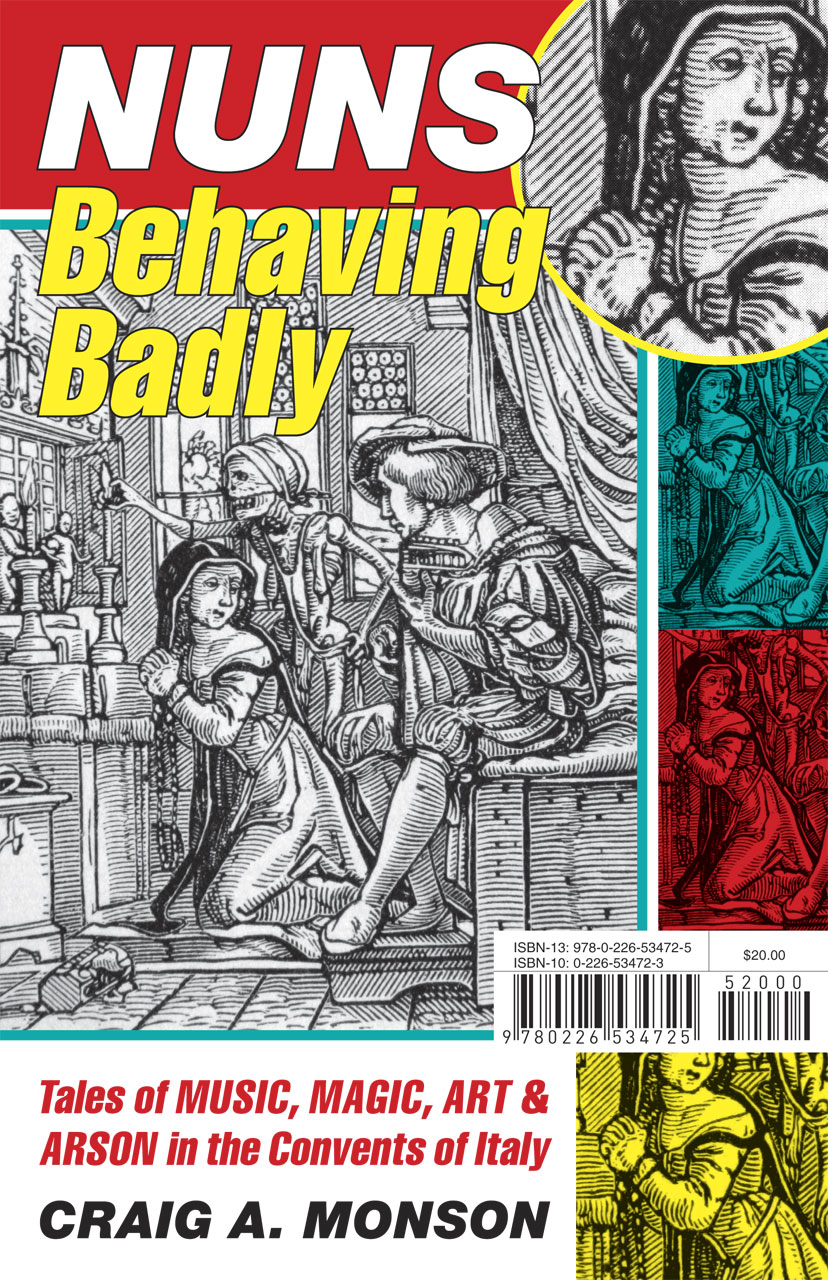
 Have you ever read a book thinking the author was a woman, but later learned that it was written by a man? Or vice-versa? This creates a disturbing kind of cognitive dissonance, and I suspect that it is hardwired to our communal instincts. We want to know whether it is a man or a woman who is talking to us. Expectations of gender are deeply embedded in all societies, and they become problematic when they ossify into rules. Gender roles, in earliest societies, were a matter of biological necessities. In a modern, urban context such roles are obsolete, and certainly damaging—especially to women. Craig A. Monson’s Nuns Behaving Badly: Tales of Music, Magic, Art and Arson in the Convents of Italy raised this issue to a conscious level once again. Christianity, always very sensitive to issues of sexuality, had developed in a social context of women as property. In the Middle Ages, where dowries were expected, families couldn’t afford to marry off all their daughters, and convents provided an easy, if not always spiritual, solution. Monson’s book, although not filled with salacious tales, illustrates the point well. In a society where wage-earning was limited to males, females had few options.
Monson narrates the stories of five different convents where a nun (or sometimes groups of nuns) refused to play by the rules established by the male hierarchy. The infractions, viewed from the twenty-first century, seem minor: playing with magic, singing, producing art work, wanting to go outside the cloister walls, visiting (gasp!) an opera! (There are a few more complex issues too, such as arson and the love that dare not Ave Maria its name.) In each case, the masculine authorities were called in to investigate, punish, and restore order. The end result is, although fascinating, somewhat melancholy. These willful women were often acting against boredom. Their lives had no impact beyond the convent wall, and, ironically, I learned, even their enclosures had prisons. A nun could be moved from her cell to the cell. And sometimes the only crime was wanting to hear a professional singer perform.
Nuns Behaving Badly is a clever title for a book. As I read the histories, however, I became increasingly convinced that those behaving poorly were not the nuns. A society fabricated on the premise that men are the divinely ordained masters of their universe is no stellar example of men behaving well. Even the occasional bishop, archbishop, or cardinal who sided with the accused had to bow to the will of the Holy Inquisition. The victims, although not physically tortured, were women who had thrown their entire futures into the service of the church, in one of the few roles allowed females in an era already pressing into the early modern age. The nuns were not behaving badly. They were simply being human. The truly bad behavior came in the form of a male hierarchy that brooked no dissent.

 Steve A. Wiggins