Bugging Out

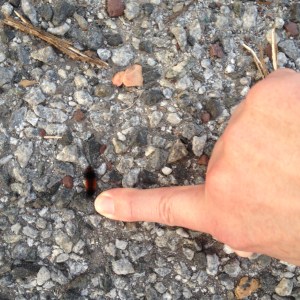
There’s a scene in Disney’s Hercules where Thebes has just been through a bunch of unnatural disasters sent by Hades to lure Hercules into the open.  The people, visibly shaken by the tragedies are talking about their need for a hero.  Then a locust hops in.  An old man says that does it, he’s moving to another city.  So with yesterday’s super soaker around here—we’ve had our roof completely replaced—water was still getting in.  I’m no expert, but it looks like it was condensation rather than roof leaks proper.  The air was saturated and cold, while inside it was at least a few degrees warmer.  I got up to find buckets scattered around that my wife had set up after I’d fallen asleep.  Then a boxelder bug appeared on the curtain in my study.  The insect on top of other misfortune.  It’s classic.

That’s because insects swarm.  We live in an older house (the only kind designed with space that can be used for books).  It doesn’t have wooden siding, but boxelder bugs like to overwinter in the walls.  I really can’t figure out why because in nature they winter in, well, boxelder trees.  Or a maple.  There are no boxelder or maple trees near our house, but they seem to like it nevertheless.  The problem is they get inside, in numbers.  We try to run a catch and release business.  It seems decidedly unfair to kill a harmless bug for doing what human-altered climate tells it to do.  When the heating kicks on, their insectoid brains tell them it’s spring and they crawl out looking for food.  Well, we don’t have any trees they like growing inside, so they wander about aimlessly.  I catch them and take them outside, figuring maybe they can find, I don’t know, a tree?
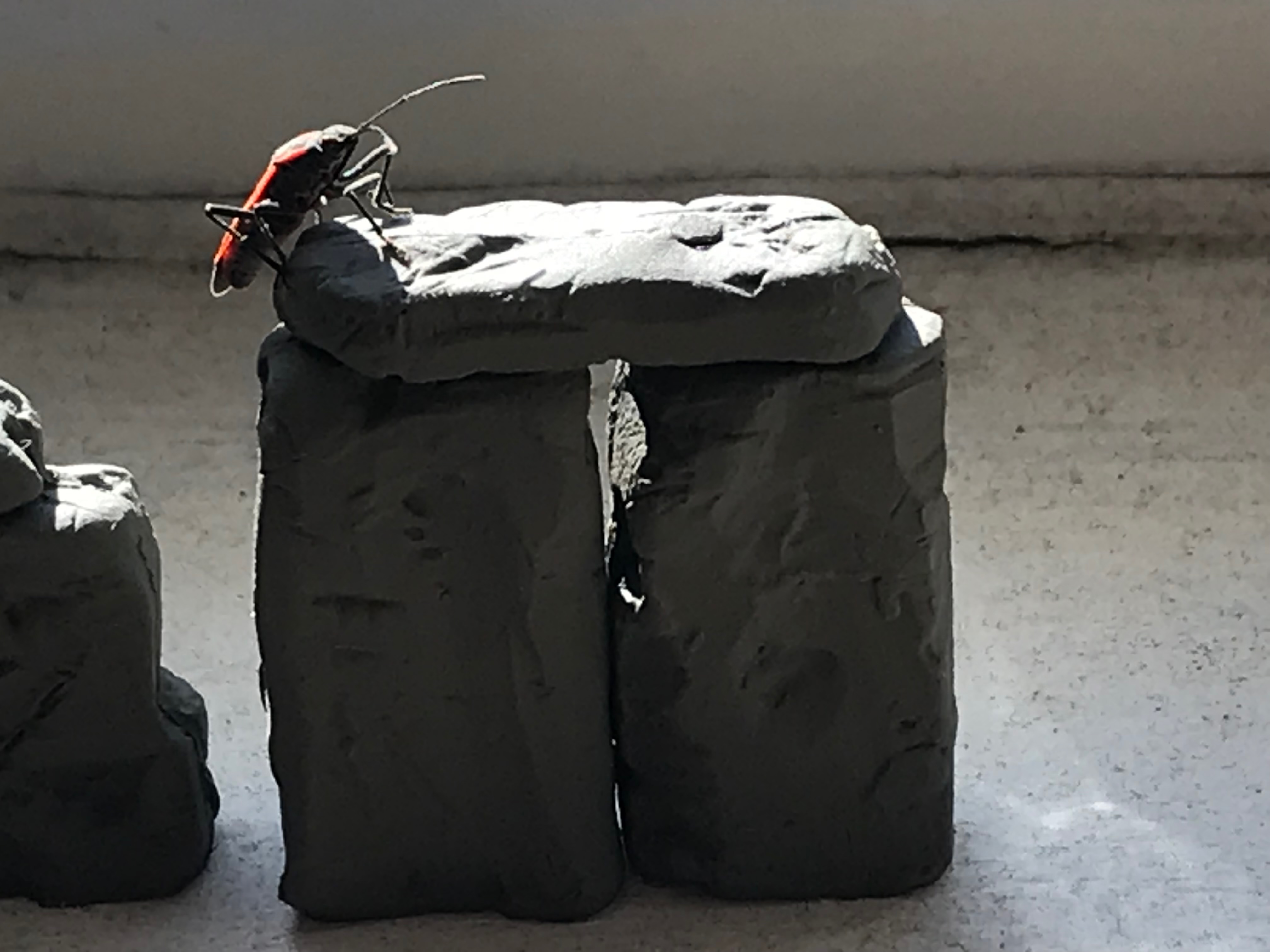
Usually when winter’s serious chill sets in, they go dormant.  This year we’ve been hovering between freezing and not, and when the sun comes out—which it sometimes does—they awaken.  They must be confused.  Somehow they don’t realize that the world has changed around them.  Going about their daily bug business (nothing seems to eat them—apparently they taste bad) the climate has broken their hibernation into segments of a few days at a time.  Perhaps they’re cranky when they crawl up the curtains, or across my desk (they pretty much stay in my study).  At least they don’t sting.  They’re not bad enough to make us leave Thebes, but it would be wonderful if they’d wise up to global warming, and maybe plan in advance.  Or maybe they’re waiting for a hero.


Insect Inside

It seems a shame we don’t have an accurate name to classify all of them.  Insects, arachnids, and arthropods, I mean.  Those creatures smaller than us that inspire fear.  I suspect I’m not alone in experiencing a profound ill-at-easiness for some time after a close encounter with various of these small creatures.  Some experiences can be sublime, such as the other day when praying mantis on the glass of our front door provided a wonderful opportunity to look at a marvel from a seldom seen angle.  More often, however, the response is one of terror at being outnumbered, out-gunned, or out-run.  Spiders can be speedy as well as scary and I often yield the floor to them.  If I’ve got an empty peanut butter jar handy I try to catch and release, but I’ll look with worry at the spot of the encounter for days.

Photo by Rosie Kerr on Unsplash

Or the flying, stinging things.  Mostly they’re good for the environment and I don’t like to kill anything.  The other day, however, while returning the recycling bin to the garage I failed to notice paper wasps had built a nest (in just a day, since I’d taken the bin out only the afternoon before) above the door.  They were offended that I’d invaded their space—their concept of time is completely off from that of creatures that tend to live decades and want to stay in the same location for years at a time—and decided to attack.  This was a new stinging experience for me.  One flew down and stung my face then quicker than lightning landed on my right hand and bit again.  Its poison burned, I can tell you.  I’ve had run-ins with lots of stinging things in my time, but the shock probably added to the hurt.  I couldn’t even get the garage door shut, as previously mentioned.  

The next morning I awoke unsettled.  Houses have cracks and crevices.  They settle over time and critters can find their way in.  I understand.  Everyone needs a home.  But opening a door and being unexpectedly attacked hardly seems fair to me.  I hadn’t even seen the nest.  It’s easy to forget, in this virtual world of pandemic proportions, that we share the planet with a wide variety of others.  The large predators are mostly gone.  The countless small ones are still here, however, and many of them enjoy the way we’ve warmed the place up for them.  I have a feeling that when we finally outlive our welcome on our home, the insects, arachnids, and arthropods will be glad to stick around.


Insecticide

Although Halloween is more about spiders than insects, a real fear seems to be swirling around the latter.  For the second time in a year, a study has been published indicating a precipitous drop in the numbers of six-legged creatures worldwide.  This is alarming because everything’s connected.  Loss of insects means loss of vertebrates that feed on them and that leads to loss of species upon which we depend.  The problem with “humans first,” simply “America first” writ large, is that all species are interconnected.  The loss of one will lead to the loss of others—that’s the way connections work—until the entire picture changes.  And it won’t be prettier.  Even for lack of bugs.

Scientists aren’t sure of why this is happening, but the likely culprit seems to be global warming.  Temperatures are changing so rapidly that evolution can’t keep up.  And since those in political power don’t believe in evolution—America first!—they have difficulty seeing how global warming—a myth!—could possibly pose any threat.  Just ask the wooly mammoth.  The fact is that the very small frequently offer the answers long before it’s too late.  The problem is you have to pay attention.  And that attention must be not on America, or Trump, or Kavanaugh.  The Supreme Court is jobless if there are no people left.  We are part of an ecosystem, and the silence of that ecosystem is very loud indeed.   Decades ago Rachel Carson wrote Silent Spring to warn of the dangers of pesticides.  In our short-sighted way, we responded by banning the most dangerous of them and turning up the heat.

We like to focus on the negative aspects of religion these days, but one of the overlooked benefits of it has been religions’ ability to shift focus.  Christianity, for example, has been an advocate of thinking of others before thinking of oneself.  Now certain elected officials seem constitutionally unable to think of anyone but themselves, but the fact is none of us would be here if it weren’t for the insects.  They work to keep our planet neat and tidy, even if we regard them as a sign of uncleanness in our houses.  Maybe not the lowest, they are one of the essential building blocks of the world we know and recognize.  And they are disappearing.  As Carson recognized decades ago, the loss of insects leads to a silent spring because the birds that feed on them will disappear.  And what about pollination—whose job will that become?  I suppose we could assign it to migrant workers, but we’re sending them away too.  America first will be America the silent and hungry.  Unless we listen to what the insects tell us.


My Bee’s Keeper

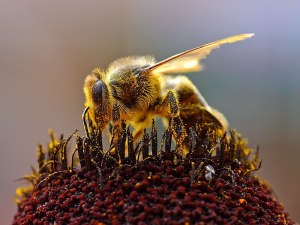
I’m not proud of it. In fact, truth be told, I tear up a little bit when I think about it. It happened so long ago, but it was a casual act of violence that made me feel big at the time. It wracks me with guilt even today. I killed a bee. For no reason. It was a summer’s day and I was following after my step-father, who’d just taken us for a haircut. Step-dad always wore a crew-cut and disliked hair on boys and men. I’ve always hated haircuts and when I saw a honey bee on a clover flower after leaving the barber shop shorn I stomped on it. I was maybe twelve. That act of senseless violence has never left me.

I’d been stung, you see. Many times, in fact. One incident was particularly dramatic. My mother had driven my brothers and me out to the woods to play with our dog. We made up a game, the way kids will, where my brothers would throw a stick and I’d race our dog to try to fetch it first. I was actually in the lead this time and stepped on a rotting stump to keep my marginal edge. The stump was home to a colony of yellow-jackets and they swarmed out, just like in the cartoons I used to watch. Before I realized what was happening I fell to the ground with multiple stingers burrowing into my bare legs. Our dog was covered with bees and we weren’t sure he’d even survive. At home Mom had me soak in a hot bath because there was a prayer meeting that night at church that we couldn’t miss. I was allowed to take a pillow to sit on over the plain wooden pew.

That incident was in my mind as I stepped on the innocent bee, gathering nectar that summer day. Immediately I regretted what I’d done. Its little body lay twitching in the grass. It had no idea who had killed it or why. My reason for doing so was lame, and long gone. All creatures on this planet are interconnected. We are killing off bees at unprecedented rates. Insect populations the world over are falling at truly alarming speed. We need our bees. We’ve tampered with nature to make it more productive and have ended up with killer bees instead. We’re now warming our globe so they can spread even as we kill off their more docile siblings. That summer sun of memory beats down on me as I consider what I’ve done, and I sincerely repent.

Photo credit: Jon Sullivan, Wikimedia Commons


Milkweed and Honey

I’ve never thought of bugs as an ethical concern. Well, not directly anyway. I had some truly frightening encounters with insects and arachnids as a child, so I tended to avoid bugs when I could. At times, I hesitate to admit, I took advantage of my size and smooched them. I did, however, mature out of that. Many years ago I stopped killing bugs that got inside, choosing instead to favor capture and release. I’d trap them in one of a variety of empty peanut-butter jars we kept around the house expressly for that purpose. The imprisoned intruder is then escorted outside and released. It seemed the only fair way to handle the situation—I don’t believe in exploiting size, and hating things with too many legs is prejudicial. Then I heard that insects are dying out.

Public domain, from Wikimedia Commons

Instead of bringing glee, this instilled a kind of panic. According to a story in the Washington Post, scientists have noted a 75% drop in bug biomass over the past several years. Stop and think about that. Insects contribute so much to our lives that we barely pay them any mind. Everything from pollination to breaking down decomposing organic matter, bugs do it. We need our insects. As with most things these days, it seems that we humans are the likely culprits. We destroy habitat, we spread pesticides everywhere, we try to take all kinds of land and make it in our own image. And we’ve sacrificed our insects along the way. As the article states—driving around country lanes on a summer night doesn’t bring up the windshield splatter that it used to. I stopped to think about that. It seems to be true.

The tiny members of the animal kingdom do a tremendous amount of work. I know they’re not doing it for us, but the things they do we don’t have to—and oftentimes can’t—do. All fruits and vegetables are pollinated by insects. Honey has been the main place where some of this shortage has been felt most directly. Bees have been disappearing. So have monarch butterflies. The fact is, we can’t live in a world without bugs. This does make it an ethical issue. If we’re going to claim dominion over all things we have no right to overlook the smallest creatures. Sure, they can, well, bug you. They fly in your face or bite you while you’re sleeping. They’re only doing what they evolved to do. I don’t mean to bug you about it, but we need to look after the minuscule and vulnerable among us.


June Bugs

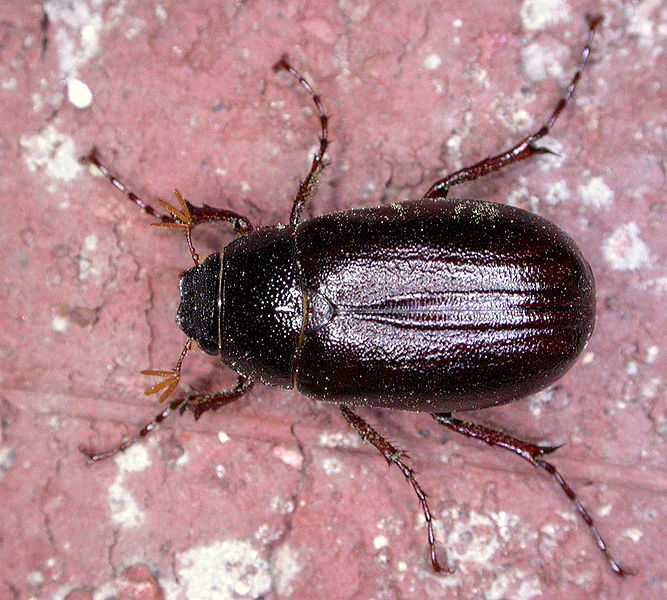
On my way to work yesterday, I came upon an overturned June bug clawing at the air, trying to regain its feet.  I’m always in a hurry getting to or from work, but I decided to stop, offering the insect a leaf to grip, and turning it back over.  I knew, as I spied birds flying overhead, that its chances weren’t good.  In the course of nature, insects are radically overproduced because so many get eaten.  In my apartment they can even be a source of sudden terror when they find their way inside.  I knew the June bug was probably nearing the end of its short time on the earth, but as I held out that leaf to it, I knew that in the act of struggling we were one.  That sounds terribly Buddhist of me, I know.  Insects and humans share, on the most basic level, the desire to survive.  Who likes to feel vulnerable—soft, unprotected underbelly exposed to the air?  Defenseless and helpless?  Certainly not this poor beetle.

Photo credit: Patrick Coin, Wikimedia Commons

Photo credit: Patrick Coin, Wikimedia Commons

Stepping off the bus in New York City, I began my daily power walk to work.  The bus had arrived a few minutes late, and my anxiety level about clocking in works as if it’s on steroids.  I have to buzz past the interesting things happening in the city, the people who merit a second look, the architecture that has an unexpected amount of detail, only to be lost in the overwhelming number of buildings.  Big buildings as numerous as bugs on a summer morning.  Then I saw a box pulled up on a low sill outside some swank bank.  I often need boxes at work, and I can’t help stopping to appreciate how this unbroken expanse of paperboard would be useful.  Then I noticed the feet sticking out the end.  There was life in this box, not so different from the beetle I’d stopped to help an hour and a half ago, in its exoskeleton, grasping for some kind of salvation.

I arrived at work agitated. I had been able to help the beetle, but what could I do for the sleeping human being in his box? I had no money in my pocket, and even a twenty would stay the exposed, raw human on the city street for no more than a few hours. To care for a person takes commitment, long-term willingness to make sure that those who fall on their backs are set again on their feet, given the resources, the opportunities they need to get along in a world where those circling above are far more dangerous than the birds in my neighborhood. I looked at my calendar. June is nearly over. The June bugs will soon disappear. And yet I couldn’t erase the image from my mind. How much relief seemed to show on that inexpressive June bug face when it could finally crawl away from the center of the sidewalk. Something was terribly wrong here. And a man was sleeping in a box just two blocks away. In the act of struggling we are one.