
Travel broadens the mind. I always find that it’s a form of education. Sometimes what I learn is disturbing. While driving across Pennsylvania on I-80 recently, I had a chance to study some contrasts. I’ve made this trip many times, but this particular journey revealed two Amish farmers out plowing their fields behind teams of horses. It’s easy to romanticize this view—there is a majesty about it. Once, while driving back to Wisconsin from an interview at Luther College, I saw an Amish farmer and his team in the rain, the horses’ breath could be seen billowing out, but the farmer, implacable in his conviction of what had to be done, stood rigidly behind them, keeping the animals at their task. When you don’t eat if the crops don’t grow, a new kind of urgency is added to this picture. All around us on the highway hi-tech vehicles whizzed, and, gathering from the behavior of the drivers, I couldn’t help but wonder if any of them were very happy.
Then we sped past a billboard. It was facing the opposite direction from our travel, but the words went something like this: “The wind dies, the sun sets, but coal lasts forever.” In much of Pennsylvania, with its spine of Appalachian Mountains, coal is abundant. Growing up some of the highways we drove had exposed coal seams in the road cuts. It’s pretty much everywhere. Coal, however, is a dirty, non-renewable, polluting source of energy that exacts a severe cost on the planet through mining. No doubt it is abundant, but the amount is certainly finite and it makes the world less inhabitable when we use it. The wind blows where it wills. The sun rises on the righteous and wicked alike. Coal is decay left from the life forms that helped ensure that we’d show up here. One of those circle of death kinds of things.

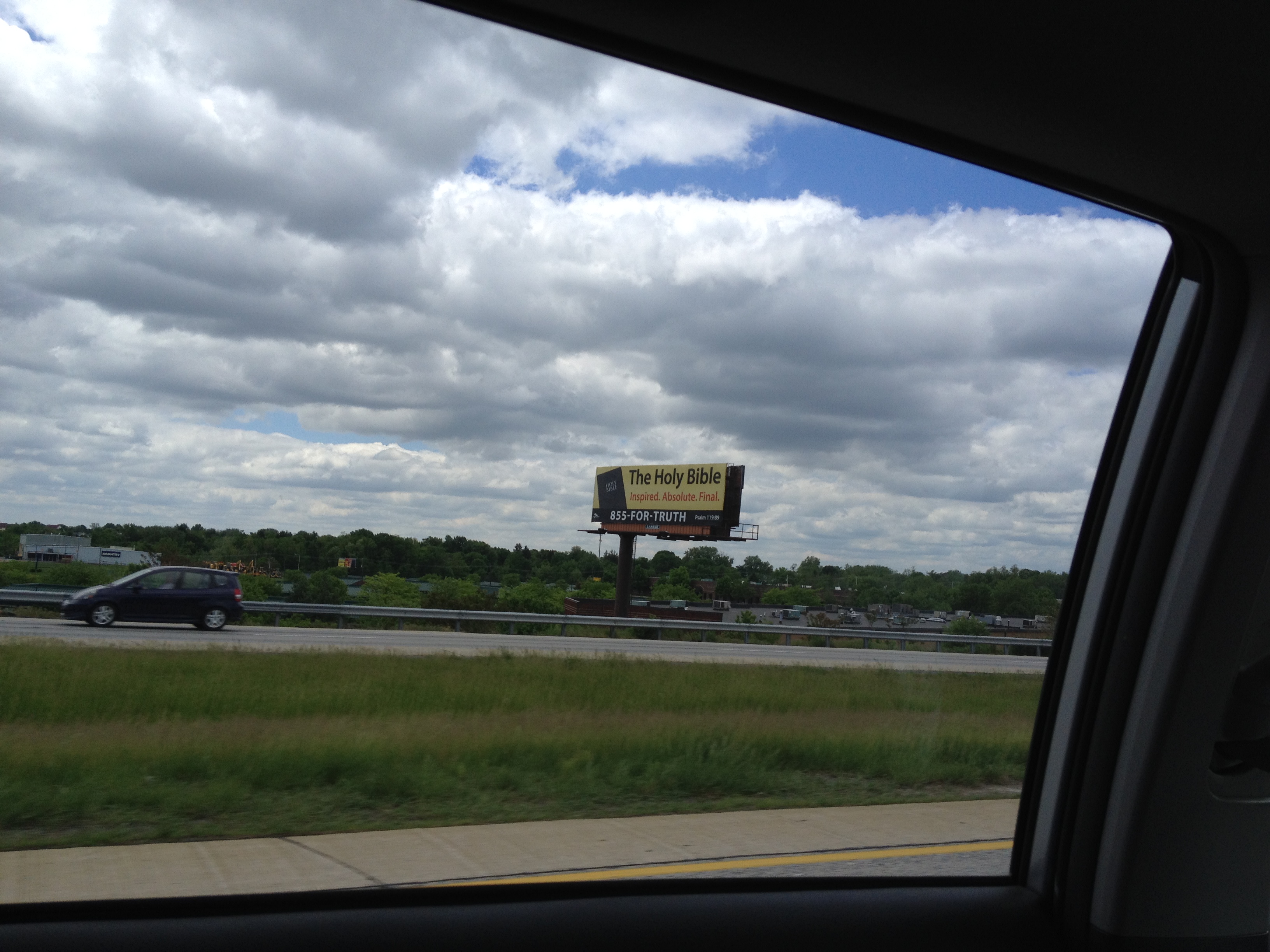
Then a car went by with a communique in paint on its back window. “Pray to end hatred” it read. This is a sentiment with which I could surely live. I recalled driving this same interstate many years ago when I was old enough to read but not enough to comprehend. The pylons of the overpasses on 80 frequently have spray-painted messages reading “Trust Jesus.” Some of them are still visible at highway speeds, faded though they are. The elements seem to have left a negative of the original work of what is technically vandalism. I think back to the Amish farmer. He’s watching, I’m sure, the never-ending flow of sinful vehicles on a highway as he plows. He’s been raised to trust Jesus and to believe in the old way of doing things. I’m behind the wheel praying that the hatred I see played out in these metal coffins will stay far from me until I can exit to some quieter backroads where the pace of life is more to my liking. And I wonder if that sunset I see is influenced by the coal that we’re burning and hoping the wind will simply blow it away.
 Steve A. Wiggins