Pods

Some cultural assets (ahem) are so well known that you come to know them by association.  I knew the story behind Invasion of the Body Snatchers (1956 and 1978) long before I saw the original, within the last couple of years.  I may have been body-snatched myself since I can’t remember when it was or why I didn’t write a blog post about it.  In any case, I’d long been curious about the remake and discovered it free (for the time being) on Amazon Prime.  The fact I’m still looking for free stuff proves I’ve not been body-snatched, I guess.  If you’ve been raised with our cultural assets you know that the eponymous body snatchers are pod people who look exactly like the victims they destroy.  Their goal is a well-ordered society with no emotions.
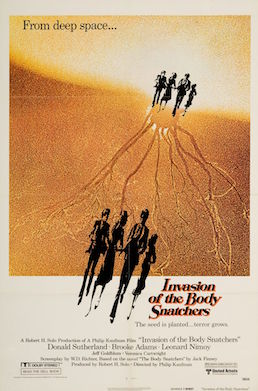
The thing that’s so interesting about the 1978 version is that its assessment has changed over time.  When it first came out, many thought, and opined, that the 1956 black-and-white version was better and this one really added nothing.  However, over time this judgment has been questioned.  Critics taking a second look have now scored it as one of the best remakes ever made, and not only that, but it is considered one of the best science-fiction horror movies of all time.  I suspect nothing in that category will ever displace Alien, but still, my first viewing of the ’78 Body Snatchers agreed with the latter assessment.  It is quite good and it has even aged well.  You can kind of guess how it’s going to end, largely because the final scene has been played over and over, but still it’s definitely worth watching.

The social commentary in the film runs deep and strong.  Non-conformity is suppressed.  Life without emotions is better than really feeling something.  Simply go along because everyone else does.  The parable has changed actors over time—fascination with social media/virtual reality have perhaps become the modern pods—but the story is as old as our species.  Probably even older.  It’s non-conformists, generally after their demise, that are realized as visionaries.  Shooting a car into orbit requires tons of money but not much vision.  I’m not conforming, however, when I agree that the 1978 remake is good.  My taste in movies has always stood apart from others, at least from my own experience.  I also think that horror is often among the more intelligent genres of film.  But then, I tend to side with the emotional.

Body Doubles

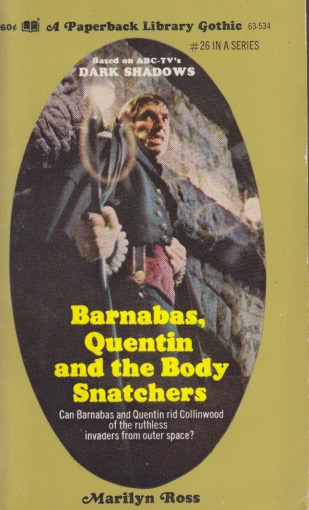
Learning about how Dark Shadows developed has freed me a bit, I think.  The stories between the original program, the novels, and the movies were never consistent.  I’d made that most fundamental of Fundamentalist errors—I’d assumed there was only one story and it went in only one way.  This helps explain, but not excuse, the Burton-Depp version of the story.  In any case, now I can read the novels with minimal baggage.  Understanding childhood is important if we survive long enough for it to haunt us.  Barnabas, Quentin and the Body Snatchers is a departure, even for Marilyn Ross.  Something critics sometimes overlook is just how literate the original, and subsequent, program was.  Ross occasionally attempts to cash in on that without feeling tied to the story line.

This plot relies on the 1956 movie, Invasion of the Body Snatchers.  Indeed, as a daily show Dark Shadows couldn’t really utilize a “monster of the week” format effectively (although it seems to have given the idea to those who later did).  The novels, however, could draw on such cultural tropes.  Both major releases of Body Snatchers (there was a remake after Dark Shadows ceased, in 1978) were considered terrifying by implication: how could you tell if someone took over the body of someone you know?  Who could you even trust, if such a phenomenon were possible?  Since such things aren’t common down here, it’s easier to suggest they come from outer space.  So it is that this installment has the weird juxtaposition of a vampire and werewolf having to outsmart aliens who take over human bodies. Kind of an early monsters vs. aliens scenario.

Again, not to seek too much depth where it doesn’t naturally exist, this scenario raises interesting questions.  How would terrestrial and extraterrestrial supernaturals interact?  I’m not sure W. E. D. Ross was up to this kind of gothic-sci-fi mash-up.  He was, after all, primarily a romance writer.  (Although, a recent trip to a library book sale and used bookstore in the same day led to the realization that paranormal romance is a burgeoning field.)  I recently read an article disputing the “willing suspension of belief” that is said to accompany such ventures.  As an adult I know that these novels are what must be considered cheesy, quick, and formulaic ephemera.  Still, I couldn’t help being pleased to see Barnabas and Quentin cooperating here.  If aliens ever do decide to invade, we’ll need all the help we can get.