Omen, O Man!

Omen_ver4

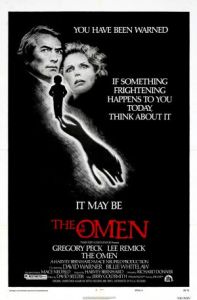
Of the unholy trinity of late-60s to mid-70s horror movies Rosemary’s Baby (1968), The Exorcist (1973) and The Omen (1976), the last always seemed the least effective to me. Having recently read about the Devil in American popular culture, and having a rainy Friday evening alone, I decided to give it a try again. Based as heavily on Hal Lindsey as it is, once one outgrows dispensationalism it is hard to be frightened by the idea of biblical end times. Everything from making up verses in “Revelations” to utterly bogus Holy Land geography (Megiddo is north of Jerusalem, not south—did the writers not even own a map?) contributes to a set of untenable tenets, even among the bibliterati. The film relies mostly on shocks and startles to earn its horror stripes, and after you’ve seen the movie once, these lose their power in subsequent viewings. Nevertheless, on this rainy May night, so close to June 6, I noticed new ways in which the movie undermines its own message.

The premise, of course, is that Damien, the son of the Devil (who apparently has a thing for bestiality), is plotting to take over the world through the means of politics. Having been watching the events of the past few months I have to wonder how the Devil could improve on progress through such channels. But I digress. His step-father Robert Thorn, US ambassador to London, discovers his “son”‘s identity and tries to kill him. With a strong anti-Catholic bias (the Antichrist is born in Rome, the seat of the church, and is protected by Roman clergy) the film nevertheless spawns sympathy for the Devil. As a child, Harvey Stephens hardly appears diabolical. Maybe it’s just because my brothers and I also spilled goldfish from their bowl once, but it seems to me he acts just like most little boys do. Who really wants to go to church at that age? As the movie approaches its climax, he’s represented as the biblical good-guy.

Thorn has to confirm Damien’s satanic identity. Like Delilah, he creeps up on the sleeping boy and cuts his hair. Convinced by a man who introduces himself “I am Bugenhagen” that he has to stab the boy, Thorn in a white car outraces police (so there might be a bit of prophecy here after all) to sacrifice the child on the altar. The movie casts Damien as both Samson and Isaac within a few short minutes. Apart from the film’s use of violence against women’s bodies (Thorn won’t allow an abortion, Kathy seems to have a penchant from falling from high places in slow motion, Baylock gets a fork in the neck) it actually seems ambivalent about the evil of the boy. An unfortunate birthmark does not a devil make. We’ve made it through the change of the millennium and many other hazards, yet dispensationalism is still with us, as is its anticlimactic Antichrist, Damien. He’s less scary than the real politics of an entirely secular age.

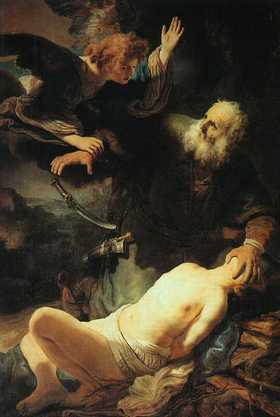
Akedah

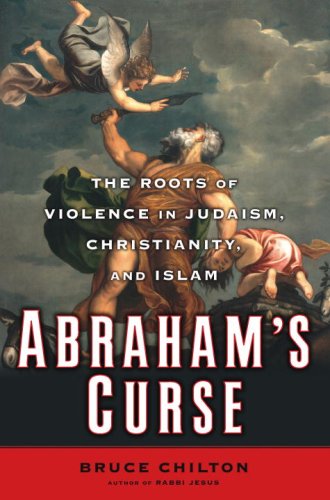
AbrahamsCurseViolence, in its most basic form, is to be blamed on evolution. Not the theory of evolution, but the fact of it. More precisely, violence is a reflex of the struggle for existence. To live animals have to eat and to eat, many have evolved to kill. While violence is endemic in the world, it isn’t so rampant that species overkill their own kind. That’s rather rare, actually. Human beings have engaged in violence against one another for our entire history, and it is only within the last century or so that we’ve made any concerted efforts to stop violence against those who are different than ourselves. Among the impulses both advocating and quelling violence is religion. Bruce Chilton’s important study, Abraham’s Curse, scours the monotheistic family tree for information on why all three major Abrahamic faiths advocate martyrdom. Or more disturbingly, why they insist on sacrifice, even of our own species.

Chilton begins with the story of Abraham and Isaac. The Akedah—the binding—or near-sacrifice of the beloved son. Since Judaism, Christianity, and Islam all share this story, and since it sets the tone of a God who seemingly demands human sacrifice, Chilton explores its implications and possible origins in sacred violence. Sacrifice predates any written records, although, as Abraham’s Curse points out, it became an established fixture in urban culture when temples began to play an important role in ancient society. No one knows why we sacrifice. By the time writing came along, it was already an established part of the picture. When the book of Genesis was penned, the story of the binding of Isaac became sacred scripture. Even in the earliest days of biblical interpretation scholars puzzled over what was going on here and its chilling implications. God, after all, comes up with the idea that Abraham should be tested with the cruelest of tests. Although the Bible isn’t explicit on the point, Abraham and Isaac never appear together again after the incident until Abraham is safely dead.

Building on this common story, Chilton takes the reader through the stories of the Maccabees where Judaism develops the concept of martyrdom, through Christianity where some actually begged for it early on, and into Islam, which still practices animal sacrifice. The idea that it is noble to lay down your life, and worse, the lives of others, points to a guilty Abraham who is a paradigm of faith. An Anglican priest, Chilton is no angry atheist. He does not, however, pull any punches. If monotheistic traditions gave us a violent heritage, they can also work to dismantle it. Ironically, it is when religions are in the ascendent that they exercise their power to perpetrate violence. All three major monotheistic religions officially advocate peace and justice. But somewhere in our deepest human experience, we know what it is to feel hunger and what an opportunistic animal does about it. Abraham’s Curse does offer solutions, however, if only we could get human beings to put down their spears and read.


Father Abraham’s Faith

Okay, so this is the scene: Abraham is old and he has just one son to whom a promise has been made (this is the biblical version, by the way). God had promised him that he’d have as many descendants as the stars in the sky, so it seem that Isaac has a long way to go. And the boy’s not married yet. Abraham calls in his trusted servant and gives lengthy, detailed instructions on how to go back to ancestral Iraq and find a wife for Isaac. Just to make sure the servant understands just how serious this is, Abraham says, “Put, I pray thee, thy hand under my thigh,” (I can’t help thinking he added a big wink) and instructs him to swear to obey the instructions precisely. Readers of the Bible since at least the Middle Ages have recognized that “thigh” here really means genitals. The more we’ve learned of the ancient world the more we’ve discovered that men touching each other’s privates was a sign of a most serious oath—it’s a touch that can’t be taken back, and any promises made in this way must be kept.

I’ve been reading about monkeys. More precisely, about evolution. When reading about how baboons show intent to form an alliance, I was surprised to learn that males utilize scrotum-grasping. Since all’s fair in love and war, when baboons fight ripping off another guy’s jewels is considered perfectly acceptable. That means that allowing another male to fondle your testicles is a sign of ultimate trust. Baboons, it seems, have been doing it long since before Abraham showed up on the scene. I wonder if this then is a case of convergent evolution of whether Abraham’s oath goes back to nature in its most basic form. Once castrated, especially in antiquity, a man had no choice about going back. To invite another man to put his hands “down there” was a serious matter indeed.

The only requirement really given to Abraham by God was circumcision. Again, from what we know of ancient times this was not unique to Israel, but the theological freight associated with it was. For a man who’s been promised as many descendants as the sand on the sea shore, allowing another man to cut away part of your reproductive organs is a sign of ultimate trust. This is a behavior that seems not to go back to nature, however. Not even chimpanzees have quite figured out how to make knives or use them to carve up sensitive areas. This has none of the marking of evolution. An act like that seems to have come directly from the gods. Abraham, in a way most modern believers would find incomprehensible, was the paragon of faith.

Contemplating the ineffable


Bread Alone

The sad story of the death of an eight-year old girl from Irvington, New Jersey bears uncanny echoes to a case a year and a half ago of a mother who starved her children believing God would provide. The current case of Christiana Glenn’s death is heart-wrenching and the outlook is not improved when it appears that the girl’s mother had religious motivation to abuse her child. Christiana died from untreated physical wounds and malnutrition, prompting columnist Kathleen O’Brien to write about how food and religion often come together in unusual ways. As O’Brien points out, religions generally safeguard children from food privations, but less scrupulous leaders of what are frequently termed “cults” do not have the same strictures. The only real difference between a religion and a cult is society’s attitude toward it—religions tend to be larger and with finer pedigrees, but beliefs are beliefs. When religions seek control over believers’ lives, they often delve into the practice of deprivations, generally mild. More extreme groups take the idea to fatal limits.

Even the Bible records from near the very beginning that deprivations are part of the religious expectation. One of the most complex and frightening stories from Genesis is that of Abraham’s near sacrifice of Isaac. No matter how theologians wash it, this story retains its stain of an adult—whether directed by God or not is a mute point—attempting to harm a child in the name of faith. The story, many centuries later, still sent Søren Kierkegaard into a tailspin that came out as Fear and Trembling. What kind of deity asks for a child to be harmed, even in jest? For Christiana Glenn, there’s no taking it back. The Bible tells us nothing of how the interior life of Isaac responded to this episode.

Food and religion are among the most common elements abused in American society. For our bifurcated (if not bipolar) outlook, one sustains body and the other sustains soul. While science still lacks evidence for the soul, the body remains the only basis upon which we have to base our ethics. Even biology dictates that care of one’s own young is an evolutionary imperative. It is tragic indeed when a religion overrides what all cultures respect as the ultimate “should” —take care of your children. In a world overpopulated by religious experts the street value of the soul will never face a recession. Believers, characterized my many religions as sheep, will go wherever their leaders tell them to go. As a culture suspicious of funding the study of religion, it may not be food that is reaped at the end of this harvest.

Thou shalt not...


The Violence of the Lambs

Religious holidays are curious affairs. In many Christian contexts “the holidays” are often poignant scenes of tension and angst. Granted, much of this is generated by human family dynamics, but then, what of religion is not? An unfortunate shooting episode erupted yesterday in Baluchistan, Pakistan during the Muslim festival of Eid al-Adha. According to Star-Ledger wire services, the followers of two rival religious leaders pulled out guns in the mosque and began firing. The festival of Eid is the commemoration of Abraham’s near-sacrifice of his son. Islamic sources suggest the intended victim was Ishmael while the Bible claims it was Isaac. Whoever came under the knife, however, the implicit human sacrifice is disturbing.

Human sacrifice has been a part of human culture for a very long time. Never a common practice, it was generally reserved for times of severe crisis, when you really, really needed the gods to pay attention. The story of the Akedah, or “binding,” of Isaac demonstrates the reluctance in Judaism to speak of Abraham as an actual murderer of a child. After all, this was only a test. Many biblical scholars see this story as an etiology, a story of origins. The binding of Isaac explains why human sacrifice is not permitted in the religion of Abraham. When it does occur, for example in 2 Kings 3.27, it is effective. Nothing like a good, old-fashioned human blood-letting to satisfy the gods.

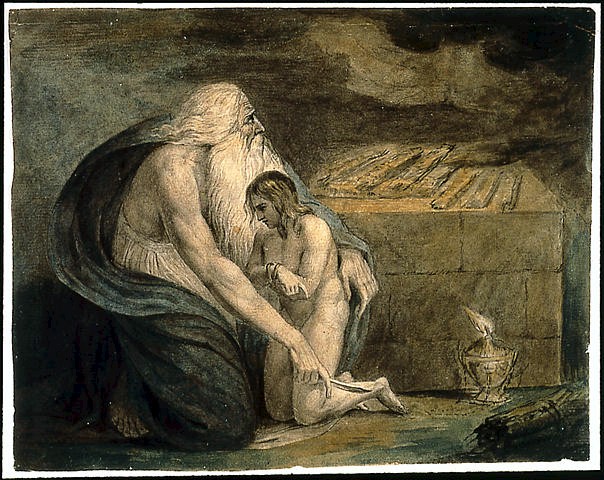
Soren Kierkegaard found the story of the sacrifice of Isaac so disturbing he wrote an entire book to deal with it. Even if we, the readers of Genesis, are given the advance knowledge that this is only a test, the image of a religiously devoted old man with the knife hovering over his bound son is the very definition of horror. And that frozen moment comes to life and acts itself out time and time again in acts of religious violence. One of the most recent was in Baluchistan, but as sure as the knife rises above the sacrifice, there have been other incidents of religious violence since that awful moment. Human sacrifice may be at the heart of religion after all.

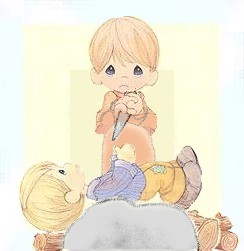
Precious moments akedah, shamelessly borrowed from James McGrath's blog


Father Abraham

“Father Abraham had seven sons; seven sons had Father Abraham.” So began a camp song that I learned many years ago. The song always confused me because, no matter how I did the math, Abraham did not have seven sons. Abraham has a way of causing confusion. The story of Abraham contained in Genesis is complex and perplexing. He is presented as a man who experiences extraordinary occasions and then doubts what he learns from them. He is wealthy and timid, yet leads troops against an alliance of five armies. God speaks directly to him, and he remains in self-doubt. He always does what he is told, although he takes initiative once in a while as well. As Genesis tells it, he is the father of Ishmael and Isaac (and six others).

Historians have a somewhat different assessment. The only evidence we have for the historical existence of Abraham is Genesis. Although other ancient documents mention Abraham they clearly received their information from either Genesis itself or its oral sources. A prince powerful enough to route five kings might merit a reference in some clay annals somewhere, one might expect. Yet history is silent. Most historians require either multiple-source attestations or official, non-literary documents to support the historicity of ancient characters. Abraham simply doesn’t qualify. Those Genesis stories are foundation myths just like those common to all cultures. They represent self-understanding, not necessarily actual origins.

Nevertheless, religiously minded debates continue to flair around him. Abraham, through Isaac, is considered father of the Jews. Christians, courtesy of Paul, consider themselves adopted children who inherit over the natural born. Muslims sometimes trace their ancestry to Abraham’s first-born, according to Genesis, Ishmael. Abraham does not exit the stage as a single man, however. He bears in his person the promise of land, a very real commodity, granted by God himself. So the story goes. We have little trouble declaring other ancient (or not-so-ancient) characters legends or myths when they have no direct bearing on the historical origins of religion. Wars are not fought over Heracles or Theseus, after all. Because of Abraham’s inheritance, however, as the singly chosen ancestor receiving the divine favor, all major monotheistic religions wish to claim him. They are often willing to kill to make that claim real. Myths do have serious real-world applications. And I still haven’t figured out that bit about seven sons. Three seem to be far more than enough.

Abraham at sixes and sevens


Biblical Weddings

Maine is getting ready to vote tomorrow on the legalization of gay marriages. With conservatives hopped up on fears that such a move will destroy traditional, patriarchal privilege, the Bible is beaten rather severely as proponents seek evidence for man + woman = marriage in holy writ. The funny thing is, the Bible says very little about marriage.

In an era when marriage is often associated with houses of worship and a smiling, tolerant divine face beaming down on a couple about to do “the bad thing” with divine sanction, it is difficult to realize just how little the Bible talks about it. The Hebrew Bible is particularly mute when it comes to the particulars of wedding ceremonies: “Then Isaac brought here into his mother Sarah’s tent. He took Rebekah, and she became his wife,” according to Genesis 24.67. No sacral ceremony here, by prior arrangement, sex equals marriage. A few chapters later when his son Jacob marries, there is a feast mentioned, but no sacerdotal functionary hovering nearby (one who might have actually noticed that Jacob ended up with the wrong woman, by the by). And so the biblical narrative limps on with patriarchs bedding and marrying their women with no mention of God. Eventually religious folks got a little nervous about this and ceremonies with divine approval were introduced, but that is not even in the case with the wedding at Cana, which, in desperation, the Book of Common Prayer latches onto for a marriage lection: “The bond and covenant of marriage was established by God in creation, and our Lord Jesus Christ adorned this manner of life by his presence and first miracle at a wedding in Cana of Galilee” (the Order for The Celebration and Blessing of a Marriage). Apart from the difficulty of a covenant being an uneasy peace between a superior and inferior party, this introduction relies on a literal Adam and Eve and the means for a large wedding party to get drunk, courtesy of the miracle in Cana. Apart from Paul’s putative comments regarding the marital status of early church leaders, we hear little else in the Bible.

I have nothing against weddings; I was the groom in a particularly stylish wedding in Ames, Iowa some years back. The problem I see is that the Bible is being forced to say what it does not. If the few biblical marriages are all heterosexual, it simply reflects the options open at the time. How does allowing gay marriages threaten the marital bless of the heterosexual? It seems to me that the only thing to be lost is “privileged status” and benefits allotted to those formally united in the eyes of the law. Unless things have changed recently, even in a religious marriage a state-issued license is required! Why not allow firm affirmations and privileges of loving couples without relying on non-existent biblical platitudes? I hope Maine will do the right thing tomorrow.