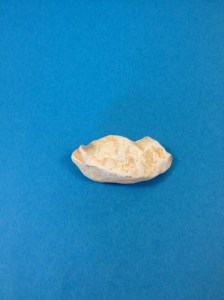
Rock Hard Cafe

IMG_0518

At first glance it may not appear to be much. A small chunk of rock, probably limestone. Hardly large enough to be used in a sling against a giant in a pinch. Still, it is special. What makes this rock special is the context from which it was removed. A friend has recently returned from Israel and he brought this rock for me. It is from the Mount of the Temptation, atop which sits a lonely monastery cared for by a single, elderly monk. The thought of someone thinking of me in such a (literally) God-forsaken wilderness is touching. My brief travels through the desert of Judea offered plenty to occupy my restless mind. I’m pretty sure we zoomed by the base of the Mount of Temptation in an air conditioned bus one day on our way to somewhere less desolate. Or more. The sharp-voiced little skeptic in my head immediately kicks in: if Jesus was alone when tempted, how could anybody possibly know where it happened? I can’t picture him leading a tour there later—“and this is where I almost turned stone to bread; don’t those pebbles look like challah to you?”

But then, it’s not about historical accuracy. This little stone in front of me is a symbol. Broken off of the karst geography of the rocky spine of the Holy Land, this shard is meant to remind me to avoid temptation. A nearly identical piece of stone from Israel sits among my teaching trinkets. One of my students went to Israel back in my days at Nashotah House and returned with a bit of limestone for me. She said, “you can keep it as long as you put it on top of my gravestone when I die.” This was a custom I’d observed long before I’d even heard of Nashotah House. Long before religion grew flinty and unyielding. Stones bear remembrance. Although Israel is not as arid as many people believe it to be, rock is a natural resource of uncommon abundance. We age and die, but the rock remains. The rock remembers.

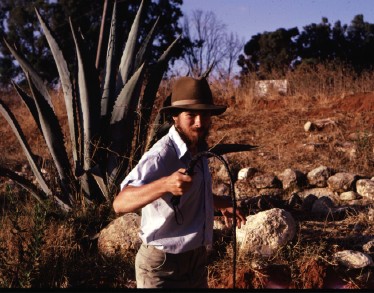
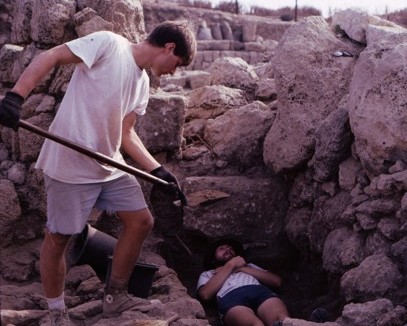
My six weeks in Israel were spent among the rocks of an ancient settlement known as Tel Dor. Archaeology, I learned, is mostly just removing the dirt from the rocks in the ground—at least at the entry level. Those stones tell a story. They were once a city, a district administrative center. Now they lie in dusty profusion, and only the most ardent of Bible readers will recall ever seeing Dor’s name in the pages of Holy Writ. Built by Solomon, the Bible grandly claims. Now all is ruins. The grandeur of a king toppled with the passage of time. My mind is drawn back to a treeless stretch of a mountain devoid of even the hardiest plants. A person can grow mighty hungry there. Mighty hungry indeed. Temptation comes, unbidden. Life is an unbroken chain of temptation, for those willing to be honest in the desert. That little stone is, in truth, bread.


After the Gold Rush

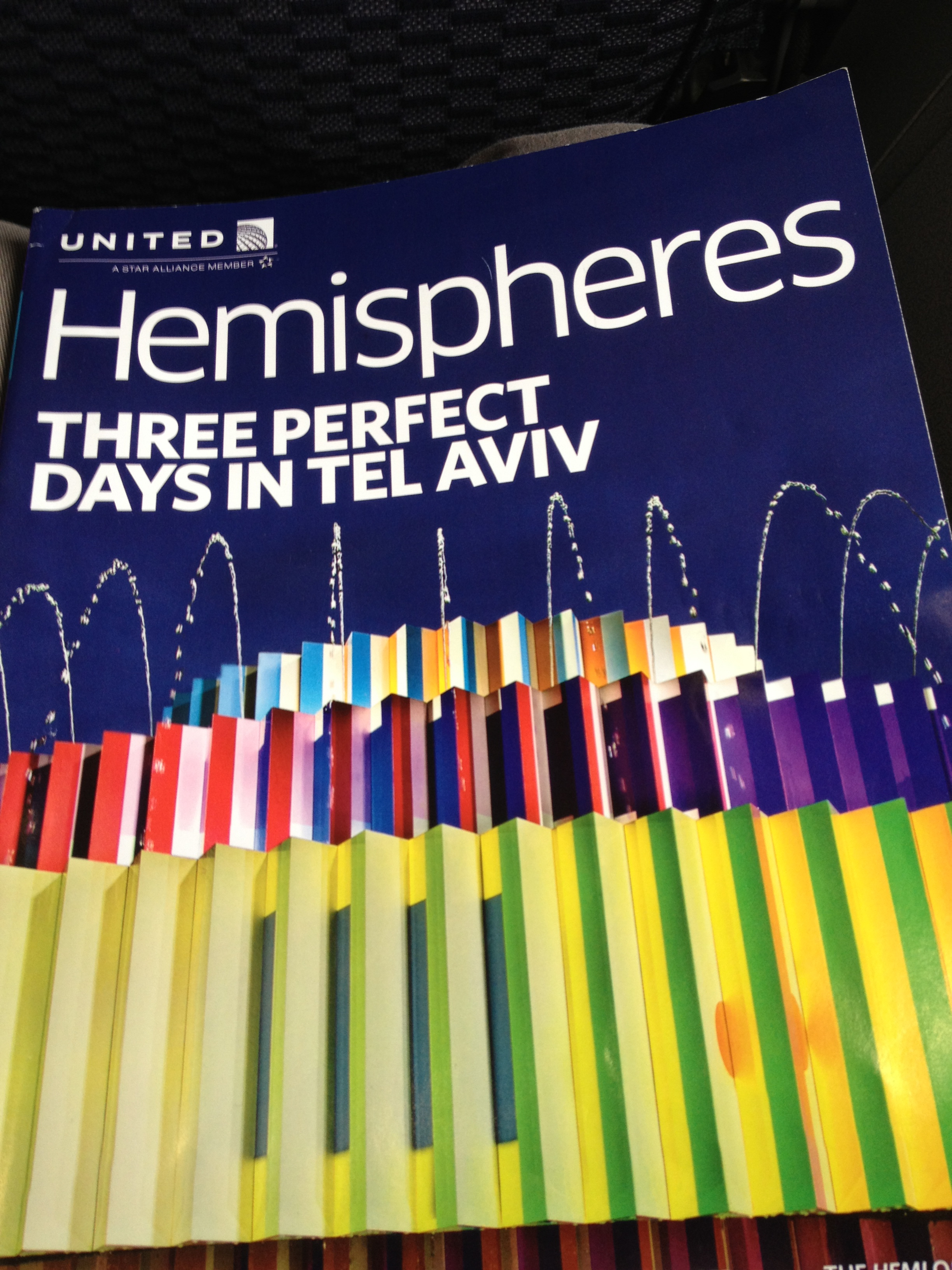
The morning I flew to Chicago for the American Academy of Religion and Society of Biblical Literature annual meeting, the headlines in the morning paper were about the rocket attacks in Tel Aviv. Ironically, the in-flight magazine cover on United, I noticed as I fastened by seat belt securely low across my waist, read “Three Perfect Days in Tel Aviv.” The irony wasn’t so much funny as it was sad. The situation in the Middle East is hopelessly entangled, but it all comes down to our obsession with dividing people into groups. Religious, ethnic, social: somehow we are not like them. We’re better, superior in some way. It matters not that proving superiority is a purely subjective enterprise. After all, we just know it. When history places one persecuted group in a position of persecuting another group, well, I’m afraid we all know what happens.

The problems in the Middle East are largely biblical and predominantly petroleum-based. Even those who tend to read the Bible figuratively can see a land claim based on an Abraham who probably never existed as strangely literal. Especially when there’s oil in them thar wells. Isolationism served the United States well until it was discovered that they had more black gold than even Texas does. Establishing a foothold in the region was not such a subtle policy; the x-ray vision of politicians funded by heavy industry saw beneath the sandy soil to the real deity that lay beneath. Dig a well, hit a gusher, and, like the Bible says, “he anointeth my head with oil, my cup runneth over.” Good news for modern capitalists. But some people will have to die.

As I sat in the lobby of a posh hotel, waiting for an appointment, I heard a fragment of a conversation as a couple of scholars rushed by. They were discussing the aftermath of the rocket attacks on Tel Aviv. One suggested to the other, in the context of how many Palestinians might die in retaliation, “well, if they can keep the numbers down…” and then they were gone. My mind jumped to The Prisoner. “I am not a number, I am a free man!” crashed in my head with the way that the dead in the Middle East are piled up as “the numbers.” I’m sure it was only intended as a convenient turn of phrase. Outside the hotel lobby the striking workers from the Hyatt labor disputes were protesting in a cold, crisp Chicago morning. They were soon cleared away. My fear, Number Six, is that you are wrong. We are all numbers, even the best of us.


Edeniana

“On Jordan’s stormy banks I stand, and cast a wishful eye”—so begins a hymn I learned as a child and which has followed me to Bloomington, Indiana. Campus visits are an expectation of some academic editors, and as I stand and look at Jordan River on the Indiana University campus, I can’t help but feel a little disappointed. I have no idea if this little stream was named after the Jordan River of Israel fame, or if it just happens that someone named Jordan was a benefactor of the university. Given that there is a Jordan Hall, and a Jordan Street, the latter seems likely. Nevertheless, whether liquid or liquidity, any Jordan in contemporary society probably traces its origins back to the river that now separates Israel from Jordan (named after the river). Many hymns celebrate the mighty Jordan without the benefit of geographical experience. The mythic river is not mighty or majestic, but a slow-moving artery that sluggishly empties into the Dead Sea. With all the history of Christian imagination, however, we like to think of it on a par with the Euphrates, or at least the Mississippi.

Jordan’s stormy banks

Biblical images have a way of catching the imagination. Although many younger people have no training in the Bible or Christianity, our culture is steeped very thoroughly in it. For some who are just rising to voting age, it must appear incredible the amount of effort politicians still put into keeping the old faith alive. It is clearly so here in Indiana. Driving down from Indianapolis I passed many signs that the Biblio-Christic pulse still throbs in the heartland. As I stopped to check my directions, I realized I’d just parked across from Pray Street. In a land where an imperative verb for a religious function stands a chance of becoming a street name, anything is possible.

After I returned from my trip to Israel many years ago, I realized that I’d neglected to take any pictures of the Jordan River. It runs like a leitmotif through our national imagination that it almost seems worth going back just to snap a shot or two. The Jordan is redolent of Eden, a land that is, according to Genesis, defined by four rivers. Water is a precious commodity in the arid Middle East. Its fluid nature seems not to have achieved the level of metaphor for those who insist on warring over religion. For gardens to bloom, there must be water and its short supply raises tensions. Water connects, however, just as readily as it separates. One of the first steps towards the great civilizations was the technology of travel by water. Why can we no longer use it for connecting rather than gerrymandering? I don’t know why this little stream is called Jordan River, but I do stand by its banks and cast a wishful eye.


The Skinny on Kansas

Perhaps it was just a slow news day, but Monday the Associated Press ran a story about a year-old skinny-dipping episode involving Kevin Yoder, US Representative from Kansas, and, by extension, Jesus.  Given that I’ve just posted on the skinny-dipping priest in A Room with a View, this seemed an apt place to consider what is being shown to the public. First of all, Yoder did not go au naturel in the swimming hole behind his house. The incident took place last August in the Sea of Galilee, the very body of water Jesus putatively walked upon.  Here’s the rub: with or without a boat, because of the association of Jesus of Nazareth with the Sea of Galilee, many people consider it a holy site. Even an Israeli police spokesman seemed a little put off by the mental image that, even if a year old, is a bit disturbing.  (The thought of any politician undressed is a bit jarring to the puritan imagination of the United States, and, one imagines, in many cases it is a reasonable phobia.) Yoder was reportedly in Israel for a trip funded by the American Israel Education Foundation. They were traveling to discuss international relationships, apparently.

As much fun as it is to catch a big player with his (less often her) pants down, I do wonder at the fuss. During my time in Israel—granted, many years ago and fully clothed except when in the shower—I noticed that American standards were not completely in force. A stroll down the beach in Natanya would easily prove my point. We like to hold our public officials to a higher standard that the average citizen, and given what they take from the system, rightfully so. Nevertheless, I wonder what harm is really done by a bit of juvenile fun. Obviously I wasn’t there, and I don’t have the context with which to judge such behavior accurately.  The Israeli police representative stated that public nudity is forbidden at the Sea of Galilee, so I suppose the legality of the act was an issue. American sexual mores, in addition to having been tempered by Victorian attitudes, are largely based on religious prejudices. The Bible is not shy on nudity, however, and people in the early Christian centuries participated in that world.  According to the Gospels, Saint Peter went fishing naked on that very same lake.  Progress obviously involves putting a cover on it.

Ironically, in trying to explain himself, Yoder said that the jump in the lake was spontaneous, a moment of joie de vivre, “just to have the experience.” He conceded that the Sea of Galilee is a special place.  And, he avers, drunk diving was not involved in the incident. No matter your level of tolerance, the emerging picture is an odd one. A group of government officials, one of them naked, standing around the Sea of Galilee at night.  A 30-something from Kansas jumps in for 10 seconds and it seems as if a storm arose over the feted Sea of Galilee just like New Testament times. One wonders how well our government represents the puritanical interests of their constituency.  Kansas, as we all know, is immune from evolution and provides a home for Fred Phelps and company. And it’s also a land-locked state. If you want to run around naked, and you’re a public official, it looks like you—like Dorothy—have to get out of Kansas.  Even then you might find yourself rocking the boat. Let’s just hope that if Peter’s inside he has the sense to pull on at least the girdle of righteousness before company comes.


Buying the Truth

Every now and again the Chronicle of Higher Education dips its trowel into the biblical archaeology debate. Those of us who’ve made extensive arguments based on ancient texts and artifacts know the territory a little too well. Archaeology, which largely grew out of biblical scholars attempting to “prove the Bible,” eventually started on its own track of scientific respectability with the predictable result of distancing itself from the Bible occurred. So far, so good. Then biblical criticism took a turn towards post-modern sensibilities. The truth cannot be known, and therefore the safest approach is to stop seeking any truth at all. Archaeologists in the know joined this venture (biblical scholars and archaeologists often cross borders in this exotic land), and began to deny historical Israel, as well as the rightly dismissed historical Abraham and Moses. Once you’ve walked a few leagues down that path, however, it is difficult to turn back. This is, of course, an over-simplified account of a complex dynamic, but the issues raised, as seen in the Chronicle, are real. Our perspective flavors our interpretation. If you don’t believe in a historical Israel you’ll never find one, no matter how hard you look. (A similar dynamic is at work in studies of religions and “paranormal” phenomena.) The word “evidence” is finessed as readily as fine hair treatments and the kinds of evidence that convince vary depending on the scholar. It is safest to admit we don’t know, sometimes.

The more troubling aspect, as far as I’m concerned, comes when the Chronicle introduces the concept of corporate sponsorship to archaeological digs. As an erstwhile volunteer on a dig (somewhere back in the Iron Age, it feels like now), I know that archaeology is frightfully expensive. There’s nothing like being on a dig to witness firsthand the amount of labor that goes into removing all that dirt–carefully! Carefully! Universities can’t afford it (stadiums don’t come cheap, you know!), so many digs rely on corporate donors–often television and film companies. And if you’re paying for footage, you want something to bring in watchers. An unnamed archaeologist quipped honestly in the Chronicle, “I don’t agree with everything they say in the films, but they pay me an awful lot more than I could ever earn from writing or teaching.” There it is, staring us straight in the face. The truth goes to the highest bidder.

That may sound benign enough, but in Israel especially, archaeology has high political stakes. You see, politicians are easily swayed by the “we were here first” argument. To get an idea of its specious nature, just ask a Native American! Proving the veracity of a David or Solomon no longer just gets God off the hook, it also builds the basis for claims against people who’ve been here an incredibly long time. The sad reality is that in archaeology, as in higher education, money speaks with an inordinately loud voice. As an agreed means of exchange, money is certainly important, but is it “true”? For those who’ve stopped short of the post-modern abandonment of that great philosophical ideal of Truth, we should be wary of allowing lucre to decide the issue. Those with money already help to decide what courses will be taught and what tels will be excavated. We run a real risk when we let those same people decide what will be considered the truth. In a society enamored of media and its ease of use, the truth is sometimes what comes across the television. There is another way, but it involves heavy digging and lots of reading. Maybe next time—but for now just pass the remote.


Disputed Territory

Revisiting a childhood home can be a bittersweet experience. As my wife reflects on the first house she remembers going up for sale, we are glad that we spent the holidays there one last time a few months back. In my case sentiment is a little harder to find. The three residences I recall from a fractured childhood all bear the same distinction: they were torn down after we left. All that remains of my youth is three parking lots. Things are a lot more level now than they were back then. Whenever I visit the area, however, I still slow down the car and remember. Memory, whether singular or collective, makes a geographic location a sacred space. We rented when I was growing up, so those spaces that I think of as mine were occupied by others before and after us. (The razing did not take place immediately after we closed the door for the last time.) Whether those others—strangers to me—consider the place special I have no way of knowing.

Holy, holy, holy?

In other cases the sacral nature of a place is hallowed by tradition. Say “the Holy Land” and most people will know that you’re referring to what is now Israel/Palestine. I only traveled there once, but was privileged to stay for about six weeks. Working on an archaeological dig is a rite of passage for young biblical scholars (for such I was at the time), and weekends were spent visiting the places I’d read about since I could first remember. One of the most jarring aspects of the holiness was the evidence of violence. Cars burning by the roadside. Bombs going off in a post office in Jerusalem. Sounds of heavy artillery lobbing explosives through a blue sky during the sunny afternoon. A place so sacred as to be continually baptized in blood. Humans, human memory, are what make a place sacred.

All of this comes to mind with the political posturing of New Jersey governor Chris Christie visiting Israel. God knows New Jersey has enough problems of its own, but it is a relief not to have him hanging around for a while. Nevertheless, what has Trenton to do with Jerusalem? One thing the Middle East doesn’t need is one more bully. Pushing, shoving, crusading, shooting, and bombing haven’t worked for that elusive peace. What value can our dauntless leader add to this unholy mess? Maybe I’m just old fashioned, but I thought governors were supposed to take care of their own problems at home and leave international schmoozing until they got to the big offices. Maybe the race for a GOP nomination isn’t over yet. The most sacred space in this country is a white house that gets sold to the highest bidder every four years. At times there is more wisdom to be found in a parking lot.


Alternate Reality

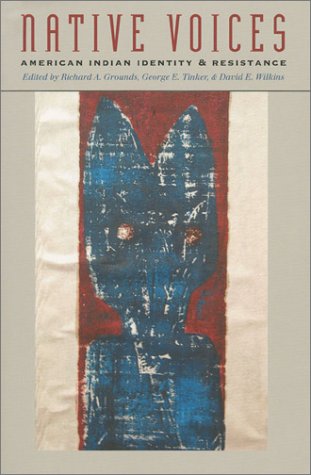
Recall a time when you did something bad. We have all done it now and again. Even the memory possesses the power to churn the stomach and lower the brow. I just finished reading Native Voices: American Indian Identity and Resistance, edited by Richard A. Grounds, George E. Tinker, and David E. Wilkins. The essays in this volume are about Native Americans by Native Americans. Many of us are taught to believe that the United States government had found some way to deal peacefully, after some bloody battles, with those hostile to the arrival of Europeans, but the truth is much sadder and more sordid. While some may say the essays in this book dismiss academic standards, I have been on the receiving end of academic standards enough to know that even highly educated people can sometimes only cower and the reality is how you feel. That is what comes through every page of this book: what it feels like to be misrepresented, demonized, caricatured, forgotten. European colonizers stole what they could in the name of Christianity and left a legacy of tears.

I nevertheless learned a great deal from this book. Here, I came to understand, not everyone agrees with the standards that Euro-Americans use to measure the world. Nowhere is this clearer than in the Native American critique of science. Those of us trained in this method feel a knee-jerk reaction when it is questioned, but those willing to consider, to ponder, will realize that a scientific worldview is a culturally conditioned form of interpretation. Other forms exist, although they have frequently been silenced. There is more than one way of knowing. In many Native American religious traditions the land itself is sacred. Being removed from tribal lands was tantamount to being separated from tribal divinity. We might be better able to dismiss it all as ancient history were it not for the fact that the oppression continues to this day.

Comparison with another oppressed religion came to mind. Ancient Israel is understood only imperfectly, but we know that the land was crucial to Israel’s sense of identity. We should, as heirs of the Judeo-Christian tradition, be sympathetic to Indigenous American sensitivity to the bond between land and religion. In the former case, the United States supported the re-formation of Israel in the 1940s. We still keep our own indigenous people out of sight and use their land with impunity. Reading Native Voices raises some very troubling specters indeed. The colonizing religion here was Christianity, a religion that says it is more blessed to give, but is more than willing to take. And to invent a tortured theological justification for the action; it’s manifest destiny—whatcha gonna do? It is time we confront what was done to the people who were here first. I have no solution, but reading Native Voices is an appropriate way to start the discussion.


Layers

I’m all for not offending anyone. I became P.C. in principal just as soon as my consciousness was raised that the very basics of English grammar caused distress to others (often women), based on its androcentric orientation. It does seem, however, that God is even more easily offended than humans. This raises some tricky questions when it involves the highest perceived authority within or outside of the universe, the font of all morality. Some of the things that offend God, if the sources are to be believed, are most unusual. Last night I attended one of those you-should-send-your-child-to-Europe-while-in-high-school seminars that remind you that being a good parent always involves a touch of poverty. The trip is a very expensive bargain, giving your daughter or son a lasting set of life-changing memories. So far I’m on board. And, what is a trip to Europe without visiting some of the great cathedrals that exhausted local, medieval economies but left modern companions to Stonehenge all around the continent? Okay. Having seen my fair share of European cathedrals, that’s perfectly understandable. Then the kicker: since these are religious places, there is a dress code.

Anyone familiar with mainstream culture even in America is aware of this idea. To attend a place where God is supposed to be present, you must dress for the occasion. The Simpsons can throw around the phrase “Sunday clothes” and everyone knows what they mean. Attend a religious service dressed down and you’ll immediately discover it. Some traditions raise this to a high sartorial art—some Episcopalians I know are so fastidious that the very statues of Jesus seem decidedly underdressed. Since your child will be in Europe and be in cathedrals, you mustn’t offend God in a foreign land. No jeans. As the parent of a teen that means buying a whole new wardrobe to add to the pricetag. Apparently the Levi-Strauss tribe is not the same one in the Pentateuch. I spent some time in Israel a number of years back. The dress code is very strict around sacred spots. No shorts or visible shoulders. In the hot climate of the Middle East wearing excessive layers, well, it’s no wonder some folks get a little irritable. God’s standards are high. Celestial even.

Nowhere is God’s discriminating taste more evident in the required “modesty” of women. Nobody told me, but apparently women are quite a turn-on to gods. Read Genesis 6 and see if you don’t agree. The burden of public hiding beneath cloth falls on them. A man’s calf doesn’t excite God nearly so much as a lady’s. In Jerusalem they used to hand our hooded cloaks to wear over your street clothes for visiting holy places, just in case. Lord knows we wouldn’t want any unrest in the Middle East!

Having lived in Europe for three years, I know about and despise ugly Americans. At home I find our culture and manner of dress fascinating. Most of us don’t think what it says about our religion. If you ever catch a priest in church wearing jeans you’ll have your own local, mini culture-shock. I’d like to figure out why God is so easily offended by human fashion, but there is no time. I’m off to the street corner with my tin cup to try to raise money to buy clothes so my child won’t offend God in Europe.

No shoes, no shirt, no salvation.


Holy Land Grabs

Civilization began in the “Middle East.” Ever since then, it has been a struggle to keep it together. One of the sad realities of the last century and continuing into this is that peace in this region seems as elusive as a Tea Partier with compassion. Claims to land are among the most complex of human inventions. Having never been a property owner, I’ve only ever watched this from the sidelines, but I know the endless surveying, assessing, and negotiating that goes into drawing invisible lines across the surface of our planet in order to determine who owns what. At least as early as the Code of Hammurabi, the placing of property markers was considered the concern of the gods. Humans are clearly among the most territorial of animals.

When my wife showed me a CNN story about an archaeological dig at Khirbet Qeiyafa in Israel, this old issue raised its weary head once more. The site, whose ancient name is not yet known, is being suggested as “the city of David” by archaeologist Yosef Garfinkel. The evidence for the suggestion, as far as I can tell from news reports, is that the city fits the right time period and lacks pig bones. With the Bible’s great claims for David’s very large kingdom, archaeologists have been unable to find evidence that such a grand entity ever existed. David himself is not historically attested outside the Bible. Those who make land claims based on a putative gift of God, however, must find physical evidence to back it up. This wish hovers like a dove over every excavation.

The death of an archaeologist

Archaeology has frequently been commandeered by special interest groups. The field of study began in the “Middle East” to find evidence for the historicity of biblical stories, some of which were never intended as history. Daunting emotional claims, however, weighed heavily on the minds of those who led the excavations. The Bible made what they supposed to be historical claims, so the physical evidence had to back it up. When Jericho was excavated and found to have been abandoned at the time of Joshua not a few heads were scratched. Archaeologists returned to the city in later excavations to try to question the results. Jericho was a ghost town long before Joshua came along because the story of Jericho has something more important than history to convey. That larger message, applicable throughout the world, seems to be: don’t base claims to special privilege on the Bible. Tea Partiers could even learn a thing or two from that message as well.


Friend of Jonah

Last year a gray whale was spotted off the coast of Herzliya in Israel. As in the days of Jonah. Actually, we need to turn the clock back a little further. According to Arthur Max of the Associated Press, the gray whale was hunted to extinction in the Atlantic already in the eighteenth century. This whale, therefore, had to travel north of Canada from the Pacific Ocean through channels that are normally frozen. Global warming has opened these passageways and plankton last seen in the north Atlantic 800,000 years ago have begun to reappear. If Jonah was smart, he’d have stayed in that whale and would’ve just kept going.

Big business stands to lose the most from cleaning up the environment. It cuts into the bottom line. Happily, if brainlessly, joining the laissez-faire coven are many of the “Religious Right” who see destruction of the environment as part of God’s plan. So much for “and behold, it was very good.” When free market economists first met the conservative evangelicals it seemed that they had little in common beyond similar haircuts and a desire to turn time back to the 1950s. Since then they’ve joined to become a very powerful force in American politics, preventing any headway to improving the globe for others, even if it isn’t a personal concern of theirs. So much for “do unto others as you would have them do unto you.”

Each year in my Prophets class I have students that are far more concerned that a literal Jonah was swallowed by a literal whale rather than hearing the message Jonah proclaimed: repent or face destruction. If we turn the thermostat up a few degrees more each year maybe Jesus will finally jump on that white stallion and split the Mount of Olives. You can’t quite see the Mediterranean from there, but if you could you might spot a lonely gray whale. You don’t need to look for the little man inside. That whale is the sign of Jonah.

Wave to Jonah for me!


Sister Christian

“They heard the sound of Yahweh God walking in the garden at the time of the evening breeze, and the man and his woman hid themselves from the presence of Yahweh God among the trees of the garden.” That’s what the verse says. Perhaps it is just one of the dangers of a literalist upbringing, but when I saw the above ad in today’s newspaper I automatically took it as a scriptural reference. There were, however, no books of Accent, Elantra, or Santa Fe (the last nevertheless being named after a saint). Genesis has become a secular word. In fact, all words are secular, but many have been co-opted by their biblical context.

Every year I ask my students what Genesis is about. Every year the first answer is “creation.” This is, naturally, incorrect. Genesis is the story of Israel’s ancestors. 39 of the 50 chapters in the book are concerned with Abraham, Isaac, Jacob, and Joseph. The creation takes up only three chapters at the beginning. It is the Bible’s “once upon a time,” not the whole story. In an over-stimulated society, however, glib responses are mandatory. Genesis means creation and let’s just tell our kids about intelligent design and evolution and let them make up their own minds – I’ve got an important text to respond to! How far the Bible has fallen!

“Genesis” is a Greek translation of the very roughly “in the beginning” (translation issues abound here, but I’m just trying to make a point) in Hebrew that opens the book of Genesis. It was the convention in olden days to entitle books after their incipits; all fairy tales would have been titled “A Long Time Ago” under this rubric. And yet we are perfectly content, in the context of a “Christian nation” to go about misunderstanding the Bible from the very beginning. The Bible need not be understood as long as it can be thumped. And if you’re looking for a good deal on a Hyundai, why not make it biblical? Naked man and woman hiding behind the tree, however, will cost you extra.


The Politics of Dentistry

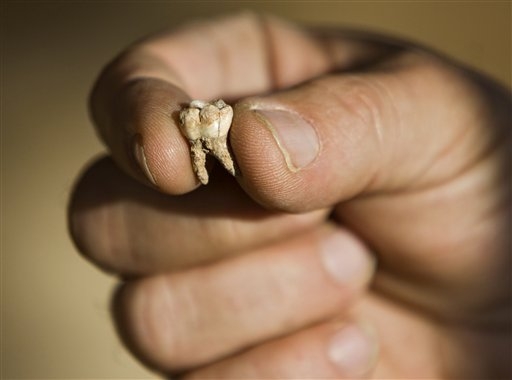
A story from the Associated Press on NPR this week announced the discovery of some teeth. No ordinary teeth, these perhaps belonged to Homo sapiens at 400,000 BP (“Before Present,” no apologies to gas-guzzlers). And they were found in Israel. Archaeologists from Tel Aviv University are quoted as stating this could rewrite the story of human evolution, suggesting that modern humans emerged some 200,000 years earlier than thought, and in Israel instead of in Africa. Now those are some ambitious choppers! Coincidentally, the discovery was announced the day I was discussing the earliest human occupation of the Levant in my Winter Term class. Of course. One of my students pointed the article out to me.

One of the endlessly fascinating aspects of archaeology and paleontology is the constant surprise of discovery. Often I have to remind myself that the past only exists in reconstruction. Once the moment is over it is lost forever, only to be rebuilt by specialists in documents and artifacts. Reconstruction, however, often comes with a political price tag. Anyone who follows the claims based on archaeological finds knows the folly of discovery. In disputed territories the work of archaeologists is used to stake claims to modern land ownership. Who in the world would not want to own the first location where modern humans emerged on the planet? What staggering claims could be made!

I have always sensed a comfort when thinking of human origins in Africa. Far from the (modern) industrialized mayhem of “civilization,” early hominids took their first tentative steps in Africa. Cut off from the rest of the post-Pangean continents except via the narrow passage of the Sinai, Africa harbored our pre-sapiens ancestors. Once they reached Asia and Europe, they interacted with Neanderthals, as genetics now demonstrate. Interaction led inevitably to extinction, so politics had to have been involved. To find the pre-political Garden of Eden, we need to cast our eyes on Africa. Anthropologists are even now disputing whether the teeth are of Homo sapiens or not. I find, when I’m in the dentist’s chair, it is best to leave politics out of the discussion.

From the Associated Press


The Chosen Peoples

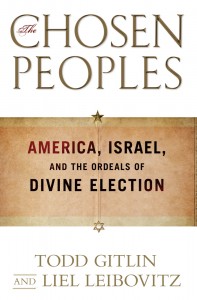
My thanks go to Simon & Schuster for sending me a review copy of Todd Gitlin and Liel Leibovitz’s new book, The Chosen Peoples: America, Israel, and the Ordeals of Divine Election (2010). Briefly, the book traces the origins of the concept of being a chosen people in both Israel and the United States. This concept is then shown in relief with those who are “unchosen.” The authors conclude by highlighting the national sense of mutual goodwill between Israel and the United States. The full text of this review is on the Full Essays page of this blog.

I read this book wearing multiple hats. Since the first chapter traces Israel’s sense of chosenness from Biblical times to the present, I began by wearing my Biblical Scholar hat. Many of the questions asked and raised about the Bible reveal a naivety about traditional claims of biblical authorship. Although certainty cannot be achieved, biblical scholars have applied textual and literary techniques to the text for well over a century now, and many of the claims simply accepted by Gitlin and Leibovitz simply do not stand up. This may seem a minor flaw, but since Abraham is foundational to this outlook, it is essential to at least consider his lack of historical attestation. Gitlin and Leibovitz assume that Genesis, with its stories of Abraham, predates the books that follow. This is not a safe assumption to make, and using this background as a foundation for further analysis might well lead to structural problems with the argument later on.

Wearing the hat of an historian, I noticed how much of the force of the argument of the book is interwoven with the idea that God has actually chosen Israel. I have told my students for many years now that historians do not make claims on God or God’s alleged activities. Texts that narrate God’s actions tend to be classified as myths rather than history. The concept of chosenness, which Gitlin and Leibovitz are reluctant to relinquish, is based on the premise that God has indeed done the choosing. An historian would be extremely reticent to make such a claim. Having noted this concern, the authors do a fine job of providing a brief, readable history of the founding of modern Israel without recourse to what God was doing in the twentieth century. When the authority of the Bible is needed, it is quoted here in King James English, hardly the most accurate translation available.

Gitlin and Leibovitz suggest that chosenness is more a curse, at times, than a blessing. The reasoning seems to be that the concept of chosenness leads inexorably to Zionism. The ideas interact on a much more subtle level than that, although certainly the Zionist movement has owed and continues to owe quite a heavy debt to the concept. The generalizations here are a bit broad – political motivations may not receive their full due. Toward the end of the chapter the ideology of messianism is engaged and brought into the discussion. It is not clear that messianism is the same as chosenness; the two ideas both emerge in Judaism, but do not always overlap. When the authors state that Zionism has always been messianic at heart (p. 57), that may be correct, but it does not necessarily reflect chosenness. Gitlin and Leibovitz are very good at pointing out the inconsistent application of the idea of messianism in the formative stages of the modern state of Israel.

Please see the Full Essays page for the remainder of this review.


Natufia to Say

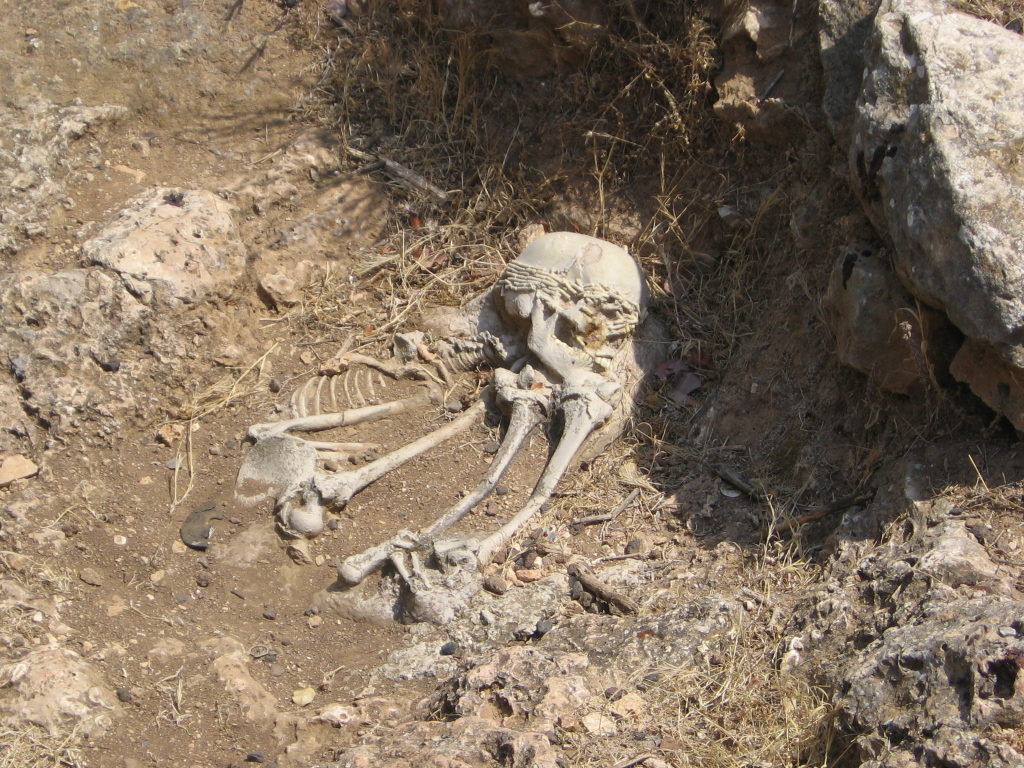
The Natufian culture predated the Israelites by millennia. They were gone by at least 7000 years by the time Israel appeared. The Natufians seem to have been the first permanent residents of a hotly disputed piece of real estate: Israel/Palestine. On Monday MSNBC reported on the archaeological find of a feasting hall among the Natufians. The story reminded my wife of similar stone-age sites that we visited in the Orkney Islands several years ago. What the story reminded me of, however, was the marzeah. The Natufian site features two activities: feasting and burial. The article notes the coincidence of 28 human burials, including one shaman, and the unmistakable signs of feasting. Bring them together and its sounds like marzeah time to me!

Natufian burial, from Wikipedia Commons

The marzeah is an imperfectly understood social institution from the ancient Levant. It is mentioned in the Bible as well as in the Ugaritic texts. Although plausibly reconstructed by modern theorists, we simply do not have a complete record of what the marzeah entailed. Two of the key elements seem to have been feasting and a funerary nature. Monotheistic religions tend to downplay the role of the dead as influential entities since they interfere with a monistic view of the divine. The two Hebrew Bible references (Amos 6.7 and Jeremiah 16.5) do not speak highly of the practice. The Ugaritic material suggests drinking may have been involved as well, further problematizing the ritual.

Now here is where the ambiguity of archaeology is thrown into sharp relief. The fact is we do not know what the Natufians were doing when they buried or feasted at this site. The Hilazon Tachtit Cave does not seem to have been a regular occupation site, and we do not have any reason to connect the burials with the feasting. Beyond a hunch. The hunch is the incredible urge to bring like things together. People excel at pattern-recognition. When I read of funerals and feasting my mind leapt to the marzeah. There seems to be no organic connection between the Natufians and Israelites (or Ugaritians), but the continuity of cultural concepts seems to strong to dismiss. Were ancient people toasting their dead with feasts that were remembered down into the Late Bronze and Iron Ages?


Who Owns History?

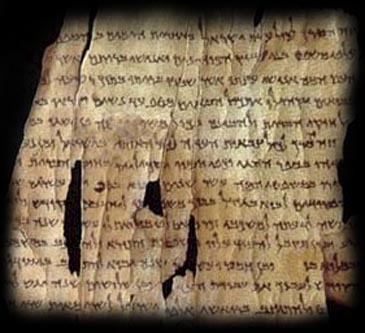
Jordan has been asking for the Dead Sea Scrolls to be given back by Israel. During the Six-Day War of 1967 some of the ancient documents were absconded by Israel, according to the Jordanian point-of-view. (Nothing in the Middle East is every truly neutral or non-biased.) According to the newspaper, now Jordan wants them back.

This controversy is part of a larger trend for nations to demand “their” antiquities from foreign powers who have claimed and displayed them (in many cases) for large numbers of people to see. They are part of the world’s heritage and the modern day countries from which they emerged want them back. Why? To bolster national pride? Because of their inherent cultural value? To draw in tourist crowds who are interested in antiquities? The ownership of history is a touchy question. History itself belongs to the entire human race while individual artifacts may be stolen, purchased, or destroyed. Some are in the hands of major museums, minor museums, or in the houses of private collectors. Nations struggling for international respectability often want their heirlooms back, and this is only natural. At the same time, these nations may not have the infrastructure to preserve the artifacts securely. Think of the Baghdad Museum. When any government becomes unstable national treasures are at risk.

The Dead Sea Scrolls owe much of their public appeal to scandal. The story of their discovery and sale, rich with intrigue and skullduggery, is widely known. They capture headlines like 2000-year-old sex symbols; their chic name and aura of mystery assure public interest. As a scholar of the Hebrew Bible, however, I have always found the Ugaritic texts to be of far greater importance. Nevertheless, while living in Wisconsin some years back, and teaching at Nashotah House, I arranged a field trip to the Field Museum in Chicago where a roving Dead Sea Scroll exhibit was settled for a limited time engagement. The seminarians were excited, and we decided to make a family trip of it. My daughter was a pre-schooler at the time, and we towed her along to be acculturated. In a dimly lit room, the feeling of an authentic Middle East chaos attended the display, people wandering blindly around, not quite sure of what they were looking at (this based on overheard conversations). People wanted to be near history, even if they didn’t know why. I had seen the famous scrolls in the Shrine of the Book some years before, but it was easy to feed off the excitement. When we got home we asked our daughter what she enjoyed the most from the bus ride and day out. “Seeing the Dead Sea Squirrels,” she replied.

History involves seeing what we want to see. Nobody owns it. Everybody owns it. Who should keep the artifacts? I don’t know. It seems that history is larger than petty desires for cultural fame. But then, that is what history records — our desires to stand out from the crowd.