Classical Education

Andrew Dickson White famously wanted Cornell University, unlike what would become known as the other Ivy League schools, to be non-sectarian. Most Ivy League universities were founded as seminaries or with the strong influence of churches. On farmland gifted by Ezra Cornell, in Ithaca, New York, the school became one of the first truly secular world-class universities. As I approached Ithaca over the weekend, my wife told me that the town had once been briefly known by the name of Sodom because the remote location’s reputed notoriety for sabbath breaking, horse racing, and profanity. It is now considered one of the most enlightened towns in the country. Famous for its waterfalls and gorges, one of the cascades is still rejects the biblical slur with the sobriquet “Lucifer Falls.”

Many place names—indeed, much of American culture in general—reflect(s) the Bible. Ours is a culture in denial of just how formative religion has been for who we are. Because of our willful blindness on this point we sometimes run the risk of being entrapped by our heritage. Despite how much we’ve educated ourselves we still see what we want to see. Our religious heritage is often considered an embarrassing family secret rather than the path by which we came to be a civil society. Religion is so frequently portrayed as an evil force that it’s easy to forget just how much we owe it for our evolution. Even education itself had a religious motivation since teaching students to read was often done with the intent that they should read the Bible.

Like nearby Binghamton, Ithaca has a statue dedicated to Martin Luther King, Jr. It bears a biblical quotation from Amos without embarrassment. Ithaca today is a livable, socially conscious community. Recycling is strongly encouraged while cars are not. Hardly a hotbed of immorality, it is one of the great examples of an American college town. Ideas are welcome here. Befitting its classical heritage of education, the city is named after the island ruled by Odysseus, according to Homer. Indeed, Ulysses lies just down the road. Homer (and yet another town in the area bears that name) presented Odysseus as among the smartest of the Greek kings. Like most classical Greeks, Odysseus was only too conscious of how the gods could interfere with one’s life. Instead of denying the obvious, however, religion was recognized as a necessary source of culture. Not that it always has to be taken too seriously. Maybe it shouldn’t be completely ignored either.
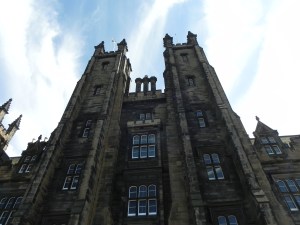

Auld Reekie

DSCN3452

Those of us who once tried to storm the walls of academe from humble beginnings soon learn our lesson. This is a guild meant only for those whose parents knew enough to suggest an Ivy League education. Those whose parents have never heard of Harvard (they exist!) and who don’t know what an Oxford is aren’t really well-placed to give advice on these matters. At a small-town high school you couldn’t count on a guidance counselor noticing your academic prowess as anything more than a statistical blip in a non-challenging career. I learned about the Ivy League too late. It was, therefore, a very pleasant surprise to have an Edinburgh colleague ask me to write a piece for a Cambridge Companion. I don’t have the contract yet, but even the invitation made my day. Maybe my month. Or career.

I spend my days commissioning just such works for a different press. I know hundreds of colleagues. Only one ever said, “would you consider writing…” I’m not being entirely fair here. I’ve been asked to contribute to Festschriften. Such volumes are the highest praise an academic can be given. John C. L. Gibson, of blessed memory, was the first honoree. Nick Wyatt was the second. Simon Parker, also departed, whose Festschrift is currently in the works, was the third. I’ve been asked for others, but regular research is beyond my reach with my current schedule. I can churn out an original article once a decade, it seems. The ideas are still there, alive and popping. The time, alas, is not.

So I’m happily sitting here thinking of how to write a Companion article. The colleague who asked me is someone I recently met. He found out that I had attended his alma mater and wondered why I hadn’t landed a regular teaching post. Edinburgh University, in the larger world, is a recognized name. I can’t see through the ivy to discern it on this side of the Atlantic, but I’m assured it’s still there. Recognizing that those who fall between the cracks can still sink a taproot and make a contribution, he asked me if I might consider it. He had me at Edinburgh. School loyalty still counts for something, I’m glad to learn. For once I feel that I don’t have to apologize for having ventured to Scotland with only my transcripts and high hopes in my pocket (and with an indulgent wife by my side). Now I’ve been asked to write. I’ve gone all red, and I hide my face behind my hand. Of course I’ll do it.


Ivory Towers

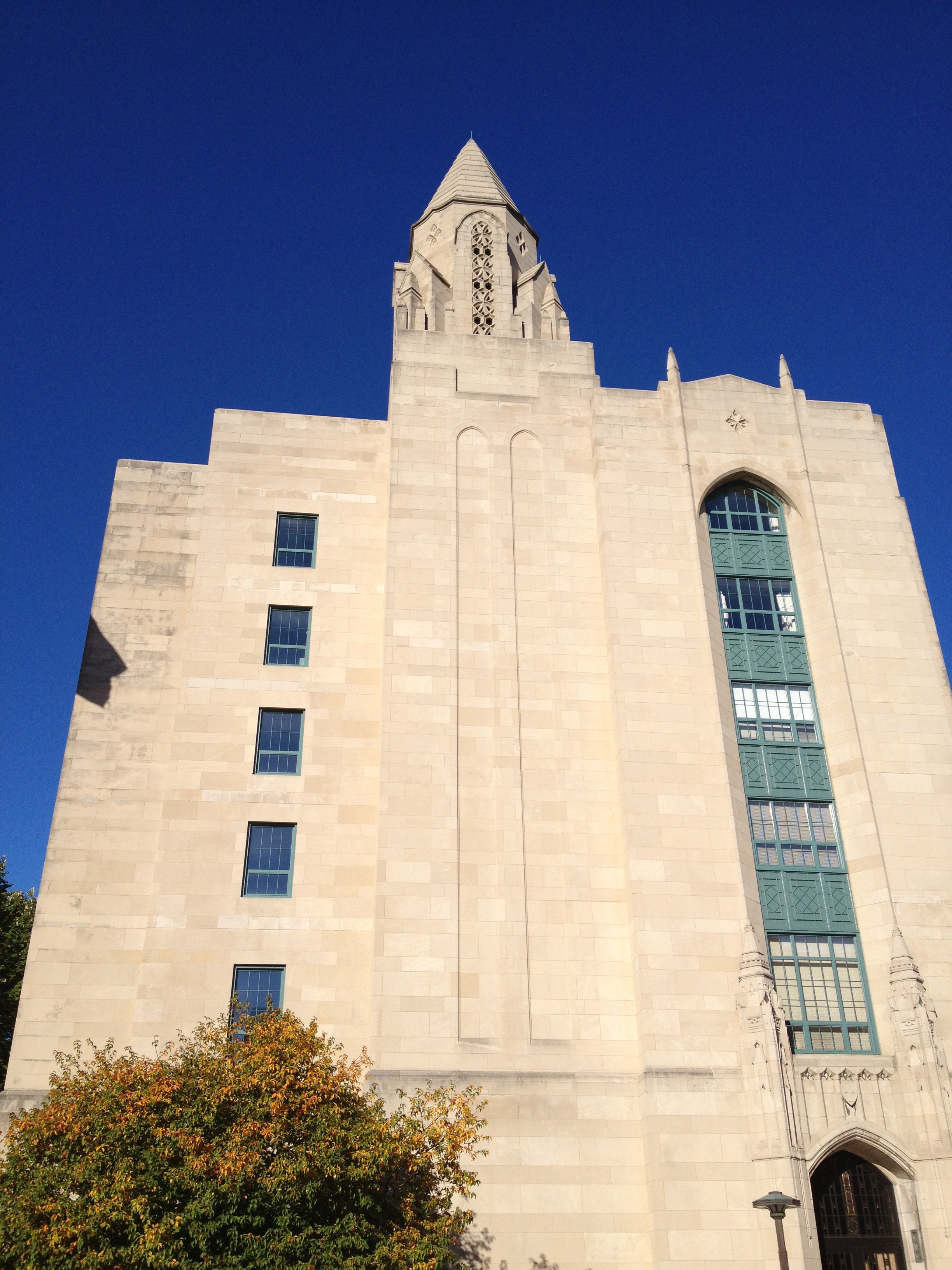
IMG_0481

I sometimes confuse “ivory tower” and “ivy tower.” It’s only a matter of or. In my mind the halls of academe are frequently covered with ivy, but the usual term for a rarified higher education is actually “ivory tower.” A pristine, white edifice unstained by the concerns of day-to-day life. It never occurred to me that the phrase might be biblical. According to tradition, King Solomon quoth, “Thy neck is as a tower of ivory” to his beloved (Song of Songs 7.4a). How the term moved from an obscure reference in a love poem to higher education involves the nature of the latter. Higher education was an enterprise of the church. These days we tend to think of religion as opposed to learning, but in fact, universities were natural outgrowths of cathedral schools where future clergy were trained. There was also a guild-consciousness about the Middle Ages that also played into this, but primarily what we think of as universities today were developed to educate clergy. Many of the Ivy League (again with the ivy!) had their origins as seminaries.

Ivory towers, however, are still remote from this. Eventually, probably due to the difficulty of interpreting the Song of Songs, ivory tower came to be an epithet of the Virgin Mary. Indeed, some interpreted Song as the love between Mary and the church. Rather than the erotic intent of Song, which quickly became an embarrassment to the chaste church, the ivory tower came to symbolize the purity of the Virgin. Untouchable, sparkling white. From the pre-Reformation church, universities sprang. Devotion to Mary ran high.

Although the origin of ivory towers as a metonym for universities is uncertain, it appears in literature by the nineteenth century. Possibly it reflects nothing more than the dignified life of the mind as opposed to the sullying of hands. Or perhaps it reflects a deeply buried knowledge that the university, as secular as it has grown, is a scion of the church with its devotion to a virgin who somehow commandeered the language of a love poem from antiquity. Today ivy is less common on campuses than it used to be. Our higher education is much too modern and chaste for that. The towers of ivory, however, remain. Now they refer almost exclusively to dreamers who’ve lost touch with the everyday world. And, as often as not, with the Bible that gave them their start.


History Department

Rather like an embarrassing personal blemish, many universities tend to hide the fact that they were originally servants of the church.  Ouch!  I know that hurts.  When I was working at Routledge I had to educate some of my fellow employees about the strange interaction between religion and higher education.  Most of the earliest universities were founded primarily as theological colleges.  That stands to reason, since as light slowly began to dawn at the fading of the Dark Ages, the practice of literacy had largely been the domain of clerics, and even today, the clergy are among society’s most dependable readers.  Universities sprang up because churches desired leaders who were informed—educated, even.  Men (at that point) who knew how to reason well.  This impetus eventually led to the kind of thinking that allowed science to emerge, although it soon had fights with its parents over who had the better perspective.  Some things never change.

University or church?

University or church?

Even considering the Ivy League here in the United States, we have schools that were generally founded for clerical purposes.  Harvard was founded mainly to train Puritan ministers.  Yale was intended to provide clergy and leaders to the colony of Connecticut.  Brown was founded by Baptist clergy, while Columbia owes its origins to the missionary wing of the Church of England.  Princeton was founded for the training of Presbyterian clergy.  Dartmouth’s Puritan clergy founded wanted a school for preparing missionaries.  Even non-sectarian Penn had clergy among its early leaders.  Cornell was the lone gunman of the truly secular schools.  The pattern even reaches to state universities that now cower at the thought of expanding or sometimes even maintaining their religion departments.  Rutgers, where I had the privilege to teach as an adjunct for a few years, was originally founded as an enterprise of the Reformed Church in America, scion of the old Dutch Reformed Church, thus giving rise to the small New Brunswick Theological Seminary that still sits in the middle of the College Avenue Campus of the State University of New Jersey.

Every now and again, I ponder this state of affairs.  Religion, love it or loath it, is foundational not only for higher education, but for civilization itself.  If the evidence of Göbekli Tepe is to be believed, religion may have been the very glue that brought societies together in the first place.  Despite the decline in mainline denominations, public survey evidence indicates Americans are just as religious as ever, or at least spiritual.  How quickly we forget that it was biblical mandates to go out and spread the news that led to the idea of a literate, educated society.  The lure of money and technology is great, and has managed to reshape the higher education landscape.  If you look, however, at the lists of institutions of higher education in the United States, even today, the largest subset is either currently affiliated with, or had been founded by, Christian groups wanting to offer education to their children. Today there are still hundreds of universities and colleges affiliated with religious groups.  Somehow I get the sense that the affection showed is not completely mutual.


Had my Phill

One of the pleasures of the editorial occupation is traveling to campuses to meet potential authors. Having no excuse not to go to Philadelphia, I jumped on a train this morning to spend the day on the campuses of the University of Pennsylvania and Temple University. I’d been to both campuses before, but they are a study in contrasts. Penn is Ivy League, of course, and the students appear confident and self-assured. Temple is a large, public university situated in a neighborhood that doesn’t exactly inspire the same confidence. The students appear happy enough, but of a rather different ethnic blend. I pondered these differences while waiting for a taxi. I hadn’t realized that PHL Taxi stands for “Prefer Hanging Loose”—after three calls and no vehicle, I had to call another company. To try to save Routledge a few pennies, I had opted for the Days Inn in north Philadelphia. A friend told me over lunch that this part of the city is probably not the safest.

In the taxi we drove through neighborhoods that politicians like to pretend do not exist. The sheer degradation of the buildings, sidewalks, and people was sad. The most common type of building, next to houses (many semi-demolished), is churches. Many of the churches bear their names in Spanish; most have heavy metal chain doors emblazoned with crosses. It seems that maybe Van Helsing would go to church in a place like this. The kind of place where a dead body does not astonish, and the people on the street corners look remarkably cheerful, given the circumstances. The Days Inn is in a more open and commercial area, and I don’t think anyone has actually been murdered in this particular room. On Temple’s campus I saw many signs for Occupy Philly.

Those who think everything is just fine with the ultra-wealthy in their heaven while we expect human beings to live like this are worse than naïve. Those who are privileged look on Occupy Philly with a sense of academic curiosity. Those who live next to poverty, hard up against it, see Occupy Philly as a mandate. We can’t keep pretending that everything is okay. If God has a plan for America, why have so many people been left out? People with more churches per block than any affluent neighborhood desires or supports? The movement may be ill-focused and leaderless, but the need is very real. Tomorrow I go back to Temple, back to where the struggle is often life and death and the need is very human. But for this evening, “Now I lay me down to sleep…” I’m sure you know how the rest of it goes.