Black Bird

Although we prefer typecasting—it’s so much easier!—Edgar Allan Poe had both depth and width as a writer.  He penned funny as well as scary, love poems and detective stories, even something like a scientific treatise.  One thing I’m sure he didn’t anticipate was his name being suborned for cheap horror movies.  Roger Corman is a Hollywood legend—a good example of a guy making it in the film industry on his own terms.  He paired Vincent Price with a number of Poe titles that had little to do with the actual works of the writer.  One that oddly stayed with me since childhood is The Raven.  This was well before I’d read the poem.  It’s funny how very specific things will stick in your mind.  I remembered the strange hat Price wore.  And I remembered—misremembered, actually—Price using a spinning magical device with sparklers.  Misremembered because that was Peter Lorre’s character, not Price.

That was it.  I didn’t remember that Boris Karloff was also in the film.  I was too young (as was he) to recognize Jack Nicholson as well.  Although I watched The Twilight Zone, I didn’t realize the script was by Richard Matheson.  This film was loaded with talent, but it really was goofy.  I recollected Price was a magician, but I didn’t know this was a rather silly battle to become chief magician.  Lorre’s ad libbed lines were surprisingly funny, even after all these years (I was about one when the film came out).  Surprisingly, the movie did well at the box office, despite its taking a sophomoric approach to perhaps Poe’s most serious poem.  

I’d avoided watching it again for all these years because of that sparkler scene.  I’m not sure why that particular moment wedged itself so firmly in my young brain.  It seemed so not Poe that I couldn’t get back to the movie, apparently.  With Price and Lorre camping it up—Karloff was, by all accounts, most professional as an actor—and Nicholson uncharacteristically timid, the cheap special effects, it’s obvious that viewers enjoyed a good laugh at this one.  It’s not true to Poe, of course.  It’s true to Roger Corman, however, a filmmaker who knew how to deliver cheaply and quickly and still earn some money at it.  I’d last seen The Raven about half a century ago.  I may be tempted to watch it again, after having seen it as an adult, but if I wait too long I’ll need to leave that duty to someone who’s read this and who isn’t afraid of sparklers. 

Witches of September

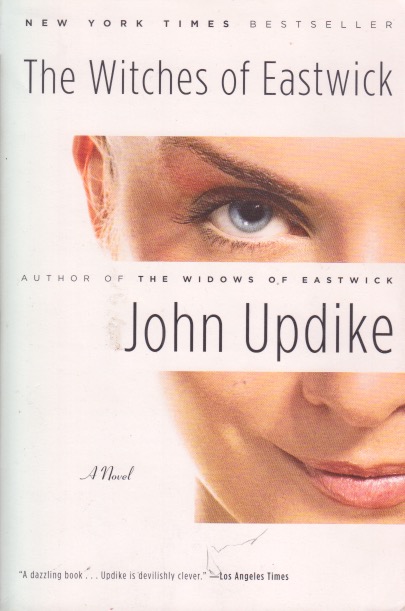
I’ve never read any John Updike before.  I understand that his novels foreground religion, which I didn’t realize.  I have watched The Witches of Eastwick, in movie form, a time or two.  In fact, I wrote a bit about the film in one of my books.  This got me curious to read the novel and I found a copy at a used book sale up in Ithaca some months back.  Now that September’s here, it seemed like an opportunity to see what the original story had to say about witches.  There is a problem, of course, in having watched the movie first.  Not only does it tell you which actors the characters should look like, but it also predisposes your orientation to what will happen.  In this case all that will mislead you.

The movie centers on Jack Nicholson’s Darryl Van Horne—like most Nicholson movies, his character takes over—whereas the novel is definitely centered on the three witches, Alexandra, Jane, and Sukie.  They don’t fall into the background, but neither do they always work in concert.  The movie tells, in other words, a very different story.  Updike’s literary treatment focuses on female characters and the mischief they cause.  Nor is it entirely clear that Van Horne is demonic, as in the movie.  A church features prominently in both versions, amusingly Unitarian in the novel, with Van Horne not upstaging the sermon but giving an invited one himself.  No fear of sacred places here.

The wrath of the witches isn’t directed toward Van Horne either.  A character left out of the film, who marries Van Horne and whose brother is his real target of affection, is hexed and killed by the witches instead.  In many ways this could be construed as a kind of gentle horror story, although it’s never marketed that way.  I kept waiting for certain scenes in the movie to be narrated, as it were, in the flesh.  This led to the revelation that these scenes were invented for the cinematic version.  Both novels and movies are stories.  When shown on the big screen, we expect them to be adapted.  My personal preference is for the film to present the same story.  It can’t always be done, of course.  In this case the movie left some questions open that I hoped the novel would answer.  Since the stories are so different, the questions remain.  I have a feeling I’ll read more Updike down the road, but I’ll avoid watching the movie first.


Terror Able

Saturday afternoons were made for B movies. After a hectic week, nothing soothes like grainy picture quality and poor dialogue. This weekend offered a chance to view The Terror. This 1963 Roger Corman film won its bad marks the honest way – by earning them. Nevertheless with Jack Nicholson playing against Boris Karloff and a plot so convoluted that I had to draw a chart to figure out what I’d just watched, the movie lived up to its grade. Throw in Francis Ford Coppola as an associate producer and it’s party time. Corman’s legendary cheapness and fondness for disproportionate claims of scares that never materialize only add to the charm. After watching the opening sequence one gets the distinct impression that Franklin J. Schaffner had watched this film before setting up the climatic scene of Planet of the Apes.

In keeping with a recent trend on this blog, the plot involved a witch. An old woman from Poland resettles in France to avenge her murdered son. The crone casts a spell transforming a bird into a beautiful young woman. The first words of the spells sent me fumbling for the “rewind” button. “Tetragrammaton, tetragrammaton,” the old woman intones to begin her spell. In a movie fraught with dialogue problems, this might be considered simply a choice of foreign-sounding, mysterious syllables to be uttered for an audience not expected to know that tetragrammaton is the title of the sacred four-letter name of Yahweh. By this point the plot was so convoluted that making God the agent behind a pagan curse seemed almost natural.

The analog with the Bible soon became clear. The Bible holds its sway over many because of its often beautiful rhetoric. Sparing the time to study what the rhetoric might have meant in its original context is an exercise few believers can afford to undertake. Our world has become so full of things that taking time to explore the implications of one’s religion must compete with ever increasing Internet options, thousands of channels of television, and plain, old-fashioned figuring out how to get along. Religion is a luxury item and, as experience tells us, it is best not to look too closely at luxuries – their flaws too readily appear upon detailed inspection. Allowing religion its exotic sounding mumbo-jumbo preserves its mystery and power. And if a witch says a theologically freighted word we can just chalk it up to entertainment. We are too busy to examine what our religions really say. Roger Corman may have unintentionally discovered a real terror in a movie that will keep no one awake at night.