Esau and Jacob

“Jacob have I loved, but Esau have I hated,” at least according to the recollection of Paul in Romans. One of the most poignant scenes in the Hebrew Bible is the story of Esau. Born as the elder brother, in ancient times one could expect certain privileges. Yes, Esau sold his birthright to his brother over a rumbling stomach, but he still knew that the blessing—the true gift—was still his. That, however, Jacob took from him by deception. Isaac, their aged father, was blind but wanted to bless his firstborn before he died. While Esau was out hunting, Jacob slipped in, in disguise, and stole the blessing before fleeing to Iraq. In Genesis 27, Esau came in as instructed only to find the blessing gone. His weeping has never ceased through the ages as his father blessed him with a sword. Years later, Jacob returned to find his brother a wealthy and powerful man. A man who forgave and forgot. But Paul remembered.
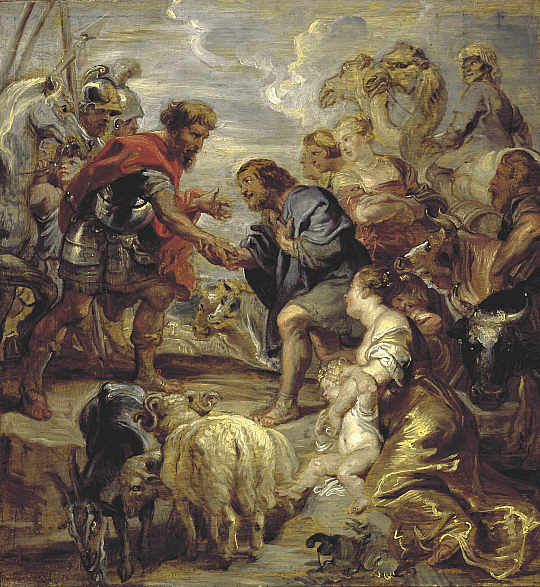
Rubens, The Reconciliation of Jacob and Esau

Rubens, The Reconciliation of Jacob and Esau

Hate is a strong word. As a child the worst punishment I can recall came from saying that I hated someone. That word was worse than a swear. Hatred was not worthy of a loving god. Like Esau, however, we don’t stay young forever. By our sword we make our living. For some of us that sword was the written word that we were told was sacred. The image of big, hairy Esau weeping before his blind father disturbed me. He’d done nothing wrong. In fact, he was simply doing what his father asked him to do when his brother snuck in and took something that my young mind couldn’t even parse out from the birthright earlier bargained. Clearly, however, it was important.

Upon returning home six chapters later, Jacob fears Esau’s righteous wrath. He knows his brother has legitimate cause to hate him. Esau, however, aware that he has enough, welcomes the prodigal home with open arms. There is enough to go around. Even today, with the will to do so, the hatred could be removed. This is a metaphor, not literalism. Genesis is, after all, not history. Stories, however, can convey what facts cannot. Millennia have passed and myths have come and gone. In the simple, if primitive justice of my childhood, you dare not say you hate your brother. Having grown up with brothers I learned that despite conflicts that inevitably arise, hatred is never the answer. Esau forgave, according to Genesis 33. And the land was wide enough for all.


Biblical Weddings

Maine is getting ready to vote tomorrow on the legalization of gay marriages. With conservatives hopped up on fears that such a move will destroy traditional, patriarchal privilege, the Bible is beaten rather severely as proponents seek evidence for man + woman = marriage in holy writ. The funny thing is, the Bible says very little about marriage.

In an era when marriage is often associated with houses of worship and a smiling, tolerant divine face beaming down on a couple about to do “the bad thing” with divine sanction, it is difficult to realize just how little the Bible talks about it. The Hebrew Bible is particularly mute when it comes to the particulars of wedding ceremonies: “Then Isaac brought here into his mother Sarah’s tent. He took Rebekah, and she became his wife,” according to Genesis 24.67. No sacral ceremony here, by prior arrangement, sex equals marriage. A few chapters later when his son Jacob marries, there is a feast mentioned, but no sacerdotal functionary hovering nearby (one who might have actually noticed that Jacob ended up with the wrong woman, by the by). And so the biblical narrative limps on with patriarchs bedding and marrying their women with no mention of God. Eventually religious folks got a little nervous about this and ceremonies with divine approval were introduced, but that is not even in the case with the wedding at Cana, which, in desperation, the Book of Common Prayer latches onto for a marriage lection: “The bond and covenant of marriage was established by God in creation, and our Lord Jesus Christ adorned this manner of life by his presence and first miracle at a wedding in Cana of Galilee” (the Order for The Celebration and Blessing of a Marriage). Apart from the difficulty of a covenant being an uneasy peace between a superior and inferior party, this introduction relies on a literal Adam and Eve and the means for a large wedding party to get drunk, courtesy of the miracle in Cana. Apart from Paul’s putative comments regarding the marital status of early church leaders, we hear little else in the Bible.

I have nothing against weddings; I was the groom in a particularly stylish wedding in Ames, Iowa some years back. The problem I see is that the Bible is being forced to say what it does not. If the few biblical marriages are all heterosexual, it simply reflects the options open at the time. How does allowing gay marriages threaten the marital bless of the heterosexual? It seems to me that the only thing to be lost is “privileged status” and benefits allotted to those formally united in the eyes of the law. Unless things have changed recently, even in a religious marriage a state-issued license is required! Why not allow firm affirmations and privileges of loving couples without relying on non-existent biblical platitudes? I hope Maine will do the right thing tomorrow.