
Frankly, I expected better. The Comedy of Terrors seemed to have a lot going for it. With my current interests in American International (AIP), Vincent Price, Jacques Tourneur, and Richard Matheson, watching it for free was a no brainer. And I mean, no brainer. Maybe it lacked the Roger Corman touch. The premise is cute enough, bring together horror icons and have them take the mickey out of Shakespeare’s Comedy of Errors. Peter Lorre and Boris Karloff join Price and Matheson scripts generally don’t disappoint. Tourneur had a string of great horror movies behind him. But the magic just isn’t there. Comedy horror, or horror comedy, is difficult to pull off well. Particularly if it’s deliberate. What Young Frankenstein got right just went wrong in Comedy.
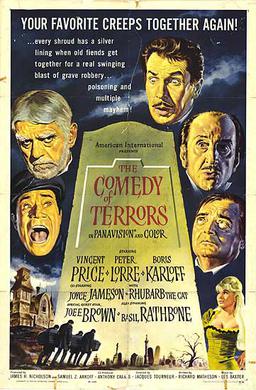
All of this makes me more conscious of just how impressive a great movie is. With so many moving parts, films leave plenty of gaps where things can go awry. The vast majority of movies perish with little notice, of course. Success—earning more than it cost you (still waiting for that with my writing)—comes to some, and that’s what has me vexed here. Tourneur was a talented director. The actors all had proven themselves repeatedly. Matheson brought life to so many horror and sci-fi movies and television shows. Even AIP had a number of hits after starting out as notorious for their low-budget approach. The jokes in Comedy aren’t funny and the horror’s not scary. Some have opined that the sarcasm is spot-on, but it didn’t seem so to me. There’s even some disagreement as to whether the film earned its budget back or not.
Horror movies come in all stripes. And spots. Even solids. Comedy horror isn’t my favorite, but some of the gems of the genre (Rocky Horror Picture Show, Gremlins, Shaun of the Dead, Ghostbusters) show that the combination can work but ought to serve as cautionary tales. (Both Ghostbusters 2 and Gremlins 2 failed to capture the magic of their forebears.) If everything falls together just fine, step back and bask in wonder. Trying too hard (of which I’ve been accused) sometimes doesn’t work while you’re attempting to be funny. It’s pretty clear that Nicholson and Arkoff thought bringing all of this talent together was a recipe for success. Of course, there are plenty of moving parts and a director, or even a producer, is entitled to a blunder or two. I like a good laugh as much as the next guy, and after seeing this flick I could use one.
 Steve A. Wiggins