Tentacly Fun

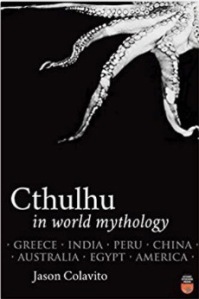
Anyone who has spent time amid scholarly religion tomes knows how cases used to be made for connections.  Similarities were seen as parallels, and it wasn’t unusual for the learned to assert that ideas were organically related.  This same style (now much out of date) was borrowed by writers proposing that what we now call “ancient astronauts” visited the earth and helped with things like the pyramids of Egypt and Stonehenge.  Jason Colavito knows how to parody such writing as he demonstrates in his Cthulhu in World Mythology.  Known as a skeptic and critic of what he calls “pseudoscience,” Colavito is also a Lovecraft aficionado.  This tongue-in-cheek treatment approaches the subject with an earnestness that almost convinces the reader that Colavito actually believes what he is writing.  Meanwhile he’s poking fun at those who like to draw untenable parallels and invent unwarranted scenarios.

All of this is accomplished by using H. P. Lovecraft’s brainchild Cthulhu.  Good old-fashioned common sense tells readers that a fictional god-monster created by a fiction writer is not to be believed.  What Colavito does, with a straight face (or straight pen) is pretend all this is real.  Finding tenuous connections between ancient myths and words that can, from certain angles, resemble the name Cthulhu, Colavito takes the unwary reader down the garden path that suggests Cthulhu was the origin of nearly all world mythologies.  Or rather that all world mythologies are reflections and recollections of when Cthulhu was widely known.  Treating both fiction and factual sources with footnotes, this is a fanciful romp through “research” published by fictional characters made up by Lovecraft right next to actual sources where scholars are addressing something else, most of them in older tomes.

As an example of good fun, one thing worries me about the book.  Granted, it was published before the great Cthulhu was elected in 2016, but many people today have difficulty discerning actual facts from alternative facts.  “Fake news” can cover a host of sins.  Reconstructing the ancient past is notoriously laborious.  Not having written records means guesses are necessary.  When writing does appear it is so far removed from contemporary uses of the art that its original usages are sometimes completely opaque.  Receipts we understand.  Myths not so much.  Rituals even less.  Many scholars spend their lives in attempting some logical reconstruction of ancient cultures.  We have very little scientific means to test them.  It might make sense, in such situations, to offer Cthulhu as a suggestion for filling the gaps.


Headline News

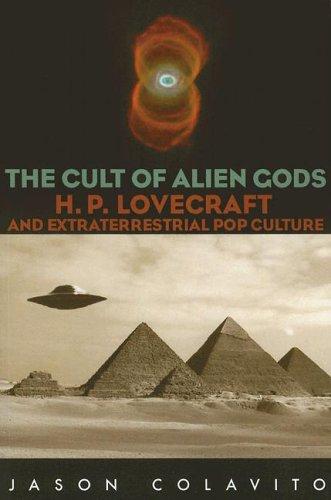
Some headlines just can’t be resisted.  George Knapp: Christian Fundamentalists in the Pentagon Shut Down Government Paranormal and UFO Probes Due to Demon Fears” is one such headline.  It appears on the blog of Jason Colavito, a name I recognized from the book The Cult of Alien Gods: H. P. Lovecraft and Extraterrestrial Pop Culture that I read several years back.  Skeptical of many strange claims made, Colavito criticizes journalist George Knapp for some sloppy reporting.  If you go all the way down the rabbit hole, you will end up in some very weird places indeed!  What caught my attention here, however, is the connection between demons and UFOs.  More than that, the claim that government funding was deep-sixed for fear of the Devil.  (Has anyone else noticed that it’s October?)

This isn’t the first time I’ve read about this.  Having grown up Fundamentalist, I often heard talk of the Devil’s wiles.  One of the things he had his demons do, I was told, was fly around in UFOs to deceive people into thinking demons were aliens.  If this sounds far-fetched to you, remember that God made dinosaur bones to plant in the ground to test people’s faith in Genesis 1.  That’s just the kind of universe we live in.  Better get used to it.  The real problem, and one with which Colavito concurs, is that high ranking military officers (and other government officials) believe the Fundamentalist screed.  This is a matter of documented truth—much of our government policy is dictated by the evangelical agenda.  Stranger than fiction.

In 1952 there was a UFO flap in Washington DC.  No matter how you choose to explain it, this is an incident on the public record, and the Air Force responded with its famous temperature inversion explanation.  At the same time, some Fundamentalists were thinking that demons had improved on the bat-wings they’d been using for millennia.  They now zipped around in silvery discs with the same object as they’ve always had—to dis the Almighty.  As entertaining as such a story may be, it becomes scary when it might indeed be the motivation for government action.  I don’t know about you, but when I look at just how much of my meager paycheck goes to the powers that be, I want to know that rational people are spending it wisely.  Wait.  Well, I thought some of them were rational until a couple of years ago, about this time.  In any case, we do get some entertainment value for our cash, which is some comfort I suppose.  Keep watching the swamp!


Cthulhu’s Revenge

H. P. Lovecraft. Monsters. Aliens. UFOs. Ancient Egyptians. Sumerians. Is there nothing this book doesn’t have? Having read many of H. P. Lovecraft’s stories over the years, I have always been taken by how, as a writer, Lovecraft disappeared from public attention only to spring back in the 1990s. I discovered Lovecraft while doing research on Dagon, the putative “fish god” of the “Philistines.” Every time I typed the name of the deity into Google, I came up with pages and pages of Lovecraft. In my lonely room on a gray Wisconsin campus, I began to read his stories and shiver with fear as I walked across a dark parking lot to my car. Jason Colavito obviously has a great appreciation for Lovecraft as well, and his book The Cult of Alien Gods: H. P. Lovecraft and Extraterrestrial Pop Culture is a fun read for a November night. Colavito suggests that the “ancient astronaut” craze that has informed many a young mind stems back to Lovecraft’s fiction. Cthulhu and his ilk.

I’m not sure that Colavito convinced me that the ideas of ancient aliens began with Lovecraft, but he does an excellent job of exposing the foibles of many theorists who build houses of cards on shifting sand. One of the most interesting connections Colavito makes is that Creationism and Ancient Astronaut-ism are not dissimilar. “Both are, in essence, a concession that science is the ultimate arbiter of truth, and both seek to (mis)use science to give absolute authority to their beliefs” (331-2). This is an aspect of Creationism I hadn’t considered before. In the uncompromising desire for scientific respectability, the only option open is to bend science to the will of religion. This distortion must be carefully executed, convincing the followers that true science has validated a religious ideal. Rhetoric and occluding argumentation must be utilized carefully here. It seems Cthulhu has world domination in his squishy mind again.

Lovecraft famously gave us fantasy worlds where ancient space creatures left their impressions as gods upon a vulnerable humanity. Mysteries of the past—and Colavito doesn’t deny there are mysteries—are so easily explained by dei ex machina, and working with fantasy is so much easier than working with physics. To approach the mysteries with an answer already in hand, however, is to deny science its glory. As a civilization we owe much to a scientific understanding of the universe we inhabit.