
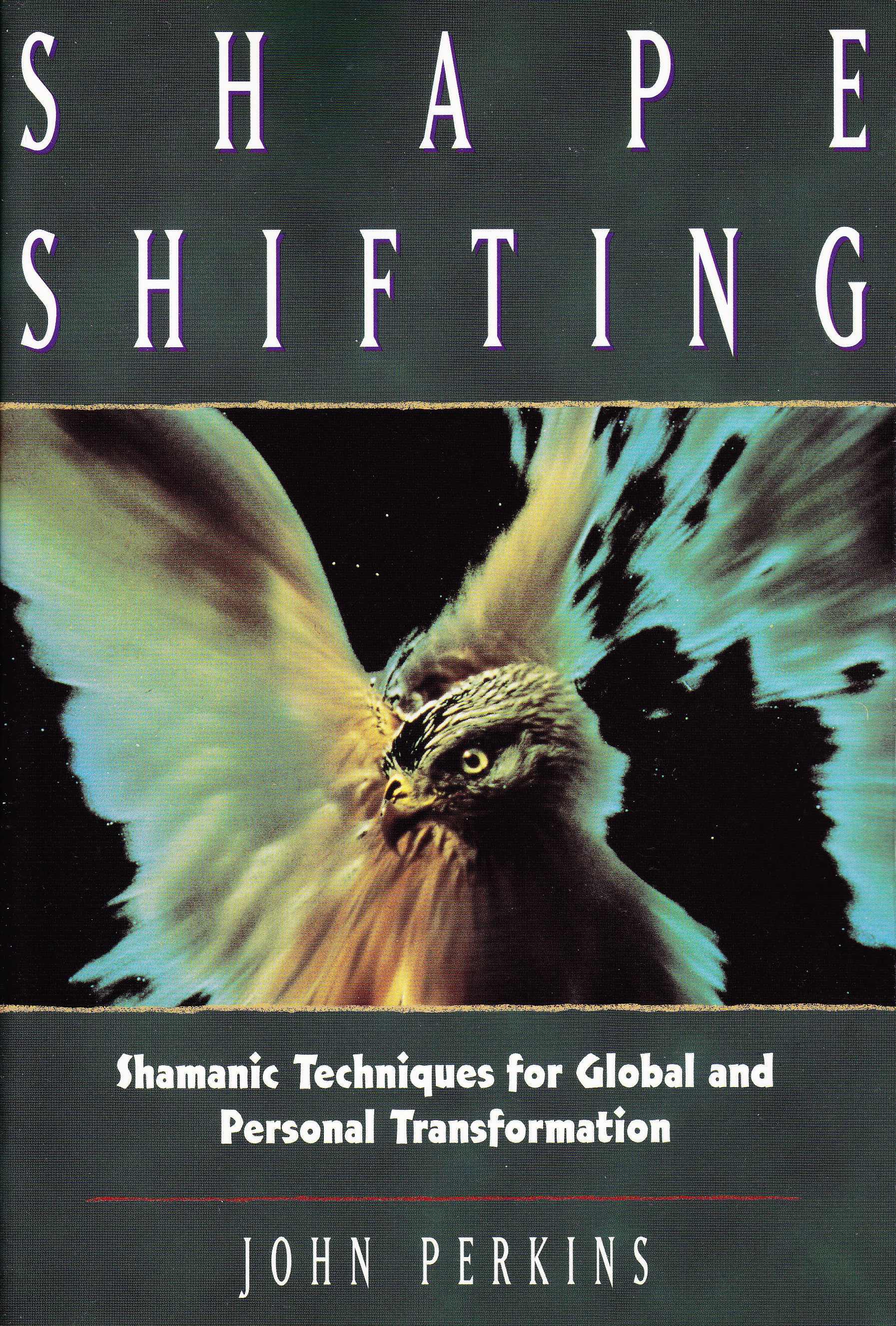
 I confess that I haven’t read Confessions of an Economic Hitman. Being incurably drawn to the weird, however, I picked up a copy of John Perkins’ earlier book, Shape Shifting: Shamanic Techniques for Global and Personal Transformation at the recent Hunterdon County Library Book Sale. I also confess that I fear being classed as one of those irrational sorts who’ll believe anything. It’s pretty obvious to anyone who’s been to college or university that a Ph.D. is no protection from the strange ideas that waft through human gray matter. Many years of teaching convinced, I hope, at least a few of my students that I approach the study of religion in a reasonable—dare I suggest?—rational, way. Despite appearances to the contrary on this blog, I weigh evidence carefully. Sometimes the evidence suggests we don’t yet have all the data. So it was with an open mind, but also a dose of skepticism, that I read through Perkins’ book. And yes, he does suggest that cellular-level transformation is possible.
Before breaking out your hooey-meters, however, consider that John Perkins is a successful businessman. Money speaks, n’est-ce pas? So I’m reminded every rational working day. The human mind, however, plumbs realms on which empirical method sheds little light, even to this day. Psychologists still debate whether there is a subconscious mind at all. And then there’s that troubling question of what exactly reality is. Historically, people have answered such questions with religion. And religion quite often permits entry where science declares “no gods allowed.” So did John Perkins really transform into a ball of energy and float across both time and space and see such disturbing sights as he describes? Did Richard Bach really astro-project with his partner, as recounted in The Bridge Across Forever? Are we really rooted to this mundane world where politicians and entrepreneurs make all the rules?
Perkins recounts his experiences with shamans of the Amazon, and like Jeremy Narby, his experiences with ayahuasca, a consciousness-altering plant. He even recounts transforming into an “inanimate object” so that his wife could not see him. Is it real? Can science measure such events? Does anything escape the penetrating stare of the electron microscope? We will have our Richard Dawkinses on one hand declaring an unequivocal “No!” The other hand, however, may be generating the sound of clapping for those who have ears to hear. Or at least for those who have eyes to read. At the end of this book, truth comes down to a matter of belief.
 Steve A. Wiggins