Hungry for Choice

I was recently asked to speak to a senior seminar about Holy Horror (many thanks for the invite!).  One of the questions asked was how/why I chose the movies I did.  The same question applies to Nightmares with the Bible.  The thing is, my avocation is an expensive one, particularly on an editor’s salary.  The number of horror movies is vast and our time on this planet is limited, so one thing any researcher has to do is draw limits.  Otherwise you get a never-ending project (some dissertations go that way).  I had figured, for both books, that I’d seen enough movies to make the point I was trying to make.  Neither book was intended to be “the last word,” or comprehensive, but were attempts to open the conversation.  Since none of my books have earned back nearly what resources I’ve put into them, a line has to be drawn.  Movies are expensive when they get to the bottom of the “outgoes” column.
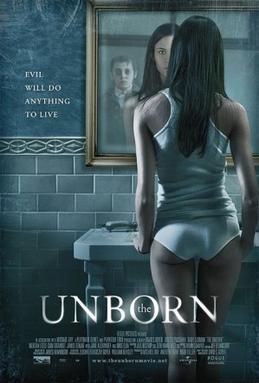
All of this is to explain why I didn’t include The Unborn in either book.  (It fits into both.)  I was aware of the movie, but I had to decide what I could afford in order to get the books written.  I confess that I wish I’d watched this one sooner.  (Remember, it’s a conversation!)   This movie has so much in it that I may break my self-imposed rule of no double-dipping for blog topics.  Or perhaps I’ll pitch something to Horror Homeroom.  The Unborn is about a dybbuk.  Like The Possession, it features a Jewish exorcism.  Like An American Haunting, a holy book is destroyed.  (The credits include a statement that no actual Torahs were harmed in the making of the film.) Interestingly, the exorcism is a joint effort between a rabbi and an Episcopal priest.  Held in an asylum.  It’s also a story about twins.

The skinny: college-aged Casey is being pursued by a three-generation dybbuk.  Her mother, who died by suicide in an asylum, had been adopted.  Casey is unaware that she was a twin, her brother having died in utero.  She discovers her birth grandmother, a Holocaust survivor, who clues her in to why all the strange things are happening to her.  Her own twin brother was possessed by a dybbuk at Auschwitz.  It is now after Casey, having caused her mother’s suicide.  The plot is pretty sprawling, and the exorcism scene over-the-top, but I’m only scratching the surface here.  There’s so much to unpack that I wish I had a bigger movie-and-book budget.  But then we all have our demons with which to struggle.


Der Golem

The golem is a monster of fascination.  It has been the subject of movies from quite an early period.  The earliest, now mostly lost, seems to have been Paul Wegener’s Der Golem (1915).  This film became the first of a trilogy, with the second (also lost) being, The Golem and the Dancing Girl (also originally titled in German, 1917).  The third film mostly survives and is therefore often called The Golem, based on the fact that it is the one we can still see.  Der Golem: wie er in die Welt kam (The Golem: How He Came into the World, 1920) is considered a must-see early horror film, although that designation comes from the fact of there being a monster.  It’s not scary.  It is, after all, a silent film.

Having watched some recent examples of Jewish horror I realized that I’d missed this one and set out to rectify the situation.  This film is actually the prequel to the other two, with Wegener’s golem having already established a cinematic presence.  I wasn’t sure what to expect from the story, but I supposed that it would be the oppressed Jews creating a golem to protect them and that it would eventually go berserk, as soulless people generally do.  It may have helped to have seen the two missing films, I suspect.  This golem is made to protect the Jews, but the edict against them is cancelled by the fact that the golem exists.  The emperor is impressed with the Jewish magic and allows the Jews to remain in their ghetto.  The golem, however, develops feelings for Rabbi Loew’s daughter, which is an interesting twist.

The rabbi does lose control of his creation, and it refused to allow him to deactivate him by removing the secret word revealed by Astaroth, under a star on his chest.  A little girl outside the ghetto, picked up by the golem, playfully pulls off the star and saves the day.  This really isn’t Jewish horror, at least not in the sense of more recent films.  It’s not very close to the Jewish golem legend and saving the Jewish community is left up to a gentile girl.  The ending clearly inspired James Whale’s Frankenstein some eleven years later, but the messaging of the film is pretty much what you might expect for a non-Jew trying to tell a Jewish story.  The fact that a demon is involved in bringing the golem to life puts us into a more Christianized view of things.  Still, this historic film, which is just over an hour in length, started something that has grown more sophisticated as Jewish horror started to come into its own.


J-Horror

J-Horror better move over.  There’s a new kid on the block.

For many years those of us strange fans of horror have used “J-Horror” as shorthand for Japanese Horror.  With two highly successful films (eventually series) of the mid-nineties (Ju-On and Ringu) the Japanese contribution stormed back into American consciousness.  Those of us who grew up on Godzilla knew that J-Horror had been around for decades already, but these new movies were distinctly creepy.  So much so that English-language versions were remade for both original films (The Grudge and The Ring, respectively—rather like Let the Right One In and Let Me In).  So far, so good.  So why does J-Horror need to move over?

At least three separate friends have pointed me to another emerging J-Horror trend: Jewish horror movies.  These used to be rare.  With cases of early antisemitic themes in horror, and the real life horror of the Holocaust, this is certainly understandable.  “Christian” producers or directors delving into Jewish themes would seem to be in bad taste.  Still, some notable Jewish-themed horror has begun to emerge.  (I addressed one such film in my recent Horror Homeroom piece.)  The Possession (discussed in both of my most recent books) centers around the need for a Jewish exorcist in the case of a dybbuk problem.  For more information, you know where to look!  It seemed to me that the dybbuk box contents were reminiscent of the Holocaust, but that may not have been intentional.

I recently wrote a post about The Golem.  This is a recent Israeli movie that builds on the traditional Jewish monster.  Although set before the Holocaust, the fact that there’s a pogrom in the film shows that the concept is not far off.  The movie that people have recently been pointing me toward is The Vigil.  I’ve not had an opportunity to see it yet, but the press it’s received suggests it too will be another classic based on lived experience in Judaism.  I’m not sure if Jewish horror will eventually rival the numbers of Japanese horror films, but the offerings thus far have been noteworthy.  Horror often addresses the problem of human suffering.  With all the oppressions in “white” society, it’s no wonder that, along with Black horror, Jewish horror is beginning to garner attention.  Although it’s clearly not to everyone’s taste, horror is often a genre with a conscience.  It becomes a screen on which we can see our worst behaviors projected.  And if we’re wise, we’ll take steps to make such suffering become merely an unfortunate memory.