Fragmented

The existentialists, remember, used to put scenes in their plays to remind you that you were indeed watching a play.  In keeping with their philosophy, there was no reason to fool yourself.  Meanwhile, movies seldom break the fourth wall, immersing you in a story that, if done right, will keep your eyes firmly on the screen.  With home based media, however, we’ve all become existentialists.  (Of course, some of us had made that move before the internet even began.)  When we watch movies we always have that “pause” button nearby in case an important call, text, or tweet comes through.  We can always rejoin it later.  Life has become so fractured, so busy, that an unbroken two hours is a rarity.  I see the time-stamps on my boss’s emails.

While the existentialist side of me wants to nod approvingly, another part of me says we’ve lost something.  What does it mean to immerse ourselves into a story?  I know that when I put a book down it feels like unraveling threads at the site of a fresh tear in the fabric of consciousness.  Even the short story often has to be finished in pieces.  Poe, who knew much, wrote that short stories should be read in a single sitting.  All of mine have bookmarks tucked into them.  For a fiction-writer-wannabe like me, you need to feed the furnace.  To write short stories, you have to read short stories.  Novels must be spread over several weeks.  Some can take months.  I would like long novels again if time weren’t so short.  Presses are even encouraging authors to write short books.  Readers want things in snippets.

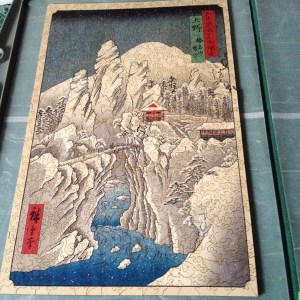
Perhaps all this fragmentation is why I enjoy jigsaw puzzles so much.  Part of the thrill is remembering several places in the picture simultaneously.  Being able to pick up where you left off.  I limit my puzzle work to the period of the holidays when I can take more than one day off work in a row and the lawn doesn’t require attention and those trees that you just can’t seem to get rid of don’t require monitoring.  But puzzles are designed for interruption.  Movies and short stories are intended to engage you for a limited, unbroken period.  The real problem is that we’ve allowed our time to become so fragmented.  A creative life will always leave several things undone by its very nature.  Other forces, mostly economic, will demand more and more time.  The best response, it seems to me, is to be existentialist about it.

Photo by Hans-Peter Gauster on Unsplash

Puzzling Traditions

Like most families, we have tried over the years to develop our own holiday traditions.  These, like all things, evolve.  When I was a professor the semester break meant, after a flurry of grading, a month of a more relaxed schedule.  We would travel to family outside of Wisconsin every year, and worked on what a “usual” holiday might look like for our small family in the remaining time at home.  Now that I work for a company, and my wife works for a company, the holiday break is severely curtailed, but it has allowed us the opportunity to invent our own traditions.  One of them is to put together a quality jigsaw puzzle on Christmas Day.  (Two of these puzzles were destroyed in the flood that ruined so many books, and will need to be replaced eventually.)

I’m aware how nerdy puzzle-solving might sound.  I’m not spending the day out riding an ATV through the woods, discharging a firearm, or watching sports on television.  Piecing together a puzzle is a quieter pursuit, and the puzzles we have are of quality artworks, and completing one makes it feel like all is right with the world for a little while.  As with most things on this blog, it also serves as a metaphor.  Yesterday as we watched the movie The Man Who Invested Christmas (which portrays very well the life of those who try to write; the exception being that Dickens had little trouble finding publishers and the benefit of early success), it occurred to me that as we put together the puzzle of our lives, we do so with the box top missing.  We don’t know what the picture is.  Slowly some sections start to come together, but overall, we don’t know what we’re doing.

Long ago I learned the folly of planning out a life.  Moving forward is good, yes, and making plans wise.  You cannot, however, know the way those plans might fit elsewhere in this decades-long unfinished puzzle.  There’a a fairly large section of mine called Nashotah House.  I would never have planned that intentionally, and thinking back, it was being there that renewed my interest in horror.  I thought I’d be at a university where I might continue my research into ancient deities and how the world of biblical Israel developed its own conception of that world.  That’s what I thought the cover of the box would look like.  Instead I’ve found myself editing the books that others write and using the scant time left over to write my own, on a topic far different than that in which I earned an advanced degree.  As the last piece slips into the puzzle, I feel a sense of accomplishment.  I may not have done much, but I’ve used the limited time off to step back and try to take, however briefly, the larger view.