
It’s curious, the desire to see a movie based on a novel you’ve already read. I was intrigued to see how Peter Weir might handle Picnic at Hanging Rock. As my post about the novel points out, the book, as it stands, is ambiguous about what happens to the missing girls. It was only as I saw the film that I realized just how complex a story was crammed into a relatively brief novel. Film directors have to make choices and although this one follows the book to quite a large extent, some elements were more clearly implied in the cinematic version. The suspicion on Michael Fitzhubert was clearer, as was the fear that the girls had been molested. The character of Mrs. Appleyard, although not exactly kind, is treated somewhat sympathetically. It’s not implied that she might’ve killed Sara, for example. Her treatment of the orphan, however, does lead to suicide.
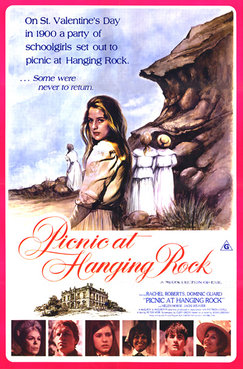
This story isn’t simple to untangle even in the book. Being literature, it isn’t clear exactly what is happening throughout. It allows for ambiguity. The novel never explains how the girls went missing or what happened to them. Hanging Rock is presented as mysterious, almost a portal. One way the movie deals with this is by invoking Poe. It begins with a voiceover reading “Dream within a Dream.” Indeed, the movie is shot with a dream-like quality. The roles of the male characters is, appropriately, understated. The story is about women and coming of age. It’s often considered an example of dark academia. Appleyard College isn’t a school at which fair treatment is doled out and Miranda, the most accomplished student, is compared to an angel, adding to the dreamlike quality of it all.
Using Poe to frame a film may not be entirely fair. It does signal the viewer that what follows may or may not be reality. Although Wikipedia can’t be considered the final authority—anyone can edit it—it lists (as of this writing) the movie Picnic at Hanging Rock as an adaptation of Poe’s famous poem. Maybe by implication, but the story is clearly that of Joan Lindsay’s novel. She presented this, in the sixties, as an account of an actual event, which it is not. I found it interesting that dialogue was added to the film that doesn’t appear in the novel. Overall, however, this seems to work as an art film. The movie has been hailed as the greatest Australian movie of all time, and just this year was rereleased in theaters. I’m glad to have seen it, but remain curious.
 Steve A. Wiggins