Hungry Madness

It’s been on my wishlist of movies to watch for a few years, In the Mouth of Madness.  A tribute to Lovecraftian horror, as well as a probing of insanity, it is a heady mix.  In keeping with my usual rules for movie watching, I hadn’t pre-read anything about it that would give away the plot.  Coming to it fresh, a number of things stood out.  There were some very good scenes and parts of the movie made me want to like it a lot.  It is a great movie for religion and horror analysis, and in that regard it’s much better than Prince of Darkness (despite Alice Cooper).  In fact, had I been able to see it years ago, it would’ve been included in Holy Horror.  That itself is noteworthy since two of John Carpenter’s other movies were in it: The Fog and the aforementioned Prince.  I suppose I should provide a little summary (if possible) in case you haven’t seen.
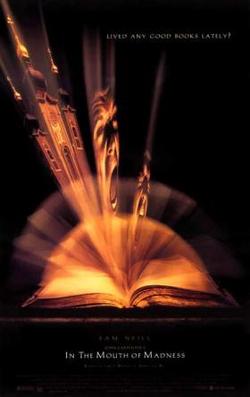
Trent is an insurance investigator, and a hardened skeptic.  A horror writer who outsells Stephen King, Sutter Cane, has gone missing and Trent’s sent to investigate.  He discovers that Cane is in a town that doesn’t exist (Hobb’s End) and that his books are not fiction.  In fact, Trent is a character in one of his novels.  When people read his latest book, In the Mouth of Madness (a title adapted from Lovecraft), they go insane and begin killing others.  The plot gets a bit busy because people are starting to transform into slimy, Lovecraftian monsters and this reality, if the book is read, or movie watched, will spread to all of humanity, leading to our extinction.  A bit too ambitious, the plot can’t hold all this weight, but it really isn’t bad.  There’s just too much going on.

The religion elements come in because Cane has holed himself up in an unholy church.  He refers to his latest novel as the “new Bible.”  “More people,” he says, “believe in my work than believe in the Bible.”  He later refers to himself as God.  I haven’t seen all of Carpenter’s films, but there seems to be a trajectory of his earliest major films being his best.  Halloween and The Thing are classics.  The Fog isn’t bad.  When he brings religion into his stories, as in The Fog, things begin to cloud over a bit.  Prince of Darkness doesn’t deliver a believable Devil.  In the Mouth of Madness doesn’t quite hang together well enough.  It’s not a bad movie, though.  It has given me some ideas for another book, if I can stay sane long enough to write it.
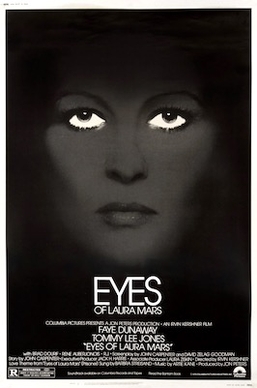

Eyes Have It

Seeing things from another person’s eyes is perhaps the most important social trait our species has.  We can empathize because we see someone else’s suffering.  It’s a shame to see this breaking down in real time.  Nevertheless, in the case of Laura Mars it may have saved her life.  The Eyes of Laura Mars is a psychological horror film about a controversial photographer (Mars), who suddenly sees things through the eyes of a killer.  The movie is a whodunit, keeping viewers guessing who it is that’s stabbing the eyes out of those Laura works with and cares about.  It’s not a great movie, despite the fact that it was written by John Carpenter.  Both this film and Carpenter’s Halloween were released in 1978.  Eyes is often considered a photo-slasher and Halloween was, of course, a full-blown slasher.  The former was Carpenter’s first major motion picture, while the latter was his first as director.

Screenshot

I’m about to spoil the ending, I fear, so please be warned.  Before I do, however, I will say that the film isn’t bad, even if it isn’t that good.  I had guessed the villain reasonably in advance of the reveal, but the movie did keep me second-guessing my conclusions.  The speculative element of Mars’ ability makes this a supernatural horror film, but one which seems relatively believable.  And the Bible is quoted in it, making it eligible for a Holy Sequel.  The characters—a high society artist and a New York City cop—aren’t terribly religious, but John Neville, the detective, moralizes about Mars’ work at a publicity event.  Okay, so here comes the spoiler.

After floating several possible murderers—a couple members of Mars’ crew are hinted at, as is her ex-husband—it turns out that the detective has dissociative identity disorder and although he and Laura have fallen in love, the moralizing part of his personality is a killer.  He provides Laura with a gun and tells her to shoot the man who comes after her.  When he finally does, he begs her to do it.  The twist ending, at this remove from the original, may be guessed ahead of time, but there is still quite a lot of tension in the story.  The murderer falling in love with his intended victim is a reversal of the more common lover-turned-murderer trope.  It’s not a bad freshman try on the part of John Carpenter, but when his directorial debut came out two months later, his ability in the horror genre was more fully in view.


Carpenter Ward

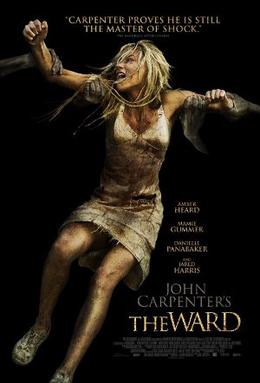
Surveying my streaming service for something free, I found The Ward.  It advertises itself as “John Carpenter’s The Ward,” and Carpenter has proven his mettle more than once.  I found out afterwards that this 2010 film is his last, to date.  Although it has jump startles and scary sequences, it isn’t as frightening as his best work, such as Halloween and The Thing.  The eponymous ward is a psych ward.  A young woman with amnesia is brought to the facility in 1966.  She’s somewhat violent but begins to make friends with the other four girls in the ward.  It won’t be satisfying to discuss this without a major spoiler, but I’ll try to hold off for another paragraph before giving it.  Overall the movie is creepy and atmospheric, but not really a classic.  Movies about mental hospitals have built-in scary material, and The Ward meets expectations there.

Kristen, the girl with amnesia, is resourceful and nearly escapes a few times.  She’s worried because a ghost in the asylum is killing the other girls.  Nobody will believe her, of course, since she’s an inmate.  Now the reveal: the other girls are all projections of Kristen’s personality.  Actually, Kristen’s name is Alice, and she’s been at the asylum for some time, a patient with multiple personality disorder.  The other girls that are killed by the “ghost” are part of a new therapy her doctor uses to try to get Alice back.  The other girls, or personalities, had banded together and “killed” Alice and her “ghost” is now seeking them out and killing them.  In reality, only Alice is there.  While the viewer is rooting for the other girls, they are preventing Alice from being cured.

In some ways this is similar to Split, but that would come six years later.  The horror here is the loss of self-knowledge.  The little backstory that is given shows Alice suffering trauma as a child, forcing the dissociation that leads to her split personalities.  As a horror movie The Ward has the jump scares and eerie atmosphere that often work in the genre.  There are chase scenes and a monster.  The story, however, rides heavily on that final reveal.  It really doesn’t live up to Carpenter’s full potential.  It does, however, take the final girl trope seriously.  It’s not really a surprise that it failed at the box office.  Although Split came later, other such films had been produced earlier.  What this one lacks is Carpenter’s characteristic flair.  Still, there are many other films that deliver less when they stream for free.


Homemade Halloween

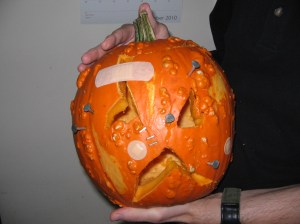
Halloween is a holiday that brings together many origins.  One of the more recent is the tradition of watching horror movies in October.  I don’t know if anyone has addressed when horror films became associated with the holiday, but Halloween hasn’t always been about startles and scares.  Histories usually trace it to the Celtic festival of Samhain.  Samhain was one of the four “cross-quarter days.”  Along with Beltane (May Day), its other post equinox cousin, it was considered a time of year when death and life could intermingle.  Spooky, yes.  Horror, not necessarily.  Many cultures have had a better relationship with their dead than we do.  We live in a death-denying culture and consequently lead lives of futile anxiety as if death can somehow be avoided.

As a holiday Halloween only became what it is now when it was transported from Celtic regions to North America.  Other seasonal traditions—some of English origin such as Beggars’ Night and Guy Fawkes Night—which fell around the same time added to the growth of trick-or-treating and wearing masks.  At its heart Halloween was the day before All Saints Day, which the Catholic Church transferred to November 1 in order to curb enthusiasm for Samhain.  As is usual in such circumstances, the holy days blended with the holidays and a hybrid—call it a monster—emerged.   When merchants learned that people would spend money to capture that spooky feeling, Halloween became a commercial enterprise.  Despite All Saints being a “day of obligation,” nobody gets off school just because it’s Halloween.

My October has been particularly busy this year.  One of the reasons is that Holy Horror, as a book dealing with scary movies, is seasonally themed.  As I was pondering this, weak and weary, upon the eve of a bleak November, I realized that home viewing of horror—which is now a big part of the holiday—is a fairly recent phenomenon.  Many of us still alive remember when VHS players became affordable and you could actually rent movies to watch whenever you wanted to!  Doesn’t that seem like ancient history now, like something maybe the Sumerians invented?  People watch movies on their wristwatches, for crying out loud.  I suspect that John Carpenter’s Halloween had a good deal to do with making the holiday and the horror franchise connection.  Horror films can be set in any season (Wicker Man, for instance, is about Beltane, and three guesses what season Midsommar references).  We’re so busy that we relegate them to this time of year, forgetting that we still have something of the wisdom of the Celts from which we might learn.


Longer Nights

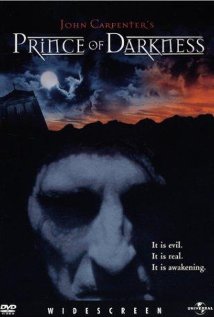
Nothing accompanies the slow decent into winter like scary movies. Now that autumn is officially here, it is time to look for the religious motifs in frightening movies again. Perhaps it is time to join Netflicks, because when it comes to my own movies I have mainly choices among bargain basement films I’ve picked up over the years. Over the weekend I watched one of them. John Carpenter’s Prince of Darkness is the second of his apocalyptic-themed movies, following on the remarkably creepy The Thing. (This is one of the few remakes that manages to outdo the original in just about every way.) Prince of Darkness, however falters almost from the beginning. I do appreciate a movie that is straightforward about using religion as the source of fear, and one that even has a character who is a graduate student in theology! Apart from the priest and street people, all the ill-fated characters are academics—professors and grad students of theoretical physics, the sciences, and our one, lone theologian. The plot revolves, literally, around a swirling green liquid in a decrepit church, which is the Anti-Christ.

Although the trappings are all here for a truly frightening experience, Christianity doesn’t really lend itself to a frightening mythology. To get to something truly tremendous, Prince of Darkness posits a kind of gnostic anti-God who is the father of Satan. The persona is evil writ so large that it is simply not believable that a corroded screw-top jar is able to contain him. For anyone who’s studied history or anthropology, placing the date of the Ball Mason jar back seven million years ago sounds like random guesswork. Homo sapiens sapiens weren’t even around then, making one wonder why God thought of a jar to trap the viscous Anti-Christ millions of years before the “fall” necessitated a regular Christ. The Bible appears, in transmogrified form, as an ancient book of spells that when translated sound suspiciously like the good old King James.

The movie does have its creepy moments—abandoned churches are scary; even fully functional ones can be remarkably spooky at night. It is difficult to accept that a priest would go to a physics professor before consulting his bishop, but then we have to prevent this movie from becoming just a watered-down Exorcist flick. Having Alice Cooper appear as the leader of the homeless minions was a nice touch, in any case. Since we are all still here, the movie ends predictably enough, with Satan’s Dad being stopped before entering the world. It does, in a de rigueur metanarrative, involve a self-sacrifice, albeit not a virginal one. And for the surviving handful of academics, life goes on as normal the morning after. Perhaps evil was blown too large to be believable here. Enough human-sized diabolism exists to frighten any reasonable person. And autumn is only just starting.


Holy Horror

Back in October, in the spirit of the season, I attended a local lecture by a ghost hunter at a nearby public library. This sincere young man struck me as perfectly normal, but haunted by his ghostly encounters. During the question session someone asked about TAPS (The Atlantic Paranormal Society, of “Ghost Hunters” fame). The lecturer indicated that TAPS is not above fabricating evidence for ratings, a disappointing but not unexpected factor when it comes to television. He even gave some evidence to back his assertions. Nevertheless, my wife’s whimsical six-month subscription to the TAPS Paramagazine has continued on well past its expiration date, and when the November/December issue arrived, I was interested to see a piece entitled “Sacramental Horror: What scary stories can tell us about what is real.” Well, this was too good to pass up.

The article, written by Presbyterian minister Jonathan Weyer, discusses the value of horror films. The juxtaposition of a clergyman and horror films is a little unexpected, but believable. After all, many horror films feature religious ideals clothed in monstrous form. Dividing horror films into Uncanny/Unsettling horror, gross-out horror, and torture porn, Weyer goes on to explain how uncanny or unsettling horror underscores the moral order of the universe and is therefore appropriate for Christian contemplation. He even draws the Nicene Creed into it. Gross-out horror serves the function of making the viewer contemplate death and perhaps even helps to make fun of it. This is a less noble, but still acceptable Christian enterprise. Torture porn, on the other hand, simply has no redeeming value. Sacramental horror really didn’t enter the discussion. Douglas Cowan’s Sacred Terror takes this issue on more directly.

I really don’t expect much insight from a fanzine that treats the reality of fairies and the prognostications of tarot cards next to the genuinely mysterious, such as ghosts. Finding morality in horror films is often a matter of eisegesis. The fear in such films often emerges from the sacred, either in pure or distorted form. Even if “the pure of heart or, often the virgin” survives while “Wrongdoers get put to the axe,” as Weyer states, seldom is that the intended point of the movie. John Carpenter denies that there was a moralizing message in his Halloween, often cited as the movie that established the “good girl survives” motif. The fact is that horror relates to the sacred in the element of fear. If people were not afraid, there would be little for religion or horror movies to accomplish.