Moralizing Gods

In my more radical moods I sing along with John Cougar about fighting authority.  Living in society means never being completely free.  This pandemic only amplifies that.  What I want may not be best for others.  Not to mention excessively corrupt authority *ahem* Washington DC [coughs into elbow].  Still, a friend sent me an article titled “Did judgmental gods help societies grow?  The piece by Lizzie Wade appeared in Science recently.  The article begins by noting that judgmental gods are rare.  It then suggests complex societies seem to have had judgmental gods at their beginnings.  Moralizing gods demand cooperation.  People want to do what they want.  If we’re going to reap the benefits of a highly specialized society we all need to play our part, however.  Authority always does win, I guess.

Wade’s article suggests that this kind of orthodoxy is now being called into question.  Moralizing gods, it’s suggested, appear after a complex society gets started.  Interestingly, these gods tend to be males.  (That point’s mine, not Wade’s.)  I have been wondering for quite some time just how the data from Göbekli Tepe will influence the re-construction of models concerning how civilization began.  It seems that long before settled populations emerged, back in hunter-gatherer days, people still came together to build temples.  Were they afraid of judgmental gods?  Certainly they thought it was important to gather occasionally at numinous places and ponder the larger questions.  Since they left no written records and they’ve all died out the best we can do is make educated guesses.  Who knows what might’ve been their motivation?
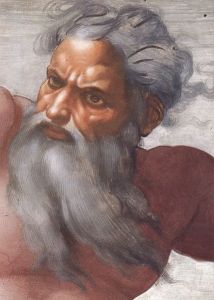
The one thing that seems certain to me, no matter how we nuance it, is that religion is integral to society.  Science is necessary for our survival (ancient people weren’t backward rubes, by the way—they had a kind of scientific outlook, but without all the advanced math).  Religion, however, seems originally to have brought us together.  Outside our comfort zones.  Hunter-gatherer societies limit their sizes to people you can know reasonably well.  They tend not to have private property and they share things most people in “civilized” settings wouldn’t.  To grow larger than a roving band that can sustain itself by moving from place to place once the food’s gone, agriculture was necessary.  But Göbekli Tepe suggests it only followed after religion began bringing people together in the first place.  Were their gods authoritarian?  There’s really no way of knowing that.  So when I’m feeling radical I have to remember than when it’s over I turn the volume down, comb my hair and go back into society.  Well, once the pandemic’s over.

A Cougar’s Mother

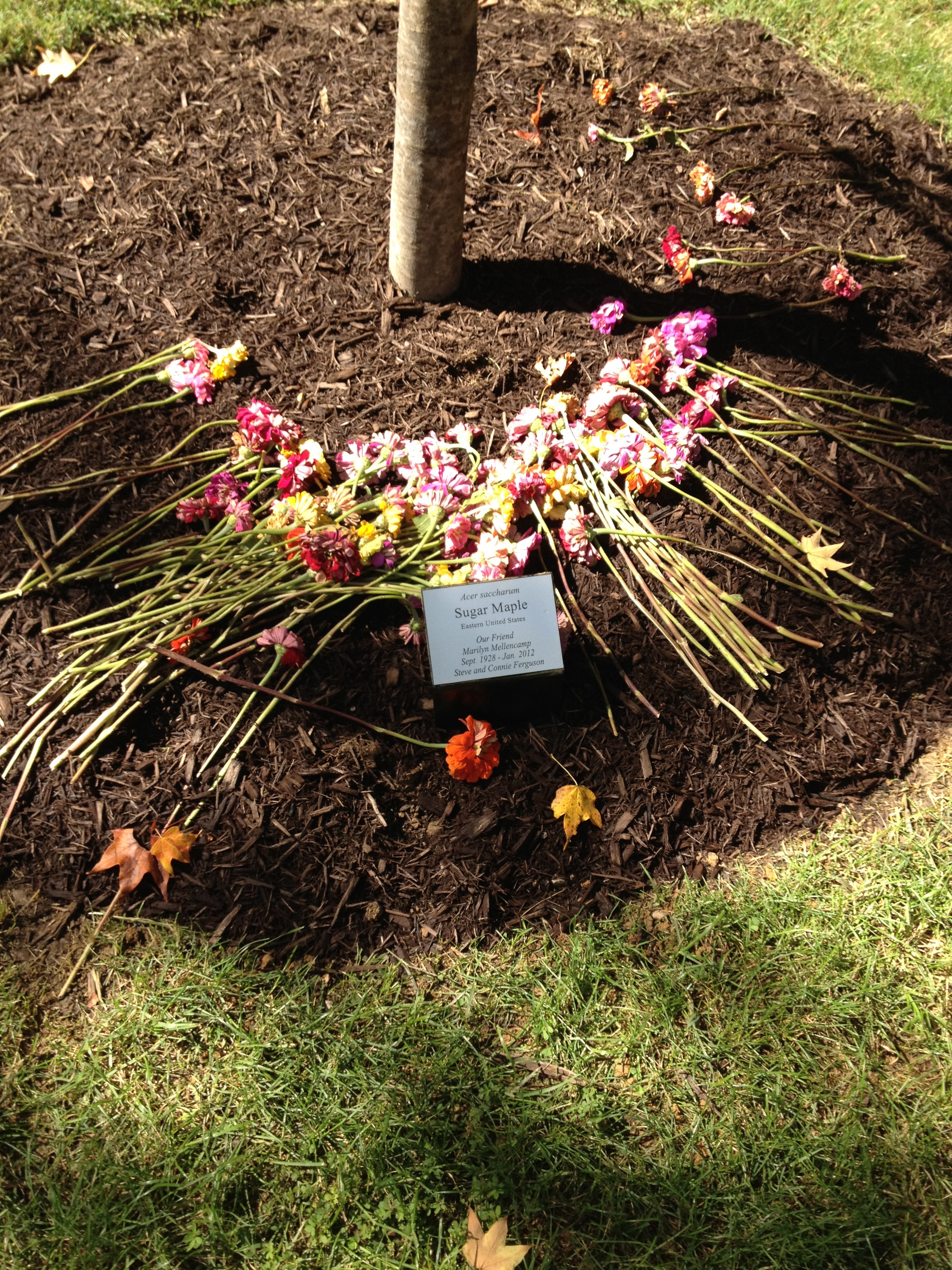
While on a stroll between appointments at Indiana University in Bloomington, I came across a tree with flowers laid underneath and a memorial plaque at its base. I glimpsed the name Mellencamp, and for a fan of rock, it didn’t take much imagination to tie it to John Cougar. Indeed, the memorial is dedicated to his mother, an artist, who died earlier this year. I first came to know of Indiana University because of music. I married a musician who, like myself, had to sacrifice a career doing what she loved in order to “get by.” Although she hadn’t studied at Indiana, my wife knew the reputation of the campus well. At a sunny moment between appointments I sat outside one of the music buildings listening to students practice through the open windows and read about Marilyn Mellencamp. An article in a local paper explains that this week an exhibition of her art is on display in Bloomington. When I read the quote from Waldron Arts Center Gallery Director Julie Roberts that the arts “are viable ways to make a living and they are vital part of being a happy and alive person,” I felt a renewed sense of hope. There are others, it is clear, who see that the arts are called the humanities for a reason. In a culture where only money matters, there is no culture. Think about it.

Since the industrial revolution we’ve been told that the measure of a human is how much money they are able to make. Something profound has been lost since then as great universities cut programs for the arts and humanities while business departments build new facilities. Talk about gaining the world but losing your soul—business cattily replies, “I have no soul.” While John Mellencamp never rivaled the biggest bands for income, his work, particularly Scarecrow, is full of human empathy. I listened to that album over and over in 1985, recounting the farm crisis and the demise of those not driven by corporate greed. And looking at this maple tree I wonder when the last time was that someone honestly mourned the death of a corporate mogul.

It is the mark of a deeply schizophrenic society that we all aspire to what fails to inspire. Our economy is driven by the material—money—and not that which speaks profoundly to what it means to be a human being. We keep the arts alive because the wealthy require something worthwhile upon which to spend their lucre. Is not buying art buying part of another person’s soul? We can’t define souls materially, science must conclude they don’t exist, but every time you say, “I feel happy/fulfilled/satisfied” you belie the facts. Souls may not be material, and they may never be found in laboratories. They are nevertheless part of the human constitution, and I for one, would lay a flower under a tree and know that it is more than just fertilizer for the next growing commodity.