Off with Their

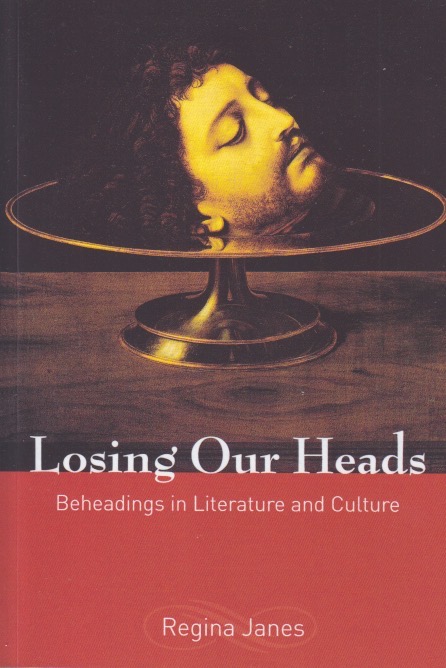
“Heads, I win,” is common enough as a call for flipping a coin.  That element of chance plays through Regina Janes’ Losing Our Heads: Beheadings in Literature and Culture.  You see, John the Baptist has a lasting place among the beheaded—indeed he’s featured on the cover of the book.  And since Janes is looking at the topic in literature and culture, you can’t very well leave John out.  I wonder what it says about humanity that there are so many other possible examples to include that this book is a mere sampler.  Applying literary theory to the process, it becomes, well, theoretical at points, but still it’s an eye-opening book.  Even if not always comfortable to read.  The first few chapters, which cover the development of European beheadings, aren’t sweetness and light.  There’s more happening here than meets the eye.  These heinous acts set the stage for symbolism, however.

The material on John the Baptist is fascinating and insightful.  It’s ironic, in some ways, that Jesus’ cousin is perhaps most famous for being beheaded.  He also sheds light on his more famous family member through literary parallels.  And, of course, it doesn’t end there.  The idea gets picked up and explored by others in various art forms.  You don’t really want to look, but since they’re there in the illustrations, you do.  Then the book moves on to African stories.  Playing off Conrad’s Heart of Darkness, Janes gives voice to African authors who explore beheading within their own cultural contexts.  All this goes back, historically, much further than John.  Indeed, beheading is part of very early myths as well.  It does make you stop and think.

I read books like this looking for clues.  There’s a larger object in mind.  And some of the insights I found were in examples afforded only a paragraph here or there.  I read this book because of a journey of which a colleague sent me through an innocent enough discussion.  There’s a reason we talk of excitement as “losing our heads,” and for some of us that excitement is research-laden.  Naturally squeamish, I’m an odd one for watching horror.  There’s something more to find here, however.  Although gruesome at points, you learn something from wandering through this museum of heads.  And when looked at through different lenses (of course, Freud is there) new perspectives emerge.  Beheading is violent and yet it’s been a part of human culture for a very long time.  There’s much to ponder here.


Saving Face

Although it has been commented upon in Rate My Professor, my beard is not intended to be impressive. In fact, it’s not really. Since I was quite young I dreamed of being a bearded man. I don’t know why. My father and my step-father were clean-shaven. The pictures of Jesus with which I grew up, however, seemed to suggest that a kindly man must be a bearded one. Nature deemed, however, that my facial hair would be less impressive than that of many boys I knew in high school who were already contending with five o’clock shadow. I never liked shaving. To me, nature dictated that men should be bearded, and who was I to combat nature? Except for a brief stint when I had to make a living in retail, I’ve worn a beard since I’ve been able to do so. I don’t fuss with it, trying to make it something it’s not. It is simply who I am.

339px-Epicteti_Enchiridion_Latinis_versibus_adumbratum_(Oxford_1715)_frontispiece

So when my wife sent me an infographic from the Washington Post about religious beards, my curiosity was piqued. It actually makes me a little self-conscious, I have to admit. I vehemently dislike anyone commenting on my appearance. There’s also something vaguely sexual about facial hair, coming as it does with the onset of puberty (a few years later in my case). Looking at the ways various religious groups condone facial sculpting, I couldn’t help but think that traditionally religions have said, to borrow a phrase from Frozen, “let it go.” Or let it grow. God and nature are one here. Genetics may determine what kind of beard may grow, but it takes religions to say it is God’s plan. For me, standing before a mirror before dawn, scraping my face with a very sharp piece of metal while I’m still yawning hardly seems civilized. Wash and go seems much more natural to me.

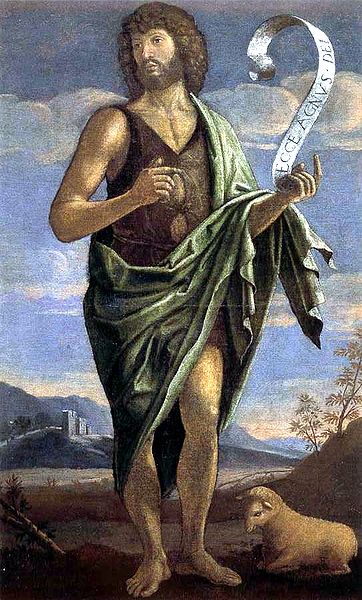
In the biblical world, the beard was a symbol of experience. Lifespans in those days were precarious. Guys surviving to my level of whiteness were revered. Today we are considered scruffy and lazy and unwilling to play by the rules society has set. I suppose it’s no accident that I was always a fan of John the Baptist with his unkempt appearance. Like Elijah before him he was a man of the wilderness. As nature made him. I last shaved in 1988. Were I to do so again, I fear what I might find underneath. Harrell Beck, before he died, once said to me, “you’ll never shave it off.” Although once I did, he has proved himself among the prophets. Just don’t say anything about it to me since, like religion, to me it is a very private thing.


Water Flowing Underground

One of the most compelling characters of the Bible is John the Baptist. Unconventional and non-conformist, he speaks with unquestioned authority based on pure conviction. Baptism comes in many forms. When we moved our daughter into her dorm room, we found water from the HVAC vent dripping on her bed. I’ve been similarly baptized on NJ Transit buses in the summer when the condensation gathers just above my head. (Of course, being on the bus, I’m always hoping that it’s only water.) Considering how well HVAC contractors seem to be paid, it is always a wonder to me that little things like leaks can’t be sought and settled. Water always seeks the lowest point. In baptism a person is plunged even lower, beneath the water. It’s kind of like drowning.

John the Baptist with the number of the HVAC guy

John the Baptist with the number of the HVAC guy

I was baptized in a river (or a creek that passed for a river in my part of Pennsylvania). Our church didn’t believe in infant baptism, so I was old enough to know that I was to be held under the surface for a second or two—a frightening prospect for a non-swimmer like me. It turned out alright, as these things generally do, and my ten-year-old sins were washed away to be somebody else’s problem further down stream.

The origins of baptism are somewhat of a mystery. Many religions include purification rituals, including Judaism. Judaism, however, never seems to have taken ritual washing to the level demanded of John the Baptist. Even he had a rather tepid view compared to that of later Christians who made salvation without it impossible. It is perhaps the implicit admission of shame, or possibly the public spectacle of it all that makes it such a rite. Being rained on in the presence of a priest doesn’t count. Nor does, in some traditions, a mere trickle on the head. The victim must be cut off from the air above. Religion does insist on a fair bit of threat for believers as well as non. And so the water drips. Of course it’s a holiday weekend so they can’t get the maintenance guy to fix it until at least Tuesday. As we wait we know that the water will always continue to seek the lowest point.


Making Light

Back when I was a starry-eyed camp counselor in the Western Pennsylvania Conference of the United Methodist Church, “Christmas in July” was a chic (in as far as Christians can be chic) trend. Kids lucky enough to be at camp that week were treated to a neo-Christian holiday that included a half-birthday for Jesus and cheap gift-giving. (The fact that Jesus’ birthday, in as much as it can be determined, is mid-way between December and July seemed a strangely mute point.) Our “gifts” were generally manufactured from natural products found in the woods and were a diversion to help the homesick campers concentrate on the truly Christian practice of getting stuff. Interestingly, here on Midsummer (the solstice is actually the first day of astronomical summer, but our pagan forebears were more into astrology, it seems, than astronomy) we are on the second most-celebrated holiday in the northern latitudes. With its midnight sun in the far north, and warm temperatures starting to make a regular appearance, light outweighs darkness for just a little bit, and life is never easier than this. No wonder Midsummer appeals to the archetypal mind.

Of course, Christianity could not accept a purely natural holiday, attributed as it was to the beneficence of heathen gods. In an even more dubious exercise than fixing the date of Jesus’ birth, Midsummer became the nativity of John the Baptist, or St. John’s Eve. While some scholars dispute the historical existence of Jesus (not terribly convincingly), the case against John the Baptist might be a little stronger. The prototypical forerunner, the herald announcing something greater than himself is so uncharacteristic of religious folk that it lends itself to considerable doubt. John is described like Elijah, one of the greatest prophetic figures of biblical times. John’s birthday? Anybody’s guess. Since he is second to Jesus, put his birthday on the opposite solstice. (I realize the solstice was June 20; at this early hour of the morning, I think today may also qualify.)

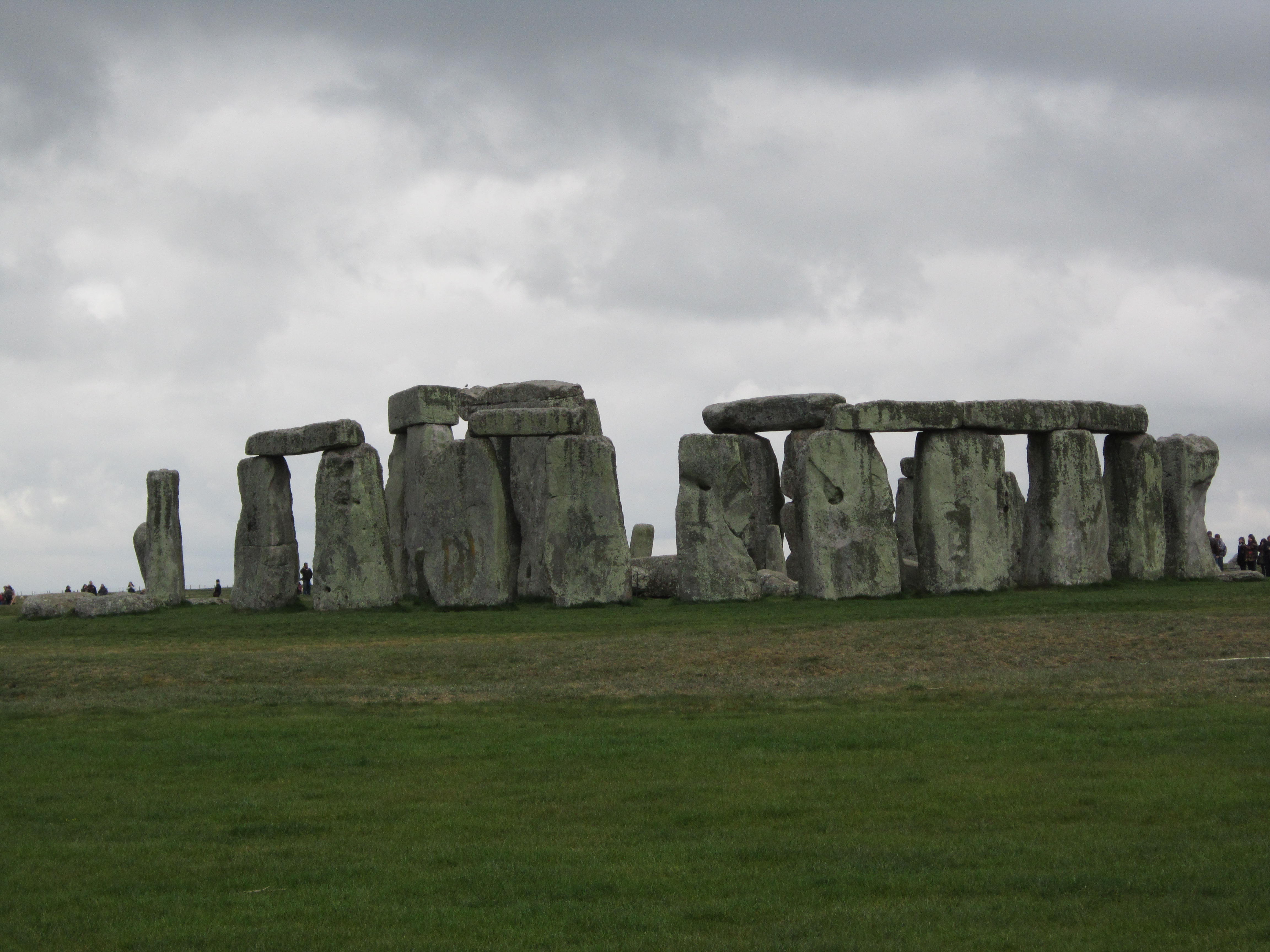
Back at Easter, historically near the vernal equinox, I found myself at Stonehenge. Knowing I was missing Druid priests by a full set of quarter days, it was still an exhilarating experience. Ancient people welcomed the return of increasing light with religious fervor. The effort it took to move these monoliths to the barren plains of Salisbury is nearly unimaginable. They represent, at some level, the invincible nature of the sun, our warmth and light. In physical, astronomical, terms they had no idea what the sun might be. It was, undoubtedly, the source of light and warmth, and even every lizard and turtle sunning itself on a rock participates in welcoming its return. So we’ve come to the solstice once again. It is the high point of the year. Now we begin our slow descent back into nights that will grow longer until the winter solstice once again reverses the trend. We don’t need Christmas in July–we already have it in June.


Kupalle or Ivan Kupala

The mysteries of newspaper layout are opaque to the laity, but the basic premises are clear; important news in the front, less pressing matter behind. The human eye, while expert at pattern detection, craves breaks in a series of repetitive columns of identically sized words. Newspapers and textbooks therefore punctuate the strictly “factual” information with images that lighten the ocular burden. So it was that yesterday’s New Jersey Star-Ledger graced the World and Nation section on page 10 with a photo of Kupalle.

Photo credit: Nikolay Yastrebov, European Pressphoto Agency

The caption notes that these young ladies are celebrating the pagan summer solstice holiday of Kupalle in Minsk. The summer solstice was almost two weeks ago, so why the photo made its premiere yesterday is one of those newspaper-specialist mysteries. Nevertheless, my curiosity about Kupalle was piqued. The photo looked like a more family-friendly version of a ceremony portrayed in The Wicker Man where young ladies leap over a fire. Some research revealed that Kupala is an ancient Russian water goddess, connected in some way with Neman, a Celtic goddess (thus the Wicker Man tie-in). The festival dedicated to Kupala involves leaping over a bonfire to ensure fertility. Kupala may have been lunar in origin but her name translates as “she who bathes.”

Christianity has a long history of subsuming “pagan” celebrations, often “baptizing” them into Christian form. In Belarus, Kupalle became the festival of Ivan Kupala, “John the Bather.” Kupalle was literally baptized. June 24, as the fictive date of John the Baptist’s birth, is a saint’s day in Roman Catholicism. The timing of the holiday intentionally coincides with Midsummer, one of the most sacred times of many nature religions. Ironically, in the Baptist’s name a holiday was reborn into Christian form. In the post-communist days of Eastern Europe, not only does Orthodox Christianity appear publicly, but its precursors once again engage public interest. Even if it is two weeks late.