Cuckoo’s Roost

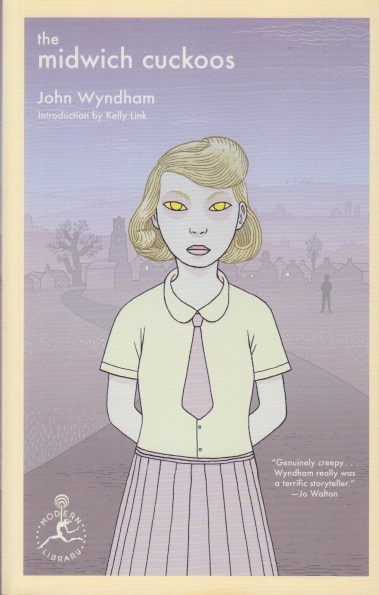
John Wyndham is someone I discovered through movies.  Often considered a science-fiction writer, his works cross over into horror, particularly on the silver screen.  Many years ago I read Day of the Triffids and, having seen Village of the Damned, wanted to read The Midwich Cuckoos.  It was a pretty long wait.  I kept thinking I might find a copy in a used bookstore, but it never happened.  When I saw a reprint edition I ordered it with some Christmas money.  There are some horror and sci-fi elements to the story, but there’s also a bit of thriller, as it’s called now, thrown in.  The book is quite philosophical because of the character Gordon Zellaby, a Midwich resident who keeps thinking about what is happening in terms that don’t match the expectations of other, more prosaic thinkers.  In case you’re not familiar:

Midwich becomes unapproachable for a period because an alien ship (the sci-fi part) has covered it.  Everyone in the village is asleep for a couple of days.  When they awake, generally no worse for wear, they soon discover that all the women of childbearing years are pregnant.  They all give birth about the same time to children that look eerily alike and have bright golden eyes.  The officials know this has happened but adopt a wait-and-see attitude.  Meanwhile, the locals get on with things but they discover these new children develop about twice as quickly as humans do and they can control people with their minds.  They also have collective minds so that their brainpower is quite above that of Homo sapiens.  Zellaby makes the connection with cuckoos—birds that lay their eggs in the nests of other birds and after they hatch shove the other chicks out of the nest.  Indeed, this is a story about what if cuckoos were humanoid aliens who tried the same thing with people.  Told with a British stiff upper lip.

The story slowly unfolds and gets scary as it grows.  I saw the movie quite a few years ago and the details were lost on me, so I was learning as I read.  I suspect that it differs from the book quite a bit.  Perhaps it’s the Britishisms that make this story less of a horror tale.  There’s a kind of jocularity to the style, at least for a good bit of it.  The serious issues of how governments and individuals interact is raised and discussed to a fair extent.  Even though the book is fairly short, there’s a lot going on here.  But now I need to watch the movie again.

Trouble with Triffids

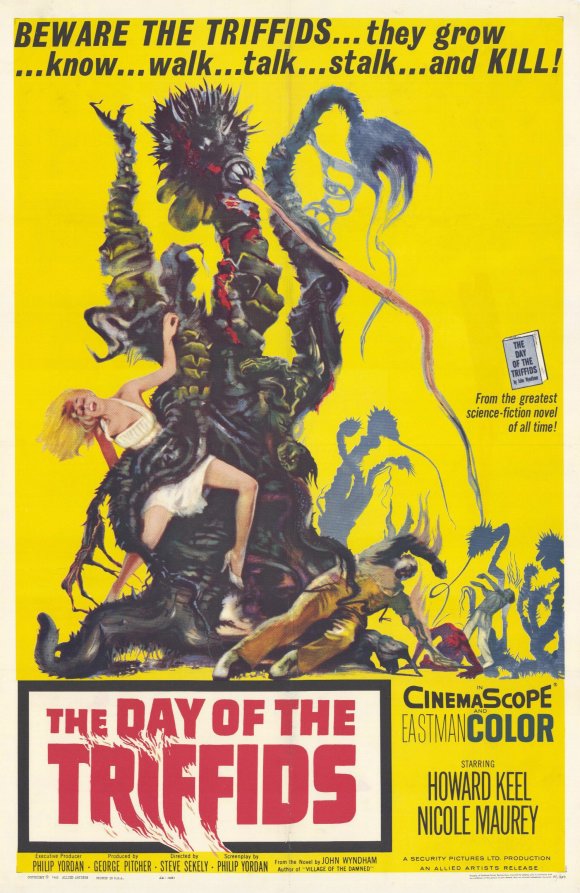
Some time ago, I posted about the John Wyndham novel, The Day of the Triffids. In playing on the loss of humanity’s primary sense of sight, the story creates a truly eerie scenario in which people are harvested by plants. Not just any plants, but alien plants! Of course, such an idea demanded a movie rendition. The film was released the year I was born, but I only just got around to watching it. Compared to the psychologically thrilling novel, the movie doesn’t ever reach the intended level of terror. Nevertheless, religion, as usual, plays a role in the movie. As Bill Masen, the protagonist, makes his way from London to Paris, attempting to find other people who retain their sight after a devastating meteor shower blinded most of the world, he comes upon a mansion where the wealthy owners are caring for the disabled. (Hard to imagine that these days, but it was the 60’s, and idealism was kicking in.) While discussing their rather hopeless options, Bill suggests there is little reason for optimism. His new-found love interest, Christine, says “We must keep faith,” to which Bill replies, “It’s going to take more than that to get through this.”

Indeed, God is no help against the triffids. These intelligent, moving plants are soon everywhere, consuming humans and intent on taking over the planet. Bill and Christine, along with their adopted daughter Susan, make their way to Spain in hope of finding a military solution. They stop at a mission, topped with a cross and inhabited with a helplessly blind, and expecting, couple. The message is clear—there is no god to help those left to their own devices. Even those who live in god’s real estate have been abandoned. Those who survive are those who help themselves. Eventually our hapless heroes are rescued by the navy and a submarine moves them safely away from triffid-infested Europe. Then, in the final scene, our blended family is seen walking into a church while a voiceover declares that the triffids did not defeat humanity after all, and “Mankind survived and once again have reason to give thanks.”

Exegeting this film, however, leads to some uncomfortable conclusions. Those who had no divine aid give thanks to an impotent deity after it is all over. The solution for destroying triffids—salt water (you might want to store that away for future use)—is discovered by scientists and is applied at their personal peril. Even the heavenly-based origin of the menace has divine overtones: colorful portents in the sky are the provenance of God. In 1962 science had not yet even reached the moon. The default fallback, based on decades of evangelical sculpting of culture, is to give thanks to the Lord, despite the devastation. Indeed, a new Garden of Eden might be said to have resulted from the triffid assault. In this garden parasitic plants teach humans to give thanks, but the vast majority of humanity remains blind.


Converting Triffids

“Stupendous as this disaster is, there is, however, still a margin of survival. It may be worth remembering just now that we are not unique in looking upon vast calamity. Whatever the myths that have grown up about it, there can be no doubt that somewhere far back in our history there was a Great Flood. Those who survived that must have looked upon a disaster comparable in scale with this and, in some ways, more formidable. But they cannot have despaired; they must have begun again – as we can begin again.” This quote from John Wyndham’s Day of the Triffids brings into focus a number of themes from this blog. Initially, it is another example of the intersection of science fiction and religion, specifically the Bible. In his apocalyptic 1951 novel, Wyndham can find no better example of disaster than the Flood Myth. The Bible and science fiction have kissed each other once again.

Another recurring theme reflects on disaster and how religions deal with it. As the Gulf of Mexico oil spill begins taking on apocalyptic dimensions religion is brought into the discussion in a variety of ways: God will take care of it; it is a sign of the end times; God is punishing us for something; corporate greed must stop. Take your choice. When people feel threatened, religion is quickly brought off the shelf, dusted off, and thrust out as the harbinger of deep solutions. Those of us who deal with religion every day must be forgiven for being a bit more circumspect.

The Flood Myth is a regular theme as well. It crops up in unlikely as well as predictable locations. As mentioned yesterday, it was evident in the Mystic Aquarium (unexpected), and it constantly resurfaces in Fundamentalist rhetoric (predictable). On a previous travelogue entry I mentioned Noah’s Ark being rebuilt in Maryland (unexpected). Seeing the Flood as the benchmark of worldwide disasters in a science fiction novel may be predictable, but the troubling ethical concomitants drawn out by Wyndham are profoundly disturbing. The Flood is not longer the worst disaster imaginable, but the Bible will continue as the measure of catastrophe long after the triffids have vanished.