Sodom Returns

Somebody really ought to write a book.  It’s not me, but when new archaeological discoveries with large explanatory value emerge, they begin to paint an interesting picture.  Archaeologists have determined that Tall el-Hammam, a city in Jordan of about 8,000 residents, was wiped out by a cosmic airburst, or meteorite.  If you missed it in the headlines it may be because this happened in 1650 BCE.  Barring volcanoes and other melting phenomena, since they don’t get hot enough, the cosmic airburst is the best theory.  Given that Tall el-Hammam is not far from the Dead Sea, it has been posited that the sudden destruction of this city led to the biblical story of Sodom and Gomorrah.  This makes sense to me.  Just like the theory that the flooding of the Black Sea by the Mediterranean led to stories of the flood.

Sodom and Gomorrah afire, by Jacob Jacobsz. de Wet; image credit: Daderot, public domain via Wikimedia Commons

People who had no other ways to explain such things would naturally consider them forms of divine punishment.  Deep-seated guilt seems to be a universal of human psyches, sometimes for good reasons.  In any case, an entire city wiped out by a meteorite looks like the finger of God just as much as lightning does.  Biblical scholars have long supposed that the story of Sodom and Gomorrah was an etiology, or origin story, of the formation of the Dead Sea.  This is partially based on the famous salt pillars, more than one of which bears the name “Lot’s wife” or the equivalent.  And the Dead Sea is unlike any other body of water on the planet.  

I suspect that over time other biblical stories may find logical explanations in ancient catastrophes.  I haven’t found convincing those that try to explain the “plagues of Egypt” based on a scientific daisy-chain of events, although they are interesting.  There’s no doubt that between the expulsion from Eden and the arrival of Moses there were dramatic events narrated by Genesis.  If these were ghosts of memories of ancient tragedies that makes sense to me.  They’re moralized, of course.  Aesop’s Fables also ended with the moral of the story.  We still like to know what a story means, and a good movie or novel will have some kind of message to convey.  There’s no way to prove that Tall el-Hammam’s destruction led to the biblical account, or that memories of a catastrophic flooding of the Black Sea led to tales of arks.  But still, somebody ought to write a book.  I’d read it.

Last Chance to Sea

I wasn’t brave enough to don swimming trunks in front of academic colleagues and climb into the Dead Sea. Instead, I dipped a finger in an touched it to my tongue. I’m not sure if it was the bromides or some other toxic minerals, but I immediately wretched and knew that I wouldn’t be putting any Dead Sea salt on my chips. Years later, for comparison, I tried a bit of the Great Salt Lake. Disappointing, to say the least. Already by the time I’d visited the Dead Sea it was dying further. In a recent article on NBC entitled “Thousands of Sinkholes Threaten Dead Sea’s Tourism Industry,” the fate of a sea already dead grows even worse. Water is always an issue in dry climates, and the only real source for renewing Dead Sea water is the Jordan River, which is being dammed and used for human purposes, robbing the Dead Sea of its renewal. The sinkholes are a result of underground salt deposits being dissolved by fresh water as the salty matrix gets siphoned away for industrial chemical farming. Dead Sea levels have dropped 100 feet since 1980.

The Dead Sea is one of the most striking regions on the planet. It is as far as you can go below sea level and still be on dry ground (at least on the shore, that is). The air smells like sulphur and the thickness of the atmosphere at that depth protects you from the sun’s rays, despite the heat. The water is so saline that only bacteria can live there. (The article, ironically, states, “it is very difficult for animals and plants to thrive there.”) By comparison the Great Salt Lake is practically drinking water. Famously, people are unable to sink in the Dead Sea, as its salt enhances buoyancy, so that you can read a newspaper while floating on your back. Like most natural wonders, humans are destroying it. The sinkholes are prophetic, I fear.

363px-Dead_Sea_Galilee

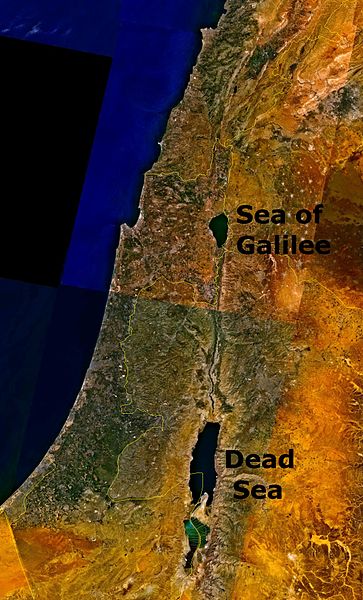
Great evaporating beds line parts of the Dead Sea shore where minerals can be obtained without having to dig into the earth. You can buy some as cosmetics at the local mall. These mineral salts are what make the Dead Sea what it is. And it is shrinking. Satellite imagery of the Sea can bring salty tears to my eye. We’ve slowed the flow of Niagara Falls, and we’ve begun melting our polar caps. Even so, we can’t get enough water to sustain our lifestyle. It has been said that the next major war will not be over oil, but water. Even a glance at California can make me thirsty. In a rare show of cooperation, Israel, Jordan, and the Palestinian Authority are building a pipeline to bring Red Sea water into the shrinking Dead Sea. I hope that this might bode well for the future in the region. Although there is no love lost between these neighbors, they all realize that something unique lies on their border, and when it’s gone it will be a loss to the entire world. That is the real Sodom and Gomorrah.


Windmills of My Mind

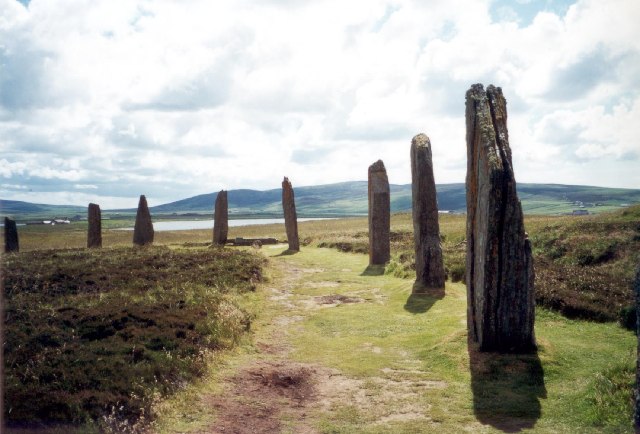
Stonehenge may be the best known stone circle in the world, but it is by no means the only one. Not too many miles from its more famous cousin lies Avebury, a village that is built on the site of an ancient stone circle and henge. Far to the north, in the Orkney Islands the impressive Ring of Brodgar stands sentinel over Stromness on Mainland. My students were sometimes surprised to learn that the Middle East also has its ancient stone circles. Some speculate that the town of Gilgal in the Hebrew Bible derived its name from such a circle. In the 1920s a series of large stone circles were discovered in what is now the kingdom of Jordan, and these circles are back in the news as archaeologists try to decipher the purpose of these huge rings. Unlike their European relatives, the Jordanian circles are only a few feet high, but they are about 400 meters in diameter. Eleven are known. Clearly not high enough to pen animals, the circles remain a mystery even today.

Ring of Brodgar, Photo credit: Alex Cameron, WikiMedia Commons

Ring of Brodgar, Photo credit: Alex Cameron, WikiMedia Commons

Most ancient circles have uncertain functions. We don’t really know what they were for, but considering the tremendous amount of labor involved at such sites as Stonehenge and Avebury, clearly they were considered extremely important. Likely religious. Circles, of course, are an embodiment of mystery—they have no beginning or ending. Even pi, a necessary figure in circular calculations, seems to be an infinitely non-repeating decimal value. Adding to the questions of the Jordanian circles is the lack of a decisive date. They seem to be a couple of millennia old at least, perhaps significantly older.

Like the lines on the plains of Nazca in Peru, the significance of the circles can only be fully appreciated from the air. People have long left drawings for the gods, it seems. Circles, however, suggest a kind of utility as well as just a pleasing shape. One of the problems of archaeology, however, is that it can’t always tell us why people built unconventional structures. Archaeologists are sometimes left guessing just as much as the rest of us. The stone circles of antiquity are, in their way, humbling feats for us to ponder. If they were religious features of the landscape, their construction in an the neolithic period points to a significance beyond the level of the great medieval cathedrals of Europe. It seems no wonder, then, that religion has been with us ever since, despite its frequently announced demise. What are the Jordanian circles? Religion often steps in to explain what reason cannot. Given what we know, this guess may be the best solution.


Who Owns History?

Jordan has been asking for the Dead Sea Scrolls to be given back by Israel. During the Six-Day War of 1967 some of the ancient documents were absconded by Israel, according to the Jordanian point-of-view. (Nothing in the Middle East is every truly neutral or non-biased.) According to the newspaper, now Jordan wants them back.

This controversy is part of a larger trend for nations to demand “their” antiquities from foreign powers who have claimed and displayed them (in many cases) for large numbers of people to see. They are part of the world’s heritage and the modern day countries from which they emerged want them back. Why? To bolster national pride? Because of their inherent cultural value? To draw in tourist crowds who are interested in antiquities? The ownership of history is a touchy question. History itself belongs to the entire human race while individual artifacts may be stolen, purchased, or destroyed. Some are in the hands of major museums, minor museums, or in the houses of private collectors. Nations struggling for international respectability often want their heirlooms back, and this is only natural. At the same time, these nations may not have the infrastructure to preserve the artifacts securely. Think of the Baghdad Museum. When any government becomes unstable national treasures are at risk.

The Dead Sea Scrolls owe much of their public appeal to scandal. The story of their discovery and sale, rich with intrigue and skullduggery, is widely known. They capture headlines like 2000-year-old sex symbols; their chic name and aura of mystery assure public interest. As a scholar of the Hebrew Bible, however, I have always found the Ugaritic texts to be of far greater importance. Nevertheless, while living in Wisconsin some years back, and teaching at Nashotah House, I arranged a field trip to the Field Museum in Chicago where a roving Dead Sea Scroll exhibit was settled for a limited time engagement. The seminarians were excited, and we decided to make a family trip of it. My daughter was a pre-schooler at the time, and we towed her along to be acculturated. In a dimly lit room, the feeling of an authentic Middle East chaos attended the display, people wandering blindly around, not quite sure of what they were looking at (this based on overheard conversations). People wanted to be near history, even if they didn’t know why. I had seen the famous scrolls in the Shrine of the Book some years before, but it was easy to feed off the excitement. When we got home we asked our daughter what she enjoyed the most from the bus ride and day out. “Seeing the Dead Sea Squirrels,” she replied.

History involves seeing what we want to see. Nobody owns it. Everybody owns it. Who should keep the artifacts? I don’t know. It seems that history is larger than petty desires for cultural fame. But then, that is what history records — our desires to stand out from the crowd.