
With the recent release of Harry Potter and the Half-Blood Prince in theaters, young minds (or at least juvenile ones!) turn once again toward things magical. Anthropologists find difficulty in distinguishing between magic and religion, and many kids have been introduced to religious themes through this series of books and movies. I admit to having read the books and even having seen some of the films, and one of the memorable mythical sub-supporting characters that captured my attention was the mandrake. My first exposure to this herbological wonder was, naturally, the Bible. (Well, after Mandrake the Magician, of course.)
The tale of Reuben’s mandrakes in Genesis 30 shows a hint of that old white magic. Rachel bargains sex for mandrakes and the next time she is mentioned she becomes pregnant. Mandrake roots are often claimed to have anthropomorphic qualities – just how anthropomorphic depends on the imagination and how many the viewer has ingested. In the Middle Ages, the roots were classified as mandrake and womandrake!
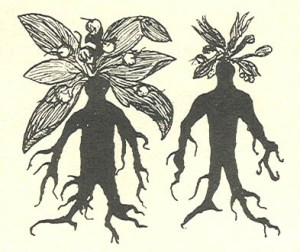
Womandrake and Mandrake from a 12th-century manuscript
The mandrake (mandragora officinarum) is a Mediterranean plant that had medicinal, and likely “religious” usages in the ancient world. A natural narcotic, the plant is poisonous in sufficient dosages, and it was used as an ancient kind of anesthetic, having been available long before whiskey. When a mandrake was uprooted, its humanesque tuber was thought to emit such a horrendous cry so as to drop the uprooter dead. Dogs were therefore tied to mandrake roots and prodded or urged to run, extracting the plant and dying in the process. Before calling the good folks at PETA, please note that no dogs were harmed in the writing of this post! Although this legend has a distinctly medieval bouquet, it is a method of mandrake hunting actually cited as long ago as Josephus. The mandrake has long arrested the human imagination. From Rachel to Pomona Sprout, the mandrake has not lost its potency for mystical mischief.
 Steve A. Wiggins