The Printed Word

I miss them, newspapers.  Now, I’ve never been a great newspaper reader—I tend to live in my own little world, I guess, and I really have no taste for politics.  I still glance over the New York Times headlines daily (mostly) but that’s not what I’m talking about.  I’m talking about physical newspapers.  The other day we had a family creativity session.  This generally involves painting in some form or other and I realized with chagrin that we had no newspapers to lay down.  Nothing to protect the table top.  The same is true when we carve pumpkins, or do other activities that make you think that you want to protect your furniture.  Newspapers were always there.  We used to line our birdcage with them.  Made papier-mâché out of them.  They were handy to have around.

Josef Danhauser, Newspaper Readers, public domain. Image credit: Österreichische Galerie Belvedere, via Wikimedia Commons

We live fairly close to our means, so we don’t have lots of drop cloths lying about.  (Plastic is so much less feeling than paper.)  We don’t have rolls of butcher paper in our kitchen.  We even use cloth bags for groceries, so grocery bags are at a premium.  Our electronic mania has meant that physical creativity suffers.  I do applaud the saving of trees, but you sometimes just need the disposable broadsheet to catch the drips.  (And when I paint, believe me, there are drips.)  But perhaps this is a symptom of this insipid internet life into which we’ve slipped.  The other day I was searching for an electronic services store.  I’m not even sure what to call them anymore.  I had to go to the physical store (yes, they still make them) to have something looked at.

The website kept telling me a store with a different name was what I was looking for.  All I wanted to know was whether this was an actual store or some knockoff.  If you’ve purchased what are being called “dups” now you know that companies blatantly use other companies ads to sell cheap knockoffs that don’t resemble the product you wanted at all.  This all seems to be perfectly legal.  I guess I’m just nostalgic for the days when you had to have patience and doing things slowly was a sign of good quality.  The 24-hour news cycle has hardly been a benefit, and Trump could’ve never been elected without it.  And if you wanted to paint something, you’d just go to the stack of newspapers that every house seemed to have, and paint over any headlines you wished you hadn’t seen.
Short-Changed

Time often feels short.  When we back it up against the pencil marks on the doorpost we find it seems to shrink with its own passing.  It is nevertheless relentless.  This shows especially with daily tasks, such as the posts on this blog, which leave enormous piles of writing behind.  I used to print every entry I wrote but I had to stop because there were too many.  There are now well over 4,500 of them and yet time keeps going and each day demands its sacrifice.  It’s that way with other daily tasks too.  It’s staggering, for example, to think of just how much food you eat in a lifetime.  It makes sense of why we struggle against that middle-age bulge.  Little bits add up.  I suspect that’s why the news can feel overwhelming at times.  It just keeps piling on.

If I’d chosen to study journalism—I really didn’t know what it was, despite being co-editor of my high school newspaper—I might’ve reached the point of being paid for my writing by now.  Even with my published fiction stories (and two of my nonfiction books) no money has ever changed hands.  I know from editorial board meetings that journalists expect pay for what many of us give away for free.  Writing is funny that way.  The best way to improve is to practice, and so I spend time each day writing blog posts, as well as content for books and articles and fiction stories.  As I said, there’s quite a pile.

Time is relentless.  It’s also in short supply.  The marking of each passing day with writing is a reminder of just how quickly the sand slips through the glass.  Other tasks go neglected for writers, which is, I expect, why we appreciate being paid for our work.  But just imagine if we were paid for reading.  What if every book read brought in say, in today’s economy, $1,000.  Would we be a more literate society then, valuing the work of writing?  For nonfiction editorial boards note the difference between professors, who are paid to do other things (and paid pretty well, considering), and journalists who live by the pen.  I have another job, helping other writers get published.  I suppose that means I have less time to do my own writing.  Time and writing are engaged in a complex dance which, when viewed from a distance, may look beautiful.  And when the dance is done you’ll find another piece of paper to add to the pile, regardless of whether it has monetary value or not.


Fast One Flood

I’m not sure what to believe anymore. This crisis of faith revolves not around religion, but around media. Pundits have been saying for some time that the internet has meant the slow death of journalism, and there are so many websites that redistribute news that its like the whole world is involved in a constant, perpetual game of “telephone.” All of this is preface to a story a friend sent me that appeared on the website God. I’m not sure I trust God. The story is too good to be true. At least in a schadenfreude sort of way. God is hosted on thegoodlordabove.com, and, well, we all know about dot coms. The article concerns the destruction of Answers in Genesis’ Noah’s Ark theme park by a flood. That is believable. Floods do occur, as Noah knew. What becomes unbelievable is that the National Weather Service forecaster stated that there were no storm clouds in the area at the time. That qualifies as a miracle.

Martin,_John_-_The_Deluge_-_1834

Did this really happen? I don’t know. I wasn’t there. Plenty of times when I was there (wherever there happened to be at the time) I wasn’t even sure what happened. Can I find the truth? One of the police sites for internet rumors is Snopes (also a dot com). I remember when Snopes began as a place to quell fears of urban legends. Back when the worldwide web was young, there was a verisimilitude to stories gleaned from the net. Living in the sparsely populated Midwest, it was easy to believe that some of these things could happen to you. At times I held onto Snopes like a crucifix, especially if I had to go out alone at night. Snopes tells me that thegoodlordabove is not to be trusted. The story is false, like others that have originated on the site. Answers in Genesis, unfortunately, is still going strong with its theme park.

Authoritative texts aren’t what they used to be. There was a day when all you had to do was pull a black leather book off the shelf to find the definitive answers. In Genesis or any other of the books. Now we rely on the worldwide consensus of the web. You can’t trust God on a website. Snopes, however, is pretty reliable. It’s the Scully to our natural Mulder. That’s why the web will never have the same impact as print media. Even the website for your bank or government can be cleverly faked. I might’ve looked no further had the purported flood not fallen from a cloudless sky. I guess I’d better be a wary believer. For the internet tells me so.


Headliners

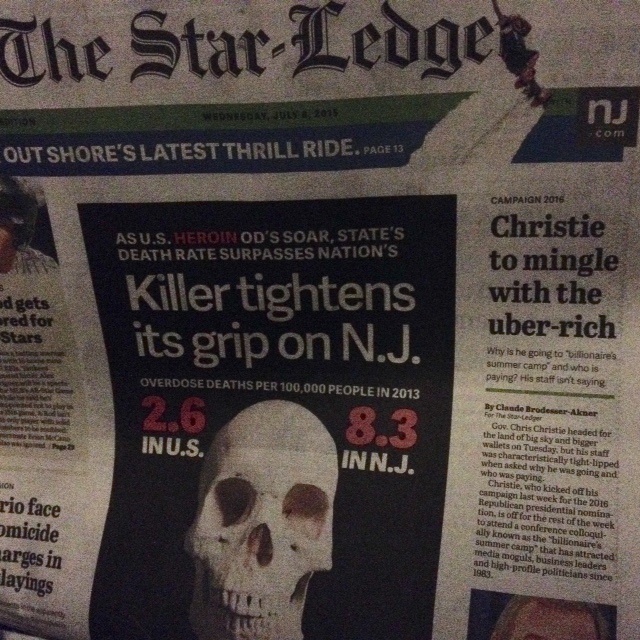
I sometimes wish I was a journalist. Just this past week a couple of people questioned my journalistic skills for an opinion piece I wrote for Religion Dispatches. I’m fully capable of professional research, but who has the time? Still, being a journalist might be fun. Thinking up clever headlines would be challenging day after day, but nevertheless, it might be enjoyable. Editors who lay the articles next to each other on the page must have a sense of irony. This past week in the New Jersey Star Ledger the central headline read “Killer tightens its grip on N.J.” The column to the right began “Christie to mingle with the uber-rich.” Having lived in New Jersey under Christie’s entire reign, I’m no fan. I’ve despised bullies since I was a kid, and rich bullies are worse than the working class variety. New Jersey certainly seems no better off to me. Now he wants to be President.

FullSizeRender

The real headline, however, about the killer in New Jersey is not yet another prison-break story. It deals with heroin overdose deaths. According to the article, per 100,000 people in the U.S. 2.6 deaths are from heroin overdose. In New Jersey the figure is 8.3. New Jersey, as the most densely populated state (1200 people per square mile, I once read) has its share of problems. Most of us like to pretend that drugs are somebody else’s issue, but I’ve known addicts and they are not evil. When life offers you unrelenting recession after recession and all attempts to better yourself run up against the 1 percent, frustration is inevitable. Even earning a doctorate will only lead to jobless misery. What more can you do than get an education? Heroin is dangerously addictive and it makes the user feel great, I’m told. Society doesn’t offer many other options. At least in Rome they had bread and circuses.

He who would be President, however, can’t be concerned about that. The uber-rich must be fed. And fed. And fed. Those whose ambition to high public office is naked power would be foolish to ignore their fellow plutocrats. Down here on the streets, things look a little dicier. Although I think I understand why many turn to chemical relief, I’ve never been tempted by drugs myself. One of the reasons I turned to religion was the prevalence of drug use in the town where I grew up. There seemed to be no future in substance abuse. I may not have chosen the most promising of ways to move ahead either, in retrospect. Now I find myself living with a governor who represents all that’s wrong with government. And if you’re going to die of drug-related despair, it seems like his particular state is the place it’s most likely to happen. Long live the king!