
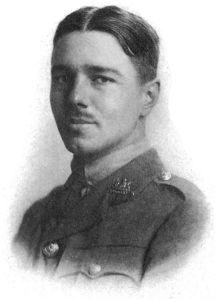
 Much of my exposure to literature has come through my daughter. I didn’t really grow up in a literary family. We had a prominent television and not much money for books, so I was headed for a typical American predilection for TV as some form of intelligence. When I began reading, it was what I could discover on my own and the required reading of English classes. Needless to say, I missed a lot. My daughter recently had to analyze a poem of Wilfred Owen. Although my wife had a book of Owen’s poetry, I never really had reason to read it. Like Joyce Kilmer, Wilfred Owen was a poet that was killed in World War One, only one in a long list of poets and dreamers that have been slaughtered in pointless conflicts. The poem that she studied was “Dulce et Decorum Est.” The poem describes a gas attack during which one soldier is unable to get his mask on in time and the gruesome death that follows.
The poem led to a family discussion about the cruelty of chemical weapons, and larger still, the pointlessness of war. Throughout history wars have been waged by the rich and powerful for reasons that may ultimately benefit some of their subjects but which, if not for the pride and prejudice of the powerful, would perhaps have been resolved without recourse to more efficient ways of killing. I always remember the Star Trek episode “A Taste of Armageddon,” where the Enterprise encounters a planet at war waged by computers and those who are calculated as victims report willingly to death chambers. This, they claim, is a more humane way to fight. In a Kirkesque maneuver, the man who gets me cut-rate flights and hotel rooms destroys the machine telling the people of Eminiar VII that if they have to face the grim cruelties of war they will find a way to stop fighting. Futuristic thinking indeed.
Today we have robots that can fly and attack, killing our enemies without putting us at risk. These are the grandchildren of mustard gas and a myriad of creative and horrid ways that people have devised for killing others. Wilfred Owen was killed just days before the war ended. His poem exposes the lie of Horace’s line, “dulce et decorum est pro patria mori”—sweet and decorous it is to die for one’s country. If I hear Owen clearly, it is the “dulce et decorum” to which he objects. Until we find humane ways to solve our differences, even in the Kirk Model, there will be wars. Death fought over effortless solutions of those in power will never be sweet or decorous. Although poets often die young, their lives remain as symbols pointing the direction ahead for the rest of us mortals left to reflect on their words.

 Steve A. Wiggins